

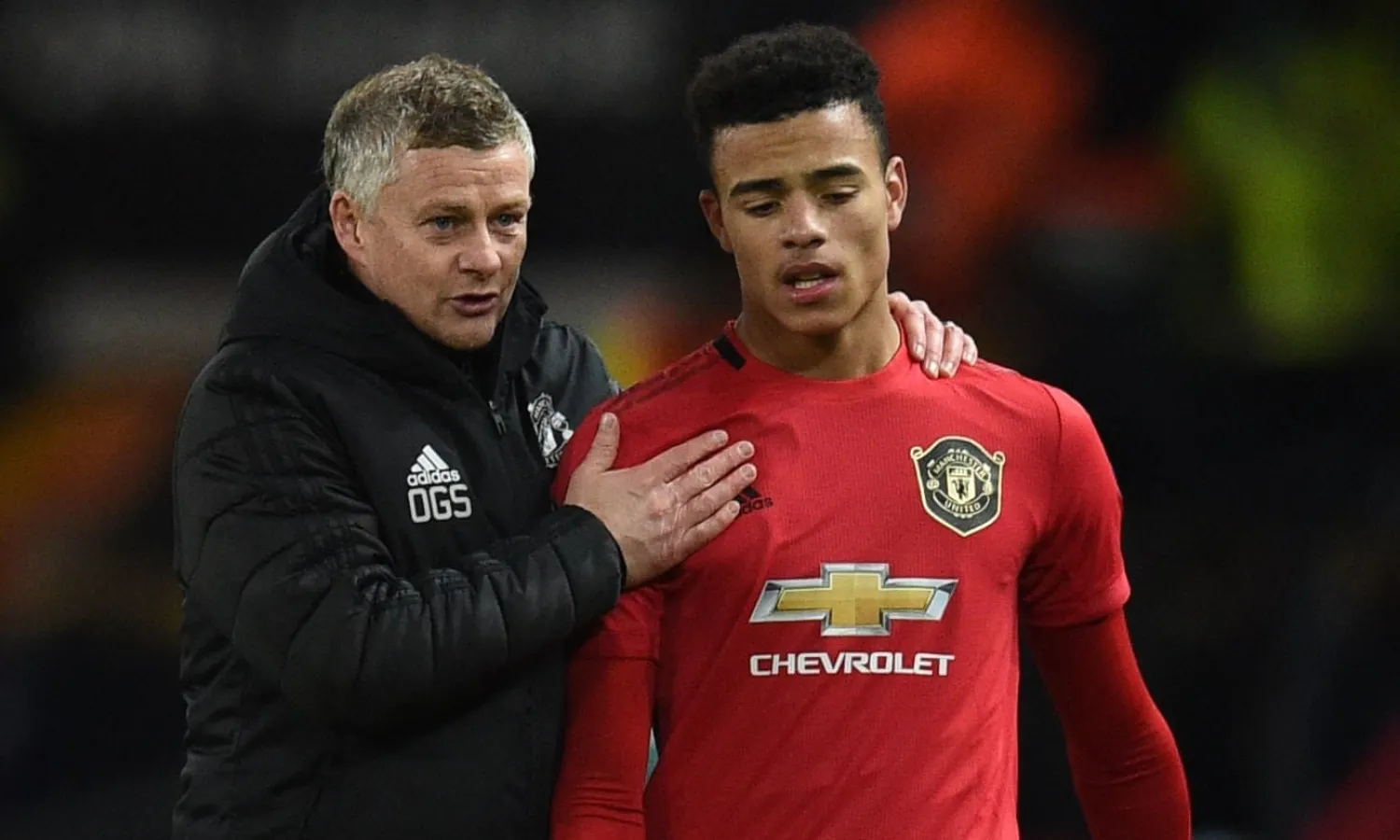

Calm Mason Greenwood Can Avoid Exciting Teenage Talent Implosion

Ole Gunnar Solskjær, who knows a thing or two about being a young striker at Old Trafford, with their latest protege Mason Greenwood. Photograph: Oli Scarff/AFP via Getty Images
TT

Calm Mason Greenwood Can Avoid Exciting Teenage Talent Implosion

Ole Gunnar Solskjær, who knows a thing or two about being a young striker at Old Trafford, with their latest protege Mason Greenwood. Photograph: Oli Scarff/AFP via Getty Images

At times this week it has been tempting, but not that tempting, to feel a bit sorry for Mason Greenwood. Brilliant teenage striker plays for Manchester United. Brilliant teenage striker scores in three league games in a row. Brilliant teenage striker has a way of moving around the pitch that suggests he’s playing with the benefit of a half-second delay, a man with a slightly more refined understanding of angles and gravity.

Meanwhile, the world outside has turned into a pre-zombie apocalypse montage sequence. The Euros have been canceled. And large parts of the country are sitting around losing themselves in six weeks of reheated microwave football.

Let’s face it, Greenwood never really stood a chance of flowering in the shadows. He is, among other things, something to talk about right now.

At Villa Park on Thursday night Greenwood’s recent goals were replayed from assorted angles. The cameras lingered lasciviously through the warm-up. “How big a future does this man have?” Kelly Cates asked Roy Keane, who is no longer the wild, moss-encrusted figure of mid-lockdown, but instead appeared on television shaved and trimmed and grimacing in a sports jacket, looking like a battle-scarred off-duty detective inspector two hours into a particularly harrowing parents’ evening.

So that future, Roy. How big? “Massive.”

We know how this tends to go from here. There is a game that plays itself out around the arrival of an exciting teenage talent in English football, one that tends to follow the familiar manic/depressive modeling of most significant events.

Stage one: extreme gurgling excitement. Stage two: a shared angry backlash against stage one, which will now be framed as a key driver in the inevitable media-led implosion of Exciting Teenage Talent.

Either side of which Exciting Teenage Talent is free to get on with the stark, thrillingly brutal business of finding its own level in a sport that has always eaten its young, where margins of fortune and success are fickle, and where so often something flickers for a moment, then vanishes and is gone.

Except, it seems fair to say, Greenwood seems a little bit different. Here is a talented young footballer who doesn’t really look like other talented young footballers. This isn’t about his feats on the pitch, which, in all honesty, are just an intriguing subplot so far. A career total of nine league goals. Two weeks of brilliance in empty grounds against semi-dormant opposition. A scorer this year against Villa, Norwich, Tranmere, Watford, Brighton, Bournemouth, and Lask Linz.

To offer some extreme perspective, at the same age Kylian Mbappé was traumatizing Manchester City in the Champions League and pushing Cristiano Ronaldo and Robert Lewandowski as the best center-forward in world football.

Your average extremely talented young footballer takes time to steep and find their level. There is always a period of retrenchment, a ridge of low pressure to pass.

Early on it seemed possible there might even be a bump in the road at Villa Park. In the third minute something unexpected happened. Greenwood went to shoot under pressure and scragged the ball in a sad arc toward the corner flag. In the process he ended an extraordinary run of three goals scored from a total of just three shots in his last two games.

Nothing is wasted here. Greenwood’s record now reads: 15 shots, eight on target, and five goals scored in his last seven games. This is a player whose chief skill is the ability to reduce a wild, concussive sport to something that feels like clarity.

“It won’t be long before he’s knocking on the door wanting to play center-forward,” Gary Neville observed during his punditry duties, but this also feels a little generic. As a right-sided attacker Greenwood’s United career record reads: played 11, won 10, drawn one, with four wins and four goals from that position in United’s last four league games.

There is nothing that needs fixing here, just a footballer with the brains and the mobility to play outside those rigid lines. Even the way he attacks defenders is thrillingly calculated, gliding from side to side like a speedskater, always finding angles, switching feet, taking you into places you don’t want to go.

Again, this is not the standard version of youthful attacking exuberance. Perhaps it explains why people are keen to compare Greenwood to other footballers. Most common is Robin van Persie. There is also something of a young Alan Shearer in his certainty, his two-footed shooting power, his easy physicality.

Five minutes after half-time at Villa Park he carried the ball forward, cut across goal, played a cushioned pass inside with his left foot, took it back with the other, then spanked it with thrilling power into the corner.

He walked back looking fine, cool, comfortable with all this. This seems to be his way. Greenwood is calm. Greenwood is fearless. Perhaps he’s just clear-sighted.

Because if something has changed recently, it is the energy around talented young footballers. That feeling of vertigo is gone, the sense of people clinging to the side of some sheer face, terrified by their own precarious destiny.

A good point of comparison for Greenwood is to list the players he’s not like. In particular he’s not like Michael Owen or Wayne Rooney or Robbie Fowler, prototypes for the modern-day precocious English striker, all of whom seemed to emerge with cartoonish mega-strengths: lightning speed, street football super skill. Here they come barrelling out into the adult world like some supercharged street car, all gleaming exhausts, and re-bored engines, burning through the liquid gas of their own extreme talent.

Whereas Greenwood is something sleeker and more assured. And really why would he be anxious about anything? There has never been a better time to be a teenage prodigy.

These are managed, mature young men, academy-schooled for this moment, the world around them less volatile and less shrill. In a way youthful talent has never had it so good, or seemed so certain of its own shape.

No doubt talent will remain a problem, something to be fretted over and picked away at. But whether he really is “massive”, or merely quite good, or good for a while, this does feel like an unusually good time to be Mason Greenwood.

(The Guardian)


Shakhtar Boss Pays Ukrainian Racer $200,000 After Games Disqualification

Ukrainian President Volodymyr Zelenskiy holds helmet as he meets with a Ukrainian skeleton racer Vladyslav Heraskevych , who was disqualified from the Olympic skeleton competition over his "helmet of remembrance" depicting athletes killed since Russia's invasion and his father and coach, Mykhailo Heraskevych, amid Russia's attack on Ukraine, in Munich, Germany February 13, 2026. (Ukrainian Presidential Press Service/Handout via Reuters)
TT

Shakhtar Boss Pays Ukrainian Racer $200,000 After Games Disqualification

Ukrainian President Volodymyr Zelenskiy holds helmet as he meets with a Ukrainian skeleton racer Vladyslav Heraskevych , who was disqualified from the Olympic skeleton competition over his "helmet of remembrance" depicting athletes killed since Russia's invasion and his father and coach, Mykhailo Heraskevych, amid Russia's attack on Ukraine, in Munich, Germany February 13, 2026. (Ukrainian Presidential Press Service/Handout via Reuters)

The owner of ‌Ukrainian football club Shakhtar Donetsk has donated more than $200,000 to skeleton racer Vladyslav Heraskevych after the athlete was disqualified from the Milano Cortina Winter Games before competing over the use of a helmet depicting Ukrainian athletes killed in the war with Russia, the club said on Tuesday.

The 27-year-old Heraskevych was disqualified last week when the International Bobsleigh and Skeleton Federation jury ruled that imagery on the helmet — depicting athletes killed since Russia invaded Ukraine in 2022 — breached rules on athletes' expression at ‌the Games.

He ‌then lost an appeal at the Court ‌of ⁠Arbitration for Sport hours ⁠before the final two runs of his competition, having missed the first two runs due to his disqualification.

Heraskevych had been allowed to train with the helmet that displayed the faces of 24 dead Ukrainian athletes for several days in Cortina d'Ampezzo where the sliding center is, but the International Olympic Committee then ⁠warned him a day before his competition ‌started that he could not wear ‌it there.

“Vlad Heraskevych was denied the opportunity to compete for victory ‌at the Olympic Games, yet he returns to Ukraine a ‌true winner," Shakhtar President Rinat Akhmetov said in a club statement.

"The respect and pride he has earned among Ukrainians through his actions are the highest reward. At the same time, I want him to ‌have enough energy and resources to continue his sporting career, as well as to fight ⁠for truth, freedom ⁠and the remembrance of those who gave their lives for Ukraine," he said.

The amount is equal to the prize money Ukraine pays athletes who win a gold medal at the Games.

The case dominated headlines early on at the Olympics, with IOC President Kirsty Coventry meeting Heraskevych on Thursday morning at the sliding venue in a failed last-minute attempt to broker a compromise.

The IOC suggested he wear a black armband and display the helmet before and after the race, but said using it in competition breached rules on keeping politics off fields of play. Heraskevych also earned praise from Ukraine President Volodymyr Zelenskiy.


Speed Skating-Italy Clinch Shock Men’s Team Pursuit Gold, Canada Successfully Defend Women’s Title

 Team Italy with Davide Ghiotto, Andrea Giovannini, Michele Malfatti, celebrate winning the gold medal on the podium of the men's team pursuit speed skating race at the 2026 Winter Olympics, in Milan, Italy, Tuesday, Feb. 17, 2026. (AP)
Team Italy with Davide Ghiotto, Andrea Giovannini, Michele Malfatti, celebrate winning the gold medal on the podium of the men's team pursuit speed skating race at the 2026 Winter Olympics, in Milan, Italy, Tuesday, Feb. 17, 2026. (AP)
TT

Speed Skating-Italy Clinch Shock Men’s Team Pursuit Gold, Canada Successfully Defend Women’s Title

 Team Italy with Davide Ghiotto, Andrea Giovannini, Michele Malfatti, celebrate winning the gold medal on the podium of the men's team pursuit speed skating race at the 2026 Winter Olympics, in Milan, Italy, Tuesday, Feb. 17, 2026. (AP)
Team Italy with Davide Ghiotto, Andrea Giovannini, Michele Malfatti, celebrate winning the gold medal on the podium of the men's team pursuit speed skating race at the 2026 Winter Olympics, in Milan, Italy, Tuesday, Feb. 17, 2026. (AP)

An inspired Italy delighted the home crowd with a stunning victory in the Olympic men's team pursuit final as

Canada's Ivanie Blondin, Valerie Maltais and Isabelle Weidemann delivered another seamless performance to beat the Netherlands in the women's event and retain their title ‌on Tuesday.

Italy's ‌men upset the US who ‌arrived ⁠at the Games ⁠as world champions and gold medal favorites.

Spurred on by double Olympic champion Francesca Lollobrigida, the Italian team of Davide Ghiotto, Andrea Giovannini and Michele Malfatti electrified a frenzied arena as they stormed ⁠to a time of three ‌minutes 39.20 seconds - ‌a commanding 4.51 seconds clear of the ‌Americans with China taking bronze.

The roar inside ‌the venue as Italy powered home was thunderous as the crowd rose to their feet, cheering the host nation to one ‌of their most special golds of a highly successful Games.

Canada's women ⁠crossed ⁠the line 0.96 seconds ahead of the Netherlands, stopping the clock at two minutes 55.81 seconds, and

Japan rounded out the women's podium by beating the US in the Final B.

It was only Canada's third gold medal of the Games, following Mikael Kingsbury's win in men's dual moguls and Megan Oldham's victory in women's freeski big air.


Lindsey Vonn Back in US Following Crash in Olympic Downhill 

Milano Cortina 2026 Olympics - Alpine Skiing - Women's Downhill 3rd Official Training - Tofane Alpine Skiing Centre, Belluno, Italy - February 07, 2026. Lindsey Vonn of United States in action during training. (Reuters)
TT

Lindsey Vonn Back in US Following Crash in Olympic Downhill 

Milano Cortina 2026 Olympics - Alpine Skiing - Women's Downhill 3rd Official Training - Tofane Alpine Skiing Centre, Belluno, Italy - February 07, 2026. Lindsey Vonn of United States in action during training. (Reuters)

Lindsey Vonn is back home in the US following a week of treatment at a hospital in Italy after breaking her left leg in the Olympic downhill at the Milan Cortina Games.

“Haven’t stood on my feet in over a week... been in a hospital bed immobile since my race. And although I’m not yet able to stand, being back on home soil feels amazing,” Vonn posted on X with an American flag emoji. “Huge thank you to everyone in Italy for taking good care of me.”

The 41-year-old Vonn suffered a complex tibia fracture that has already been operated on multiple times following her Feb. 8 crash. She has said she'll need more surgery in the US.

Nine days before her fall in Cortina d'Ampezzo, Italy, Vonn ruptured the ACL in her left knee in another crash in Switzerland.

Even before then, all eyes had been on her as the feel-good story heading into the Olympics for her comeback after nearly six years of retirement.
