


Ethiopia's Ethnic Unrest Leaves Destruction in Its Wake

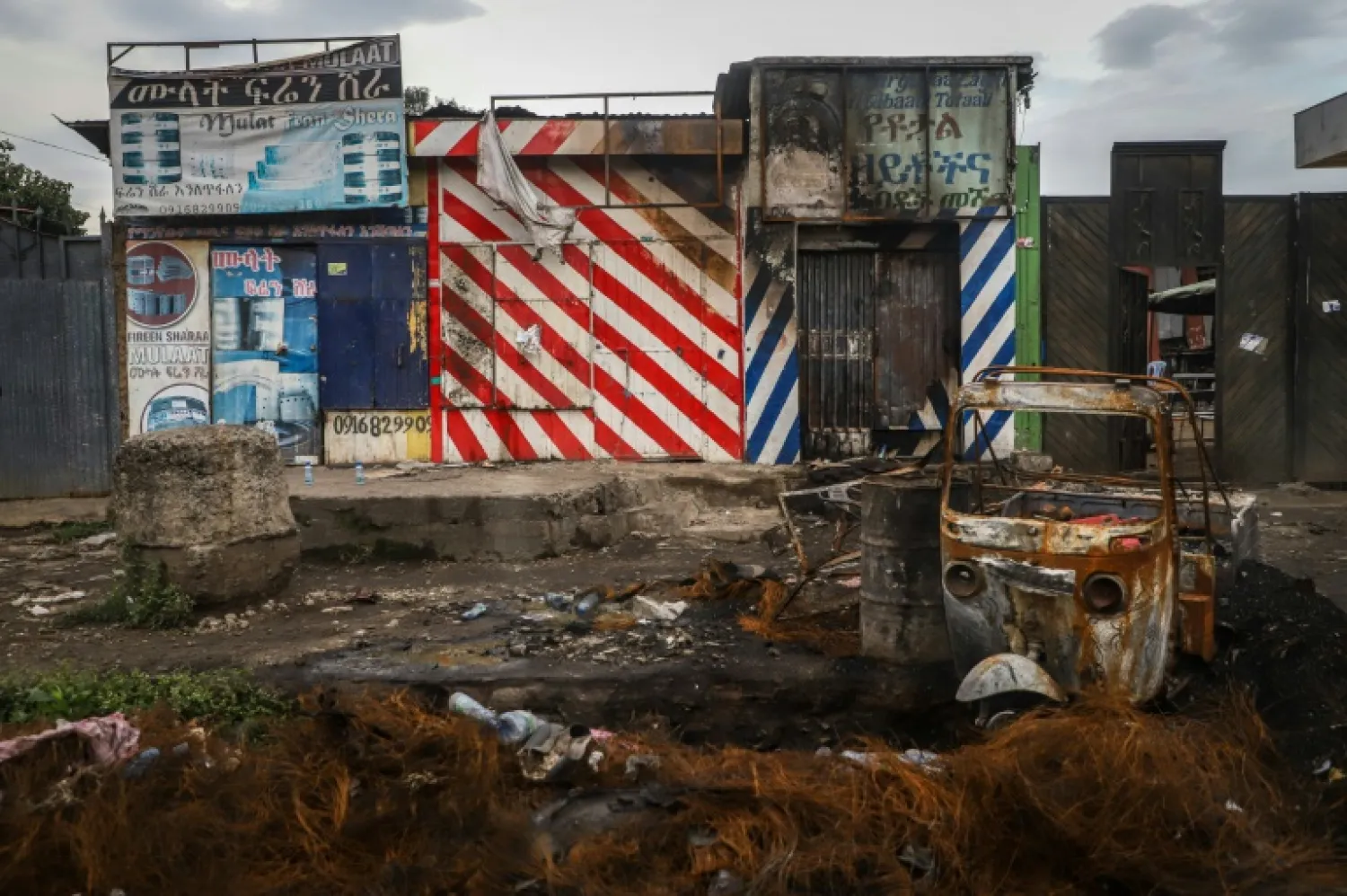
Hundreds of homes, schools, hotels and other businesses owned by non-Oromos were targeted for destruction by mobs | AFP
TT

Ethiopia's Ethnic Unrest Leaves Destruction in Its Wake

Hundreds of homes, schools, hotels and other businesses owned by non-Oromos were targeted for destruction by mobs | AFP

Girma had no choice but to watch from afar as a crowd chanting "This is our place!" set fire to the school he founded more than a decade ago.

Though he has lived his whole life in Shashamene, a fast-growing town in Ethiopia's Oromia region, Girma's parents are not members of the country's largest ethnic group, the Oromo, meaning he is often treated as an outsider.

Had he tried to intervene and save his school from the Oromo youths bent on destroying it, he thinks he may well have been killed.

"If you leave them to do whatever they want, they don't touch you. But if you try and save your place and property, they'll come to you," he said, asking to be identified only by his first name.

The unrest that left Girma's school a charred ruin was kicked off by the murder two weeks ago of Hachalu Hundessa, a pop star beloved by Oromos for giving voice to deep-rooted feelings of political and economic marginalization.

In the days that followed, between 179 and 239 people -- officials have provided conflicting tallies -- were killed because of inter-ethnic violence or the use of lethal force by police and soldiers against demonstrators.

Yet those numbers fail to capture the full devastation in places like Shashamene, where hundreds of homes, schools, hotels, and other businesses owned by non-Oromos were targeted for destruction by mobs.

Similar property damage has been reported in towns across Oromia, which surrounds the capital Addis Ababa.

"Our research so far suggests that the property damage has been worse than in previous bouts of unrest," said Laetitia Bader of Human Rights Watch.

To non-Oromo victims, the damage indicates they may no longer be welcome in places they have long called home.

"With the strategy that they're using, to burn the key places... I don't know if they intend for people to come back," said Almaz Morgan Chapman, who lost her hotel in Shashamene to the violence.

- 'Oromo lives matter' -

Shashamene is best known for its large community of Rastafarians, but the town is also one of the busiest trading hubs in Ethiopia's Rift Valley.

That means there was plenty of high-value property to attack.

On a main road into town, businesses have been looted and burnt black, their front windows shattered, their walkways covered in twisted scrap metal.

Sidewalks are lined with torched vehicles, including five soda delivery trucks surrounded by broken bottles.

On the side of a looted insurance company building, someone scrawled the words "OROMO LIVES MATTER".

Yet certain buildings -- a school here, a restaurant there -- remain unscathed, and residents told AFP most of these are owned by Oromos.

Chapman, a native of Trinidad and Tobago who founded her 28-room Lily of the Valley hotel 15 years ago, said a mob set it alight mere hours after Hachalu's death was reported, forcing her to flee the compound while still in her pajamas.

She noted that a neighboring hotel owned by an ethnic Amhara was also looted, but a third hotel on the same strip owned by an Oromo went untouched.

"These attacks on property owned by non-Oromos are sadly only the latest bout of intercommunal violence in Ethiopia where political polarisation is often along ethnic lines," said William Davison of International Crisis Group.

- Scare tactics -

It is unclear how many people were killed and injured in Shashamene during the violence.

The government has not provided geographic breakdowns of fatality tallies, nor has it said how many deaths were caused by security forces or inter-ethnic violence.

Some Shashamene victims treated in nearby Hawassa were shot by security forces, while others were hurt with "sticks and stones", which are sometimes used in inter-ethnic attacks, said Dr Zinaw Serniso, CEO of Hawassa Referral Hospital.

Whatever the casualty count, relations between ethnic groups are clearly fraying.

At the height of the violence, young men in Shashamene dragged machetes along cobblestone roads, producing a grating sound intended to intimidate non-Oromos, said one resident, who insisted on anonymity for her safety.

With only native Afaan Oromo speakers feeling comfortable going outside, "it took three days before we started to hear Amharic in the street again," the resident said.

Witnesses stressed that many Oromos stood up for their non-Oromo neighbors, trying to prevent their homes and businesses from being destroyed.

One Oromo resident, who also insisted on anonymity, told AFP he took in an ethnic Gurage family who live next door, adding that he was "embarrassed by what happened" in Shashamene.

"It's very sad as an Ethiopian that I'm alive at this time, thinking about ethnicity when we should be focusing on the worst poverty ever," he said.

"We have nothing and we destroy what we have."

- Business is 'finished' -

Such shows of solidarity aside, several non-Oromo business owners said they were considering leaving.

One owner said two of her staff from the Amhara region recently packed up and fled after six years in Shashamene.

The government should prioritize "credible prosecution and redress" to prevent such violence from happening again, HRW's Bader said.

Chapman, the hotel owner, said she would stay in the area to see if the government would compensate her for her losses, but she has no plans to reopen.

"I still love Ethiopia... But as far as doing business, I'm finished. Retired," she said.

"The Oromo retired me."


UK Ministers Back Starmer Amid Fresh Calls to Quit

 British Prime Minister Keir Starmer co-hosts a multinational virtual summit at the Elysee Presidential Palace, in Paris, France, on April 17, 2026. (Tom Nicholson/Pool via Reuters)
British Prime Minister Keir Starmer co-hosts a multinational virtual summit at the Elysee Presidential Palace, in Paris, France, on April 17, 2026. (Tom Nicholson/Pool via Reuters)
TT

UK Ministers Back Starmer Amid Fresh Calls to Quit

 British Prime Minister Keir Starmer co-hosts a multinational virtual summit at the Elysee Presidential Palace, in Paris, France, on April 17, 2026. (Tom Nicholson/Pool via Reuters)
British Prime Minister Keir Starmer co-hosts a multinational virtual summit at the Elysee Presidential Palace, in Paris, France, on April 17, 2026. (Tom Nicholson/Pool via Reuters)

British government ministers on Sunday backed embattled premier Keir Starmer as he struggles to shake off a scandal over long-time Jeffrey Epstein associate Peter Mandelson.

Starmer is due to face lawmakers in parliament on Monday to explain how Mandelson was appointed Britain's ambassador to the United States in late 2024 despite failing to pass security checks.

The beleaguered prime minister, who has been dogged by the controversy for months, said Friday that he and other ministers were not told Mandelson had failed the vetting process, calling that "unforgivable".

He has blamed foreign office mandarins for allowing Mandelson's appointment against the advice of security officials, and sacked the department's top civil servant Olly Robins on Thursday.

But ex-civil servants have accused Dowing Street of scapegoating Robbins while opposition leaders have called for Starmer to quit, with accusations ranging from incompetence to willful misleading of the public.

Technology minister Liz Kendall told the BBC on Sunday that Starmer would not have appointed Mandelson had he known that he had not received the appropriate security clearance.

Deputy prime minister David Lammy, who was foreign secretary when Mandelson was appointed to Washington, said the same in an interview with the Guardian published late Saturday.

Kendall said Starmer should remain in his job because he had "made the right call" on big issues, such as building closer relations with the European Union and limiting Britain's involvement in the Iran war.

"I think he is an honest man and a man of integrity who says it was a mistake to appoint him," she told Sky News.

Lammy said it was "inexplicable" that the foreign office had kept Downing Street in the dark, telling the Guardian he had been "shocked and surprised" when he learned what happened.

Starmer, already widely unpopular with the British public due to several policy mis-steps, has faced repeated questions about his judgement for selecting Mandelson whose friendship with Epstein was well known.

He sacked Mandelson in September 2025 after new details emerged about the depth of Mandelson's ties to Epstein, who died in prison in 2019 while facing sex-trafficking charges.

UK police are investigating allegations of misconduct in office by Mandelson when he was a Labour minister more than 15 years ago. He was arrested and released in February.

Mandelson has not been charged and denies criminal wrongdoing.


Australian Soldier Charged with War Crimes Vows to Clear His Name

A former member of Australia's elite Special Air Service regiment Ben Roberts-Smith leaves the Federal Court in Sydney on May 1, 2025. (AFP)
TT

Australian Soldier Charged with War Crimes Vows to Clear His Name

A former member of Australia's elite Special Air Service regiment Ben Roberts-Smith leaves the Federal Court in Sydney on May 1, 2025. (AFP)

An Australian former soldier charged with committing war crimes in Afghanistan vowed on Sunday to clear his name, saying he had never "run from a fight" in his first public comments since his arrest.

"For the past 10 years, my family and I have been subject to a campaign to convince Australians that I've acted improperly in my service in Afghanistan," Ben Roberts-Smith told journalists at the Gold Coast.

"I categorically deny all of these allegations, and while I would have preferred these charges not be brought, I will be taking this opportunity to finally clear my name," he said.

Roberts-Smith was granted bail on Friday after a high-profile arrest on five counts of "war crime -- murder". Police alleged he was complicit in a string of unlawful killings between 2009 and 2012.

The Victoria Cross recipient has denied all the charges.

He was released from prison on Friday evening after 10 days behind bars.

"I'm proud of my service in Afghanistan. While I was there, I always acted within my values," he said on Sunday.

Australia's most decorated living soldier met Queen Elizabeth II, had his portrait hung at the Australian War Memorial and was honored as the nation's "father of the year".

But the war hero's reputation was called into question in 2018, when a series of news reports linked him to the alleged murder of unarmed Afghan prisoners by Australian troops.

Roberts-Smith allegedly kicked an unarmed Afghan civilian off a cliff and ordered subordinates to shoot him, The Age and The Sydney Morning Herald reported.

He was also said to have taken part in the machine-gunning of a man who had a prosthetic limb, which he later used as a drinking vessel with other soldiers.

Roberts-Smith has staunchly maintained his innocence throughout, launching legal action against the newspapers that carried the allegations.

But his efforts to sue The Age and The Sydney Morning Herald for defamation backfired, with a judge finding in 2023 that many of the journalists' claims were "substantially true".

Such civil trials carry a lower burden of proof than the criminal proceedings Roberts-Smith now faces.

Australia deployed 39,000 troops to Afghanistan over two decades as part of US- and NATO-led operations against the Taliban and other militant groups.


Zelensky Says Oil Sanctions Relief Provides Billions for Russian Military

Ukraine's President Volodymyr Zelensky waits to welcome Swedish king in Lviv on April 17, 2026, amid the Russian invasion of Ukraine. (AFP)
TT

Zelensky Says Oil Sanctions Relief Provides Billions for Russian Military

Ukraine's President Volodymyr Zelensky waits to welcome Swedish king in Lviv on April 17, 2026, amid the Russian invasion of Ukraine. (AFP)

Ukrainian President Volodymyr Zelensky on Sunday condemned the easing of sanctions on Russian oil after the United States extended a waiver meant to soften surging energy prices driven by the Middle East war.

"Every dollar paid for Russian oil is money for the war" and is used for devastating strikes on Ukraine, Zelensky said in a post on X.

Zelensky did not mention the United States, but President Donald Trump's administration on Friday issued a month-long sanctions waiver allowing the sale of Russian oil and petroleum products that are at sea.

The action was intended to bring down soaring energy prices. But the US Treasury Department extension came two days after Treasury Secretary Scott Bessent said that Washington would not renew the waiver.

Zelensky said there were more than 110 tankers carrying Russian oil in breach of international sanctions currently at sea, carrying more than 12 million tons of crude "which, due to the easing of sanctions, can once again be sold without consequences.

"That is $10 billion -- a resource that is directly converted into new strikes against Ukraine," Zelensky said.

The Ukraine leader said that in the past week, Russia had launched more than 2,360 attack drones, more than 1,320 guided aerial bombs "and nearly 60 missiles of various types at our cities and communities".

A 16-year-old boy was killed and four people wounded in one overnight attack on the northern city of Chernihiv, the head of the local administration said Sunday.

Zelensky said: "It is important that Russian tankers are stopped, not allowed to deliver oil to ports. The aggressor's oil exports must decrease, and Ukraine's long-range sanctions continue to work toward that goal."
