
Israeli Strikes Kill 60 Pro-Iranian Fighters In Syria in 3 Months
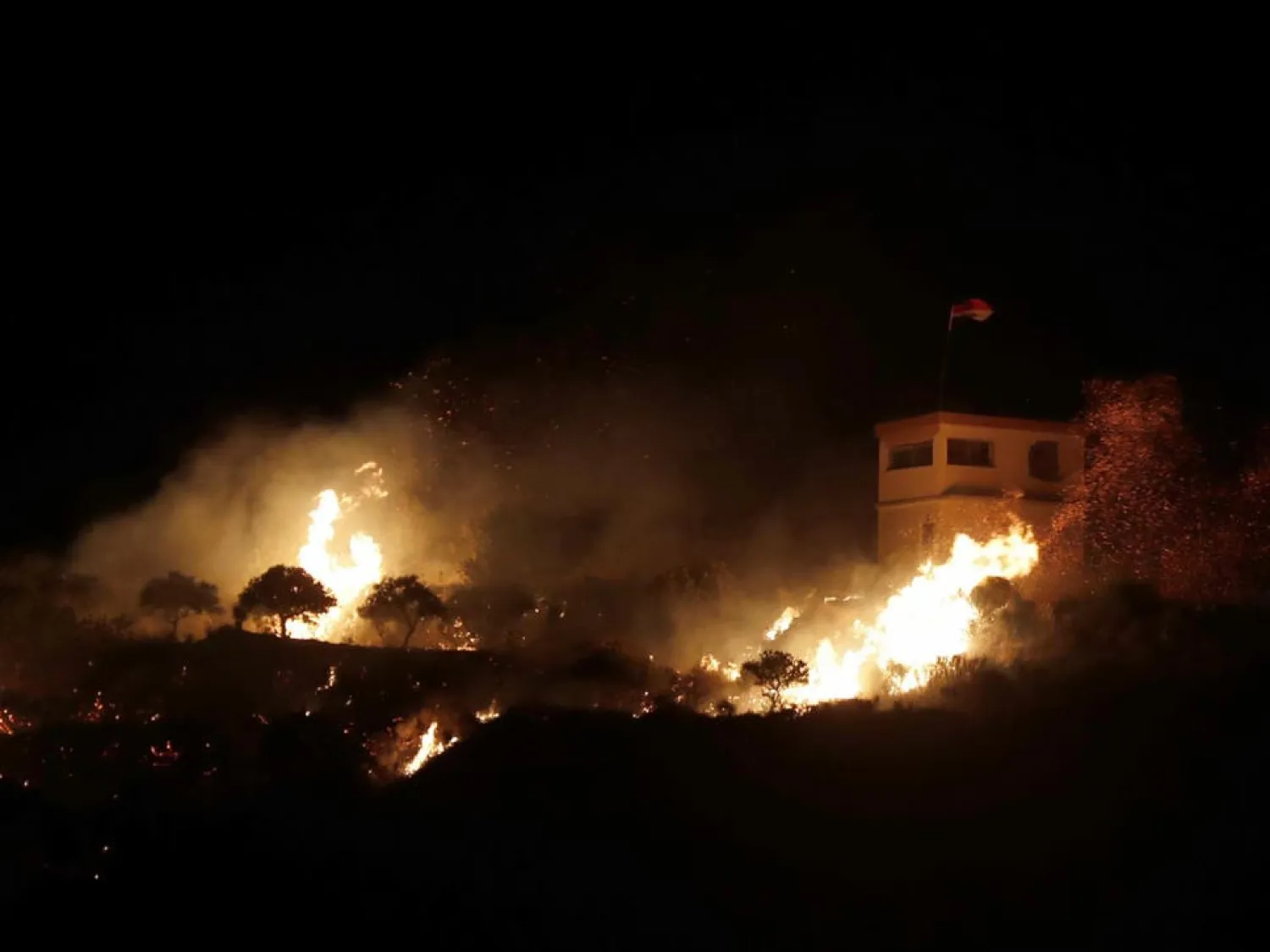
A fire following an Israeli helicopter attack on a Syrian observation post next to the village of Majdal Shams ( EPA )
Israeli airstrikes in Syria have killed at least 60 pro-Iranian paramilitary fighters while sources confirmed that a Hezbollah “cooperator” was killed in the countryside of Deraa on Monday, reports said.
The Syrian Observatory for Human Rights said that from early May till July 21, it documented a series of attacks against Iranian positions in Syria that left at least 60 casualties from non-Syrian paramilitary fighters including Fatimiyoun, Hezbollah, the Revolutionary Guards and others.
It said the Israel forces carried out those airstrikes against a number of Iranian targets in the south, central and east of Syria.
Israel has acknowledged conducting many raids inside Syria since the start of the civil war in 2011 where it sees Iran’s presence as a strategic threat.
The London-based watchdog said that since early May, airstrikes targeted many pro-Iranian positions in Syria, including in Quneitra, Deraa, Homs, Aleppo, Deir Ezzor, Hama, Damascus and its countryside.
“Those airstrikes killed around 60 Iranian paramilitaries and destroyed a large number of arms and ammunition depots,” it said.
The Observatory has also documented the death of a “collaborator” for Lebanese Hezbollah, after being shot dead inside his home in the town of Al-Harak in the eastern countryside on Monday.
SOHR sources said earlier that unidentified gunmen stormed the house of a former faction opposition commander in Al-Sanamin town in Daraa countryside, opening fire on those in the house, killing five fighters and former commanders, and injuring others.
It also documented the death of three regime forces and the injury of five others, as an improvised explosive device (IED) exploded in a vehicle for the 9th Division, north of the city of Nawa in Daraa countryside.
This brings the number of attacks and assassination attempts in various forms and methods by detonating IEDs, mines, booby-trapped vehicles and shootings from past June to date, to more than 590 attacks, according to the Observatory.
Looting of Yemen’s Antiquities Surges in Houthi-Controlled Areashttps://english.aawsat.com/arab-world/5291161-looting-yemen%E2%80%99s-antiquities-surges-houthi-controlled-areas
Looting of Yemen’s Antiquities Surges in Houthi-Controlled Areas
Smuggled Yemeni antiquities offered for sale abroad (local media)
The looting of Yemen’s antiquities is surging in areas under Houthi control, as illegal excavations increasingly target historic sites rich in archaeological treasures. Experts accuse influential figures of shielding organized trafficking networks that loot and smuggle artifacts abroad, placing a significant part of Yemen’s cultural heritage at risk.
Experts say the provinces of Ibb and Dhamar, south of Sanaa, home to some of Yemen’s most important ancient cities and the capitals of early Yemeni kingdoms, have become hotspots for unauthorized excavations in recent months. Ancient cemeteries and archaeological sites are being systematically dug up in search of rare artifacts, while Yemeni antiquities are increasingly surfacing on illicit markets in the country and overseas.
Yemeni antiquities expert Abdullah Mohsen revealed that a collection of rare artifacts was recently offered for sale in the city of Yarim, in Ibb, just days after illegal excavations were carried out at several ancient cemeteries in the historic city of Zafar, the former capital of the Himyarite Kingdom.
The collection includes gold jewelry and valuable bronze artifacts, among them a rare gold dagger hilt dating to the first century AD. According to experts, it is only the third known example of its kind from the Himyarite era.
Illegal excavations have become increasingly frequent (local media)
Mohsen said he received photographs of the artifacts from a Yemeni heritage enthusiast who requested anonymity for security reasons.
He added that the objects display unmistakable archaeological characteristics confirming their authenticity and scholarly value, and strongly suggest they originated from the recently looted burial sites.
Heritage experts say the close timing between the illegal excavations and the appearance of the artifacts on the black market are a clear sign that organized networks are systematically extracting and rapidly trafficking antiquities, exploiting weak oversight and the absence of effective protection for archaeological sites.
Yemeni artifact for sale in the United States (local media)
Rare discoveries
Archaeology professor Layla Aqil identified the gold object shown in the photographs as the hilt of a sword or dagger, crafted with intricate gold wirework and decorated with the Heracles knot, a motif widely used during the Hellenistic period between the first and third centuries AD as a symbol of strength and authority.
She said the hilt is only the third known example of its type, resembling two previously discovered daggers - one housed in the Museum of Islamic Art collection and the other unearthed at the Al-Asibiyah archaeological site.
Both feature delicate floral motifs inlaid with colored enamel, a further sign that the newly surfaced piece dates from the same period.
Aqil also noted that the twisted gold bracelets found in the collection represent a classic form of jewelry in ancient Yemen. Comparable examples have been excavated at Al-Asibiyah, Qaryat Al-Faw, and the Al-Hasmah site in Shaqrah, Abyan province, and are believed to date from between the first and third centuries AD.
Experts stress that the importance of these artifacts extends well beyond their monetary value. They provide critical evidence about the history of Yemen’s ancient kingdoms and the evolution of their craftsmanship, technology, and artistic traditions, making their loss an irreplaceable scientific and cultural setback.
Archaeological inscription found near homes in Houthi-controlled areas (local media)
Organized smuggling
Archaeologists have also warned of expanding antiquities trafficking networks operating in Ibb and Dhamar, saying illegal excavations have become increasingly frequent over recent months as institutions responsible for safeguarding cultural heritage have weakened and archaeological sites remain largely unprotected.
They said they possess information indicating that the rare artifacts are now in the hands of an influential network specializing in looting historic sites and trading antiquities.
According to their accounts, the group enjoys the backing and protection of influential figures in Houthi-controlled areas, enabling illegal excavations to continue and facilitating the organized smuggling of artifacts out of Yemen.
The experts warned that the destruction of archaeological sites results not only in the loss of historic objects but also in the irreversible destruction of archaeological layers and their scientific context, depriving researchers of historical evidence that can never be recovered and inflicting lasting damage on Yemen’s cultural legacy.
They called on the relevant authorities and international organizations responsible for protecting cultural heritage to act urgently by dismantling trafficking networks, recovering stolen collections, halting illegal excavations, and strengthening protection for archaeological sites.
Government Delay Revives Specter of ‘Two Administrations’ in Iraq’s Kurdistan Regionhttps://english.aawsat.com/arab-world/5291149-government-delay-revives-specter-%E2%80%98two-administrations%E2%80%99-iraq%E2%80%99s-kurdistan-region
Government Delay Revives Specter of ‘Two Administrations’ in Iraq’s Kurdistan Region
A photo published by the Patriotic Union of Kurdistan website showing Bafel Talabani meeting Masrour Barzani.
Nearly two years after elections for Iraq’s Kurdistan Region parliament, the winning Kurdish parties have yet to convene the legislature, elect a speaker, or form a new government. Had that process moved forward, it would have produced a fully empowered cabinet to replace Prime Minister Masrour Barzani’s administration, which has been serving in a caretaker capacity since before the October 2024 regional elections.
In May 2023, Iraq’s Federal Supreme Court, which rules on constitutional disputes, declared the extension of the Kurdistan parliament unconstitutional and ruled that Barzani’s cabinet should be considered a caretaker government.
With the political stalemate showing no sign of easing, a senior figure in the Patriotic Union of Kurdistan (PUK) warned that the region could drift toward “two officially separate administrations.”
Speaking to Asharq Al-Awsat on condition of anonymity, the official said Kurdistan already operates under a dual administrative system in practice, but warned that the arrangement could become formal if Kurdish parties remain unable to agree on a new government.
The Kurdistan Region effectively had two separate administrations from the mid-1990s until 2006, following armed conflict between the Kurdistan Democratic Party (KDP) and the PUK. The KDP governed from Erbil and Duhok, while the PUK administered Sulaymaniyah, with separate governments, security forces, and financial institutions.
The split officially ended in 2006 with the formation of a unified Kurdistan Regional Government after years of political negotiations following the 1998 Washington Agreement, although both parties retained strong influence in their traditional strongholds.
The PUK official blamed the KDP for delaying government formation, saying it “wants everything” and is unwilling to relinquish key government positions to other parties. The two dominant Kurdish parties have repeatedly traded blame for the prolonged political paralysis.
A senior KDP official previously told Asharq Al-Awsat that continued failure to form a government could ultimately force the region to hold fresh elections.
According to politicians and activists, the rival bloc — which includes the PUK and the New Generation Movement — is demanding the premiership and an equal share of senior government positions.
The PUK official acknowledged that a return to separate administrations would undermine the region’s future but said the party remains prepared to make concessions to preserve Kurdistan’s unity. He also pointed to a recent meeting between PUK leader Bafel Talabani and the party’s parliamentary bloc, during which Talabani stressed that the PUK is not obstructing the formation of a new cabinet and supports accelerating the process.
However, comments from other senior PUK figures have raised concerns. Yousif Goran, a member of the party’s political bureau and head of its research center, wrote on the party’s official website that the long-term viability of the Kurdistan Region “in its current form” is increasingly in doubt because of internal political dysfunction and shifting regional and international dynamics.
He added that the region has not experienced such deep political polarization since the administrations were unified in 2006 and argued that meaningful political change is now essential. He also warned that Iraqi Kurdistan no longer enjoys the level of international backing it received after 1991, when it effectively separated from Baghdad’s control.
Meanwhile, Kifah Mahmoud, media adviser to KDP leader Masoud Barzani, dismissed talk of separate administrations as “political suicide” that would endanger the region’s highest interests. He described such proposals as part of broader efforts to undermine the Kurdistan Region and its federal model, insisting that parliament is the proper forum for resolving political disputes.
Mahmoud also said early elections remain one option for breaking the deadlock, while arguing that the PUK’s alliance with the New Generation Movement should have been formed before, rather than after, the regional elections.
Lebanon: Aoun Urges Opponents of ‘Framework Agreement’ to Present an Alternativehttps://english.aawsat.com/arab-world/5291138-lebanon-aoun-urges-opponents-%E2%80%98framework-agreement%E2%80%99-present-alternative
An Israeli poses for a photograph beside Lebanese and Israeli flags displayed on a monument in the border town of Metula, near the Lebanese frontier (AP).
Lebanon: Aoun Urges Opponents of ‘Framework Agreement’ to Present an Alternative
An Israeli poses for a photograph beside Lebanese and Israeli flags displayed on a monument in the border town of Metula, near the Lebanese frontier (AP).
Lebanon has stepped up contacts with US officials to press Israel to proceed with the withdrawals stipulated under the framework agreement signed by both sides in Washington late last week, amid what Lebanese officials describe as troubling indications that Israel may delay the process and take unilateral measures, including installing crossing gates in areas it continues to occupy in southern Lebanon.
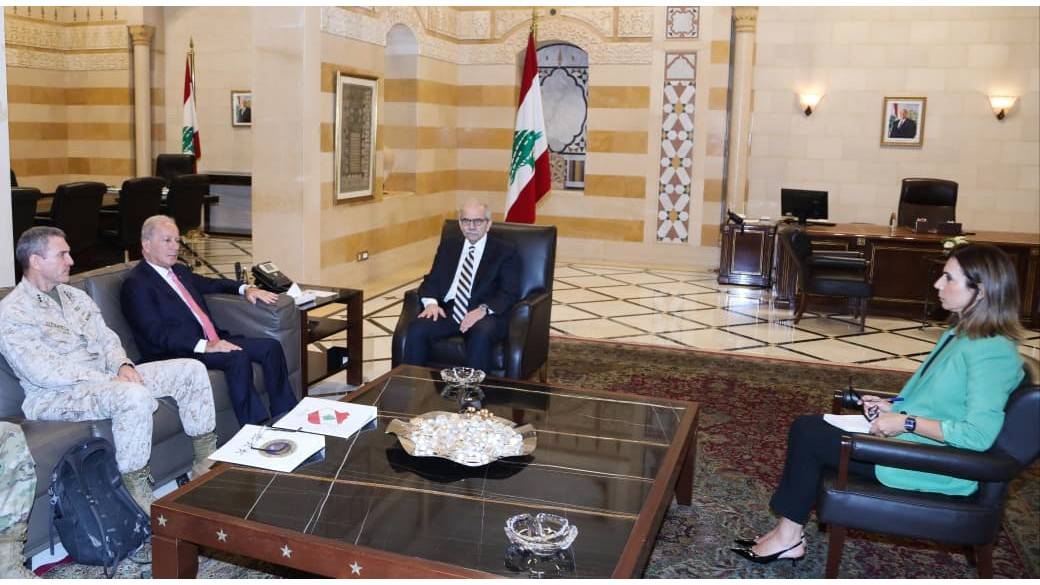
Well-informed Lebanese sources told Asharq Al-Awsat that US Central Command (CENTCOM) commander Gen. Brad Cooper, during his recent visit to Beirut, agreed with Lebanese officials on the mechanisms that will govern the pilot areas from which Israel is expected to withdraw.
The sources said one of Cooper’s senior aides has remained in Lebanon to oversee implementation, adding that Beirut has received no notification of any delay or change to the understandings reached with Washington. They stressed that Lebanon remains committed to avoiding direct contact with Israel, with all communication continuing exclusively through US mediation.
Speaking on Wednesday, Lebanese President Joseph Aoun defended the framework agreed in Washington, saying it includes provisions covering an Israeli withdrawal, the return of displaced residents, the release of detainees, and the repatriation of Lebanese remains held by Israel. He emphasized that it is a framework, not a final agreement.
Aoun said Lebanon, as a sovereign state, had independently decided to negotiate on its own behalf without compromising its legal, political, or military principles, rejecting claims to the contrary. He also praised Parliament Speaker Nabih Berri for insisting on two “red lines”: preventing internal strife and protecting the army, saying all Lebanese agree on both principles.
The president called on critics of the negotiations and the framework to offer a viable alternative or present their views through state institutions. While describing political disagreement as legitimate, he warned against fueling divisions or portraying the framework to supporters as “an act of surrender or humiliation.”
Aoun also dismissed reports that Army Commander Gen. Rodolphe Haykal or other security chiefs — apart from the director general of General Security — were to be removed, saying such rumors are intended to undermine the armed forces and security institutions.
Addressing the concept of sovereignty, Aoun argued that genuine sovereignty lies in making independent national decisions. Lebanon’s decision to negotiate for itself, rather than allowing another country to negotiate on its behalf, had unsettled many, he underlined.
He reiterated that negotiations are preferable to war, arguing that past conflicts had failed to achieve lasting results. If opponents reject the framework, they should explain what alternative they propose, he said, noting that repeated requests for one have gone unanswered.
Responding to accusations that the framework legitimizes Israel’s occupation, Aoun stressed that every provision calls for extending Lebanese state authority across the country’s entire territory and for a complete Israeli withdrawal. He added that the framework also addresses the return of displaced people, detainees, Lebanese remains, and international support. While acknowledging that the document is not ideal, the president described it as the best achievable outcome within Lebanon’s national principles.
Aoun vowed to press ahead with the process “for the sake of the country,” arguing that Lebanon has a rare opportunity it should not squander. He noted that if critics prefer war, they should explain what military confrontation has achieved, noting that Lebanon regained the Lebanese section of Ghajar in 2000 only to lose it again in 2006, lost five border positions in 2023, and now has more than 66 towns under Israeli occupation.
لم تشترك بعد
انشئ حساباً خاصاً بك لتحصل على أخبار مخصصة لك ولتتمتع بخاصية حفظ المقالات وتتلقى نشراتنا البريدية المتنوعة