


China's Young Jobseekers Struggle Despite Economic Recovery

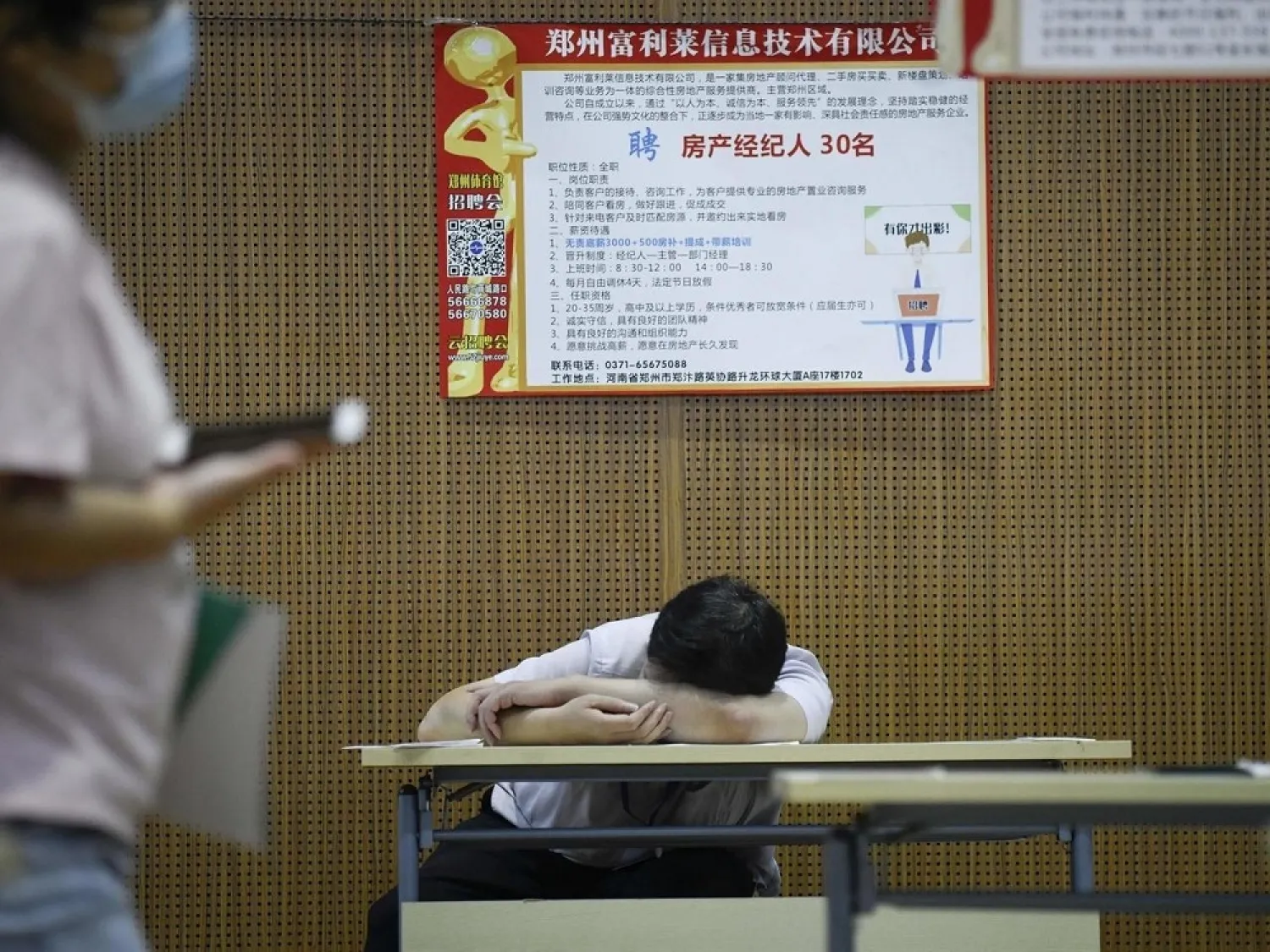
A jobseeker takes a break at a recruitment fair in Zhengzhou, China. (AFP)
TT

China's Young Jobseekers Struggle Despite Economic Recovery

A jobseeker takes a break at a recruitment fair in Zhengzhou, China. (AFP)

Biology student Ma Jingjing wandered the hall of a job fair in central China among other young Chinese hoping to find work in an economy crushed by the coronavirus pandemic.

Ma, 26, is one of almost nine million people graduating and entering the job market this year at a time of great uncertainty, an issue that has the ruling Communist Party worried to the point that President Xi Jinping has made it a priority.

The world's second-largest economy may have rebounded sharply from a historic virus-induced contraction, but its young graduate jobless rate in June was more than three times that for urban unemployment.

Ma was among hundreds of young faces streaming in and out of the job fair on a recent weekend in Zhengzhou, where employers in industries ranging from real estate to manufacturing were recruiting.

Like many others, the aspiring teacher is "at a loss" and wondering if she should settle for any job or hold off work for further education.

"I have applied to seven or eight private schools, but only one has called me back for an interview," she told AFP at the fair.

"I've studied for so many years and don't want my family to pay for further training," she said.

"I'm especially worried about my finances."

Aware of the risk that mass unemployment can spark political unrest -- jeopardizing the party's pledge of prosperity in return for unquestioned political power -- the government has been making efforts to boost graduate employment via state-owned enterprises (SOEs).

But poorer opportunities this year are pushing some into further studies, less ideal jobs or other options.

'Extremely anxious'

Although China's economy appeared to make a strong comeback in the second quarter -- growing 3.2 percent on-year -- analysts caution the rebound may be overestimated, with a gap re-emerging between national figures and higher-frequency data.

Louis Kuijs of Oxford Economics told AFP there is no doubt China is recovering, but the magnitude would determine if growth is "strong enough to re-absorb some of the labor market problems" that emerged earlier this year, such as layoffs.

A gap in growth of a few percentage points could lead to a difference of millions of jobs created, he added.

Although China's urban unemployment rate slipped to 5.7 percent in June, 19.3 percent of new graduates remained jobless, UOB economists said in a report, adding the labor market "continued to face challenges".

Top-level economic data has not necessarily meant better hiring on the ground.

A 27-year-old surnamed Kang, who graduated in 2017, is back in the market after his contract in the communications industry in Beijing ended.

He decided to return to Zhengzhou, but has only received around five callbacks after sending more than 30 resumes to firms -- and is still looking for a job.

"The virus outbreak has limited travel and a lot of job fairs have been postponed or cancelled," he said. "I'm extremely anxious."

Lu Yifan, 25, said the pandemic had caused many overseas Chinese students like him to return home sooner than planned -- adding to the flood of jobseekers.

And Guangdong graduate Zhao Jingying, 22, told AFP: "For us (this year), getting a single job offer is a feat."

Another, Beijing-based Huo Ruixi, 23, left university in July but is planning a second round of further education after an unsuccessful five-month job search.

'Pressures are larger'

The crisis is also causing problems for employers.

Yang Changwei, manager at Deyou Real Estate, told AFP at the Zhengzhou fair it was getting harder to hire sales staff based on commission.

"It feels like jobseekers' mindsets have shifted," he said.

"In sales, you may or may not make deals but with other jobs there can be more stability in income. Because of the epidemic, financial pressures are larger as well."

Officials are ramping up efforts to boost graduate employment, and Premier Li Keqiang announced over nine million new roles will be created this year.

A State Council guideline in March said smaller firms that recruit graduates with contracts longer than a year will be given a subsidy, while SOEs will "continuously expand" the scale of graduate-hiring this year and next.

Henan authorities, for one, said at least half the recruitment positions at SOEs within the province should be reserved for this year's graduates, while Nanjing city in Jiangsu province set aside one billion yuan ($143 million) to provide 100,000 internships for struggling graduates, Xinhua news agency reported.



Saudi Aramco Reportedly Sells Oil from Jafurah Field as Huge Project Starts

Saudi Aramco's Jafurah project. Photo: Aramco
TT

Saudi Aramco Reportedly Sells Oil from Jafurah Field as Huge Project Starts

Saudi Aramco's Jafurah project. Photo: Aramco

Saudi Aramco sold oil from its $100 billion Jafurah project in the first reported export from the massive natural gas development, Bloomberg reported.

Jafurah is Aramco’s first unconventional field, developed using the type of hydraulic fracturing, or fracking, techniques pioneered in the US shale patch.

The deposit, which Chief Executive Officer Amin Nasser calls the company’s crown jewel, will produce massive amounts of natural gas once at capacity, expected in 2030. It also has plentiful volume of liquid fuels that will boost the company’s returns, Nasser has said.

The oil that Aramco sold is condensate, a light oil liquid that’s often found in gas deposits, according to traders with knowledge of the purchases. It will go to buyers in Asia for loading later this month or in early March, Bloomberg quoted the traders as saying.


Industry Ministry: Saudi Arabia Saw 220% Surge in Mining Licenses in 2025

The surge highlights the appeal of the mining investment environment in the Kingdom. SPA
TT

Industry Ministry: Saudi Arabia Saw 220% Surge in Mining Licenses in 2025

The surge highlights the appeal of the mining investment environment in the Kingdom. SPA

The Saudi Ministry of Industry and Mineral Resources has announced record growth in the number of new mining exploitation licenses issued in 2025, showing a remarkable increase of 220% compared to 2024.

The surge highlights the appeal of the mining investment environment and the ministry's ongoing efforts to promote the exploration and utilization of the Kingdom's mineral resources, which are valued at over SAR9.4 trillion.

Jarrah Al-Jarrah, the ministry’s spokesperson, revealed that total investment in these new licensing projects has exceeded SAR44 billion, focused on the extraction of high-quality mineral ores, including gold and phosphate.

Al-Jarrah emphasized that the ministry is dedicated to facilitating mining investments and streamlining the process for both local and international investors, thereby supporting sector development and maximizing returns.

This effort aligns with the objectives of Saudi Vision 2030, which aims to position mining as the third pillar of national industry and a key contributor to economic diversification.

The Saudi mining sector made significant progress in the 2024 annual survey of mining companies conducted by the Fraser Institute of Canada.

The Kingdom improved its position in the Mining Investment Attractiveness Index, moving up from 114th place in 2013 to 23rd place globally. This achievement underscores the effectiveness of regulatory and legislative reforms within the sector.


UK Economy Barely Grew in Q4 as Budget Uncertainty Weighed

The financial district of the City of London (Reuters)
TT

UK Economy Barely Grew in Q4 as Budget Uncertainty Weighed

The financial district of the City of London (Reuters)

Britain's economy barely grew in the final quarter of 2025 as activity fared worse than initially estimated during the run-up to finance minister Rachel Reeves' budget, official figures showed on Thursday.

Gross domestic product grew by 0.1% in the October-to-December period, the same slow pace as in the third quarter, the Office for National Statistics said.

Economists polled by Reuters, as well as the Bank of England, had forecast 0.2% fourth-quarter growth compared with the ‌previous three months.

The ‌period was marked by rampant speculation about tax increases ‌ahead ⁠of Reeves' budget ⁠on November 26. The ONS revised down monthly GDP data for the three months to November to show a 0.1% contraction rather than 0.1% growth.

Some more recent data have suggested that uncertainty has lifted for consumers and businesses.

"Looking at various surveys, there were some tentative signs that sentiment turned a corner and started to improve after the budget last year, which could help deliver a pick-up in activity this ⁠year," Luke Bartholomew, deputy chief economist at Aberdeen, said.

"However, recent ‌political uncertainty may see that sentiment bounce reverse."

Prime ‌Minister Keir Starmer has had to fight to keep his grip on Downing Street this ‌week due to fallout from the Jeffrey Epstein scandal.

Thursday's figures underscored why ‌investors think that the Bank of England is more likely than not to cut interest rates again in March.

The monthly GDP data showed a sharp downward revision to growth.

The data suggested hesitancy on the part of businesses during the fourth quarter as their investment fell ‌by almost 3% - the biggest quarter-on-quarter drop since early 2021, driven largely by volatile transport investment.

Economist Thomas Pugh at ⁠tax and consultancy ⁠firm RSM said the overall weakness in business investment suggested budget uncertainty held back investment and spending.

Manufacturing was the biggest driver of the increase in output, despite the fact that car output was still recovering from September's cyber attack on Jaguar Land Rover, while the dominant services sector was flat. Construction output contracted by 2.1%.

In 2025 as a whole, Britain's economy grew by an annual average 1.3%, the Office for National Statistics said, compared with 0.9% in France, 0.7% in Italy and 0.4% in Germany.

British economic growth per head contracted by 0.1% for a second quarter, although it rose by 1.0% for 2025 as a whole.

In December alone, the economy grew by 0.1%, the ONS said, as expected in the Reuters poll. That left the size of the economy back at its level of June 2025.