


UN-Backed Court to Issue Verdicts in Lebanon's Hariri Case

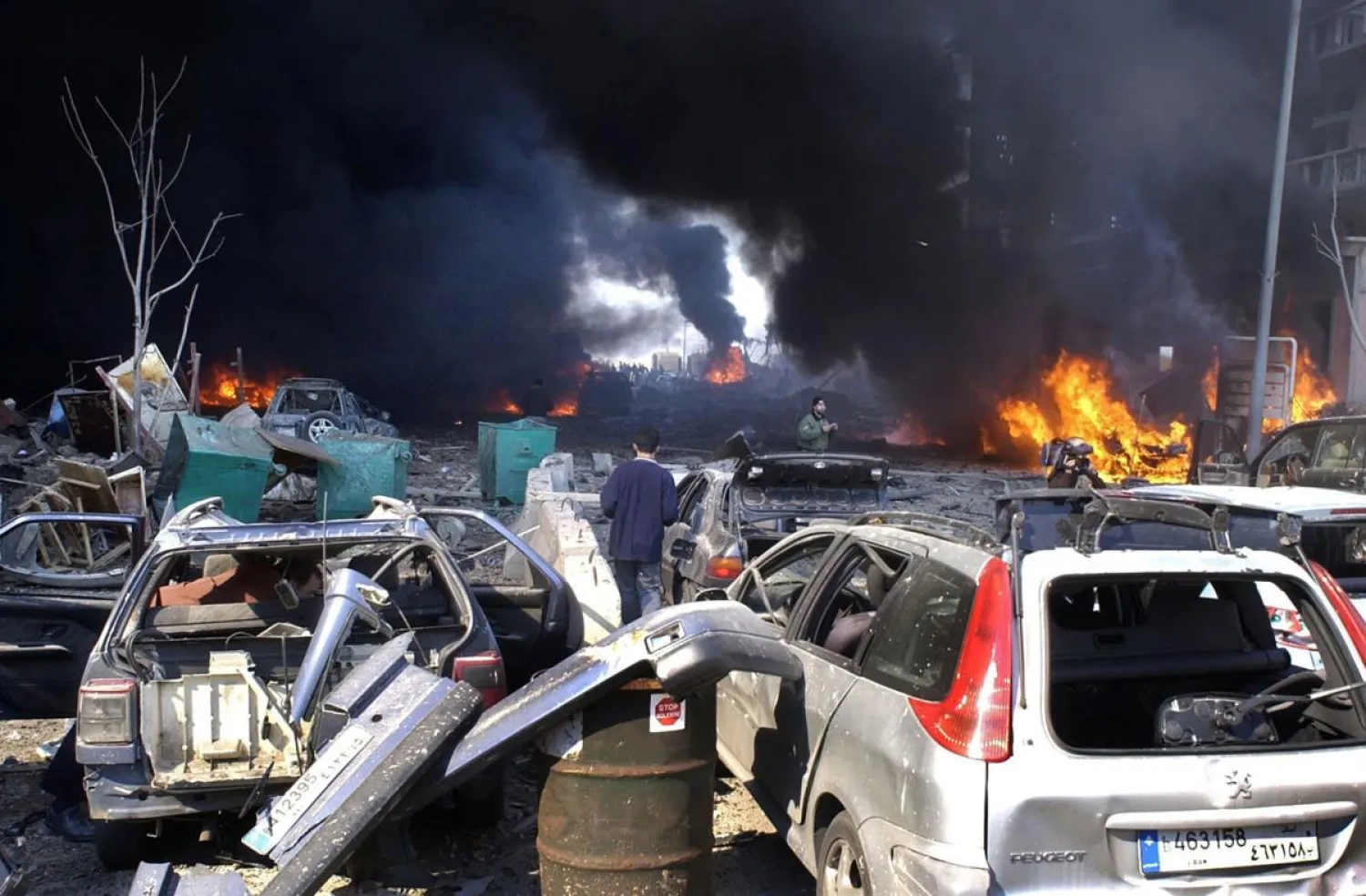
In this Feb. 14, 2005 file photo, destroyed vehicles litter the site of a massive bomb attack that tore through the motorcade of former Prime Minister Rafik Hariri in Beirut, Lebanon. More than 15 years after the truck bomb assassination of Hariri in Beirut, a UN-backed tribunal in the Netherlands is announcing verdicts this week in the trial of four members of the militant group Hezbollah allegedly involved in the killing. (AP Photo, File)
TT

UN-Backed Court to Issue Verdicts in Lebanon's Hariri Case

In this Feb. 14, 2005 file photo, destroyed vehicles litter the site of a massive bomb attack that tore through the motorcade of former Prime Minister Rafik Hariri in Beirut, Lebanon. More than 15 years after the truck bomb assassination of Hariri in Beirut, a UN-backed tribunal in the Netherlands is announcing verdicts this week in the trial of four members of the militant group Hezbollah allegedly involved in the killing. (AP Photo, File)

More than 15 years after the truck bomb assassination of former Lebanese Prime Minister Rafik Hariri in Beirut, a UN-backed tribunal in the Netherlands is announcing verdicts this week in the trial of four members of the militant group Hezbollah allegedly involved in the killing, which deeply divided the tiny country.

The verdicts on Tuesday at the Special Tribunal for Lebanon, based in a village on the outskirts of the Dutch city of The Hague, are expected to further add to soaring tensions in Lebanon, two weeks after a catastrophic explosion at Beirut´s port that killed nearly 180 people, injured more than 6,000 and destroyed thousands of homes in the Lebanese capital.

Unlike the blast that killed Hariri and 21 others on Feb. 14, 2005, the Aug. 4 explosion was believed to be a result of nearly 3,000 tons of ammonium nitrate that accidentally ignited at Beirut's port. While the cause of the fire that provided the trigger is still not clear, Hezbollah, which maintains huge influence over Lebanese politics, is being sucked into the public fury directed at the country´s ruling politicians.

Even before the devastating Beirut port blast, the country´s leaders were concerned about violence after the verdicts. Hariri was Lebanon´s most prominent Sunni politician at the time, while the Iran-backed Hezbollah is a Shiite Muslim group.

Some Lebanese see the tribunal as an impartial way of uncovering the truth about Hariri´s slaying, while Hezbollah - which denies involvement - calls it an Israeli plot to tarnish the group.

One analyst believes the lengthy investigation and trial have rendered the result almost redundant. The defendants remain at large.

Michael Young of Carnegie Middle East Center wrote recently that the verdicts "will seem like little more than a postscript to an out-of-print book."

"The UN investigation was glowingly referred to once as a mechanism to end impunity. It has proven to be exactly the contrary," Young wrote, saying those believed to have carried out the assassination "risk almost nothing today."

But for others, especially those more closely linked to the violence that has plagued Lebanon, the verdicts still carry significance.

"It´s going to be a great, great moment not only for me as a victim but for me as a Lebanese, as an Arab and as an international citizen looking for justice everywhere," said prominent former legislator and ex-Cabinet Minister Marwan Hamadeh, who was seriously wounded in a blast four months before Hariri´s assassination. Hamadeh said those who killed Hariri were behind the attempt on his life. The tribunal has indicted one of the suspects in Hariri´s assassination with involvement in the attempt on Hamadeh´s life.

Hamadeh resigned as a member of parliament in protest a day after the Beirut port blast.

Hariri was killed by a suicide truck bomb on a seaside boulevard in Beirut that killed him and 21 others, and wounded 226 people.

The assassination was seen by many in Lebanon as the work of Syria. Following post-Hariri assassination protests, Damascus was forced to withdraw thousands of troops from Lebanon, ending a three-decade domination of its smaller neighbor.

The tribunal was set up in 2007 under a UN Security Council resolution because deep divisions in Lebanon blocked parliamentary approval of the court that operates on a hybrid system of Lebanese and international law. The investigation and trial cost about $1 billion, of which Lebanon paid 49% while other nations paid the rest.

Initially, five suspects were tried in absentia in the case, all of them Hezbollah members. One of the group´s top military commanders Mustafa Badreddine was killed in Syria in 2016 and charges against him were dropped.

The other suspects are Salim Ayyash, also known as Abu Salim; Assad Sabra, Hassan Oneissi, who changed his name to Hassan Issa and Hassan Habib Merhi. They are charged with offenses including conspiracy to commit a terrorist act, and face maximum sentences of life imprisonment if convicted. Sentences will not be announced Tuesday but will be determined at later hearings.

The four defendants, however, are unlikely to serve any prison time - they have never been detained despite international arrest warrants and Hezbollah has vowed never to hand over any suspects.

Even if they are all convicted, Hezbollah as a group will not officially be blamed as the tribunal only accuses individuals, not groups or states.

Prosecutors based their indictments on telecommunications data of cellular telephones that the suspects allegedly used to track Hariri´s movements starting weeks before the assassination until the explosion occurred. The tribunal heard evidence from 297 witnesses during the trial, which started in 2014 and spanned 415 days of hearings.

Omar Nashabe, who served as a consultant for the defense team in the tribunal for about five years, said that since there was no consensus in Lebanon over the tribunal and parliament did not approve it, the trial "may not be the best process to reach justice in such cases."

He said that the people of Lebanon are divided between some who want the tribunal to confirm their suspicions about the perpetrators and others who continue to see the court as part of a wider conspiracy to discredit Hezbollah.

"Therefore this tribunal is doomed to fail because of the lack of consensus," The Associated Press quoted Nashabe as saying, adding that if the defense appeals the case the verdict will not mark the end.

Hezbollah leader Hassan Nasrallah last week insisted on the innocence of the suspects regardless of the verdicts. "For us it will be as if they were never issued," he said of the verdicts. Nasrallah warned against attempts to exploit the verdicts internally and externally in order to target the group.

Former Prime Minister Saad Hariri, son of the late Hariri, has said he will make a statement regarding the verdicts after they are made public. Asked about concerns over repercussions of the verdict, he said "justice must prevail regardless of the cost."

Since the assassination in 2005, several top Syrian and Hezbollah security officials have been killed, in what some supporters of the tribunal say were the result of liquidations to hide evidence.

Hamadeh, the legislator, called such deaths "Godly justice," adding that "we don´t know how. Some say they were liquidated by their own teams, some say the Syrian regime got rid of them to put the suspicion and the doubts away, some said internal feuds."



Lebanese Army Chief Faces Labeling Dispute During Washington Visit

Lebanese Army Commander General Rodolphe Haykal during his visit to Washington (Lebanese Army Command)
TT

Lebanese Army Chief Faces Labeling Dispute During Washington Visit

Lebanese Army Commander General Rodolphe Haykal during his visit to Washington (Lebanese Army Command)

What was meant to be a routine visit by Lebanese Army Commander General Rodolphe Haykal to Washington to discuss military support and aid coordination turned into a political flashpoint, after a brief meeting with US Senator Lindsey Graham ignited a dispute over whether the army chief would describe Hezbollah as a “terrorist organization.”

The controversy was sparked by a brief meeting with hardline Republican Senator Lindsey Graham, who publicly said he cut the meeting short after Haykal declined to use the designation in what he called the “context of Lebanon.”

What happened in the Graham meeting

In a post on X, Graham said: “I just had a very brief meeting with the Lebanese Chief of Defense General Rodolphe Haykal. I asked him point blank if he believes Hezbollah is a terrorist organization. He said, “No, not in the context of Lebanon.” With that, I ended the meeting.”

“They are clearly a terrorist organization. Hezbollah has American blood on its hands. Just ask the US Marines,” he added.

“They have been designated as a foreign terrorist organization by both Republican and Democrat administrations since 1997 – for good reason.”

“As long as this attitude exists from the Lebanese Armed Forces, I don’t think we have a reliable partner in them.”

“I am tired of the double speak in the Middle East. Too much is at stake,” Graham concluded.

The reaction went beyond expressions of displeasure. Some US coverage suggested Graham effectively raised questions about the “usefulness” of continuing support for the Lebanese army if such a gap persists between the US position and Lebanon’s official language.

Haykal’s answer raises its cost in Washington

Inside Lebanon, the issue is not limited to the stance on Hezbollah. Still, it extends to the army’s role as a unifying institution in a country whose political balance rests on sectarian arrangements and deep sensitivities.

Adopting an external designation, even a US one, in official language by the head of the military could be interpreted domestically as a move that risks triggering political and sectarian division or drawing the army into confrontation with a component that has organized political and popular representation.

That explains why Lebanese voices, including some critics of Hezbollah, defended the logic that “the state does not adopt this classification.” Therefore, the army commander cannot formally do so.

In other words, Haykal sought to avoid two conflicting languages: Washington’s legal and political framing of Hezbollah, and the Lebanese state’s language, which walks a fine line between the demand for exclusive state control over arms and the avoidance of reproducing internal fractures.

US State Department position

Amid the controversy surrounding the Graham meeting, an official US position emerged on Tuesday through the US Embassy in Beirut, welcoming the visit and focusing on the core US message.

The statement said that “the Lebanese Armed Forces’ ongoing work to disarm non-state actors and reinforce national sovereignty as Lebanon’s security guarantor is more important than ever.”

The wording was notable because it separated two levels: continued US reliance on the army as a state institution, and, in practice, linking that reliance to the issue of disarming non-state actors.

The phrase avoids direct naming but, in the Lebanese context, is widely understood to refer primarily to Hezbollah.

The visit’s broader track

Despite the political awkwardness, Haykal’s visit was not reduced to a single meeting. He held senior-level military talks, including meetings with US Central Command chief Admiral Brad Cooper and Chairman of the Joint Chiefs of Staff General Dan Caine.

According to a statement from a Joint Chiefs spokesperson, the meeting “reaffirmed the importance of enduring US defense relationships in the Middle East.”

The visit coincided with broader discussions in Washington on support for the Lebanese army and plans to extend state authority, as international reports spoke of Lebanon entering new phases of a plan to dismantle illegal weapons structures in the south and north.

The army commander’s visit had initially been delayed for reasons that add another layer to understanding Washington’s sensitivity to the military’s language.

In November 2025, sources quoted the US State Department as saying Washington canceled scheduled meetings with the Lebanese army commander after objecting to an army statement on border tensions with Israel, prompting the visit to be postponed to avoid a pre-emptive political failure.


Egypt Steps Up Efforts to Support Gaza Administration Committee After Entry Stalled

Displaced Palestinians inspect the damage after Israeli aircraft targeted a five floor house last night, in Khan Younis southern Gaza Strip on February 6, 2026. (AFP)
TT

Egypt Steps Up Efforts to Support Gaza Administration Committee After Entry Stalled

Displaced Palestinians inspect the damage after Israeli aircraft targeted a five floor house last night, in Khan Younis southern Gaza Strip on February 6, 2026. (AFP)

Egypt is intensifying efforts to back the National Committee for the Administration of Gaza, hoping it can begin operating inside the enclave to implement commitments under the second phase of the ceasefire agreement, which started about two weeks ago but has yet to take shape on the ground.

Experts told Asharq Al-Awsat that those Egyptian efforts, through phone calls and meetings with international partners, are focused on two main objectives: pushing for the deployment of police forces and an international stabilization force on the one hand, and securing a gradual Israeli withdrawal on the other, increasing pressure on Israel to move the agreement forward.

A member of the administration committee said in a brief phone statement to Asharq Al-Awsat, speaking on condition of anonymity, that there is still no specific date for entering the enclave.

In the Slovenian capital, Ljubljana, Egyptian Foreign Minister Badr Abdelatty stressed Cairo’s full support for the work of the committee headed by Dr. Ali Shaath.

He made the remarks during a dialogue session of the Arab-Islamic committee on Gaza with Slovenian Foreign Minister Tanja Fajon.

The foreign ministers of Saudi Arabia, Jordan, and Bahrain attended the meeting. Abdelatty stressed the importance of the committee’s role in managing the daily affairs of Gaza’s residents and meeting their basic needs during the transitional phase.

He underscored the need to ensure the continued flow of humanitarian and relief aid into the enclave, as well as the formation and deployment of an international stabilization force to monitor the ceasefire.

Abdelatty reiterated his stance during a phone call on Friday with British Foreign Secretary Yvette Cooper.

The Gaza committee, established under the ceasefire agreement, operates under the supervision of the Board of Peace, chaired by US President Donald Trump. The committee has been holding meetings in Cairo since it was announced last month and has yet to enter Gaza.

Ahmed Fouad Anwar, a member of the Egyptian Council for Foreign Affairs and an academic specializing in Israeli affairs, said Egypt is making significant efforts to facilitate the committee’s mission as quickly as possible and enable it to operate.

He said this would limit Israeli obstacles, increase pressure on Israel, and place it under the obligations set out in the plan, particularly withdrawal from Gaza. This would counter intense pressure from Tel Aviv to accelerate the disarmament of Hamas without implementing its Gaza agreement commitments.

Palestinian political analyst Abdel Mahdi Motawea said Israel objected not only to the committee’s work but even to its emblem.

He noted, however, that Israel is not the only party hindering the committee. Hamas and other factions want to impose conditions on the committee’s work.

He warned of serious concerns that the committee could be marginalized, stressing that Egypt’s extensive efforts to support it are crucial at this critical stage of the Gaza agreement.

Hamas announced days ago that it was ready to hand over management of the enclave to the committee, while Israel continues to obstruct it.

Anwar expects the committee to begin operating in the enclave soon if Egypt’s efforts and those of international partners succeed and Washington responds positively.

He warned that the committee's failure would threaten the ceasefire agreement.


Gaza Deal Mediators Have Few Options on Hamas Disarmament

Hamas fighters in Gaza City. (AFP)
TT

Gaza Deal Mediators Have Few Options on Hamas Disarmament

Hamas fighters in Gaza City. (AFP)

Israel’s demand for the disarmament of Hamas has become the top priority since the second phase of the Gaza agreement began 10 days ago.

It exposed deep uncertainty over how such a step could be enforced amid firm resistance from the movement, which says it will not relinquish its weapons unless progress is made toward establishing a Palestinian state.

Analysts speaking to Asharq Al-Awsat said the issue has left mediators with minimal options, ranging from complete disarmament to freezing weapons, either by persuading Hamas or applying pressure.

The demand has become a political pressure tool that Israeli Prime Minister Benjamin Netanyahu and others in Israel are likely to use increasingly in the run-up to elections, they added.

Israeli opposition figure Benny Gantz, who is preparing for elections, called on Thursday in a post on X for the “disarmament of Hamas.”

Israeli Defense Minister Israel Katz said on Wednesday that Israel will dismantle Hamas if it does not agree to lay down its arms.

Netanyahu, following a meeting on Tuesday with US envoy Steve Witkoff, said he was insisting on the non-negotiable demand to disarm Hamas before any step toward rebuilding Gaza.

Military and strategic analyst Brig. Gen. Samir Ragheb said mediators have few options other than reaching understandings or exerting pressure, noting that the demand to disarm Hamas has been echoed by Israel, Washington, the EU, and donors, and has become an obstacle to ending the war and launching reconstruction.

He said Netanyahu and others would use the issue electorally and as a pretext to collapse the agreement at any time, adding that the second phase is filled with “landmines,” particularly those related to the Israeli withdrawal, which Netanyahu does not want to address.

Strategic and military expert Maj. Gen. Samir Farag said available options are now limited, suggesting that freezing weapons may be more likely than complete disarmament, mainly since Hamas’ arsenal does not consist of missiles or drones and could be handed over.

He said there is US and Israeli insistence on implementing the weapons clause, but that it must coincide with an Israeli withdrawal and guarantees to prevent a new war.

By contrast, sources in Hamas told Reuters on Wednesday that the group had agreed to discuss disarmament with other Palestinian factions, but that neither Washington nor regional mediators had presented it with any detailed or concrete proposal on disarmament.

Israel’s Channel 13 reported in late January that the US was preparing a document granting Hamas several weeks to hand over its weapons to multinational forces within a set timeframe. Failure to comply would give Israel the green light to “act as it sees fit,” the channel said.

Farag stressed that Hamas’ room for maneuver is extremely limited and that it must quickly reach understandings with mediators, particularly Egypt, Qatar, and Türkiye, to resolve what he described as the most significant obstacle currently being created by Israel.

Ragheb said Hamas has no option but to implement US President Donald Trump’s Gaza plan and the disarmament clause, warning against delaying or circumventing it, as “every day lost poses a threat to the ceasefire agreement.”

He added that police forces in the enclave would be deployed within days or weeks, along with a possible stabilization force, leaving little space for further maneuvering.