Saudi Arabia and Iraq Discuss Political, Economic, Security Issues

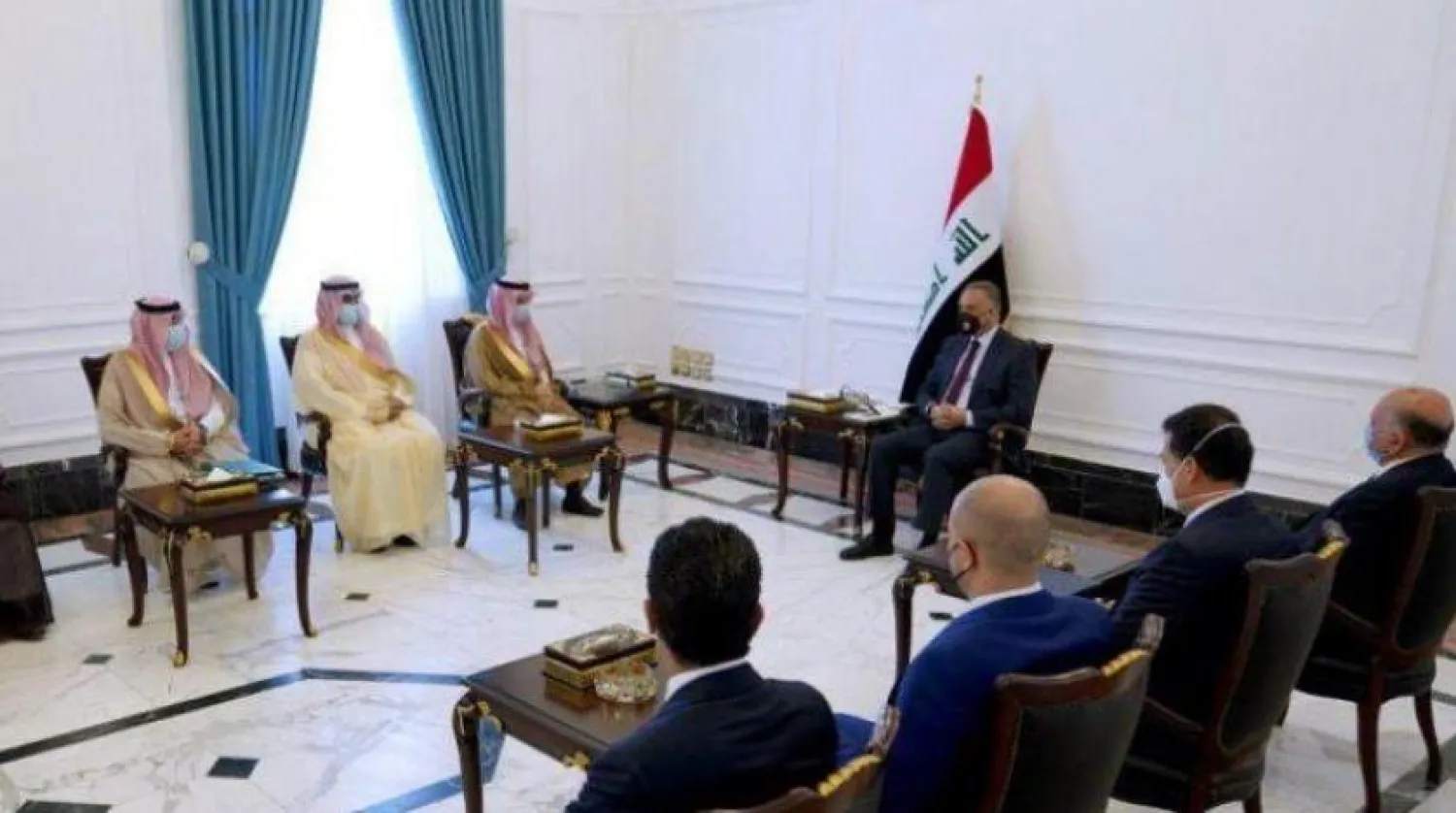
Iraqi Prime Minister Mustafa Al Kadhimi meeting with Saudi Foreign Minister Prince Faisal bin Farhan at his office in Baghdad, Iraq, 27 August 2020. EPA
TT

Saudi Arabia and Iraq Discuss Political, Economic, Security Issues

Iraqi Prime Minister Mustafa Al Kadhimi meeting with Saudi Foreign Minister Prince Faisal bin Farhan at his office in Baghdad, Iraq, 27 August 2020. EPA

Saudi Arabia and Iraq have continued to reinforce bilateral political and economic cooperation by discussing a number of potential energy, petrochemical, and agricultural projects.

The Kingdom and Iraq have also been discussing boosting regional peace and security.

“Today I was pleased to visit Iraq, a country with which we have deep historic ties and share an ambitious future,” Saudi Foreign Minister Prince Faisal Bin Farhan tweeted.

The FM arrived in Iraq on Thursday at a time when Baghdad and Riyadh are seeking to strengthen their ties, especially in energy as Iraq is experiencing a shortage of electricity.

“I discussed with Prime Minister Mustafa al-Kadhimi the steadily growing bilateral relations and common challenges and conveyed to him the greetings of the Kingdom's leadership and its good wishes to the brotherly Iraqi people,” Prince Farhan clarified in a tweet about Saudi-Iraqi ties.

Saudi Arabia is “a true partner to Iraq,” said Kadhimi, for his part, adding that Baghdad is “looking forward to building excellent relations… in a way that achieves a better future for both countries.”

Iraqi Foreign Ministry Spokesman Ahmed al-Sahaf revealed that Prince Farhan also met with his Iraqi counterpart, Fuad Hussein.

Al-Sahaf, in statements he made to Asharq Al-Awsat, said that the two officials talked about many issues, especially bilateral ties and implementing memorandums of understanding signed by previous Iraqi governments.

“Deepening economic and investment relations between the two countries, including those related to agriculture and petrochemicals, and supplying Iraq with energy, were also discussed,” al-Sahaf added about the two foreign ministers’ meeting.

The two sides also discussed linking Iraq’s energy to the countries of the Gulf Cooperation Council, he told Asharq Al-Awsat.

Both Prince Farhan and Hussein, according to al-Sahaf, confirmed the importance of reinforcing security and stability in the region and the need to support Iraq on all levels.

“The two sides also discussed the outcomes of the Iraqi prime minister's visit to Washington and the results of the recently held Amman tripartite meeting,” al-Sahaf revealed.


Saudi, Omani FMs Discuss Regional Developments

Saudi Minister of Foreign Affairs Prince Faisal bin Farhan bin Abdullah meets with his Omani counterpart Badr bin Hamad bin Hamood Albusaidi in Riyadh on Wednesday. (SPA)
TT

Saudi, Omani FMs Discuss Regional Developments

Saudi Minister of Foreign Affairs Prince Faisal bin Farhan bin Abdullah meets with his Omani counterpart Badr bin Hamad bin Hamood Albusaidi in Riyadh on Wednesday. (SPA)

Saudi Minister of Foreign Affairs Prince Faisal bin Farhan bin Abdullah received in Riyadh on Wednesday his Omani counterpart Badr bin Hamad bin Hamood Albusaidi.

They reviewed the strong bilateral relations between their countries and ways to boost them across various fields.

They also addressed the latest developments in the region and the importance of continuing efforts to achieve security and stability.


OIC Condemns Israeli Decision to Ban 37 Aid Groups from Operating in Gaza

 The sun sets over a tent camp sheltering Palestinians displaced by the Israeli offensive, on New Year’ Eve in Khan Younis, southern Gaza Strip, December 31, 2025. (Reuters)
The sun sets over a tent camp sheltering Palestinians displaced by the Israeli offensive, on New Year’ Eve in Khan Younis, southern Gaza Strip, December 31, 2025. (Reuters)
TT

OIC Condemns Israeli Decision to Ban 37 Aid Groups from Operating in Gaza

 The sun sets over a tent camp sheltering Palestinians displaced by the Israeli offensive, on New Year’ Eve in Khan Younis, southern Gaza Strip, December 31, 2025. (Reuters)
The sun sets over a tent camp sheltering Palestinians displaced by the Israeli offensive, on New Year’ Eve in Khan Younis, southern Gaza Strip, December 31, 2025. (Reuters)

The General Secretariat of the Organization of Islamic Cooperation (OIC) strongly condemned on Wednesday Israel’s decision to prevent 37 international non-governmental organizations operating in the humanitarian and health sectors from carrying out their activities in Gaza.

The Secretariat stressed that these organizations “play an indispensable role in alleviating humanitarian suffering in Gaza.”

The OIC General Secretariat “warned of the grave consequences of this arbitrary measure, which is likely to dangerously exacerbate the catastrophic humanitarian situation in the Gaza Strip due to Israeli restrictions that hinder the entry of sufficient humanitarian and medical aid.”

It deemed the Israeli decision as “illegal and a “blatant violation of the principles of international humanitarian law and the advisory opinion of the International Court of Justice, which obliges the Israel to facilitate the work of international and humanitarian organizations and to allow the adequate and unhindered delivery of humanitarian assistance to the Gaza Strip.”

The OIC General Secretariat called on the international community “to take the necessary measures and exert effective pressure on Israeli authorities to reverse this decision, ensure the protection of humanitarian workers, and guarantee the freedom of humanitarian organizations to operate without restriction throughout the occupied Palestinian territory.”


Gulf Countries, OIC Say Security of Saudi Arabia and GCC States Integral to Region

A general view of Kuwait City buildings, Kuwait, December 23, 2024. (Reuters)
TT

Gulf Countries, OIC Say Security of Saudi Arabia and GCC States Integral to Region

A general view of Kuwait City buildings, Kuwait, December 23, 2024. (Reuters)

Qatar announced that it is following with great interest the ongoing developments and events in Yemen, reiterating its full support for the legitimate Yemeni government and the importance of preserving Yemen’s unity and territorial integrity, safeguarding the interests of the brotherly Yemeni people, and achieving their aspirations for security, stability, and development.

In a statement, the Qatari Ministry of Foreign Affairs stressed that the security of Saudi Arabia and the Gulf Cooperation Council states is integral to the security of Qatar, stemming from the deep-rooted brotherly ties and shared destiny that unite the GCC countries.

The ministry commended the statements issued by Saudi Arabia and the United Arab Emirates, noting that they reflect a commitment to prioritizing the region’s interests, boosting the principles of good neighborliness, and adhering to the foundations and principles enshrined in the Charter of the Gulf Cooperation Council.

Qatar will remain at the forefront of countries supporting efforts to promote dialogue and diplomacy as the optimal path to achieving prosperity, security, and stability for the region and its peoples, stressed the ministry.

Kuwait's foreign ministry issued a similar statement, saying the security of Saudi Arabia and GCC states is a fundamental pillar of Gulf collective security, rooted in the bonds of brotherhood and shared destiny among them.

It expressed continued support for regional and international efforts aimed at promoting dialogue and peace, emphasizing diplomacy as the most effective path to achieving security, stability, and lasting peace in the region.

Bahrain, chair of the current session of the GCC, praised the “pivotal role played by Saudi Arabia and the United Arab Emirates in supporting the security and stability of Yemen, stemming from their brotherly responsibilities and shared commitment to the security and stability of the Gulf region within the GCC framework.” 

The Bahraini Ministry of Foreign Affairs stressed its “confidence in the wisdom of the leaderships of Saudi Arabia and the UAE, and in their ability to contain any differences within the framework of the GCC, in line with the principles of the GCC based on solidarity, mutual understanding, and unity, serving the shared aspirations to instill security, stability, peace, and prosperity for the benefit of the region and its peoples.” 

The ministry reiterated Bahrain’s “firm and supportive stance toward all regional and international initiatives and efforts aimed at reaching a comprehensive and lasting political solution in Yemen, in accordance with the GCC initiative and its executive mechanism, the outcomes of the Comprehensive National Dialogue Conference, and relevant UN Security Council resolutions.” 

Jordan also praised Saudi Arabia and the UAE's roles in supporting Yemen.

OIC

Secretary-General of the Organization of Islamic Cooperation (OIC) Hissein Brahim Taha underlined the organization’s firm stance in support of Yemen, its sovereignty, unity, and territorial integrity.  

He reiterated the OIC’s categorical rejection of any actions or attempts that would undermine Yemen’s unity or compromise its constitutional legitimacy and national institutions, in light of recent developments in the country. 

He renewed the OIC’s full support for the legitimate Yemeni government, represented by the President of the Presidential Leadership Council. He stressed the importance of preserving and strengthening state institutions in order to realize the Yemeni people’s aspirations for security, stability, and development. 

Taha condemned any actions or practices by the Southern Transitional Council that pose a direct threat to Yemen’s unity, undermine peace efforts, and prolong the conflict.  

“Any disruption to Yemen’s security and stability also threatens peace and security across the region,” he warned. 

He welcomed the announcement of the UAE’s withdrawal of forces from Yemen, describing it as a “constructive step that supports de-escalation efforts and spares the blood of the Yemeni people.” 

He further stressed that the security, sovereignty and territorial integrity of Saudi Arabia “constitute inviolable red lines.” 

“Any threat to the Kingdom’s security is a direct threat to the security of the entire region and the Islamic world,” Taha added, underscoring the OIC’s “full solidarity with Saudi Arabia in all measures taken to safeguard its national security.” 

He stressed “the need to continue supporting political and diplomatic efforts aimed at reaching a comprehensive and lasting solution to the Yemeni crisis.” 

He called on all Yemeni parties “to uphold legitimacy, renounce violence, and prioritize dialogue and the higher interests of Yemen and its people, in order to achieve security, stability, and development while preserving the country’s unity, sovereignty, and territorial integrity.”