

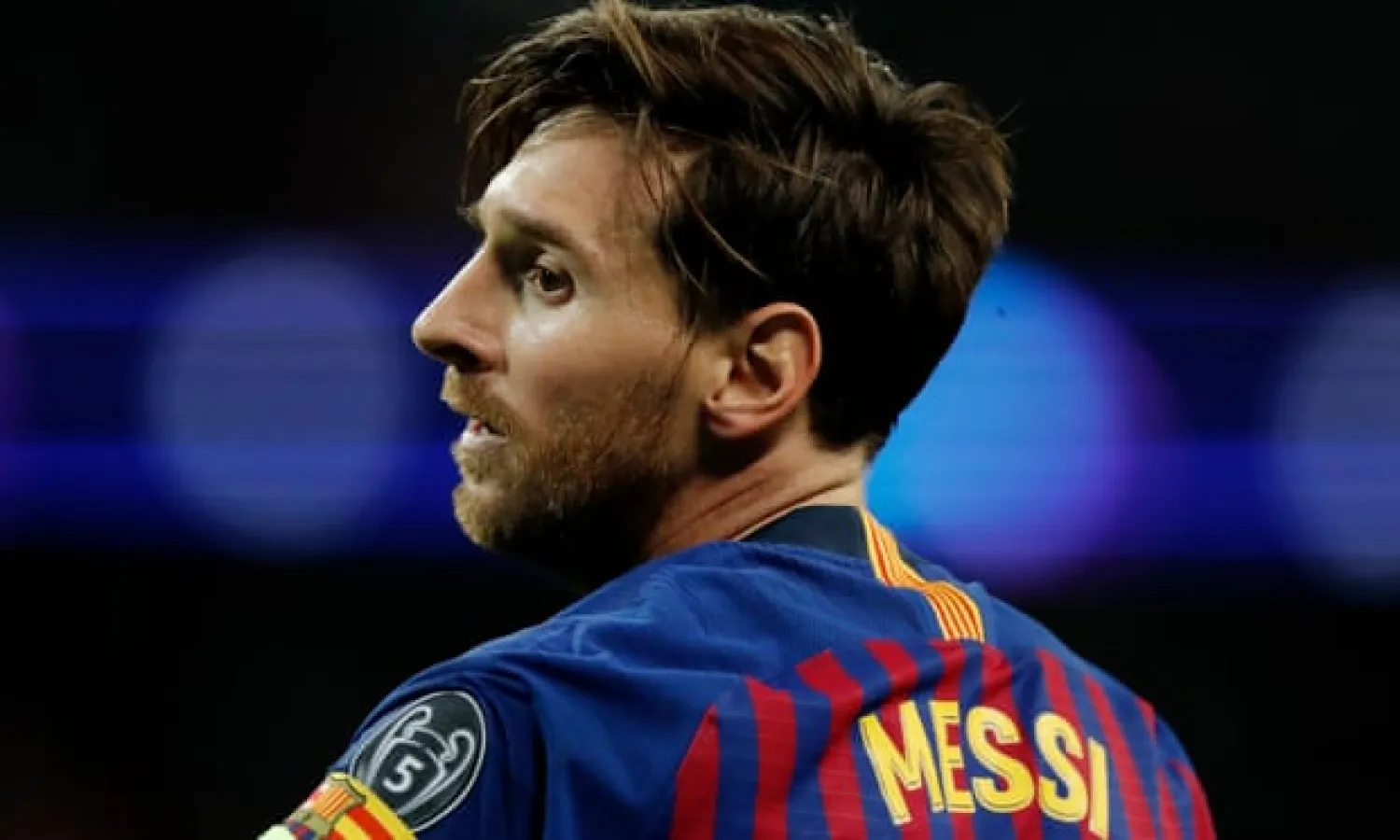

After Messi, Barcelona Will Never Be the Same

 Barcelona could not even entertain the idea of Lionel Messi retiring when he mentioned it last year, let alone him playing for another club. Photograph: Tom Jenkins/The Guardian
Barcelona could not even entertain the idea of Lionel Messi retiring when he mentioned it last year, let alone him playing for another club. Photograph: Tom Jenkins/The Guardian
TT

After Messi, Barcelona Will Never Be the Same

 Barcelona could not even entertain the idea of Lionel Messi retiring when he mentioned it last year, let alone him playing for another club. Photograph: Tom Jenkins/The Guardian
Barcelona could not even entertain the idea of Lionel Messi retiring when he mentioned it last year, let alone him playing for another club. Photograph: Tom Jenkins/The Guardian

The end is getting nearer, Lionel Messi said the night he collected his sixth Ballon d’Or. It was hard enough for Barcelona fans to accept then; it is harder now, and not just because eight months on it is closer and more real than ever. Deep down they all knew he would go some time quite soon – “I am 32,” he said – they just didn’t need reminding, to be suddenly confronted by reality. What no one imagined was that he would go this soon or this way, that it would come to this: an end quite so bitter, quite so broken.

If it hurt Barcelona fans to imagine a time when Messi stopped playing, it is worse to contemplate a time when he only stopped playing for them. This isn’t really that Messi is going; it’s when he’s going, why he’s going, and how he’s going. Where he is going, too: Manchester City, Paris Saint-Germain, Juventus, it doesn’t matter much. What matters is that it’s to another club. At least when he said the end was near, they imagined getting there together – his final game, like his first, would be in a Barcelona shirt, a fond if tearful farewell, a collective celebration which will never happen now.

The reaction to his using the word retirement that night last December was revealing, a collective panic, a “don’t say that”, as if seeking to escape a truth that didn’t bear thinking about. Afraid of being exposed by Messi, the board rushed to respond. “Leo’s got a long time left,” the president, Josep Maria Bartomeu, said – not least because he had to.

Bartomeu has spoken for Messi many times, his authority to do so less with each appearance, irritation rising in the Argentinian. The president insisted there was Messi para rato – a lot of Messi left – and that phrase covered both Catalan sports dailies, something a little needy, a little desperate, in the headline. It’s said that sportsmen die twice, first when they retire. Barcelona clung to his final years, as if trying to delay the inevitable.

As it turned out, there wasn’t even a year left. After 20 seasons at Barcelona, 17 in the first team, after 34 trophies and 634 goals, it almost certainly comes to an end. It is damaging news for Barcelona and for La Liga, already confronted by a troubling reality. Yet even that is not really the point. Players don’t talk about retirement the way that people don’t talk about death, Jorge Valdano says, but this is a fate worse than that. Not for the rest of football of course – there will be excitement at seeing him elsewhere, the electricity of expectation – but for Barcelona fans. It will feel wrong.

It is wrong and it has been for a long time, culminating here, the collapse complete. Football player leaves football club is not so shocking really, but this is. Yes, because it’s Messi, but it is more than that.

Messi signed for Barcelona on a paper napkin, Charly Rexach and his father scrawling an agreement on a serviette at the tennis club up the road. He signs off with a burofax, a formal letter, a recorded delivery that arrived at the Camp Nou at 7.20pm on Tuesday. Beyond talking now, beyond reconciliation, Messi served legal notice of his intention to leave – and to do so for free. A clause in his contract allows him to walk away.

On Wednesday the sporting director, Ramon Planes, said he wanted to build a winning team around the best player in the world, a brilliant idea they might have thought of sooner. The night before Barcelona had replied via a burofax of their own, insisting the clause does not apply, having expired. The club’s interpretation is that if he was to depart he had to inform them by 10 June. Tuesday was 25 August; his chance had gone. They reminded him that his buyout stands at €700m. And said they wanted him to continue.

It is no way to seek reconciliation. When two sides have reached the point that they are talking through lawyers and formal letters, there’s not much love left. All that’s left is to negotiate or to fight, to limit the damage or risk multiplying it. The question now is what that clause says: does it set a specific date? And when? If so, the legal position is clear. If not, if it says something more vague, referring instead to some variation on “the end of the season”, then that can be argued in court. And, yes, this really might end up in court: club versus captain.

Captain? The best player they have had. The best player anyone has had, perhaps. There is no satisfactory resolution now.

If the battle is over when Messi had to inform them of his decision, then the war is already lost. How do you come back from that? And how did you get to this? How bad can it be that Messi is so determined to leave, so desperate in fact, so convinced there’s nothing to stay for that it is announced like this? And by brokering it like this, it breaks even more. Take it back a few years, incidentally, and how can it be that Messi, when he renewed his deal in 2017, wanted an escape clause at all? Why did he insert the chance to walk out for free on his terms, a get‑out, just in case? How can it be that they let him?

For two years he didn’t go when he could have done. But the collapse continued, the deterioration of the club, the dark nights: Rome, Liverpool, Lisbon. The divide widened. If they tried to make him happy, they failed. “We give the [fans] nothing,” Messi lamented. He wasn’t blameless but he watched his peak years pass without a European Cup. He saw teammates leave. He saw others come and fail. It was time to pull the cord. The sword of Damocles fell.

The shock is not so much that Messi, whose anger and frustration has been increasingly evident, has taken this decision. It is not that the relationship is bad, it is that it is this bad. Confrontation has been increasingly common and played out in public, his anger more and more apparent, but somehow the threat never felt real – certainly, the club did not appear to see the danger – more like a deterrent than a genuine goal. The surprise is not that there were problems but that they were so profound, so irreversible. Having acted now, they deepen still further.

The crisis, building for five years and beyond, is such that Messi has turned his back on everything: his club, his home, his own plans. When he did, Carles Puyol announced his support and Luis Suárez responded with applause. Arturo Vidal said when a tiger is cornered, he comes out fighting.

This is war, the hostility open. And in the middle, the club. What’s left of it. Now even the most significant symbol they have is sullied. Nothing can ever be erased but it can be seen through different eyes. The conflict now is eternal, sides will be taken. There is no way back from this – even if, somehow, he can be convinced to stay. But it can never be the same again.

Some saw Messi’s move as a means of pressure, one last attempt to force change at the top, but it’s gone beyond Bartomeu now, a president who won’t resign anyway. Needing time to fix an economic mess that could become his personal liability, he literally can’t afford to.

And so it ends, changing everything for everyone. Not because Messi is going but because of how it is happening, the damage done. Even if Barcelona make enough money to resolve a financial crisis – and €300m across fee and saved salary is not beyond the realms. Even if they build a team that win without him, others emerging from his long shadow. Even if he doesn’t play well wherever he goes. Even if he comes to lament leaving – and on some level he knows it is guaranteed that he will. Even then, this is a stain that will not go.

It’s not about next year; it is about every year. This moment will always be there, part of a legacy lost, resentment lingering. A symbol of the collapse, of a failure astonishingly abject, of a crisis that in the end took everything with it, even him. Supporters will always remember the time things got so bad that the best player they ever had decided it was time to walk away and sent a letter to say so, the news they feared more than any other possibly in their entire history arriving by recorded delivery.

The Guardian Sport



Sunderland Worst Hit by Losing Players to African Cup of Nations 

14 December 2025, United Kingdom, London: Sunderland's Habib Diarra (L) and Leeds United's Gabriel Gudmundsson battle for the ball during the English Premier League soccer match between Brentford and Leeds United at the Gtech Community Stadium. (dpa)
TT

Sunderland Worst Hit by Losing Players to African Cup of Nations 

14 December 2025, United Kingdom, London: Sunderland's Habib Diarra (L) and Leeds United's Gabriel Gudmundsson battle for the ball during the English Premier League soccer match between Brentford and Leeds United at the Gtech Community Stadium. (dpa)

Premier League Sunderland will have to do without six players over the next few weeks and are the club worst hit as the Africa Cup of Nations takes its toll on European clubs competing over the holiday season.

Sunderland, eighth in the standings, had four of their African internationals in action when they beat Newcastle United on Sunday, but like 14 other English top-flight clubs will now lose those players to international duty.

The timing of the African championship, kicking off in Morocco on Sunday and running through to January 18, has long been an irritant for coaches, with leagues in Belgium, France, Germany, Italy, Netherlands, Portugal, and Spain also affected.

Hosting the tournament in the middle of the season impacts around 58% of the players at the Cup of Nations, though the Confederation of African Football did try to mitigate the impact by moving the start to before Christmas, so it is completed before the next round of Champions League matches.

The impact on European clubs was also lessened by allowing them to release players seven days, rather than the mandatory 14 days, before the tournament, meaning they could play for their clubs last weekend.

Sunderland's Congolese Arthur Masuaku and Noah Sadiki, plus full back Reinildo (Mozambique), midfielder Habib Diarra (Mali), and attackers Chemsdine Talbi (Morocco) and Bertrand Traore (Burkina Faso) have now departed for Morocco.

Ironically, Mohamed Salah’s absence from Liverpool to play for Egypt should lower the temperature at the club after his recent outburst against manager Arne Slot, but Manchester United will lose three players in Noussair Mazraoui, Bryan Mbeumo and Amad Diallo, who scored in Monday’s 4-4 draw with Bournemouth.

France is again the country with the most players heading to the Cup of Nations, and with 51 from Ligue 1 clubs. But their absence is much less impactful than previously as Ligue 1 broke after the weekend’s fixtures and does not resume until January 2, by which time the Cup of Nations will be into its knockout stage.

There are 21 players from Serie A clubs, 18 from the Bundesliga, and 15 from LaLiga teams among the 24 squads at the tournament in Morocco.


Rodgers Takes Charge of Saudi Team Al-Qadsiah After Departure from Celtic 

Then-Celtic head coach Brendan Rodgers greets supporters after a Europa League soccer match between Red Star and Celtic at Rajko Mitic Stadium in Belgrade, Serbia, Sept. 24, 2025. (AP)
TT

Rodgers Takes Charge of Saudi Team Al-Qadsiah After Departure from Celtic 

Then-Celtic head coach Brendan Rodgers greets supporters after a Europa League soccer match between Red Star and Celtic at Rajko Mitic Stadium in Belgrade, Serbia, Sept. 24, 2025. (AP)

Brendan Rodgers has returned to football as the coach of Saudi Arabian club Al-Qadsiah, six weeks after resigning from Scottish champion Celtic.

Al-Qadsiah, whose squad includes Italian striker Mateo Retegui and former Real Madrid defender Fernandez Nacho, is in fifth place in the Saudi Pro League in its first season after promotion.

Rodgers departed Celtic on Oct. 27 and has opted to continue his managerial career outside Britain for the first time, having previously coached Liverpool, Leicester and Swansea.

In its statement announcing the hiring of Rodgers on Tuesday, Al-Qadsiah described him as a “world-renowned coach” and said his arrival “reflects the club’s ambitious vision and its rapidly growing sporting project.”

Aramco, the state-owned Saudi oil giant, bought Al-Qadsiah in 2023 in a move that has helped to transform the club’s status.

“This is a landmark moment for the club,” Al-Qadsiah chief executive James Bisgrove said. “The caliber of his experience and track record of winning reflects our ambition and long-term vision to establish Al-Qadsiah as one of Asia’s leading clubs.”

Rodgers is coming off winning back-to-back Scottish league titles with Celtic, where he won 11 major trophies across his two spells. He also won the FA Cup with Leicester.

Al-Qadsiah's last two coaches were former Liverpool striker Robbie Fowler and former Spain midfielder Michel.


Portugal to Return to F1 Calendar in 2027 and 2028 

12 July 2025, United Arab Emirates, Abu Dhabi: Red Bull driver Max Verstappen leads into turn one during the Abu Dhabi Grand Prix at the Yas Marina Circuit, Abu Dhabi. (dpa)
TT

Portugal to Return to F1 Calendar in 2027 and 2028 

12 July 2025, United Arab Emirates, Abu Dhabi: Red Bull driver Max Verstappen leads into turn one during the Abu Dhabi Grand Prix at the Yas Marina Circuit, Abu Dhabi. (dpa)

Formula One will return to Portugal's Portimao circuit in 2027 and 2028 after the Dutch Grand Prix at Zandvoort drops off the calendar.

Formula One announced a two-year deal in a statement on Tuesday.

The 4.6-km Algarve International circuit in the country's south last hosted the Portuguese Grand Prix in 2020 and 2021, both seasons impacted by the COVID-19 pandemic with stand-in venues.

In 2020, seven-times world champion Lewis Hamilton took his 92nd career win at Portimao, breaking the record previously held by Michael Schumacher. Hamilton also won in 2021.

"The interest and demand to host a Formula One Grand Prix is the highest that it has ever been," said Formula One chief executive Stefano Domenicali, thanking the Portuguese government and local authorities.

The financial terms of the deal were not announced.

"Hosting the Grand Prix in the Algarve reinforces our regional development strategy, enhancing the value of the territories and creating opportunities for local economies," said Economy Minister Manuel Castro Almeida.

Portugal first hosted a grand prix in Porto in 1958, with subsequent races at Monsanto and Estoril near Lisbon. The late Brazilian great Ayrton Senna took his first grand prix pole and win at the latter circuit in 1985.

Formula One announced last year that Zandvoort, a home race for four-times world champion Max Verstappen, would drop off the calendar after 2026.

The championship already features a record 24 races and Domenicali has spoken of European rounds alternating to allow others to come in.

Belgium's race at Spa-Francorchamps is due to be dropped in 2028 and 2030 as part of a contract extension to 2031 announced last January.