


Erdogan Threatens France to ‘Pay Price’… Greece Slams Turkey’s ‘Megalomania’

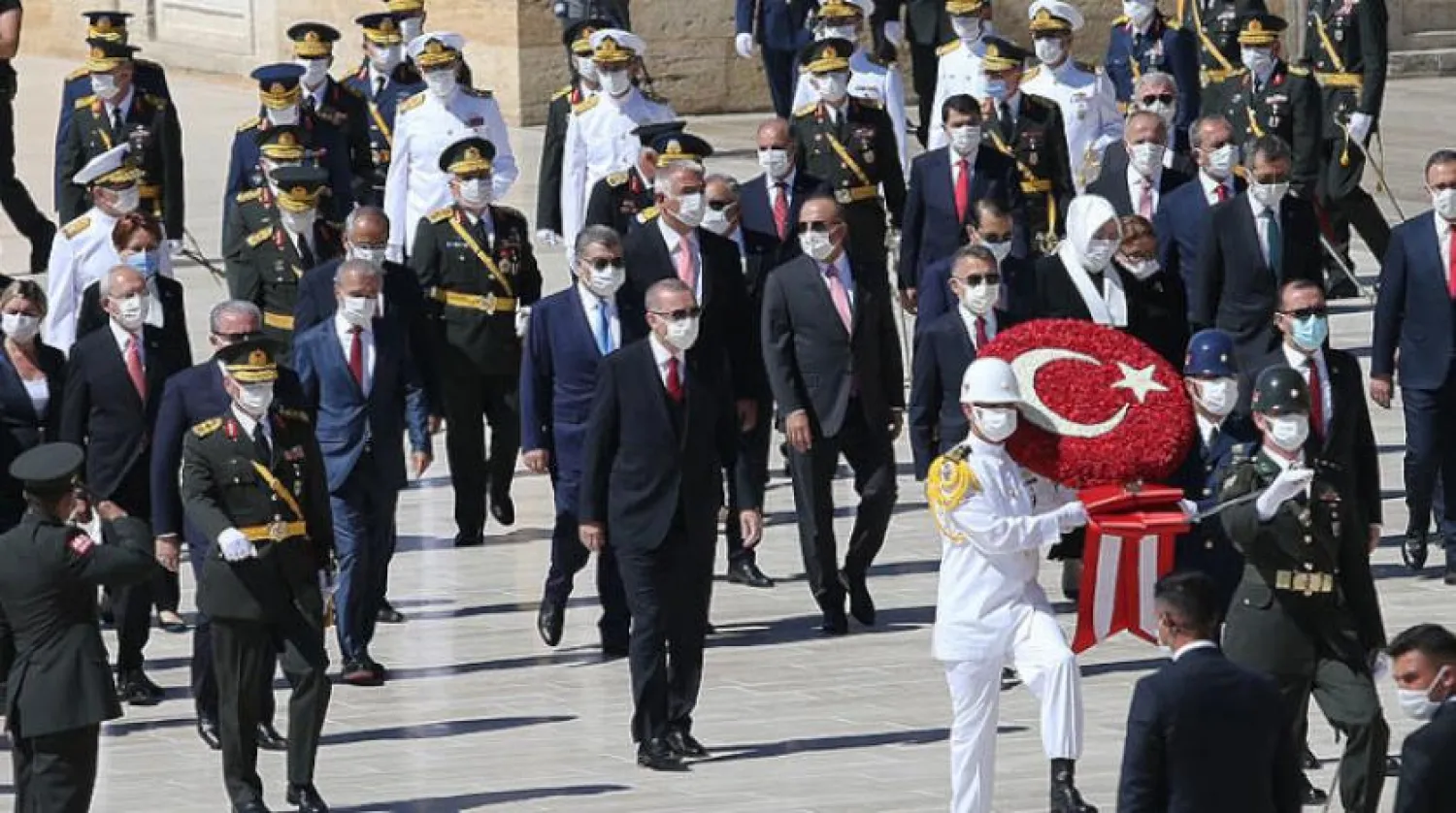
Erdogan during his visit to the Ataturk mausoleum on Sunday, August 30, 2020 (EPA)
TT

Erdogan Threatens France to ‘Pay Price’… Greece Slams Turkey’s ‘Megalomania’

Erdogan during his visit to the Ataturk mausoleum on Sunday, August 30, 2020 (EPA)

A war of words has escalated between Turkey on one hand, and Greece and France on the other hand over Turkish energy exploration in the eastern Mediterranean.

Turkish President Recep Tayyip Erdogan threatened Paris to “pay a price” for interfering in the dispute between Ankara and Athens.

“Turkey, in the eastern Mediterranean in particular, will not bow to threatening, intimidation and blackmailing language, will continue to defend its rights arising from international law and bilateral agreements,” Erdogan said.

“It is absolutely not a coincidence that those who seek to exclude us from the eastern Mediterranean are the same who attempted to invade our homeland a century ago,” he wrote on the guestbook of the mausoleum of Turkish Republic’s founder Mustafa Kemal Ataturk in the capital Ankara on Sunday, marking the 98th anniversary of the Victory Day over Greek troops during Turkey’s war of independence.

He lashed out at leaders of France and Greece, calling them “greedy and incompetent.”

Erdogan asked newly-commissioned officers in Ankara: “Do Greeks accept what could happen to them because of their greedy and incompetent leaders? “Do the French know the price they will pay because of their greedy and incompetent leaders?”

“When it comes to fight, we will not hesitate to make sacrifices. The question is: when they stand against us in the Mediterranean, are they ready to make the same sacrifices? To our enemies, we say: Bring it on!”

Ankara is intransigent about the European threat to impose sanctions for its gas exploration in the disputed areas with Greece. It announced Saturday fresh military maneuvers in northern Cyprus.

Turkish Vice President Fuat Oktay also warned Greece not to expand its coastal zone into the Ionian Sea by six nautical miles under international maritime law, saying it would be a “casus belli” that could lead to armed conflict.

Meanwhile, Greece slammed the Turkish “megalomania,” following statements by Erdogan’s advisor, in which he hinted at a potential war.

Energy Minister Kostis Chatzidakis reproached Turkey for pursuing 19th-century politics with threats of war.

“The megalomania and self-importance on the other side of the Aegean are a bad advisor,” Chatzidakis told the Skai news channel.

Turkey’s Foreign Minister warned Greece against doubling its territorial waters in the Aegean Sea from six to 12 nautical miles.

“They cannot extend it to 12 miles. The decision taken by our Assembly years ago is valid. This could cause war,” said Mevlut Cavusoglu.

Greece had previously made agreements with Egypt, Israel, and Greek Cypriot. They are political moves against Turkey but not feasible, he noted on the recent Greece-Egypt maritime deal.

“This is our continental shelf and the approval of both states [Greece-Egypt] to the agreement would not change much for us,” he added.

Paris, for its part, denounced Sunday Ankara’s “escalating behavior.”

“Turkey objects the existence of exclusive economic zones, and questions the sovereignty of two EU member states, Greece and Cyprus, and may endanger a fundamental right, which is freedom of navigation,” French Defense Minister Florence Parly told Europe-1 radio station.

In this context, and in light of the severe tension between Ankara and Athens, a survey published by Ankara-based polling company “MetroPoll” on Saturday revealed that 59.7 percent of those surveyed want a diplomatic end to the eastern Mediterranean issue.

A total of 31.7 percent of those surveyed wanted Turkey to use military force if necessary while 8.6 percent had no answer as to how to resolve the issue.



Iran War’s Effects Already a Reality in Europe, Says EU Chief

 European Commission President Ursula von der Leyen speaks during a media conference at EU headquarters in Brussels, Belgium, Monday, March 2, 2026. (AP)
European Commission President Ursula von der Leyen speaks during a media conference at EU headquarters in Brussels, Belgium, Monday, March 2, 2026. (AP)
TT

Iran War’s Effects Already a Reality in Europe, Says EU Chief

 European Commission President Ursula von der Leyen speaks during a media conference at EU headquarters in Brussels, Belgium, Monday, March 2, 2026. (AP)
European Commission President Ursula von der Leyen speaks during a media conference at EU headquarters in Brussels, Belgium, Monday, March 2, 2026. (AP)

The ripples from war in the Middle East are already being felt in Europe, with rising energy prices and NATO allies targeted, EU chief Ursula von der Leyen said Monday.

Oil prices soared Monday peaking just short of $120 a barrel as the US-Israeli war against Iran continued into a second week, with Tehran launching fresh retaliatory strikes in the Gulf.

"We are now seeing a regional conflict with unintended consequences. And the spillover is already a reality today," the European Commission president told EU ambassadors, ahead of a midday call with Middle Eastern leaders.

"Our citizens are caught in the crossfire. Our partners are being attacked," she said, citing an Iranian-made drone hitting a British base on EU-member Cyprus, trade disruptions and the "displacement of people".

While Iran has not officially shut off the Strait of Hormuz -- through which a fifth of the world's crude supplies and a substantial amount of gas run -- shipping through the critical waterway has all but dried up.

European gas prices also jumped as much as 30 percent Monday, albeit remaining well below the peaks reached in the aftermath of Russia's 2022 invasion of Ukraine.

Von der Leyen stressed that "there should be no tears shed for the Iranian regime".

"The people of Iran deserve freedom, dignity, and the right to decide their own future -- even if we know this will be fraught with danger and instability during and after the war."

The "longer-term impact" of the war posed "existential questions" on the future of an international rules-based system and the 27-nation's bloc place in the world, she told the annual gathering of European Union diplomats in Brussels.

"The idea that we can simply retrench and withdraw from this chaotic world is simply a fallacy," she said.

Von der Leyen also addressed the Ukraine conflict and assured the gathering that Brussels will see through a vital 90-billion-euro ($104 billion) loan to Kyiv that is being blocked by Hungary.

"We will deliver on our commitments, because our credibility -- and more importantly, our security -- is at stake," she said.


Iran's Foreign Ministry Dismisses Idea of Talks While Country is Under Attack

Iranian Foreign Ministry spokesman Ismail Baghaei (Iranian News Agency)
TT

Iran's Foreign Ministry Dismisses Idea of Talks While Country is Under Attack

Iranian Foreign Ministry spokesman Ismail Baghaei (Iranian News Agency)

Iran's foreign ministry spokesperson downplayed the likelihood of a ceasefire as long as attacks continue, Iran's Student News Network reported on Monday, ‌adding that ‌Iran would ‌continue ⁠to defend itself.

"There ⁠is no point to talks about anything but defense and crushing retaliations ⁠against enemies," ‌Esmaeil ‌Baghaei said, before reiterating ‌that Tehran has ‌no war to fight with its Muslim neighbors but must ‌target "facilities used by aggressors" for its legitimate ⁠defense.

The ⁠foreign ministry spokesperson also denied any Iranian attack against Türkiye, Azerbaijan and Cyprus, pointing instead at what he called "false flag attacks."


Japan to Deploy Counter-Strike Missiles Closer to China

 A vehicle carrying the first batch of domestically developed long-range missiles, arrives at Camp Kengun in Kumamoto, southwestern Japan, early Monday, March 9, 2026. (Kyodo News via AP)
A vehicle carrying the first batch of domestically developed long-range missiles, arrives at Camp Kengun in Kumamoto, southwestern Japan, early Monday, March 9, 2026. (Kyodo News via AP)
TT

Japan to Deploy Counter-Strike Missiles Closer to China

 A vehicle carrying the first batch of domestically developed long-range missiles, arrives at Camp Kengun in Kumamoto, southwestern Japan, early Monday, March 9, 2026. (Kyodo News via AP)
A vehicle carrying the first batch of domestically developed long-range missiles, arrives at Camp Kengun in Kumamoto, southwestern Japan, early Monday, March 9, 2026. (Kyodo News via AP)

Japan will deploy a batch of long-range, counter-strike missiles in a southwest region near China by the end of March, officials said Monday.

The Ground Self-Defense Force plans to position its Type 12 surface-to-ship missiles, with a reported range of 1,000 kilometers (620 miles), in Kumamoto, Kyushu region, Chief Cabinet Secretary Minoru Kihara told a regular briefing.

"I have been told that once the necessary preparation has been made, the ministry of defense will brief local residents" about the move, said the top government spokesman.

Japan is attempting to shore up its military capacity as China increases its naval activities in the East China Sea.

It wants to hold its "counter-strike" capacity and use the missiles to hit enemy bases if Japan comes under direct attack.

Japan's ties with Beijing quickly soured after Prime Minister Sanae Takaichi hinted in November that Tokyo could intervene militarily in any attack on self-ruled Taiwan.

China views Taiwan as its territory and has not ruled out taking it by force.

Since Takaichi's remark, Beijing has imposed economic pressure on Tokyo and discouraged Chinese nationals from visiting Japan.

Local media said Japan's ground force delivered a launcher for the missiles to Kumamoto overnight without an advance notice to local communities, prompting dozens of opponents to stage a protest in front of a local military base.

Critics of the move say the missiles' deployment could make the area a target of possible enemy attacks.