


Greek Police Fire Tear Gas at Lesbos Migrants

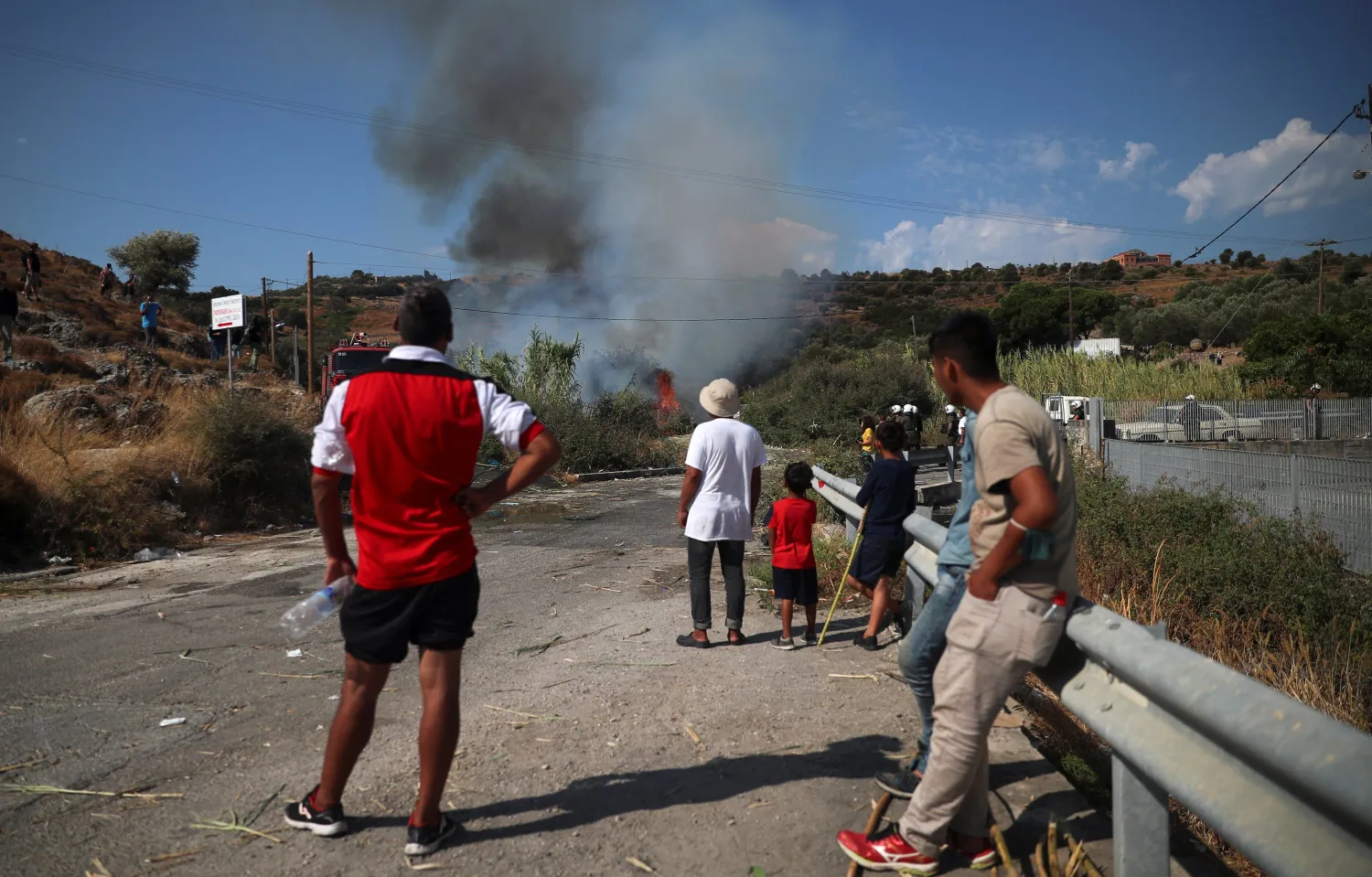
Refugees and migrants from the destroyed Moria camp look at a fire that was lifted up during a protest after the news about the creation of a new temporary camp, on the island of Lesbos, Greece September 12, 2020. REUTERS/Alkis Konstantinidis
TT

Greek Police Fire Tear Gas at Lesbos Migrants

Refugees and migrants from the destroyed Moria camp look at a fire that was lifted up during a protest after the news about the creation of a new temporary camp, on the island of Lesbos, Greece September 12, 2020. REUTERS/Alkis Konstantinidis

Greek police fired teargas to disperse a group of migrants protesting on the island of Lesbos on Saturday, four days after fires burnt the overflowing Moria refugee camp to the ground and left them homeless.

The tension broke out as hundreds of migrants chanting "Freedom" marched on a road that leads into the port of Mytilene, which police had blocked as a new temporary tent settlement was being set up nearby.

Some carried handwritten signs carrying messages including "We don't want to go to a hell like Moria again" and "Can you hear us Mrs Merkel?" in an appeal to the German chancellor.

The confrontation was shortlived.

More than 12,000 people, most from Africa and Afghanistan, have been sleeping rough since flames swept through the notoriously overcrowded Moria camp earlier this week. Some residents had COVID-19, raising fears the outbreak could spread.

The fire at the camp, which was holding four times the number of people it was supposed to, has returned the spotlight to the migration crisis facing the European Union, which has struggled to find a response that goes beyond temporary fixes.

Greek authorities have refused any mass transfer off the island, located a few miles off the Turkish coast, despite growing hostility from local residents angry after years of bearing the brunt of the crisis.

But officials said they were determined to provide shelter and proper sanitation and prevent a humanitarian catastrophe.



NATO Unveils Billions in Arms Deals to Prove Its Firepower to Trump

This handout photo taken and released by NATO on July 6, 2026 shows NATO Secretary General Mark Rutte addressing a pre-summit press conference ahead of the 36th NATO Heads of State and Government Summit in Ankara on July 6, 2026. (Handout / NATO / AFP)
TT

NATO Unveils Billions in Arms Deals to Prove Its Firepower to Trump

This handout photo taken and released by NATO on July 6, 2026 shows NATO Secretary General Mark Rutte addressing a pre-summit press conference ahead of the 36th NATO Heads of State and Government Summit in Ankara on July 6, 2026. (Handout / NATO / AFP)

NATO on Tuesday showcased a series of military projects worth billions of dollars in an attempt to convince President Donald Trump that US allies are converting fresh defense spending into real firepower.

“It’s money well spent,” an energized NATO Secretary-General Mark Rutte told government ministers and defense industry officials on the sidelines of a summit in Türkiye. He was speaking at a defense industry forum billed as NATO’s “big reveal,” to the thrum of techno music and a slick video display.

Trump, who is slated to arrive in Ankara later Tuesday, has branded NATO a “paper tiger” that would cease to function without American arms and leadership.

NATO as an organization does not own any weapons — these are the property of the 32 member countries — but it does have a fleet of 14 AWACS early warning radar surveillance planes that are about 50 years old, along with some newer surveillance drones.

A deal to replace the aging planes was announced Tuesday. Swedish manufacturer Saab will be supplying up to 10 new GlobalEye surveillance aircraft for a 10-nation consortium, Sweden's Prime Minister Ulf Kristersson announced.

“It’s a moment of great pride,” he said, noting that the twin-engine aircraft would be “made within the alliance for all the alliance.”

Some of the projects will be paid for with funds from a system of cheap loans for defense purposes set up by the European Union, comprising up to $170 billion raised on capital markets.

“We need to ensure that we are translating our economic might into military capabilities, putting the cash to work from defense plans to drones, from money to missiles and interceptors,” Rutte said.

Representatives from 15 nations shook hands and patted shoulders on a vast podium under the NATO logo as they announced a multinational effort to buy air-to-air refueling and transport planes from Airbus.

Then Rutte announced a four-country effort to purchase as many as five new Triton surveillance drones to add to NATO’s small fleet.

“It is genuinely made in NATO, and creating jobs on both sides of the Atlantic,” he said.

Rutte told reporters on the eve of the military alliance’s two-day summit in Türkiye that “we will announce tens of billions in new contracts that will provide the crucial kit we need to deter and defend.”

However, at Tuesday's event, no dollar figures were given and the display included some projects long since agreed.

The defense industry splash comes a few weeks after Rutte tried to ease US concerns about military spending at NATO with a new pitch using a chart labeled the “The Trump Trillion” — showing $1.2 trillion in spending by European allies and Canada since 2017.

Far from being impressed, Trump appeared unmoved, saying he was still disappointed at some NATO allies’ refusal to join the Iran war, which he had launched alongside Israel without consulting them.

“We don’t need their money — we don’t need anything,” Trump said. “I just want loyalty.”

Seeking a stronger Europe for a stronger NATO

The focus of the summit is a stronger Europe for a stronger NATO. The Trump administration has warned the allies that they must handle Europe’s security alone as the United States focuses on China and the Indo-Pacific region.

The Pentagon wants a reboot and is promoting what it calls “NATO 3.0,” a vision of the alliance in which Europe assumes greater responsibility for its own defense, freeing the US to concentrate on other priorities.

But hiking defense spending means increasing taxes or diverting resources from other priorities. UK Defense Secretary John Healey unexpectedly quit last month, saying the British government was not willing to spend at a time of rising threats.

Concern is mounting among some northern and central eastern countries that Russia might be preparing a hybrid attack — a combination of conventional warfare with tactics like cyberattacks — on the continent as Russian President Vladimir Putin struggles to secure victory in Ukraine.

Keir Starmer’s office said the British leader will be “focused on building a stronger and more European NATO” on what is likely to be his last foreign trip as prime minister.

Starmer, who announced his resignation June 22, has faced criticism from military leaders, opposition politicians and some in his center-left party for the slow rate of increase in UK military spending.

His government has committed to reach the NATO budget target of spending 3.5% of gross domestic product on defense by 2035 but does not have a concrete plan to get there. Its current spending plan will see that spending hit 2.7% of GDP by 2029.


Ebola Outbreak in Congo Still in ‘Expansion Phase’, WHO Says

Rubber gloves are laid out on the ground outside the Rwampara General Hospital as healthcare workers involved in the Ebola response stage a go-slow over unpaid salaries, while authorities seek to contain a new outbreak of the Bundibugyo strain of Ebola in Rwampara, Ituri province, Democratic Republic of Congo, July 6, 2026. (Reuters)
TT

Ebola Outbreak in Congo Still in ‘Expansion Phase’, WHO Says

Rubber gloves are laid out on the ground outside the Rwampara General Hospital as healthcare workers involved in the Ebola response stage a go-slow over unpaid salaries, while authorities seek to contain a new outbreak of the Bundibugyo strain of Ebola in Rwampara, Ituri province, Democratic Republic of Congo, July 6, 2026. (Reuters)

The Ebola outbreak in Congo has not yet stabilized and is still expanding, with transmission fueled by population movement, a World Health Official said on Tuesday.

The Democratic Republic of Congo has confirmed 1,561 cases, including 506 deaths, in the worst-ever outbreak ‌of the ‌rare Bundibugyo species of ‌Ebola ⁠for which there ⁠is no proven treatment or cure.

"It is still in the expansion phase unfortunately. We would like to say it is stabilizing but frankly we cannot ⁠say it yet," Dr Anne ‌Ancia, WHO ‌representative in the country, told reporters by ‌video link from Bunia, at ‌the epicenter of the epidemic.

She said that major challenges remained, such as the near-saturation of some Ebola ‌treatment centers with occupancy levels around 90%.

Another difficulty is ⁠that ⁠workers falling ill in the mining town of Mongbwalu are not seeking treatment locally, but instead travelling and spreading the disease to new regions, she said.

"Population movements, persistent insecurity and the fragility of the health system continue to complicate efforts to bring the outbreak under control," she said.


France's Le Pen Faces Pivotal Ruling in Race for President

Tuesday's verdict will be pivotal for French far-right chief Marine Le Pen's political career. Alain JOCARD / AFP/File
TT

France's Le Pen Faces Pivotal Ruling in Race for President

Tuesday's verdict will be pivotal for French far-right chief Marine Le Pen's political career. Alain JOCARD / AFP/File

France's far-right chief Marine Le Pen is bracing for a key verdict on Tuesday that will determine if she can run in next year's presidential elections, when her party has its best chance yet of winning power.

A lower court last year sentenced Le Pen, 57, to a five-year ban from public office and two years in prison over a fake jobs scam at the European Parliament.

If the appeals court upholds that ruling, it will be a devastating blow to the three-time presidential candidate's hopes to replace outgoing centrist President Emmanuel Macron.

The decision, expected to be read out from 1:30 pm (1130 GMT), could also find her guilty but include a shorter ban from public office and some form of house arrest.

If the sentence prevents her from campaigning, she has said she will hand over to her 30-year-old lieutenant, Jordan Bardella, the leader of their National Rally (RN) party.

"We will never be discouraged, we will always fight," she told crowds at a party event at the weekend.

Le Pen came third in the 2012 election, then twice made it to a runoff against Macron, in 2017 and 2022.

"I'm not scared," she said last week.

"If I can run, I will -- as long as I can campaign."

'Witch hunt'

The first trial found Le Pen -- along with 24 former European lawmakers, assistants and accountants, as well as the anti-immigration party itself -- guilty of operating a system from 2004 to 2016 to use European Parliament funds to employ RN staff in France.

The lower court also sentenced Le Pen to four years in jail, with two suspended.

Le Pen claimed her party was the victim of a "witch hunt", and some supporters sent the judges death threats.

The presidential candidate, the party and 10 others appealed.

During the appeal trial, she denied that the RN had a system to embezzle European Parliament funds, and has said her party acted in "complete good faith".

But prosecutors allege she "professionalized" a way to divert EU funds first introduced haphazardly by her late father, party co-founder Jean-Marie Le Pen, after she took over its leadership from him in 2011.

They have demanded the court maintain a five-year ban and sought a four-year term, with three years suspended.

'Very intelligent'

If Le Pen is banned from office for years, she will not be able to run for president in time for the first round on April 18 next year.

Similarly, if she is condemned to serve a one-year term on house arrest with an ankle tag, crippling her ability to campaign, she will likely decide to hand over to Bardella.

Opinion polls in recent months have largely suggested the far right will lead in the first round of next year's vote, but are divided on the outcome of the second round.

Many have shown slightly better results for Bardella than Le Pen, but their adversaries have inferred the veteran politician would be a fiercer opponent.

"This woman is very intelligent, she's not here by chance. And if she does also run for a fourth time, she won't be an opponent we can sneer at," hard-left candidate Jean-Luc Melenchon has said.

An opinion poll in late May suggested Le Pen could win the runoffs next year if she is allowed to compete.

The Harris Interactive Toluna survey of more than 1,700 registered voters projected her winning, against Melenchon as well as centrist former prime ministers Gabriel Attal and Edouard Philippe.

Other polls have however suggested Philippe -- who is also courting right-wing voters -- could emerge victorious in a runoff against the far right.