


Amazon Unveils Payment by Hand-waving

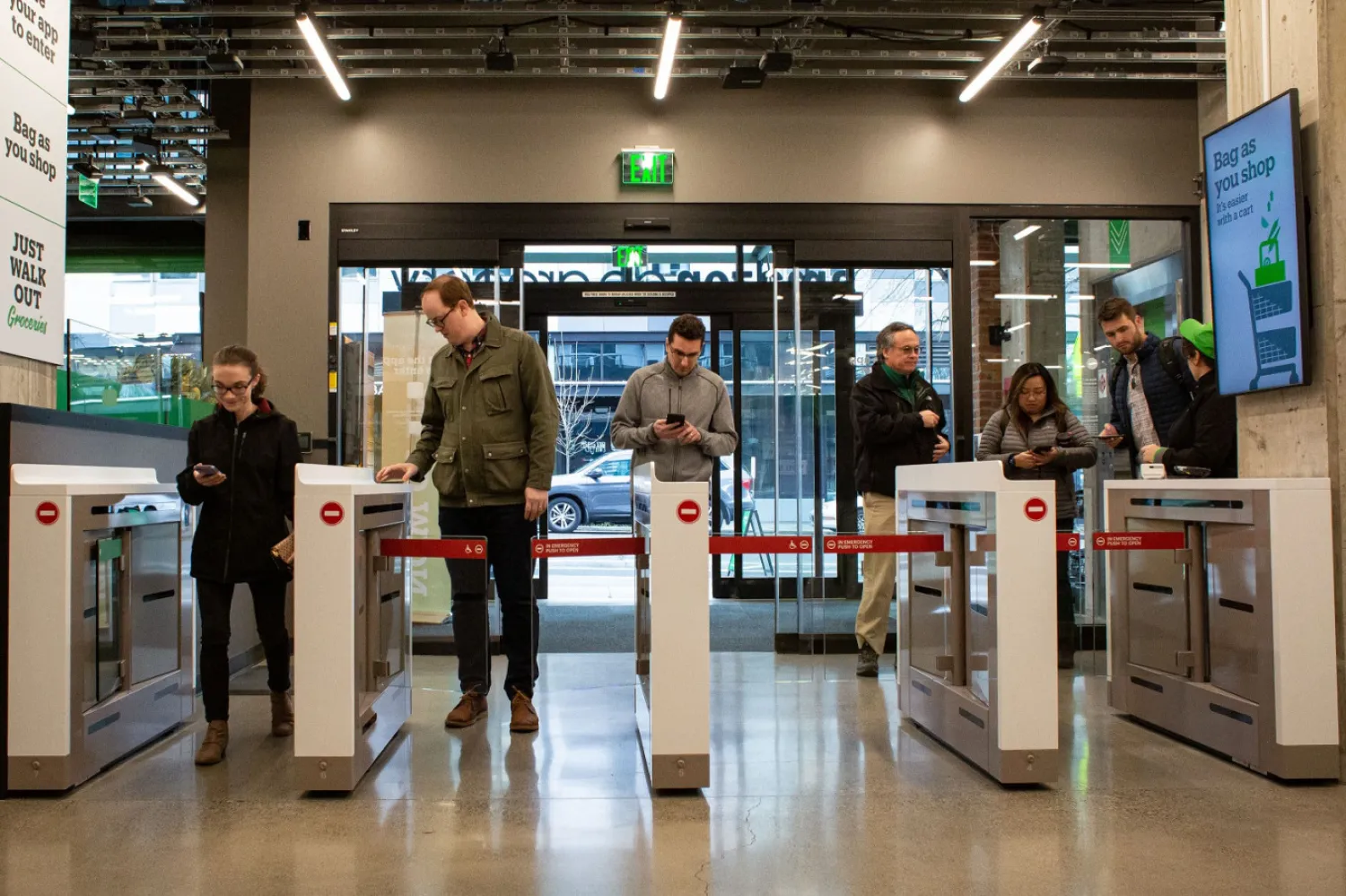
Shoppers scan their phones to enter Amazon Go Grocery on February 26, 2020 in Seattle, Washington. AFP/David Ryder
TT

Amazon Unveils Payment by Hand-waving

Shoppers scan their phones to enter Amazon Go Grocery on February 26, 2020 in Seattle, Washington. AFP/David Ryder

Amazon on Tuesday unveiled a new biometric payment system using palm recognition, to be made available to rival retailers and also promoted as a replacement for badge entry at stadiums or workplaces.

The system called Amazon One was touted as "a fast, convenient, contactless way for people to use their palm to make everyday activities like paying at a store, presenting a loyalty card, entering a location like a stadium, or badging into work more effortless."

The US technology giant said it would be installing the system at its Amazon Go retail locations, starting with two stores in its hometown of Seattle, Washington.

Amazon vice president Dilip Kumar said the system was developed as "a quick, reliable, and secure way for people to identify themselves or authorize a transaction while moving seamlessly through their day."

Amazon One uses each individual's "unique palm signature," an alternative to other biometric identifiers such as fingerprint, iris or facial recognition.

"No two palms are alike, so we analyze all these aspects with our vision technology and select the most distinct identifiers on your palm to create your palm signature," Kumar said in a blog post.

In Amazon Go stores, the palm-waving system will be added to the store's entry gate as an option for shoppers, AFP reported.

"In most retail environments, Amazon One could become an alternate payment or loyalty card option with a device at the checkout counter next to a traditional point of sale system," Kumar added.

The company said it was "in active discussions with several potential customers," which could include other retailers, but offered no details.

The announcement comes amid rapid growth in the use of biometric payments ranging from fingerprint verification on smartphones to more sophisticated systems using facial recognition.

China's Alipay -- the financial arm of ecommerce giant Alibaba -- has been using a "Smile-to-Pay" system, with a machine roughly the size of an iPad, for retailers.

The shift has also raised privacy concerns about how biometric data will be safeguarded and protected from hackers.

Amazon said the biometric data would be "protected by multiple security controls and palm images are never stored on the Amazon One device" but send to a "highly secure area we custom-built in the cloud."

Doug Stephens of the consulting firm Retail Prophet, said Amazon would need to protect the data to gain user trust in the system to make it mainstream.

"Biometrics as a form of ID/payment etc. has always made ultimate sense," Stephens said on Twitter. "The question is, will Amazon mainstream our comfort with them or violate our trust?"




AI to Track Icebergs Adrift at Sea in Boon for Science

© Jonathan NACKSTRAND / AFP
TT

AI to Track Icebergs Adrift at Sea in Boon for Science

© Jonathan NACKSTRAND / AFP

British scientists said Thursday that a world-first AI tool to catalogue and track icebergs as they break apart into smaller chunks could fill a "major blind spot" in predicting climate change.

Icebergs release enormous volumes of freshwater when they melt on the open water, affecting global climate patterns and altering ocean currents and ecosystems, reported AFP.

But scientists have long struggled to keep track of these floating behemoths once they break into thousands of smaller chunks, their fate and impact on the climate largely lost to the seas.

To fill in the gap, the British Antarctic Survey has developed an AI system that automatically identifies and names individual icebergs at birth and tracks their sometimes decades-long journey to a watery grave.

Using satellite images, the tool captures the distinct shape of icebergs as they break off -- or calve -- from glaciers and ice sheets on land.

As they disintegrate over time, the machine performs a giant puzzle problem, linking the smaller "child" fragments back to the "parent" and creating detailed family trees never before possible at this scale.

It represents a huge improvement on existing methods, where scientists pore over satellite images to visually identify and track only the largest icebergs one by one.

The AI system, which was tested using satellite observations over Greenland, provides "vital new information" for scientists and improves predictions about the future climate, said the British Antarctic Survey.

Knowing where these giant slabs of freshwater were melting into the ocean was especially crucial with ice loss expected to increase in a warming world, it added.

"What's exciting is that this finally gives us the observations we've been missing," Ben Evans, a machine learning expert at the British Antarctic Survey, said in a statement.

"We've gone from tracking a few famous icebergs to building full family trees. For the first time, we can see where each fragment came from, where it goes and why that matters for the climate."

This use of AI could also be adapted to aid safe passage for navigators through treacherous polar regions littered by icebergs.

Iceberg calving is a natural process. But scientists say the rate at which they were being lost from Antarctica is increasing, probably because of human-induced climate change.


AMD Predicts Weaker First-Quarter Sales, Shares Plunge on Nvidia Comparisons

An AMD logo and a computer motherboard appear in this illustration created on August 25, 2025. (Reuters)
TT

AMD Predicts Weaker First-Quarter Sales, Shares Plunge on Nvidia Comparisons

An AMD logo and a computer motherboard appear in this illustration created on August 25, 2025. (Reuters)

Advanced Micro Devices on Tuesday forecast a slight decline in quarterly revenue, raising concerns about whether it ​can effectively challenge Nvidia in the booming AI market and sending its shares tumbling 8% in after-hours trade.

The lackluster prediction comes despite an unexpected boost from sales of certain artificial intelligence chips to China, which began in the last quarter after the Trump administration approved a license for orders that AMD received in early 2025.

And without those sales to China which generated $390 million, AMD's data-center segment would have missed estimates for the fourth quarter.

AMD said it expects revenue of about $9.8 billion this quarter, plus or minus $300 million. That's down from $10.27 billion in the fourth-quarter which was up 34% year-on-year and ahead of LSEG ‌estimates for $9.67 billion.

PALES ‌NEXT TO NVIDIA

Though AMD is seen as one of the ‌few ⁠contenders ​that can seriously ‌challenge Nvidia, investors noted the stark contrast between the two companies' performances. AMD expects an adjusted gross margin of 55% this quarter. Nvidia has said it expects adjusted gross margin in the mid-70% range during its fiscal 2027.

"The expectations for large blowout quarters for AI-related hardware companies have skewed what the market is looking for," said Bob O'Donnell, president of TECHnalysis Research.

The forecast for the current first quarter includes $100 million from sales to China, where the situation remains "dynamic," AMD CEO Lisa Su said on a conference call with investors.

The US government ⁠has placed restrictions on the exports of advanced chips to China, but AMD received licenses to sell modified versions of its MI300 series ‌of AI chips there. Its MI308 chip competes with Nvidia's H20 ‍chip in China.

OPENAI SALES

AMD has accelerated its ‍product launches and is moving into selling full AI systems to better compete against Nvidia, which now ‍provides "rack-scale" systems that combine GPUs, CPUs and networking gear.

Last year, it entered into a multi-year deal to supply AI chips to ChatGPT-owner OpenAI, which would bring in tens of billions of dollars in annual revenue and give the startup the option to buy up to roughly 10% of the chipmaker.

Su reiterated on Tuesday that the company ​expects sales of a new flagship AI server to OpenAI and others to rise rapidly in the second half of this year, saying a global memory-chip crunch will not ⁠slow its plans.

"I do not believe that we will be supply-limited in terms of the ramp that we put in place," Su said.

BEYOND OPENAI

As Big Tech and governments across the globe double down on investing in AI hardware, shares in Santa Clara, California-based AMD have doubled since the start of 2025, outperforming a 60% bump in the broader chip index.

But analysts remain concerned that AMD's success remains tied to a handful of customers that rivals such as Nvidia could try to poach. Reuters reported this week that Nvidia made a $20 billion move to hire most of chip startup Groq's founders after OpenAI held chip supply discussions with the startup.

"Growth appears concentrated in large deployments and specific regions, and China shipments are significant enough to influence a quarter," said eMarketer analyst Gadjo Sevilla.

Revenue in AMD's key data-center segment grew 39% to $5.38 billion in the ‌fourth quarter. But excluding sales of the MI308, which is a data-center chip, that revenue would have been $4.99 billion, below estimates of $5.07 billion.


Switch 2 Sales Boost Nintendo Results but Chip Shortage Looms

This photo taken on November 4, 2025 shows a woman taking photos of a Super Mario figure at the Nintendo Tokyo store in Tokyo. (AFP)
TT

Switch 2 Sales Boost Nintendo Results but Chip Shortage Looms

This photo taken on November 4, 2025 shows a woman taking photos of a Super Mario figure at the Nintendo Tokyo store in Tokyo. (AFP)

The runaway success of the Switch 2 console drove up Nintendo's net profit by more than 50 percent in the nine months to December, the Japanese video game giant said Tuesday.

But a global memory chip shortage, created by frenzied demand for artificial intelligence hardware, could push up manufacturing costs.

The Switch 2 became the world's fastest-selling games console after launching to a fan frenzy last summer.

It is the successor to the original Switch, which soared in popularity during the pandemic when games such as "Animal Crossing" struck a chord during long lockdowns.

Both are hybrid devices that can be connected to a TV or used on-the-go.

In April-December, net profit jumped 51.3 percent year-on-year to 358.9 billion yen ($2.3 billion), and revenue nearly doubled on-year to 1.9 trillion yen, Nintendo said.

But the firm kept its annual unit sales target for the Switch 2 steady at 19 million, and also held its full-year net profit forecast of 350 billion yen.

"Nintendo Switch 2 got off to a good start following its launch on June 5 and unit sales continued to grow through the holiday season," the company said.

Nearly 17.4 million Switch 2 devices were sold in the nine-month period, it added.

"Maintaining momentum is certainly a big focus for Nintendo," Krysta Yang of the Nintendo-focused Kit and Krysta Podcast told AFP.

A lack of heavy-hitting first-party new games for the Switch 2 in coming months risks hindering growth, although third-party titles such as "Resident Evil Requiem" should help fill the gap, she said.

Nintendo said Tuesday it planned to release "Mario Tennis Fever" this month and "Pokemon Pokopia" in March.

While the firm is diversifying into hit movies and theme parks, consoles remain the core of its business.

The Switch 1 has now sold 155.37 million units -- overtaking the Nintendo DS console to be its best-selling hardware of all time.

But soaring prices for memory chips, used in gaming consoles as well as phones, laptops and other electronics, will likely be a headwind for the company.

Their prices have been pushed up as chipmakers focus on producing the advanced memory chips in huge demand to power AI data centers.

"Nintendo and other console manufacturers are publicly keeping quiet about the impact of the shortage," gaming industry consultant Serkan Toto told AFP.

But "users can forget the past when consoles always became cheaper in tandem with component costs falling over time", with price hikes potentially on the way in 2026, he said.

Yang said she thought a price increase for the Switch 2 "is not out of the question" but added that Nintendo "would likely exhaust all other options" before doing so.