

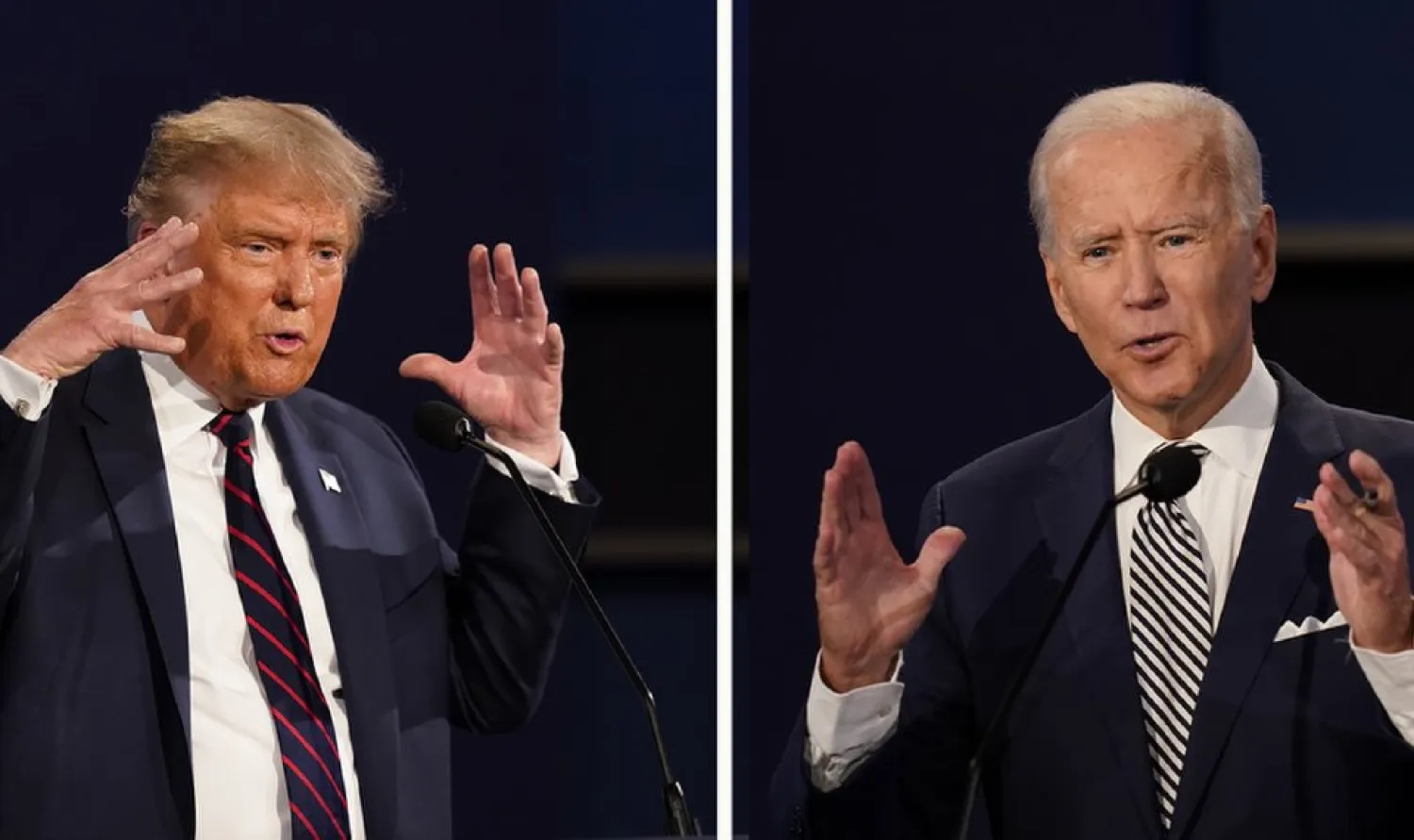

Foreign Observers Note 'Chaos,' 'Rancor' in US Debate

In this combination image of two photos showing both President Donald Trump, left, and former Vice President Joe Biden during the first presidential debate Tuesday, Sept. 29, 2020, at Case Western University and Cleveland Clinic, in Cleveland, Ohio. (AP Photo/Patrick Semansky)
TT

Foreign Observers Note 'Chaos,' 'Rancor' in US Debate

In this combination image of two photos showing both President Donald Trump, left, and former Vice President Joe Biden during the first presidential debate Tuesday, Sept. 29, 2020, at Case Western University and Cleveland Clinic, in Cleveland, Ohio. (AP Photo/Patrick Semansky)

"Chaos, interruptions, personal attacks, and insults," one outspoken Chinese newspaper editor said of the US presidential debate. An Australian counterpart said it was "swamped" by the "rancor engulfing America."

The first debate pitting Republican President Donald Trump against Democratic challenger Joe Biden was not a highlight of political oratory in the eyes of many overseas.

Yet interest ran high for its potential impact on what may be the most consequential US election in years, now just over a month away.

Observers looked for possible impact on financial markets and currencies, although the reaction was muted overall. Share prices slipped further in Japan and the dollar weakened against the Japanese yen and the euro, while US futures were lower, auguring a weak opening on Wall Street.

The debate itself went as expected, said Jeffrey Halley, a senior market analyst at Oanda.

"Markets have remained calm as no policy surprises have emerged from the debate so far," he said. "My initial thoughts are the debate will not move the needle on the Democrat lead in the national polls."

The greater worry is over how tight the race might be and whether a delay in election results might prove disruptive, said Stephen Innes of AxiCorp.

"A highly polarized and possibly legally contested US election is just around the corner," Innes said. "With mail-in votes likely to be too high (and potentially questioned), there is a chance that we still will not know the result by Inauguration Day with constitutional chaos ensuing."

Hu Xijin, editor of China's nationalistic Communist Party tabloid Global Times, offered his opinion on the newspaper's official microblog, writing that the "chaos, interruptions, personal attacks, and insults" on display were a reflection of America´s "overarching division, anxiety and the accelerating erosion of the system´s original advantages."

"I used to admire this kind of televised debate in American politics, but I have much more mixed feelings when watch it again now," wrote Hu, who personally and through his paper routinely attacks American policies.

"Indeed, the overall image of the United States is growing more and more complicated in my eyes," Hu wrote.

The editor-at-large of the newspaper The Australian, Paul Kelly, described the debate as a "spiteful, chaotic, abusive, often out-of-control brawling encounter with both candidates revealing their contempt for each other."

"The rancor engulfing America swamped the first Trump-Biden debate," Kelly wrote.

While Trump surely energized his base, he "never landed a political knock-out blow," and Biden occasionally faltered but "showed he could fight," he wrote, adding, "America faces a dangerous several weeks."

A columnist for the newspaper, Peter Hoysted, called the debate a "shout-athon" and a "verbal shambles" that reflected American political life and the "yawning gap between the left and right."

Tim Wilson, a lawmaker in Australia´s conservative government, was frustrated by the debate´s lack of policy focus.

"For most part, it was a slanging match between President Trump and Vice President Biden. I´ve got to say, I thought it was pretty unedifying in terms of a discussion, not just about the future of America, but ultimately because of the might of the United States, about the rest of the world as well," Wilson told Australian Broadcasting Corp.

Amanda Wishworth, a lawmaker in Australia´s center-left Labor Party, said, "A lot of people would be scratching their heads, especially here from Australia, where, believe it or not, our politics is a little bit more gentle than the US of A."

Foreign policy issues were largely absent from the debate, although Trump slung accusations that China had paid Biden's son Hunter for consulting work and Biden attacked Trump's trade deals with China for failing to deliver benefits.

Trump also repeatedly blamed China for the coronavirus pandemic that has killed more than 1 million people globally and laid waste to economies in the US and other nations. Trump also said he reduced the threat to the US by banning travel from China, although in fact he only restricted it.

In the Mideast, the largely domestic debate drew raised eyebrows when Biden at one point said "inshallah" as Trump hedged on saying when he would release his tax returns. "Inshallah" in Arabic means "God willing." It also can be used in a way to suggest something won´t ever happen. Al-Arabiya, a Saudi-owned satellite channel based in Dubai, and The National, a state-linked newspaper in Abu Dhabi, both published articles noting Biden´s use of the word.

A Emirati political scientist, Abdulkhaleq Abdulla, wrote on Twitter that he saw the debate as a "tumultuous verbal battle."

"How did America reach this level of political decline?" he wrote.


Top Trump Iran Negotiator Says Visits US Aircraft Carrier in Middle East

US Special Envoy Steve Witkoff delivers a press conference upon the signing of the declaration on deploying post-ceasefire force in Ukraine, during the so-called "Coalition of the Willing" summit, at the Elysee Palace in Paris, France, January 6, 2026. (Reuters)
TT

Top Trump Iran Negotiator Says Visits US Aircraft Carrier in Middle East

US Special Envoy Steve Witkoff delivers a press conference upon the signing of the declaration on deploying post-ceasefire force in Ukraine, during the so-called "Coalition of the Willing" summit, at the Elysee Palace in Paris, France, January 6, 2026. (Reuters)

US President Donald Trump's lead Iran negotiator Steve Witkoff on Saturday said he visited the USS Abraham Lincoln aircraft carrier currently in the Arabian Sea, with Washington and Tehran due to hold further talks soon.

"Today, Adm. Brad Cooper, Commander of US Naval Forces Central Command, Jared Kushner, and I met with the brave sailors and Marines aboard the USS Abraham Lincoln, her strike group, and Carrier Air Wing 9 who are keeping us safe and upholding President Trump's message of peace through strength," said Witkoff in a social media post.

Iranian Foreign Minister Abbas Araghchi said on Saturday he hoped talks with the United States would resume soon, while reiterating Tehran's red lines and warning against any American attack.


Israel’s Netanyahu Expected to Meet Trump in US on Wednesday and Discuss Iran

Israeli Prime Minister Benjamin Netanyahu delivers a speech during a special session to mark the 77th anniversary of the Knesset's establishment and the 60th anniversary of the dedication of the current building at the Knesset, the Israeli parliament, in Jerusalem, 02 February 2026. (EPA)
TT

Israel’s Netanyahu Expected to Meet Trump in US on Wednesday and Discuss Iran

Israeli Prime Minister Benjamin Netanyahu delivers a speech during a special session to mark the 77th anniversary of the Knesset's establishment and the 60th anniversary of the dedication of the current building at the Knesset, the Israeli parliament, in Jerusalem, 02 February 2026. (EPA)

Israeli Prime Minister Benjamin Netanyahu is expected to meet US President Donald Trump on Wednesday in Washington, where they will discuss negotiations with Iran, Netanyahu's office said on Saturday.

Iranian and US officials held indirect nuclear ‌talks in the ‌Omani capital ‌Muscat ⁠on Friday. ‌Both sides said more talks were expected to be held again soon.

A regional diplomat briefed by Tehran on the talks told Reuters Iran insisted ⁠on its "right to enrich uranium" ‌during the negotiations with ‍the US, ‍and that Tehran's missile capabilities ‍were not raised in the discussions.

Iranian officials have ruled out putting Iran's missiles - one of the largest such arsenals in the region - up ⁠for discussion, and have said Tehran wants recognition of its right to enrich uranium.

"The Prime Minister believes that any negotiations must include limiting ballistic missiles and halting support for the Iranian axis," Netanyahu's office said in a ‌statement.


Italy FM Rules Out Joining Trump’s ‘Board of Peace’

Italy's Minister for Foreign Affairs Antonio Tajani speaks to the press during the EPP Leaders’ meeting, in Zagreb, Croatia, 30 January 2026. (EPA)
TT

Italy FM Rules Out Joining Trump’s ‘Board of Peace’

Italy's Minister for Foreign Affairs Antonio Tajani speaks to the press during the EPP Leaders’ meeting, in Zagreb, Croatia, 30 January 2026. (EPA)

Italy will not take part in US President Donald Trump's "Board of Peace", Italian Foreign Minister Antonio Tajani said Saturday, citing "insurmountable" constitutional issues.

Trump launched his "Board of Peace" at the World Economic Forum in Davos in January and some 19 countries have signed its founding charter.

But Italy's constitution bars the country from joining an organization led by a single foreign leader.

Prime Minister Giorgia Meloni, a Trump ally, last month noted "constitutional problems" with joining, but suggested Trump could perhaps reopen the framework "to meet the needs not only of Italy, but also of other European countries".

Tajani appeared Saturday to rule that out.

"We cannot participate in the Board of Peace because there is a constitutional limit," he told the ANSA news agency.

"This is insurmountable from a legal standpoint," he said, the day after meeting US Secretary of State Marco Rubio and US Vice President JD Vance at the Olympics in Milan.

Although originally meant to oversee Gaza's rebuilding, the board's charter does not limit its role to the Palestinian territory and appears to want to rival the United Nations.
