

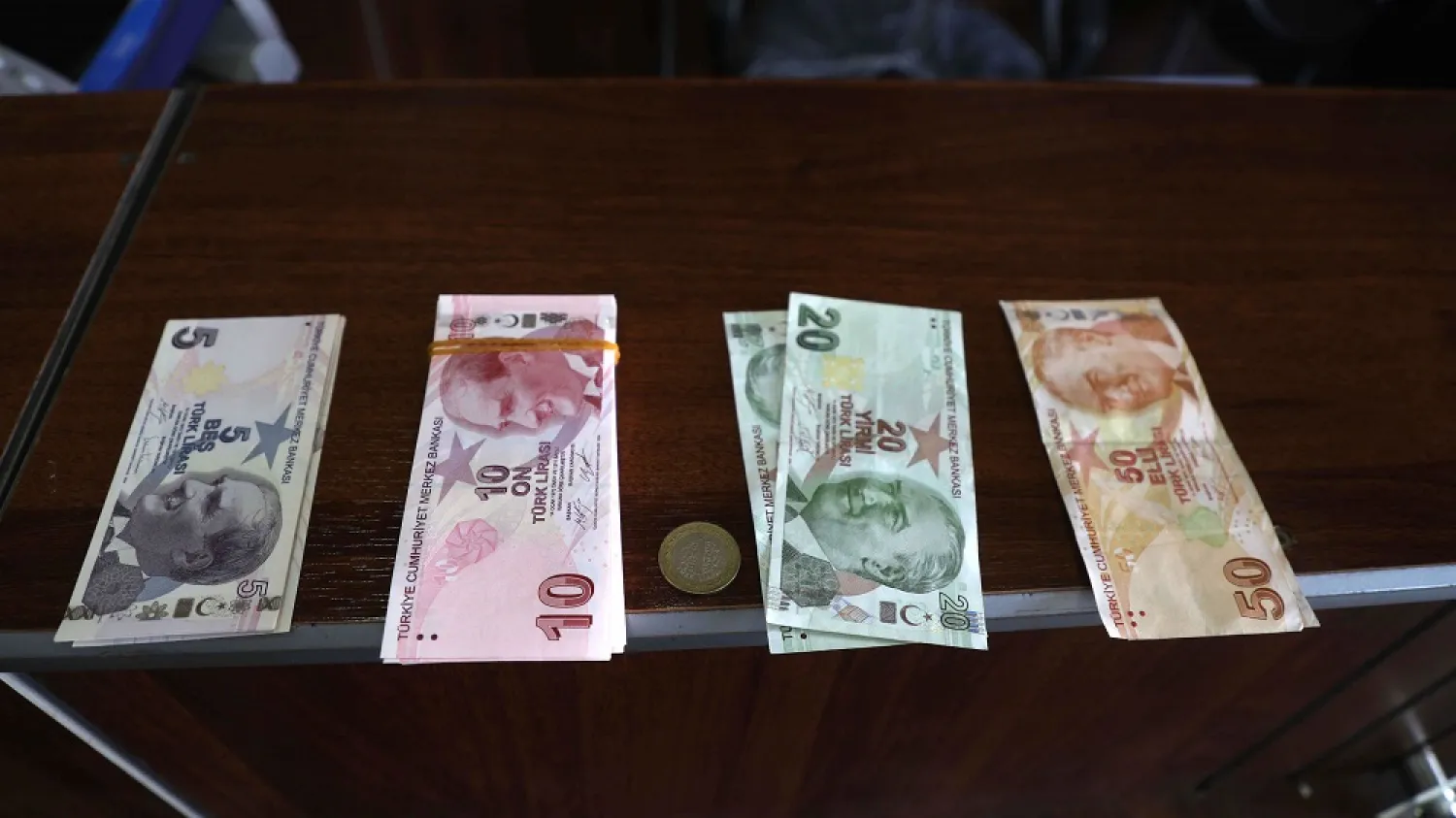

Turkish Lira Hits Record Low on Geopolitical Concerns

Turkey’s lira touched a record low against the dollar. (Getty Images)
TT

Turkish Lira Hits Record Low on Geopolitical Concerns

Turkey’s lira touched a record low against the dollar. (Getty Images)

Turkey’s lira touched a record low against the dollar on Wednesday, hit by investor unease over possible US sanctions, fraught ties with the European Union and the ongoing Caucasus conflict.

The currency has lost 24% of its value this year on worries over the central bank’s depleted forex reserves, costly interventions in the currency market, and geopolitical issues.

The lira hit a record low of 7.8850 against the US currency, weakening from a close of 7.8050 on Wednesday. By 1232 GMT it stood at 7.8800.

Concerns over possible US sanctions resurfaced after Bloomberg reported on Tuesday that Ankara would begin testing the Russian S-400 missile defense system.

Tensions with the EU, meanwhile, appeared to rise after President Recep Tayyip Erdogan said on Tuesday decisions at an EU summit last week over disputes including maritime claims in the eastern Mediterranean had been insufficient to resolve disagreements.

Erdogan and a Turkish Cypriot leader also announced the partial reopening of a Cypriot resort abandoned since the 1974 invasion by Turkey. This drew condemnation from Greece and the Greek Cypriot government.

“The EU-related concerns over geopolitical tensions decreased in recent days due to a move towards dialogue. But as of this week, an increase in tensions in both Azerbaijan and the EU can be observed,” a banker said.

Fighting between Azerbaijan and Armenian forces in Nagorno-Karabakh is at its most intense in 25 years. Ankara’s backing for Baku has set Turkey apart from other big nations, alarming NATO allies who seek a ceasefire.

Investors were also assessing the Treasury’s first eurobond issue since February. Despite the tensions and financial market turbulence, Turkey sold a $2.5 billion 5-year eurobond on Tuesday that gave buyers 6.4% interest.

Demand was three times the amount it borrowed, the Treasury said. Turkey has borrowed $6.5 billion from international markets this year, it said, out of a planned $9 billion.

Turkey's dollar-denominated bonds weakened, with the April and February issues both losing more than 1 cent on the dollar, their biggest daily fall in two weeks, Tradeweb data showed.

Five-year Turkey credit default swaps rose to 511 basis points, up 9 basis points from Tuesday's close, according to IHS Markit.



IMF Says it's Updating Assessment of US Economy to Reflect Impact of Iran War

An American Flag on the US Capitol Building is seen in Washington, US, August 31, 2023. REUTERS/Kevin Wurm/File Photo
TT

IMF Says it's Updating Assessment of US Economy to Reflect Impact of Iran War

An American Flag on the US Capitol Building is seen in Washington, US, August 31, 2023. REUTERS/Kevin Wurm/File Photo

The International Monetary Fund on Thursday said it is updating a recently completed review of the US economy to reflect the impact of the Iran war, Reuters reported.

IMF spokeswoman Julie Kozack said the updated assessment would be considered by the IMF's board in coming weeks and then published.


Czech Central Bank Keeping Options open as Iran War Clouds Rate Prospects

People leave the Czech National Bank building in central Prague December 9, 2011. REUTERS/Petr Josek/File Photo
TT

Czech Central Bank Keeping Options open as Iran War Clouds Rate Prospects

People leave the Czech National Bank building in central Prague December 9, 2011. REUTERS/Petr Josek/File Photo

The Czech National Bank (CNB) held interest rates steady as expected on Thursday and said it was keeping options open as it monitors the economic fallout from the conflict in the Middle East.

Since the United States and Israel launched strikes on Iran on February 28, oil prices have jumped above $100 a barrel, raising global risks of higher inflation and an economic hit.

Czech central bank policymakers voted unanimously to keep the main rate steady at 3.50% on Thursday, in line with forecasts from all 17 analysts in a Reuters poll last week.

The poll's median forecast saw interest rates remaining on hold for the rest of the year, although money markets have priced in chances of a hike. Governor Ales Michl said after the decision that the conditions for fighting inflation are now better than during the previous energy and inflation shock following Russia's invasion of Ukraine in 2022, as policy is now tighter and rates are higher than inflation.

He added that inflation expectations remain anchored, and it was important to keep them low.

"We are acting restrictively in the economy," he said. "On the other hand, we are monitoring the situation, we are keeping all options open."

The Czech crown was a touch weaker after the bank's decision but largely steady on the day, at 24.49 to the euro, and around its lowest levels since September after this month's declines.

INFLATION STILL SEEN STAYING LOW

The central bank had discussed a possible rate cut at its last meeting in February, before the Iran war. It last cut rates in May 2025 as part of a 350-basis-point easing cycle.

Inflation in the Czech Republic has fallen below the bank's 2% target, hitting a headline rate of 1.4% year-on-year in February with help from a government measure to ease energy bills. That provides a cushion to potential shock from higher oil prices, and Michl said inflation should stay below 2% this year, according to updated forecasts partly incorporating higher oil prices, even though core inflation should remain elevated in the quarters ahead.

The central bank will be looking at the secondary impacts of a higher oil price to see if it soaks through to other segments.


King Khalid International Airport Wins World’s Most Improved Airport at Skytrax Awards 2026

The recognition was announced during the Skytrax World Airport Awards ceremony, London - SPA
TT

King Khalid International Airport Wins World’s Most Improved Airport at Skytrax Awards 2026

The recognition was announced during the Skytrax World Airport Awards ceremony, London - SPA

King Khalid International Airport, managed and operated by Riyadh Airports Company, has achieved global recognition after being named “World’s Most Improved Airport” among more than 560 airports worldwide in 2026. It also received the award for Best Airport in the 30–40 million passengers category, ranked 14th on the list of the world’s best airports, and placed second for Best Airport Staff in the Middle East.

The recognition was announced during the Skytrax World Airport Awards ceremony, held in London on March 18, as part of the Passenger Terminal Expo “PTE World 2026,” with the participation of leading aviation industry figures and experts from around the world, SPA reported.

The achievement reflects the significant progress the airport has made across various areas, driven by a series of development initiatives that have enhanced the passenger experience and elevated service quality in line with the highest international standards, resulting in a qualitative leap in operational efficiency and performance.

This milestone underscores the Kingdom’s accelerating transformation across multiple sectors, including aviation, which continues to grow in line with the objectives of Saudi Vision 2030, aimed at positioning the Kingdom as a global logistics hub and a key center for domestic and international travel.

CEO of Riyadh Airports Company Ayman AboAbah said the achievements reflect the company’s firm commitment to advancing operational services and airport infrastructure.

Meanwhile, Skytrax CEO Edward Plaisted said the recognition reflects the scale of development achieved at King Khalid International Airport, noting that travelers are experiencing clear improvements across all stages of their journey.

He added that the airport’s rise to 14th place in the list of the world’s top 100 airports underscores the strength and impact of these developments, the efficiency of the upgrade plans, and their success in enhancing passenger experience, reinforcing its position as a key regional travel hub, and embodying the scale of its exceptional transformation.