Scientists Develop New Technique to Improve Solar Panel Productivity

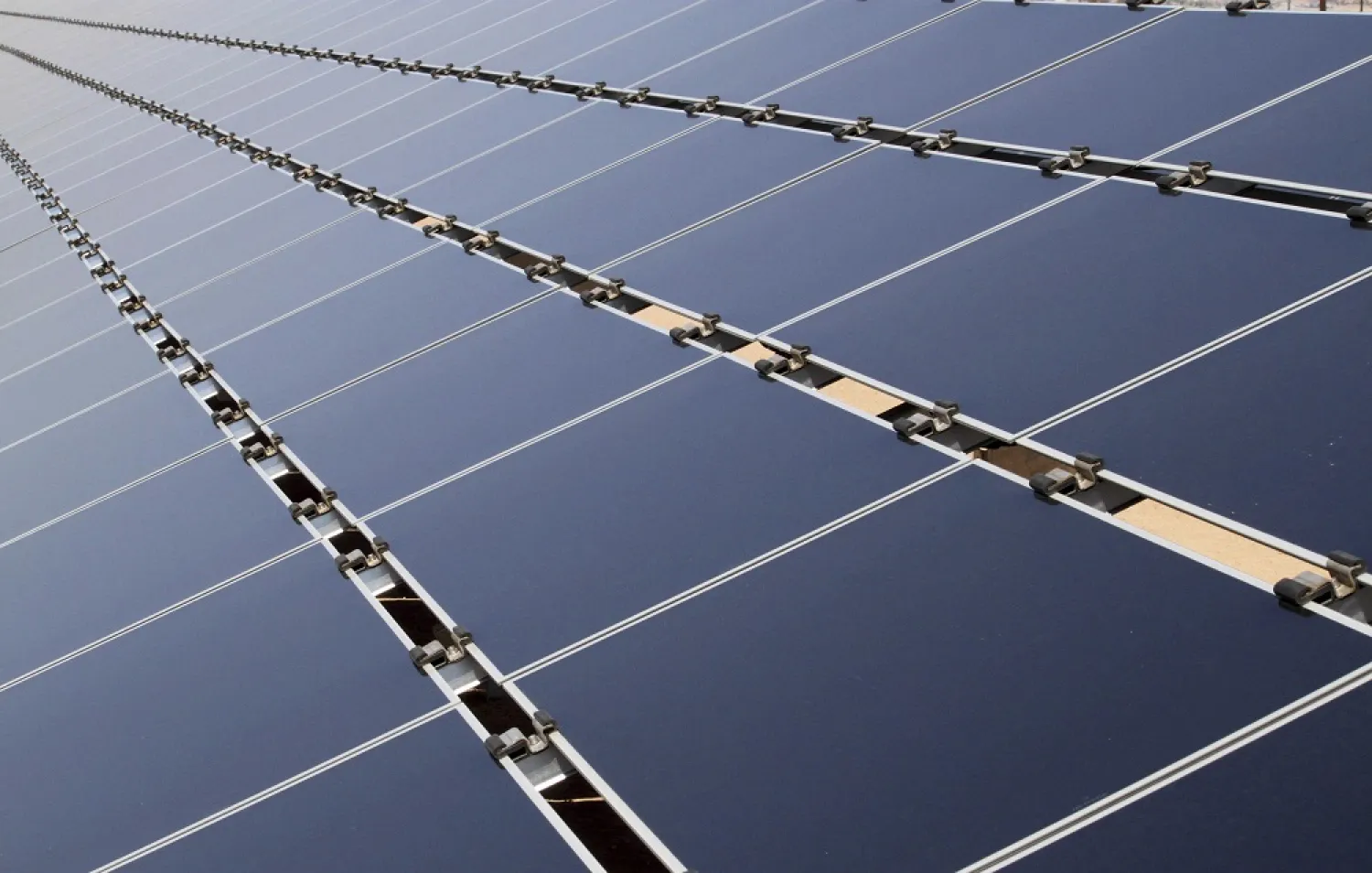
This April 20, 2011, photo shows some of the 30,000 solar panels that make up the Public Service Company of New Mexico's new 2-megawatt photovoltaic array in Albuquerque, New Mexico. (AP)
TT

Scientists Develop New Technique to Improve Solar Panel Productivity

This April 20, 2011, photo shows some of the 30,000 solar panels that make up the Public Service Company of New Mexico's new 2-megawatt photovoltaic array in Albuquerque, New Mexico. (AP)

A research team at the University of Illinois in the United States has devised a new technique to improve the productivity of solar panels.

The Physical Science journal reported that the team developed new multilayered solar panels with the potential to be 1.5 times more efficient than traditional silicon panels.

The Science Daily website cited engineer Minjoo Larry Lee, professor of electrical and computer engineering, as saying: "Silicon solar panels can convert a little over 20% of the sun's light into usable electricity. But silicon solar cells are reaching the limit of their abilities, so finding a way to increase efficiency is attractive to energy providers and consumers."

Lee's team has been working to layer the semiconductor material gallium arsenide phosphide onto silicon because the two materials complement each other. Both materials absorb visible light strongly, but gallium arsenide phosphide does so while generating less waste heat.

While gallium arsenide phosphide and other semiconductor materials like it are efficient and stable, they are expensive, so making panels composed entirely from them is not reasonable for mass production at this time, Lee said. The team therefore resorted to low-cost silicon as a starting point for its research.

Eventually, a utility company could use this technology to get 1.5 times more energy, or a consumer could use less space for rooftop panels, he explained.

Lee said obstacles remain on the path to commercialization, but he is hopeful that energy providers and consumers will see the value in using stable materials to achieve a performance boost.


Switch 2 Sales Boost Nintendo Results but Chip Shortage Looms

This photo taken on November 4, 2025 shows a woman taking photos of a Super Mario figure at the Nintendo Tokyo store in Tokyo. (AFP)
TT

Switch 2 Sales Boost Nintendo Results but Chip Shortage Looms

This photo taken on November 4, 2025 shows a woman taking photos of a Super Mario figure at the Nintendo Tokyo store in Tokyo. (AFP)

The runaway success of the Switch 2 console drove up Nintendo's net profit by more than 50 percent in the nine months to December, the Japanese video game giant said Tuesday.

But a global memory chip shortage, created by frenzied demand for artificial intelligence hardware, could push up manufacturing costs.

The Switch 2 became the world's fastest-selling games console after launching to a fan frenzy last summer.

It is the successor to the original Switch, which soared in popularity during the pandemic when games such as "Animal Crossing" struck a chord during long lockdowns.

Both are hybrid devices that can be connected to a TV or used on-the-go.

In April-December, net profit jumped 51.3 percent year-on-year to 358.9 billion yen ($2.3 billion), and revenue nearly doubled on-year to 1.9 trillion yen, Nintendo said.

But the firm kept its annual unit sales target for the Switch 2 steady at 19 million, and also held its full-year net profit forecast of 350 billion yen.

"Nintendo Switch 2 got off to a good start following its launch on June 5 and unit sales continued to grow through the holiday season," the company said.

Nearly 17.4 million Switch 2 devices were sold in the nine-month period, it added.

"Maintaining momentum is certainly a big focus for Nintendo," Krysta Yang of the Nintendo-focused Kit and Krysta Podcast told AFP.

A lack of heavy-hitting first-party new games for the Switch 2 in coming months risks hindering growth, although third-party titles such as "Resident Evil Requiem" should help fill the gap, she said.

Nintendo said Tuesday it planned to release "Mario Tennis Fever" this month and "Pokemon Pokopia" in March.

While the firm is diversifying into hit movies and theme parks, consoles remain the core of its business.

The Switch 1 has now sold 155.37 million units -- overtaking the Nintendo DS console to be its best-selling hardware of all time.

But soaring prices for memory chips, used in gaming consoles as well as phones, laptops and other electronics, will likely be a headwind for the company.

Their prices have been pushed up as chipmakers focus on producing the advanced memory chips in huge demand to power AI data centers.

"Nintendo and other console manufacturers are publicly keeping quiet about the impact of the shortage," gaming industry consultant Serkan Toto told AFP.

But "users can forget the past when consoles always became cheaper in tandem with component costs falling over time", with price hikes potentially on the way in 2026, he said.

Yang said she thought a price increase for the Switch 2 "is not out of the question" but added that Nintendo "would likely exhaust all other options" before doing so.


Snapchat Blocks 415,000 Underage Accounts in Australia

Snapchat says teens may be skirting a social media ban in Australia (Kirill KUDRYAVTSEV)
TT

Snapchat Blocks 415,000 Underage Accounts in Australia

Snapchat says teens may be skirting a social media ban in Australia (Kirill KUDRYAVTSEV)

Snapchat has blocked 415,000 accounts under Australia's social media ban for under-16s, the company said Monday, but warned some youngsters may be bypassing age verification technology.

The platform urged the Australian authorities to oblige app stores to check users' ages as an "additional safeguard" for the world-first crackdown, AFP said.

Platforms including Snapchat, Meta, TikTok and YouTube must stop underage users from holding accounts under the legislation, which came into effect on December 10.

Companies face fines of Aus$49.5 million (US$34 million) if they fail to take "reasonable steps" to comply.

Australia's eSafety online regulator reported last month that tech giants had already blocked 4.7 million accounts, delivering "significant outcomes".

As of the end of January, Snapchat said it had blocked or disabled 415,000 Snapchat accounts in Australia belonging to under-16s.

"We continue to lock more accounts daily," it said in an online statement.

But the law leaves "significant gaps", Snapchat said, arguing that age estimation technology was only accurate to within two to three years.

"In practice, this means some young people under 16 may be able to bypass protections, potentially leaving them with reduced safeguards, while others over 16 may incorrectly lose access."

Snapchat joined billionaire Mark Zuckerberg's Meta in calling on Australia to require app stores to check users' ages before allowing downloads.

"Creating a centralized verification system at the app-store level would allow for more consistent protection and higher barriers to circumventing the law," Snapchat said.

The platform said it did not believe an outright ban was the right approach.

Snapchat said it understood Australia's objectives and wanted to protect people online, but did not agree its platform should be covered by the social media ban.

"In the case of Snapchat -- which is primarily a messaging app used by young people to stay connected with close friends and family -- we do not believe that cutting teens off from these relationships makes them safer, happier, or otherwise better off," it said.


Nvidia Boss Insists 'Huge' Investment in OpenAI on Track

Nvidia CEO Jensen Huang insists the US tech giant is going to make 'a huge investment in OpenAI'. Patrick T. Fallon / AFP/File
TT

Nvidia Boss Insists 'Huge' Investment in OpenAI on Track

Nvidia CEO Jensen Huang insists the US tech giant is going to make 'a huge investment in OpenAI'. Patrick T. Fallon / AFP/File

Nvidia chief executive Jensen Huang has insisted the US tech giant will make a "huge" investment in OpenAI and dismissed as "nonsense" reports that he is unhappy with the generative AI star.

Huang made the remarks late Saturday in Taipei after the Wall Street Journal reported that Nvidia's plan to invest up to $100 billion in OpenAI had been put on ice, said AFP.

Nvidia announced the plan in September to invest $100 billion in OpenAI, building infrastructure for next-generation artificial intelligence.

The Wall Street Journal, citing unnamed sources, said some people inside Nvidia had expressed doubts about the deal and that the two sides were rethinking the partnership.

"That's complete nonsense. We are going to make a huge investment in OpenAI," Huang told journalists, when asked about reports that he was unhappy with OpenAI.

Huang insisted that Nvidia was going ahead with its investment in OpenAI, describing it as "one of the most consequential companies of our time".

"Sam is closing the round, and we will absolutely be involved in the round," Huang said, referring to OpenAI chief executive Sam Altman.

"We will invest a great deal of money, probably the largest investment we've ever made."

Nvidia has come to dominate spending on the processors needed for training and operating the large language models (LLM) behind chatbots like OpenAI's ChatGPT or Google Gemini.

Sales of its graphics processing units (GPUs) -- originally developed for 3D gaming -- powered the company's market cap to over $5 trillion in October, although the figure has since fallen back by more than $600 billion.

LLM developers like OpenAI are directing much of the mammoth investment they have received into Nvidia's products, rushing to build GPU-stuffed data centers to serve an anticipated flood of demand for AI services.