

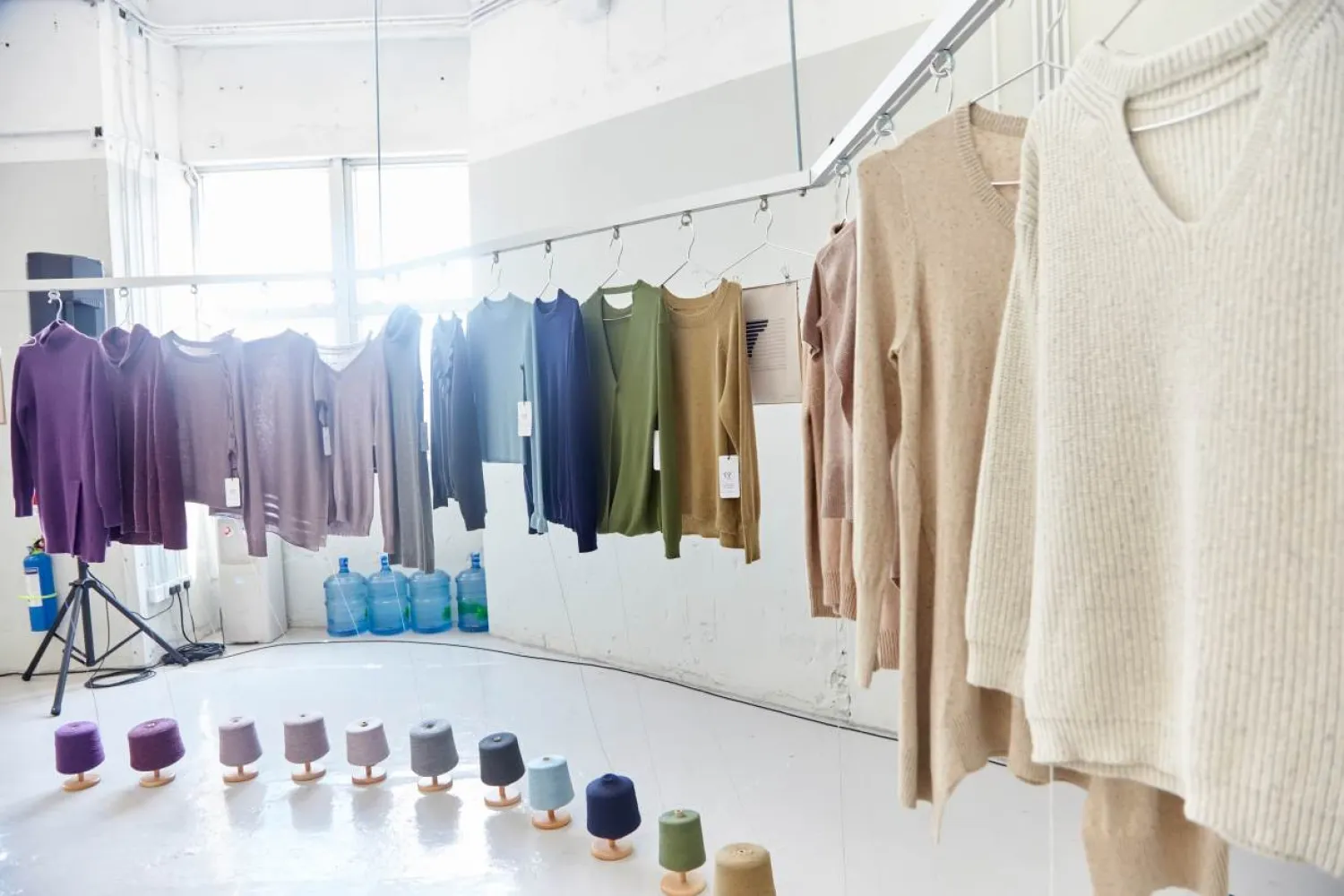

Fashion's Next Generation Goes Green

A view of a display of clothing made from yarn from recycled textiles at the Novetex Upcycling Factory in Hong Kong's Tai Po Industrial Estate, September 2018. Credit: Michael Law/Hong Kong Research Institute of Textiles and Apparel (HKRITA)
TT

Fashion's Next Generation Goes Green

A view of a display of clothing made from yarn from recycled textiles at the Novetex Upcycling Factory in Hong Kong's Tai Po Industrial Estate, September 2018. Credit: Michael Law/Hong Kong Research Institute of Textiles and Apparel (HKRITA)

From using custom-made, biodegradable fabrics and ‘living’ clothes that photosynthesize to polyester created from planet-warming carbon dioxide, European start-ups are on a quest to transform one of the world’s most polluting industries: fashion.

The business is responsible for 10% of global carbon emissions, more than all international flights and maritime shipping combined during the pre-pandemic period, said the United Nations Environment Program (UNEP).

A sizable chunk of fashion’s emissions - up to 40% - come from the manufacture of polyester, the most-used fabric, said Benoit Illy, co-founder and CEO of French start-up Fairbrics.

“If we can bring emissions from polyester to zero or negative value, we can significantly reduce industry emissions,” he said in a telephone interview, Reuters reported.

Illy and co-founder Tawfiq Nasr Allah, both chemists, aim to replace existing polyester-producing processes, which use fossil fuels, with their new technology.

It uses electricity and a catalyst to turn carbon dioxide - emitted when fossil fuels are burned and a major driver of climate change - into synthetic fibers, Illy said.

In some respects, the process is similar to trees capturing carbon dioxide from the atmosphere and using sunlight and natural enzymes to produce fiber, he said.

By the beginning of next year, Fairbrics - its name refers to a “fairer” way of producing fabrics - expects to be able to produce a kilogram of polyester yarn a day, he said.

The firm’s aim is take the effort to industrial scale in early 2024, he said.

The room for scale-up is clear: The fashion industry currently consumes more than 60 million tonnes of polyester a year, Illy said.

Under pressure from increasingly environmentally-aware shoppers, brands from luxury fashion houses to high street names also are taking steps to reduce waste.

This month, H&M, the world’s second-biggest fashion retailer, said it would showcase a recycling machine that could turn old jumpers into new sweaters or scarves on the spot at a store in Stockholm.

Every second, a garbage truck worth of textiles is landfilled or burnt, a costly waste of resources, according to a foundation set up by retired British sailing star Ellen MacArthur.

If Aniela Hoitink, founder of Dutch company MycoTEX, has her way, however, people’s wardrobes would adopt a more biological lifecycle, with garments grown and later decomposed in the way trees grow and drop leaves.

She is working with mycelium - the feeding threads of mushrooms - to produce custom-fitted, on-demand clothing that reduces waste and cuts chemical use. At the end of its life - a minimum of two years - the garments would be biodegradable.

The production cycle - growing mycelium, harvesting it, putting it into a 3D mould, drying it and then finishing the final product - currently takes about two to three weeks, said Hoitink, who has worked in fashion for more than a decade.

The 3D modelling also allows for seamless garments that are comfortable and perfectly fitted, Hoitink said.

“When you have a customized garment, it’s (a) luxury. But we believe that with this production system we can do that on a mass scale,” she said.

In particular, the material could make it easy to shape garments for different body types and markets, she added.

“Right now, everything is based on Western sizes. But African bodies are quite different. Asian bodies are quite different. If we can design with all those different body types in mind, it would be much nicer for everyone.”

According to Reuters, London-based Post Carbon Lab wants to take emissions-cutting even further, making sure fashion and design have a positive effect on the climate by turning fabrics into carbon-absorbing surfaces.

Designers and researchers Dian-Jen Lin and Hannes Hulstaert do this using photosynthetic coating technology which involves introducing microorganisms, such as algae, to the fabric.

The resulting textile, with live organisms, can then absorb climate-changing carbon dioxide, Lin said.

Having a ‘living’ garment does require a different set of care, Lin said, and users need to give it some access to moisture - such as an open window on a rainy day - as well as ventilation and light.

Fairbrics, MycoTEX and Post Carbon Lab are three of the 10 finalists in the 2020 European Social Innovation Competition, which is focused on fashion and run by the European Commission.

Other finalists, chosen from more than 760 applicants, include Germany’s Kleiderly, which recycles textile waste into new material, and Belgium-based Resortecs’ dissolvable stitching that allows for easy recycling and reuse.

The competition, now in its eighth year, is looking for practical solutions to key environmental and social issues and has focused in past years on issues such as cutting plastic waste and better integrating refugees, said Sonya Gospodinova, a European Union spokeswoman.

Three winners are expected to be announced on November 26, with each receiving 50,000 euros ($59,000) in prize money, the organizers said.

“What is the ecological role of fashion?” asked Post Carbon Lab’s Lin.

“If we don’t have the environment, where essentially we all live, there’s nothing. There’s no society, no happy communities to build on. And … the clock is ticking.”




Pieter Mulier Named Creative Director of Versace

(FILES) Pieter Mulier attends the 2025 CFDA Awards at The American Museum of Natural History on November 03, 2025 in New York City. (Photo by Dimitrios Kambouris / GETTY IMAGES NORTH AMERICA / AFP)
TT

Pieter Mulier Named Creative Director of Versace

(FILES) Pieter Mulier attends the 2025 CFDA Awards at The American Museum of Natural History on November 03, 2025 in New York City. (Photo by Dimitrios Kambouris / GETTY IMAGES NORTH AMERICA / AFP)

Belgian fashion designer Pieter Mulier has been named the new creative director of the Milan fashion house Versace starting July 1, according to an announcement on Thursday from the Prada Group, which owns Versace.

Mulier is currently creative director of the French fashion house Alaïa, and was previously the right-hand man of fellow Belgian designer and Prada co-creative director Raf Simons at Calvin Klein, Jil Sander and Dior.

In his new role, Mulier will report to Versace executive chairman Lorenzo Bertelli, the designated successor to manage the family-run Prada Group. Bertelli is the son of Miuccia Prada and Prada Group chairman Patrizio Bertelli.

“We believe that he can truly unlock Versace’s full potential and that he will be able to engage in a fruitful dialogue,’’ The Associated Press quoted Lorenzo Bertelli as saying of Mulier in a statement.

Mulier takes over from Dario Vitale, who departed in December after previewing just one collection during his short-lived Versace stint.

Mulier was honored last fall by supermodel and longtime Alaïa muse Naomi Campbell at the Council of Fashion Designers of America for his work paying tribute to brand founder Azzedine Alaïa. Mulier took the creative helm in 2021, after Alaïa’s death.


Ralph Lauren’s Margin Caution Eclipses Stronger‑than‑expected Quarterly Results

Guests wait after viewing the latest Ralph Lauren collection in New York City, US, April 17, 2025. REUTERS/Caitlin Ochs/File photo
TT

Ralph Lauren’s Margin Caution Eclipses Stronger‑than‑expected Quarterly Results

Guests wait after viewing the latest Ralph Lauren collection in New York City, US, April 17, 2025. REUTERS/Caitlin Ochs/File photo

Ralph Lauren posted third-quarter results above Wall Street estimates on Thursday, but the luxury retailer's warning of margin pressure tied to US tariffs sent its shares down nearly 6.4% in premarket trading.

The company expects fourth-quarter margins, its smallest revenue period, to shrink about 80 to 120 basis points due to higher tariff pressure and marketing spend.

Ralph Lauren, which sources its products from regions such as China, India and Vietnam, has relied on raising prices and reallocating production to regions with lower duty exposure to offset US tariff pressures, Reuters reported.

"Ralph Lauren has been able to raise prices for some time now. There is some limit on how long it can continue to do this. I think (the company's) gross margins are near peak levels," Morningstar analyst David Swartz said.

The company, which sells $148 striped linen shirts and $498 leather handbags, has tightened inventory, lifted full-price sales and refreshed core styles, boosting its appeal among wealthier and younger customers, including Gen Z.

Higher-income households are still splurging on luxury items, travel and restaurant meals, while lower- and middle-income consumers are strained by higher costs for rents and food as well as a softer job market.

The New York City-based company saw quarterly operating costs jump 12% year-on-year as it ramped up brand building efforts through sports-focused brand campaigns such as Wimbledon and the US Open tennis championship.

The luxury retailer said revenue in the quarter ended December 27 rose 12% to $2.41 billion, above analysts' estimates of a 7.9% rise to $2.31 billion, according to data compiled by LSEG.

It earned $6.22 per share, excluding items, compared to expectations of $5.81, aided by a 220 basis points increase in margins and an 18% rise in average unit retail across its direct-to-consumer channel.

Ralph Lauren now expects fiscal 2026 revenue to rise in the high single to low double digits on a constant currency basis, up from its prior forecast of a 5% to 7% growth.


Saudi Fashion Commission, Kering Launch 'Kering Generation Award X MENA'

This year's award builds on the strong success of the 2025 award, which attracted more than 500 applications, shortlisted 21 finalists, and recognized three winners. SPA
TT

Saudi Fashion Commission, Kering Launch 'Kering Generation Award X MENA'

This year's award builds on the strong success of the 2025 award, which attracted more than 500 applications, shortlisted 21 finalists, and recognized three winners. SPA

Saudi Arabia’s Fashion Commission and global luxury group Kering have launched the "Kering Generation Award X MENA" across the Middle East and North Africa (MENA) for 2026.

The announcement was made on Tuesday during the opening of the RLC Global Forum, hosted at the French Embassy in Riyadh.

This year's award builds on the strong success of the 2025 award, which attracted more than 500 applications, shortlisted 21 finalists, and recognized three winners.

Participants benefited from mentorship programs, workshops, and opportunities to strengthen their global presence. Building on this momentum, the 2026 program seeks to expand its impact across the MENA region.

The 2026 award focuses on four key areas of sustainable fashion: innovation in regenerative materials and clean production, circular design and sustainable business models, nature conservation and animal welfare, and consumer awareness and cultural engagement.

The program targets startups across the MENA region that operate in, or positively influence, the sustainable fashion sector, provided they demonstrate innovation capabilities and the ability to deliver measurable sustainability outcomes.