


PSG v Manchester United Seems a Portent of a Dystopian Super League Future

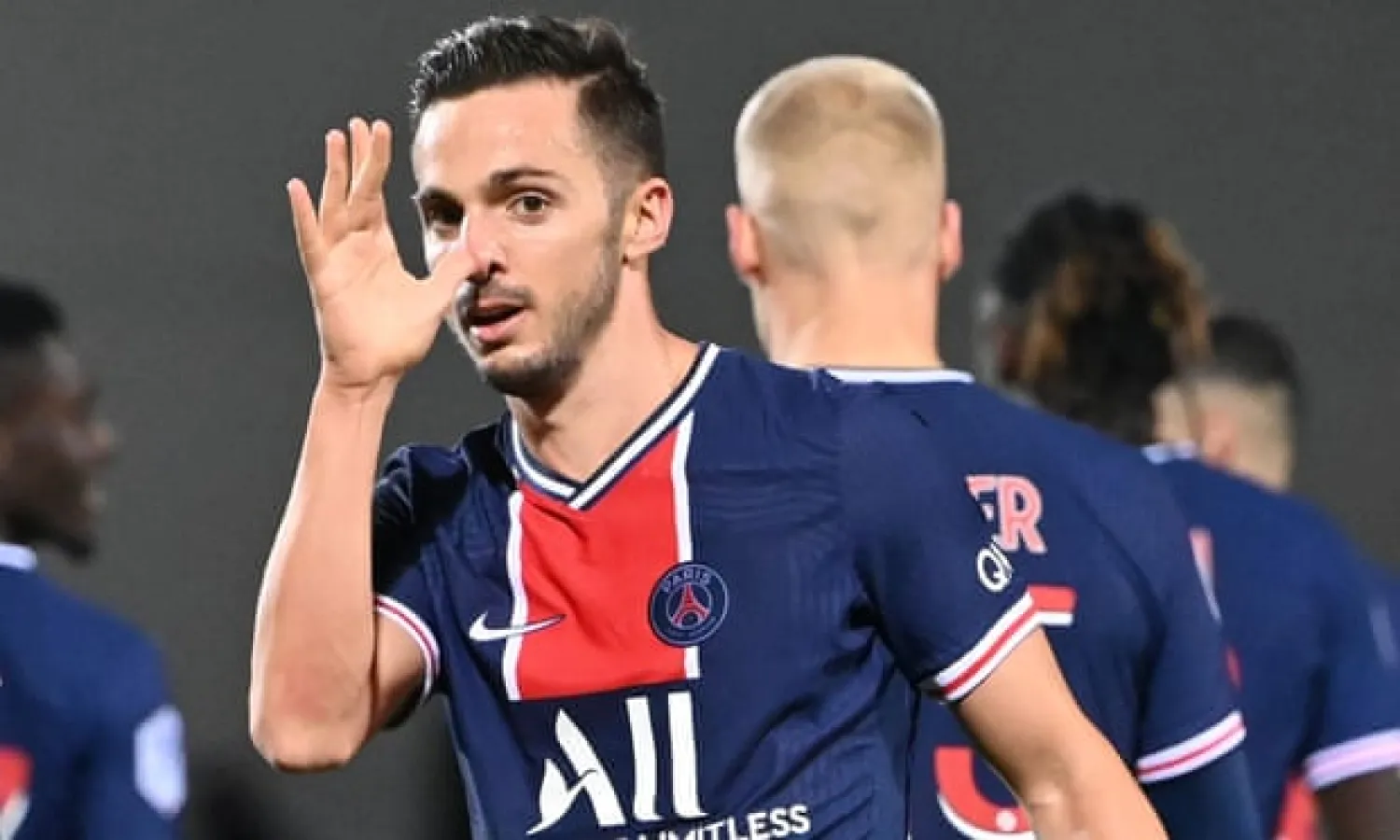
 Paris Saint-Germain’s midfielder Pablo Sarabia celebrates his first Ligue 1 goal of the season. Photograph: Pascal Guyot/AFP/Getty Images
Paris Saint-Germain’s midfielder Pablo Sarabia celebrates his first Ligue 1 goal of the season. Photograph: Pascal Guyot/AFP/Getty Images
TT

PSG v Manchester United Seems a Portent of a Dystopian Super League Future

 Paris Saint-Germain’s midfielder Pablo Sarabia celebrates his first Ligue 1 goal of the season. Photograph: Pascal Guyot/AFP/Getty Images
Paris Saint-Germain’s midfielder Pablo Sarabia celebrates his first Ligue 1 goal of the season. Photograph: Pascal Guyot/AFP/Getty Images

The clock was already showing 90. Diogo Dalot advanced on to the ball in space around 40 yards from the Paris Saint-Germain goal. His first touch was heavy and as three opponents closed in, he had little option but to shoot. Marco Verratti threw himself towards the full-back. Juan Bernat ducked away. And the middle of the three, Presnel Kimpembe, flinching, turned his back, his arm flicking away from his body. VAR showed Dalot’s wild effort had deflected off it. From nowhere, Manchester United had a penalty and an away-goals passage into the Champions League quarter-final.

Football, increasingly, is a game built on the analysis of complex data. Everything is counted, the data studied. We talk of philosophy and psychology, of tactical evolution and leadership strategies, and yet games and seasons and careers can rise and fall on moments of absurd chance. If Dalot’s first touch had been better, would he have shot? If Ligue 1 made Bernat and Kimpembe defend more frequently, might they have shown more conviction? Had Dalot’s shot been struck more cleanly, might it have hit Kimpembe’s ribs or back rather than his arm? A season earlier, there would not have been VAR to overturn the referee’s initial decision to point for a corner. And thus history is made.

Eighteen months on, as the sides prepare to meet again in the Champions League on Tuesday, the ramifications continue to be felt. From that night grew the image of Ole Gunnar Solskjær as a magus able to conjure at will the spirit of ’99. As susceptible to public pressure as ever, Ed Woodward confirmed him in the job the following week. the former United striker had seemingly read the mood of the game, dropping deep as PSG got the upper hand early in the second half, preparing for a late assault on opponents with a habit of freezing at key moments. But emotional intelligence is not enough to be a manager of a super-club.

Last season Solskjær had some success sitting his side deep and breaking. United were relatively defensively sound and they had pace and quality in forward areas but what they did not have was the sort of coordinated attacking that is necessary now at the highest level. This season the defending has also disintegrated, which may, in fairness to the manager, at least in part be the result of Harry Maguire’s struggles.

Solskjær still has his supporters and they are right that there are much bigger problems at the club. The hastiness of his appointment, the apparent lack of broader planning, is symptomatic of the failure of leadership since Sir Alex Ferguson and the chief executive, David Gill, departed in 2013.

Understandably, fans are frustrated by how much the Glazers have taken out of the club, but of just as much practical significance, at least in the short term, is how badly the available money has been spent. Discerning a consistent strategy is impossible: from Alexis Sánchez to a focus on young British talent to Edinson Cavani in two years. A net spend of £500m on transfers over five years should guarantee a certain level, yet United’s squad are short of a left-back, a center-back and a right-sided forward.

With waste like that it is little wonder Joel Glazer had to come up with a wheeze like Project Big Picture to cement United’s place at the top of English game. Far easier to rig the financial structures even further in your favor than actually to run a club properly.

The Champions League is a glimpse of that future. Its group stage should begin with a great sense of expectation and possibility. Look back to its richness and drama in the 90s, before the great stratification, when at least half the fixtures felt like monumental clashes, and compare that with a present that increasingly feels an accounting exercise: tot up the revenues and, in the majority of groups, watch the richest pair progress. And if, as seems likely, the format is rejigged in 2024, it will only be to make the rich richer.

Because United are fallible and because the group also contains RB Leipzig – who may have breached the spirit of German regulations on club ownership but are undeniably well-run, football’s degenerate economics somehow rendering a global brand a plucky outsider – Tuesday’s game against PSG feels significant. But a slightly different draw and this would be an effective exhibition between sides who know they will progress. Or project into a super league future and this could easily be a weary wrangle of sides too flawed to win but too rich to fail.

PSG should stand as a warning to the Premier League’s elite. In Ligue 1 they are untouchable, winning seven of the past eight French titles and the domestic treble in four of the past six years, a joyless hegemony that was at least in part responsible for the abolition of the Coupe de la Ligue at the end of last season, just as Big Picture proposed the axing of the League Cup.

But like so many of the other serial domestic champions, PSG are not happy. European success continues to elude them. Last season, they came closer than ever before thanks to a gentle draw and a late flurry against Atalanta but the tensions between celebrity players and the attempts of Thomas Tuchel to impose a structure remain damagingly close to the surface. And all the while the paradoxical truth grows more urgent: PSG’s domination of Ligue 1 – the latest Deloitte report shows revenues almost three times greater than that of the next French side, Lyon – means it is no preparation for elite football.

Or perhaps that is what Glazer wants. Perhaps this is the dream, two-thirds of the Premier League reduced to vassal status, minnows to be cuffed aside by the elite as a matter of course, no matter how badly they are managed.

PSG against United may be the pick of the week’s Champions League group games but it feels also like a harbinger of some dystopian future, of hollow games between franchises insulated from the costs of mismanagement, denuded of jeopardy and the emotional connection that makes football matter.

The Guardian Sport


Jota’s Sons to Join Mascots When Liverpool Face Wolves at Anfield

 Jota died ‌in ⁠a ​car ‌crash alongside his younger brother in July in northwestern Spain. (AFP)
Jota died ‌in ⁠a ​car ‌crash alongside his younger brother in July in northwestern Spain. (AFP)
TT

Jota’s Sons to Join Mascots When Liverpool Face Wolves at Anfield

 Jota died ‌in ⁠a ​car ‌crash alongside his younger brother in July in northwestern Spain. (AFP)
Jota died ‌in ⁠a ​car ‌crash alongside his younger brother in July in northwestern Spain. (AFP)

Diogo Jota's two sons will join ​the mascots at Anfield when Liverpool face Wolverhampton Wanderers in the Premier League on Saturday, the club confirmed on Friday.

Portuguese forward Jota, who played for both ‌Premier League ‌clubs, died ‌in ⁠a ​car ‌crash alongside his younger brother in July in northwestern Spain. He was 28.

Jota joined Wolves on loan from Atletico Madrid in 2017 and made ⁠a permanent move to the club ‌the following year. ‍He then ‍signed a five-year deal in ‍2020 with Liverpool, where he won the league title earlier this year.

Saturday's match marks the ​first time Liverpool and Wolves have met since Jota's ⁠death.

Jota's wife Rute Cardoso and her two sons, Dinis and Duarte, were present for the Premier League home openers for both Liverpool and Wolves in August.

Liverpool also permanently retired his jersey number 20 following his death.


Too Hot to Handle? Searing Heat Looming Over 2026 World Cup

A view of the field is seen from the stands at SoFi Stadium in Inglewood, California, on December 9, 2025. (AFP)
TT

Too Hot to Handle? Searing Heat Looming Over 2026 World Cup

A view of the field is seen from the stands at SoFi Stadium in Inglewood, California, on December 9, 2025. (AFP)

With less than six months to go before the 2026 World Cup kicks off, organizers are bracing for what could be their most challenging opponent yet: extreme heat.

Soaring temperatures across the United States, Mexico and Canada pose safety issues for players and fans and a host of logistical issues that remain far from settled.

In the depths of the $5.5 billion SoFi Stadium in Los Angeles, which will host eight World cup matches, around 15 industrial misting fans more than two meters sit in storage, waiting to be deployed. If temperatures climb above 80F (26.7C), the fans will be rolled out around the stadium.

A roof suspended some 45 meters above the SoFi Stadium pitch offers some shade for spectators, while large openings along the sides of the stadium allow for breezes from the nearby Pacific Ocean to provide a form of natural air conditioning.

"Knowing that you can put 70,000 people into a building, the energy, the excitement, the activity that comes with that, and the higher temperature, that's where we want to make sure we respond," Otto Benedict, vice president of operations for the company that manages the stadium, told AFP.

Not all of the World Cup's 16 stadiums are as modern. And Southern California is not considered to be among the highest-risk areas for a competition scheduled from June 11 to July 19, three and a half years after a winter World Cup in Qatar.

- Automatic cooling breaks -

A study published in the International Journal of Biometeorology in January warned of "serious concern" for the health of players and match officials at the 2026 World Cup due to extreme heat.

The study identified six "high-risk" host cities: Monterrey, Miami, Kansas City, Boston, New York and Philadelphia.

The "Pitches in Peril" report by the Football for Future non-profit noted that in 2025 those cities each recorded at least one day above 35C on the wet-bulb globe temperature (WBGT) scale, which factors in humidity and is considered the upper limit of human heat tolerance.

The issue of heat featured prominently at this year's FIFA Club World Cup in the United States, which drew complaints from players and coaches.

Extreme heat also marked the 1994 World Cup, the last men's edition held in the United States.

FIFA has responded by mandating cooling breaks in the 22nd and 67th minutes of all matches at the World Cup, regardless of conditions.

The World Cup match schedule released after December's draw in Washington shows daytime games largely assigned to air-conditioned stadiums in Dallas, Houston and Atlanta, while higher-risk venues are set to host evening kickoffs.

"You can clearly see an effort to align the competition schedule planning and venue selection with the concerns around player health, but also player performance," a spokesperson for the FIFPro players union told AFP. "This is a clear outcome, which we welcome, and a lesson learned from the Club World Cup."

- 'High-risk matches' -

FIFPRO says the biggest takeaway is that heat will play an increasingly central role in organizing competitions on a warming planet.

The union believes though that several World Cup fixtures remain "high-risk" and recommends postponements when WBGT readings exceed 28C.

Among those fixtures causing FIFPro concern: group-stage matches scheduled for mid-afternoon in New York, Boston and Philadelphia, as well as the final, set for a 3:00 p.m. kickoff in New York.

While teams and players work to mitigate effects of the conditions, some officials say the risks to spectators both inside stadiums and in fan zones have been underestimated.

"There is a risk and importantly, we feel like it's an underappreciated risk," said Chris Fuhrmann, deputy director of the Southeast Regional Center of the US National Oceanic and Atmospheric Administration.

"When you're cheering, you're actually generating a lot of metabolic heat and your heart rate's going up. Spectators obviously compared to professional athletes are generally not in as good physical health.

"They have a lot of comorbidities that increase the likelihood that they would have a negative health outcome or succumb to heat stress."

Stadium temperatures are also amplified by the "urban heat island" effect of concrete, asphalt and metal.

Adequate air circulation, plenty of shaded areas and access to hydration are crucial, Fuhrmann said.

FIFA has yet to clarify whether fans will be allowed to bring refillable water bottles into venues or whether water will be sold inside. FIFA did not respond to requests for comment.

- Prevention -

For National Weather Service meteorologist Benjamin Schott, who has advised FIFA and its World Cup task force, the priority is prevention, particularly for foreign visitors unfamiliar with local climates.

Another lesson from the Club World Cup, he said, is the need for multilingual messaging to ensure heat-safety warnings are clearly understood.

"The lesson learned is just trying to maybe better educate fans as they come to the United States to have a better understanding of what the weather could be like during those two months," Schott said.


Palladino’s Atalanta on the up as Serie A Leaders Inter Visit

Atalanta's Italian head coach Raffaele Palladino looks on during the Italian Serie A soccer match between Genoa Cfc and Atalanta BC at Luigi Ferraris stadium in Genoa, Italy, 21 December 2025. (EPA)
TT

Palladino’s Atalanta on the up as Serie A Leaders Inter Visit

Atalanta's Italian head coach Raffaele Palladino looks on during the Italian Serie A soccer match between Genoa Cfc and Atalanta BC at Luigi Ferraris stadium in Genoa, Italy, 21 December 2025. (EPA)

Atalanta are on the comeback trail ahead of Sunday night's visit of Serie A leaders Inter Milan, with coach Raffaele Palladino leading the charge for the revitalized Bergamo club.

Since Palladino replaced Ivan Juric last month Atalanta have rediscovered their groove, as witnessed by the way they dealt with Eintracht Frankfurt and Chelsea in the Champions League.

Atalanta sit fifth in the Champions League, level on points with mega-bucks Paris Saint-Germain and Manchester City, and now they're heading back up the Serie A table.

A last-gasp win at Genoa last weekend put Atalanta back in the top half of Italy's top flight and only three points off the European spots.

"It wasn't one of our better performances but today winning was what counted," said Palladino after the victory over Genoa.

"Those three points were hugely important for us to keep our run going and get us up the right end of the table."

Sunday's clash in Bergamo is the first of three fixtures against direct rivals for Champions League football.

Fourth-placed Roma, who are eight points clear of Atalanta, travel north at the turn of the year before the short journey to Bologna, who sit in the Conference League spot.

Atalanta have won six of their eight matches in all competitions under Palladino, who already looks more like the right replacement for Gian Piero Gasperini than Juric ever did.

However, Palladino will be without key attacker Ademola Lookman and defender Odilon Kossounou who are representing Nigeria and Ivory Coast at the Africa Cup of Nations.

"We keep scaling a mountain that a month ago seemed impossible," said Palladino.

"Let's enjoy the moment because we've got three big matches coming up and we can take them on in the right spirit."

Inter lead local rivals AC Milan -- who host Verona -- by a single point at the top of the table with champions Napoli a further point back in third ahead of their tricky trip to Jamie Vardy's Cremonese.

But Inter have been on a trip to Saudi Arabia for a failed attempt to win the Italian Super Cup, a tournament won by Napoli which has further clogged up their schedule and left them, Milan, Napoli and Bologna with a game in hand on Roma and fifth-placed Juventus.

The first two weeks of January each have midweek rounds of matches in store for the Super Cup clubs, with the following two weeks containing the decisive final fixtures of the Champions League's expanded league phase.

Inter coach Cristian Chivu has lost Ange-Yoan Bonny to a knee injury picked up in training, the Frenchman joining Denzel Dumfries, Franceco Acerbi and Hakan Calhanoglu on the treatment table.

Man to watch: Daniele De Rossi

De Rossi will make an emotional return to the Stadio Olimpico on Monday night when his Genoa team travel to the Italian capital hoping to bounce back after two unfortunate defeats to Inter and Atalanta.

The Roma icon and World Cup-winning midfielder took his boyhood club to the 2024 Europa League semi-final but was fired after a poor start last season.

He was sacked following a draw at Genoa in September last year, sparking furious protests from Roma fans, and he will be given a hero's welcome from home supporters.

Genoa sit two points above the drop zone while Roma are three points behind Inter having played a game more.
