

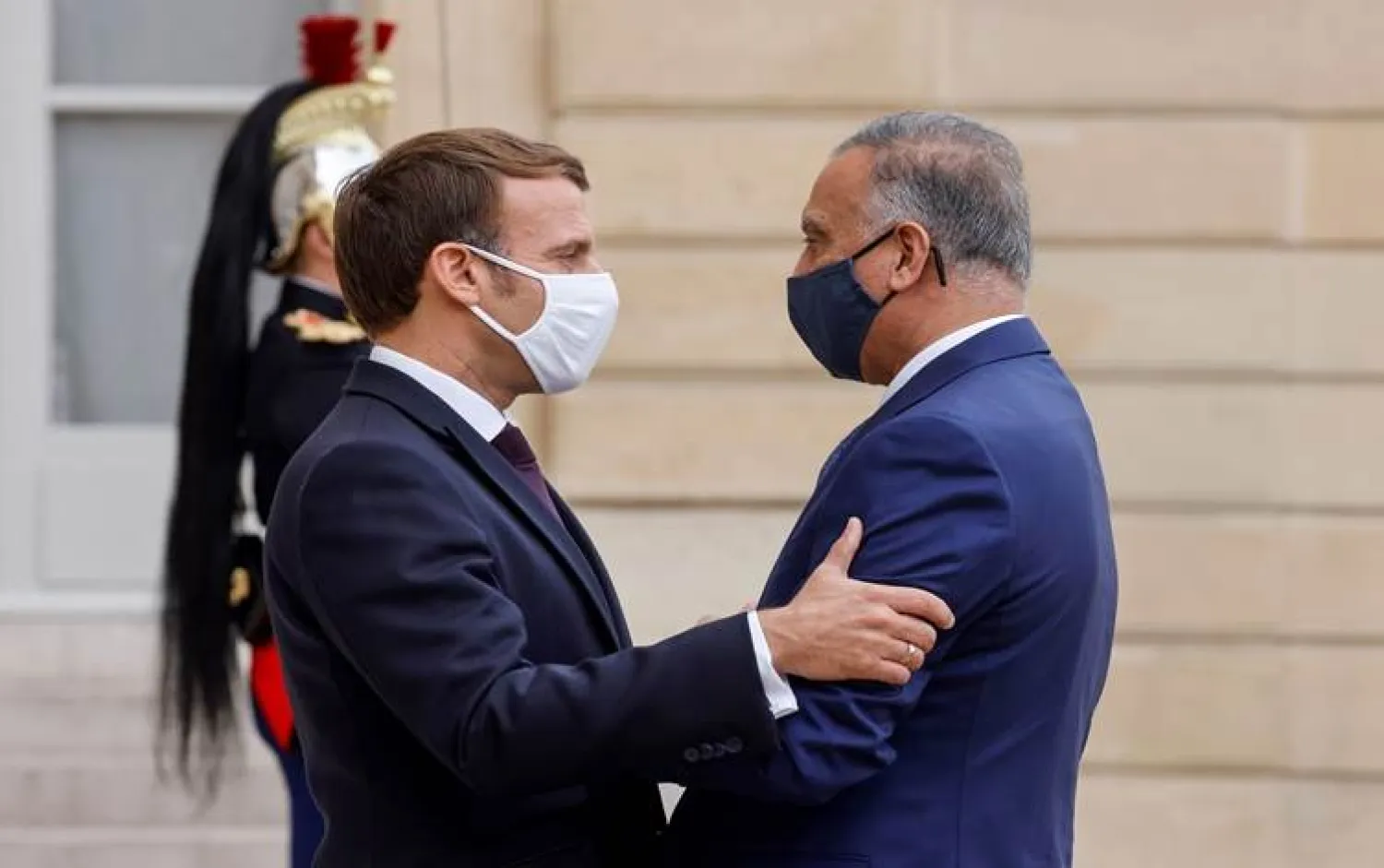

Iraq's Kadhimi, France's Macron Discuss Support to Confront Multifaceted Challenges

Kadhimi met with Macron at the Elysee on Monday | Photo: Ludovic Marin/ AFP
TT

Iraq's Kadhimi, France's Macron Discuss Support to Confront Multifaceted Challenges

Kadhimi met with Macron at the Elysee on Monday | Photo: Ludovic Marin/ AFP

Although French President Emmanuel Macron is still busy with the stabbing attack in the Paris suburb that left one man dead, the Elysee Palace provided Iraqi Prime Minister Mustafa Kadhimi Monday with an official reception ceremony and the needed time to discuss multifaceted issues, revealing Paris’ desire to enhance its relations with Baghdad.

The Prime Minister arrived Sunday evening in Paris as part of a European tour that includes France, Britain, and Germany.

In the French capital, Kadhimi sat down with Macron, his counterpart Jean Castex, President of the French Senate, Gerard Larache, in addition to the foreign and defense ministers.

French sources told Asharq Al-Awsat there is a mutual aspiration to enhance relations between the two countries.

“Paris wants to have a weighty role in Iraq, not just at the level of fighting terrorist cells. For its part, Baghdad needs to diversify its relations, not to remain trapped between Tehran and Washington,” the sources said.

Also, Iraq looks at Paris as an entrance to Europe and a side capable to help at all levels, while France considers the Iraqi market as promising with a significant chance to operate at all levels, particularly in the reconstruction process.

In this regard, Iraq and France signed Monday three memoranda of intent (MOI), in the fields of transportation, agriculture, and education, in the presence of Kadhimi and Castex. According to a statement by the Prime Minister's Office, the MOI seek to strengthen the institutional capabilities of the Ministry of Agriculture, including the exchange of experiences in the field of agriculture, training, veterinary education, plant health and agricultural research, encouraging partnerships in the fields of food and agricultural industries, agricultural machinery, and developing land and water resources.

At the level of transportation, the agreement included cooperation on the construction of a metro railway in Baghdad, while the agreement on education sought to boost cooperation in the field of education between the two parties and expand the admission of Iraqi students to French universities.

During his meeting with Macron, Kadhimi discussed strengthening joint cooperation in the field of combating terrorism.

“Macron and Kadhimi discussed relations between the two countries and ways to develop them. The latest regional and international developments were reviewed, and views were exchanged on a number of issues of common concern,” a statement by his office said. The meeting dealt with ways to enhance joint cooperation between Iraq and France, especially with regard to the economic, security and cultural fields, and in the field of combating terrorism. Kadhimi expressed his aspiration to consolidate the existing friendly relations between the two countries, and to consolidate ways of joint cooperation, in a way that enhances their common interests. He also valued France’s efforts to launch an initiative to support the Iraqi government in implementing some of its government reform program. For his part, Macron welcomed the visit of Kadhimi, and affirmed his country's keenness to strengthen ties with Iraq in various fields.

During talks with his counterpart, the Iraqi PM discussed ways to develop bilateral relations between the two countries and strengthen them in the economic, investment, security, and health fields.

The two men also tackled the situation in the region and exchanged views on a number of issues. Kadhimi stressed, according to the statement, the importance of strengthening cooperation between the two countries in many sectors, indicating: "The government seeks solid relations with the countries of the world based on common interests and restore Iraq to its international status." For his part, the French Prime Minister affirmed France's keenness to support Iraq at various levels.


EU Condemns Israel's West Bank Control Measures

The Israeli settlement of Har Homa, seen from the West Bank city of Bethlehem, Tuesday, Dec. 17, 2024. (AP)
TT

EU Condemns Israel's West Bank Control Measures

The Israeli settlement of Har Homa, seen from the West Bank city of Bethlehem, Tuesday, Dec. 17, 2024. (AP)

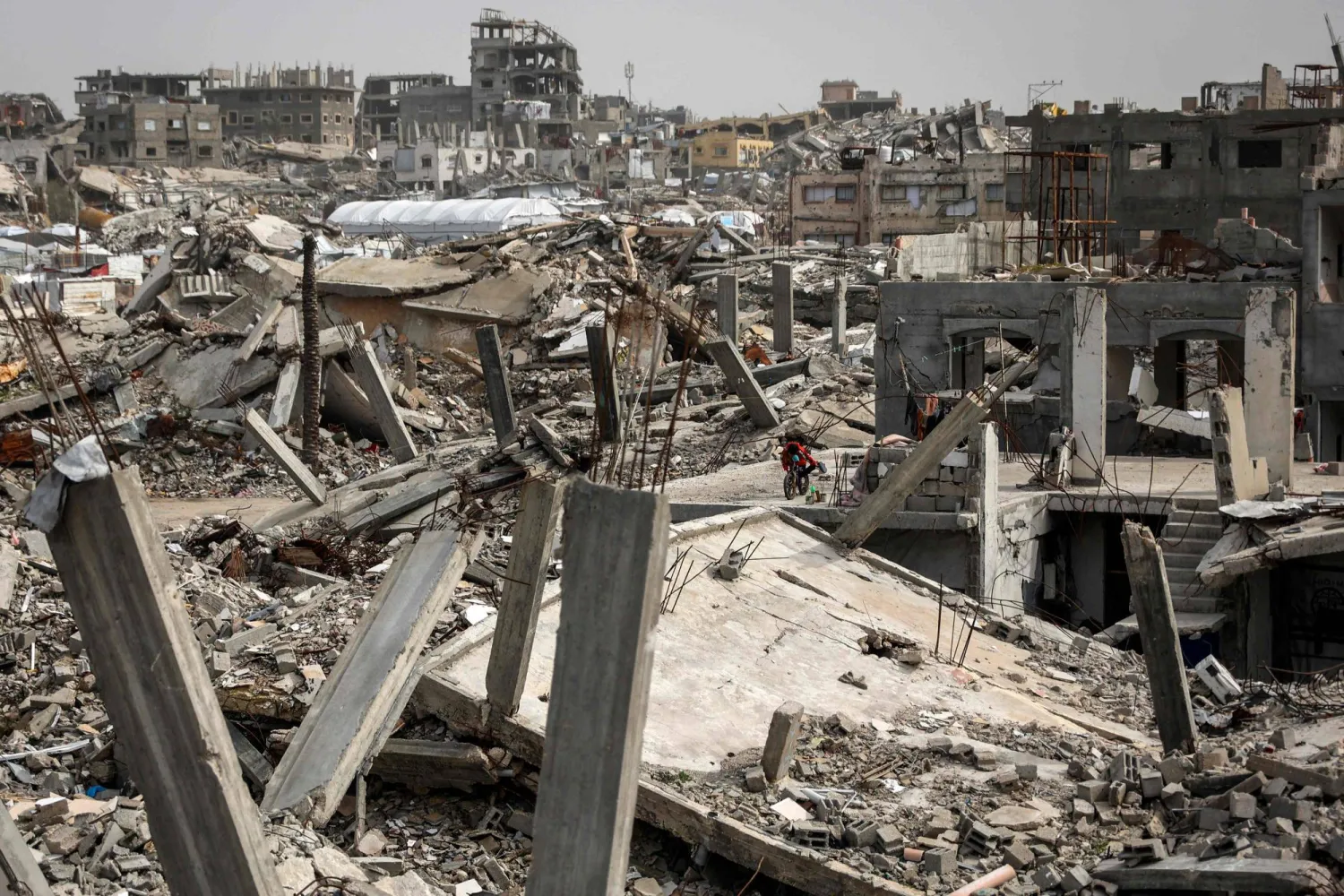
The European Union on Monday condemned new Israeli measures to tighten control of the West Bank and pave the way for more settlements in the occupied Palestinian territory, AFP reported.

"The European Union condemns recent decisions by Israel's security cabinet to expand Israeli control in the West Bank. This move is another step in the wrong direction," EU spokesman Anouar El Anouni told journalists.


Atrocities in Sudan's El-Fasher Were 'Preventable Human Rights Catastrophe'

Sudanese displaced people who left El Fasher after its fall, sit in the shade in Tawila at the Rwanda camp reception point on December 17, 2025. (Photo by AFP)
TT

Atrocities in Sudan's El-Fasher Were 'Preventable Human Rights Catastrophe'

Sudanese displaced people who left El Fasher after its fall, sit in the shade in Tawila at the Rwanda camp reception point on December 17, 2025. (Photo by AFP)

The atrocities unleashed on El-Fasher in Sudan's Darfur region last October were a "preventable human rights catastrophe", the United Nations said Monday, warning they now risked being repeated in the neighbouring Kordofan region.


"My office sounded the alarm about the risk of mass atrocities in the besieged city of El-Fasher for more than a year ... but our warnings were ignored," UN rights chief Volker Turk told the Human Rights Council in Geneva.


He added that he was now "extremely concerned that these violations and abuses may be repeated in the Kordofan region".


Arab League Condemns Israel's Decisions to Alter Legal, Administrative Status of West Bank

A general view shows the opening session of the meeting of Arab foreign ministers at the Arab League Headquarters (Reuters)
TT

Arab League Condemns Israel's Decisions to Alter Legal, Administrative Status of West Bank

A general view shows the opening session of the meeting of Arab foreign ministers at the Arab League Headquarters (Reuters)

The General Secretariat of the Arab League strongly condemned decisions by Israeli occupation authorities to impose fundamental changes on the legal and administrative status of the occupied Palestinian territories, particularly in the West Bank, describing them as a dangerous escalation and a flagrant violation of international law, international legitimacy resolutions, and signed agreements, SPA reported.

In a statement, the Arab League said the measures include facilitating the confiscation of private Palestinian property and transferring planning and licensing authorities in the city of Hebron and the area surrounding the Ibrahimi Mosque to occupation authorities.

It warned of the serious repercussions of these actions on the rights of the Palestinian people and on Islamic and Christian holy sites.

The statement reaffirmed the Arab League’s firm support for the legitimate rights of the Palestinian people, foremost among them the establishment of their independent state on the June 4, 1967 borders, with East Jerusalem as its capital.