


Iraq's 'Stadium of Horrors' in Ruins, but the Game Goes On

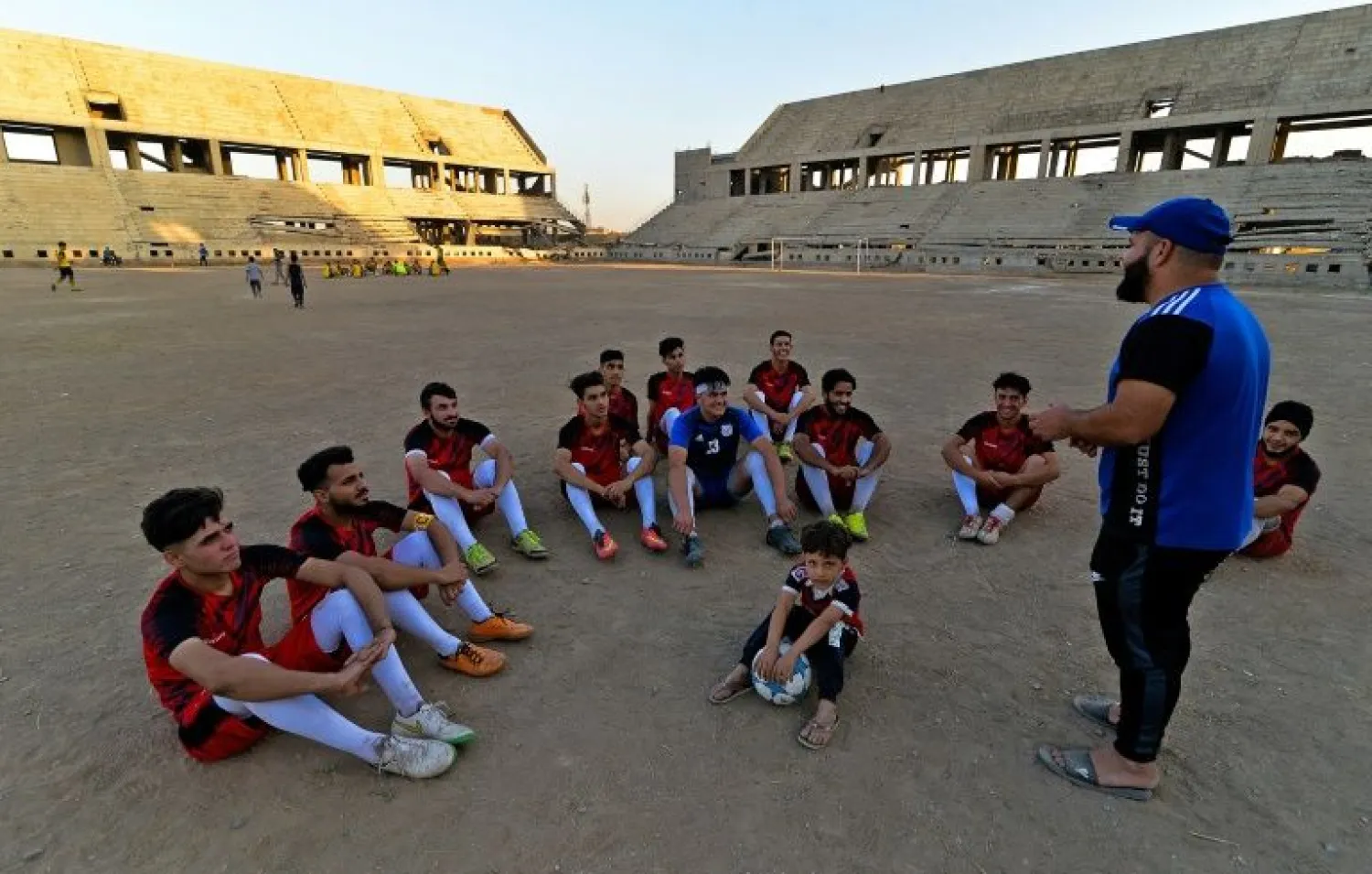
Football players train on the dusty pitch of the Al-Idara al-Mahalia stadium in Mosul which was once used by ISIS group fighters as a weapons depot and a launchpad for rocket and mortar attacks | AFP
TT

Iraq's 'Stadium of Horrors' in Ruins, but the Game Goes On

Football players train on the dusty pitch of the Al-Idara al-Mahalia stadium in Mosul which was once used by ISIS group fighters as a weapons depot and a launchpad for rocket and mortar attacks | AFP

Mohamed Fathi, coach of Mosul's football club in northern Iraq, hardly recognizes the ruined soccer stadium once used by the ISIS group fighters to fire rockets and lob mortars from.

Piles of rubble lie alongside a pitch of bumpy sand. The high concrete stadium tiers surrounding it -- with all seats torn out -- look dangerously close to collapse.

"After this was destroyed, there's no other stadiums in the city to play football," Fathi said, waving his hand at the crumbling building.

"The impact of the destruction is enough to tell you everything that happened here."

Jihadi fighters from the ISIS group seized Mosul in 2014, later expanding its so-called "caliphate" to over a third of Iraq and into neighboring Syria.

In 2017, Iraqi and coalition forces forced the hardened insurgents out in a grinding urban battle that left ancient Mosul in ruins.

The bullet-riddled 20,000-seater stadium, home to Mosul Sports Cub, was not spared, caught up in the deadly battles for control.

Two other smaller stadiums in town were also damaged.

- Football 'brings life' -

"Sadly the central government doesn't realize that football is what brings life back to a town, its people, and its youth," Fathi said. "So things have stayed the same."

Mosul Sports Club was once a solid performing club that produced some of the country's best players.

They include Hawar Mulla Mohammed, who led Iraq to its historic 2007 Asian Cup championship, and who played professionally in Europe.

Decades earlier, Iraq's national squad made its only World Cup appearance in Mexico in 1986.

Mosul's own son, skilled midfielder Haris Mohammed, ably led his country to the rare international honor.

Founded in 1947, Mosul SC played 18 seasons in Iraq's premier league, before its relegation to the first division a decade ago.

With thousands of roaring fans passionately backing their team, locals dubbed it the "stadium of horrors" for visiting teams.

But that ominous label would take on a more sinister meaning with the arrival of ISIS militants.

"I used to follow soccer matches here, and suddenly out of nowhere convoys of ISIS militants decked out with guns would show up," recounted Omar al-Mosuli, a resident in his thirties.

"It was a frightening scene, and I used to walk away quietly."

ISIS' austere and terror-ridden reign was marked by beheadings and shootings.

Like so many other facets of daily life, football changed.

Soccer disappeared as a professional pursuit -- and violence became established a past-time instead.

"Under the stands, ISIS fighters transformed the space into a massive weapons depot," Mosuli said.

"They set up launchpads inside the stadium to fire rockets during the battle to liberate the city."

He recalled how the extremists forced people to play in long shorts that reached below their knees -- and there was a strict ban on anyone donning jerseys of their favorite international teams or players.

Football matches would be abruptly halted for prayer time, he added.

- 'Plenty of talent' -

Amid Mosul's disfigured landscape, its committed players still train on the stadium's dusty pitch a couple of times a week.

There are no other suitable fields to play on.

"We are forced to train here now," Fathi, the coach, explained.

"The club's president and some of the staff even pay for the equipment out of their own pocket," he added.

But the lack of a proper place play for the team is also a reflection of the rampant corruption Iraq struggles with.

The country is consistently ranked as one of the worst performers on Transparency International's Corruption Perceptions Index.

"A foreign aid agency started reconstructing Mosul SC stadium, but the province's sports authority reassigned the site two years ago to a businessman," Mosul-based sports journalist Talal al-Ameri told AFP.

The businessman sat on the project -- a common occurrence in Iraq.

When a respected former captain of the Iraqi national squad became sports minister, Adnan Darjal, he reviewed the file.

"Due to corruption allegations, the new minister has suspended everything," Ameri added.

But the lack of stadium has not deterred Maytham Younis, the 34-year-old coach of the aptly-named amateur team Al-Mustaqbal, or "The Future".

He urges his young players to train hard, as they practice in a dusty field in Mosul's al-Bakr neighborhood in front of a small but loyal following of fans.

It is a far cry from the cheering thousands who once watched in Mosul's centerpiece stadium, but it is the best they can do for now as they wait for football to flourish again.

For now, hopes of a return to the glory days the club has seen remain a dream.

"We have plenty of talent," Younis said. "But without a stadium, it's hard for them to get noticed."



Shakhtar Boss Pays Ukrainian Racer $200,000 After Games Disqualification

Ukrainian President Volodymyr Zelenskiy holds helmet as he meets with a Ukrainian skeleton racer Vladyslav Heraskevych , who was disqualified from the Olympic skeleton competition over his "helmet of remembrance" depicting athletes killed since Russia's invasion and his father and coach, Mykhailo Heraskevych, amid Russia's attack on Ukraine, in Munich, Germany February 13, 2026. (Ukrainian Presidential Press Service/Handout via Reuters)
TT

Shakhtar Boss Pays Ukrainian Racer $200,000 After Games Disqualification

Ukrainian President Volodymyr Zelenskiy holds helmet as he meets with a Ukrainian skeleton racer Vladyslav Heraskevych , who was disqualified from the Olympic skeleton competition over his "helmet of remembrance" depicting athletes killed since Russia's invasion and his father and coach, Mykhailo Heraskevych, amid Russia's attack on Ukraine, in Munich, Germany February 13, 2026. (Ukrainian Presidential Press Service/Handout via Reuters)

The owner of ‌Ukrainian football club Shakhtar Donetsk has donated more than $200,000 to skeleton racer Vladyslav Heraskevych after the athlete was disqualified from the Milano Cortina Winter Games before competing over the use of a helmet depicting Ukrainian athletes killed in the war with Russia, the club said on Tuesday.

The 27-year-old Heraskevych was disqualified last week when the International Bobsleigh and Skeleton Federation jury ruled that imagery on the helmet — depicting athletes killed since Russia invaded Ukraine in 2022 — breached rules on athletes' expression at ‌the Games.

He ‌then lost an appeal at the Court ‌of ⁠Arbitration for Sport hours ⁠before the final two runs of his competition, having missed the first two runs due to his disqualification.

Heraskevych had been allowed to train with the helmet that displayed the faces of 24 dead Ukrainian athletes for several days in Cortina d'Ampezzo where the sliding center is, but the International Olympic Committee then ⁠warned him a day before his competition ‌started that he could not wear ‌it there.

“Vlad Heraskevych was denied the opportunity to compete for victory ‌at the Olympic Games, yet he returns to Ukraine a ‌true winner," Shakhtar President Rinat Akhmetov said in a club statement.

"The respect and pride he has earned among Ukrainians through his actions are the highest reward. At the same time, I want him to ‌have enough energy and resources to continue his sporting career, as well as to fight ⁠for truth, freedom ⁠and the remembrance of those who gave their lives for Ukraine," he said.

The amount is equal to the prize money Ukraine pays athletes who win a gold medal at the Games.

The case dominated headlines early on at the Olympics, with IOC President Kirsty Coventry meeting Heraskevych on Thursday morning at the sliding venue in a failed last-minute attempt to broker a compromise.

The IOC suggested he wear a black armband and display the helmet before and after the race, but said using it in competition breached rules on keeping politics off fields of play. Heraskevych also earned praise from Ukraine President Volodymyr Zelenskiy.


Speed Skating-Italy Clinch Shock Men’s Team Pursuit Gold, Canada Successfully Defend Women’s Title

 Team Italy with Davide Ghiotto, Andrea Giovannini, Michele Malfatti, celebrate winning the gold medal on the podium of the men's team pursuit speed skating race at the 2026 Winter Olympics, in Milan, Italy, Tuesday, Feb. 17, 2026. (AP)
Team Italy with Davide Ghiotto, Andrea Giovannini, Michele Malfatti, celebrate winning the gold medal on the podium of the men's team pursuit speed skating race at the 2026 Winter Olympics, in Milan, Italy, Tuesday, Feb. 17, 2026. (AP)
TT

Speed Skating-Italy Clinch Shock Men’s Team Pursuit Gold, Canada Successfully Defend Women’s Title

 Team Italy with Davide Ghiotto, Andrea Giovannini, Michele Malfatti, celebrate winning the gold medal on the podium of the men's team pursuit speed skating race at the 2026 Winter Olympics, in Milan, Italy, Tuesday, Feb. 17, 2026. (AP)
Team Italy with Davide Ghiotto, Andrea Giovannini, Michele Malfatti, celebrate winning the gold medal on the podium of the men's team pursuit speed skating race at the 2026 Winter Olympics, in Milan, Italy, Tuesday, Feb. 17, 2026. (AP)

An inspired Italy delighted the home crowd with a stunning victory in the Olympic men's team pursuit final as

Canada's Ivanie Blondin, Valerie Maltais and Isabelle Weidemann delivered another seamless performance to beat the Netherlands in the women's event and retain their title ‌on Tuesday.

Italy's ‌men upset the US who ‌arrived ⁠at the Games ⁠as world champions and gold medal favorites.

Spurred on by double Olympic champion Francesca Lollobrigida, the Italian team of Davide Ghiotto, Andrea Giovannini and Michele Malfatti electrified a frenzied arena as they stormed ⁠to a time of three ‌minutes 39.20 seconds - ‌a commanding 4.51 seconds clear of the ‌Americans with China taking bronze.

The roar inside ‌the venue as Italy powered home was thunderous as the crowd rose to their feet, cheering the host nation to one ‌of their most special golds of a highly successful Games.

Canada's women ⁠crossed ⁠the line 0.96 seconds ahead of the Netherlands, stopping the clock at two minutes 55.81 seconds, and

Japan rounded out the women's podium by beating the US in the Final B.

It was only Canada's third gold medal of the Games, following Mikael Kingsbury's win in men's dual moguls and Megan Oldham's victory in women's freeski big air.


Lindsey Vonn Back in US Following Crash in Olympic Downhill 

Milano Cortina 2026 Olympics - Alpine Skiing - Women's Downhill 3rd Official Training - Tofane Alpine Skiing Centre, Belluno, Italy - February 07, 2026. Lindsey Vonn of United States in action during training. (Reuters)
TT

Lindsey Vonn Back in US Following Crash in Olympic Downhill 

Milano Cortina 2026 Olympics - Alpine Skiing - Women's Downhill 3rd Official Training - Tofane Alpine Skiing Centre, Belluno, Italy - February 07, 2026. Lindsey Vonn of United States in action during training. (Reuters)

Lindsey Vonn is back home in the US following a week of treatment at a hospital in Italy after breaking her left leg in the Olympic downhill at the Milan Cortina Games.

“Haven’t stood on my feet in over a week... been in a hospital bed immobile since my race. And although I’m not yet able to stand, being back on home soil feels amazing,” Vonn posted on X with an American flag emoji. “Huge thank you to everyone in Italy for taking good care of me.”

The 41-year-old Vonn suffered a complex tibia fracture that has already been operated on multiple times following her Feb. 8 crash. She has said she'll need more surgery in the US.

Nine days before her fall in Cortina d'Ampezzo, Italy, Vonn ruptured the ACL in her left knee in another crash in Switzerland.

Even before then, all eyes had been on her as the feel-good story heading into the Olympics for her comeback after nearly six years of retirement.