


Goals Galore – but Does the Empty Grounds Theory Actually Make Sense?

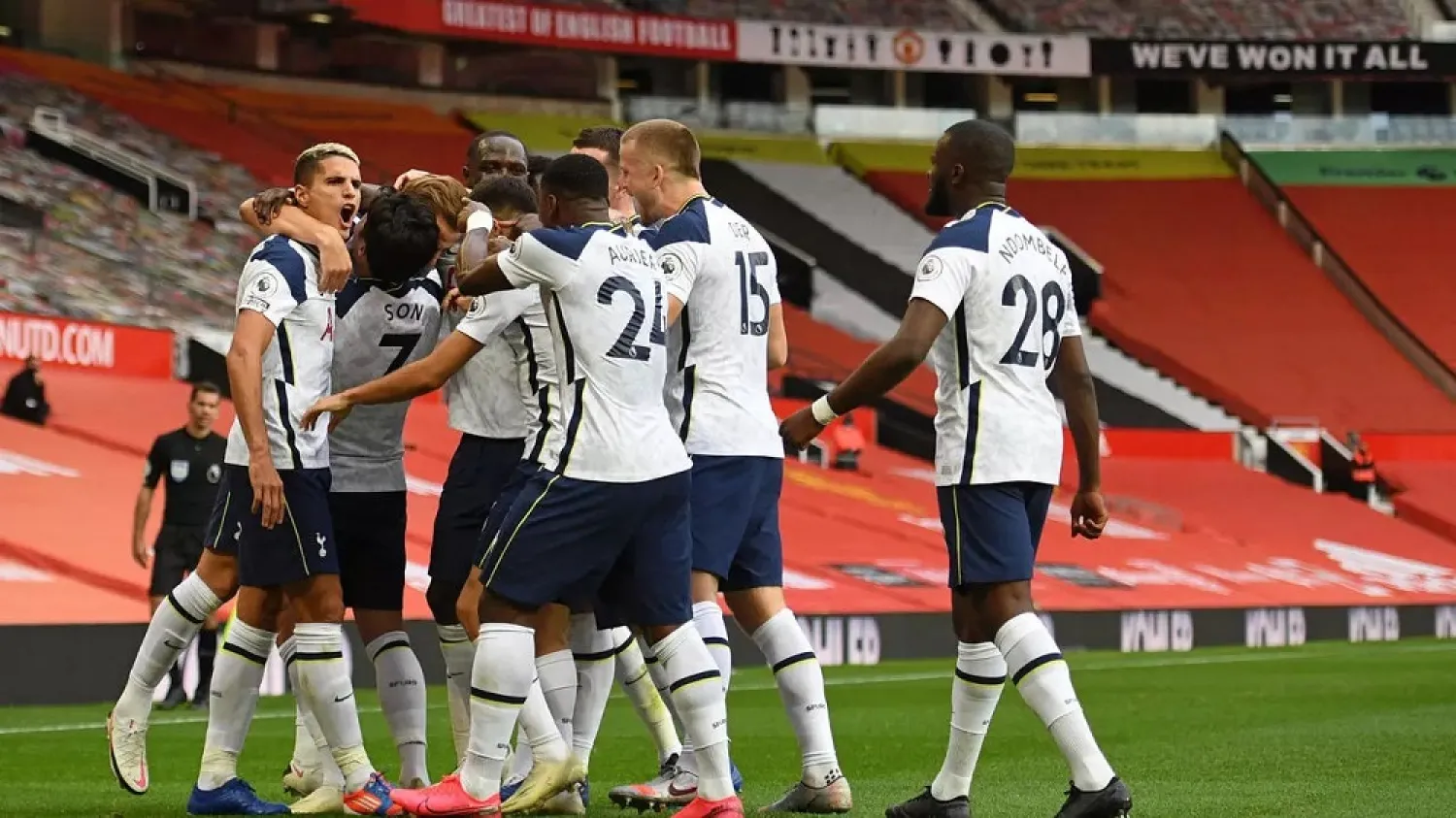
Tottenham Hotpsur's 6-1 thrashing of Manchester United is just one of a plethora of high scoring games in the Premier League this season. (AFP)
TT

Goals Galore – but Does the Empty Grounds Theory Actually Make Sense?

Tottenham Hotpsur's 6-1 thrashing of Manchester United is just one of a plethora of high scoring games in the Premier League this season. (AFP)

Goals, goals, goals. 4-3. 5-2. 6-1. 7-2. Penalties. Lots and lots of penalties. In the 48 games of the season so far, the Premier League has seen 172 goals; an average of 3.58 per game. Liverpool, runaway title holders, have been thrashed 7-2 by Aston Villa, a team who avoided relegation by a tug of the shirt last time. Manchester City have shipped five at home. There were two 3-3 draws two weekends ago. The first 0-0 was last week, West Brom against Burnley. Written down that looks wrong – two wide eyes shocked at empty nets. And it was yours for £14.95 on pay-per-view TV.

The 3.79 goals per match average recorded this month is unprecedented in the modern era (all data from Nielsen’s Gracenote). The last time football in England was so prolific was in 1930-31, when an average of 3.95 goals were scored per game. 2019-20’s average was 2.9 goals. Why?

“The obvious answer is the fact the crowd isn’t there,” says Clifford Stott, crowd psychologist and author of a book on football hooliganism. “That relationship is missing. The ‘12th man’ is a common expression, which is why playing at home has such an advantage.”

As supporters, we know it well: the dance one does between sitting and standing when the ball is in the opposition box; the hugging of strangers; the voices worn hoarse. Players sliding into adoration. The drama of dugout dust-ups.

Gary Lineker knows it well too. He only ever played one match behind closed doors in his career. A 1985 replay of a third-round FA Cup tie between Leicester and Burton Albion at the Baseball Ground. “The first time we won easily,” Lineker tells me. Leicester won 6-1 and he scored three. “That game was annulled [ because Burton’s goalkeeper had been injured by a missile thrown from the crowd] so we played again at Highfield Road. We won 1-0, but I had my hat-trick ripped away from me!”

What was it like, playing without fans? “It feels like training but more important. Training plus, I call it. It doesn’t feel like a match. I think, too, when teams are getting battered, home or away, there’s that element: you’ve got to keep going for the fans. It is probably easier for heads to drop and semi-give up without.”

Penalties have played a large part in the weight of scorelines too – fueled by the introduction of draconian changes to the handball rule (since softened) and the liminal nature of VAR-decided offsides. There have been a record 23 so far this season as of last week, with a conversion rate of 92%. Lineker: “Less pressure behind the goal. Both sets of fans give pressure, so you have it double.”

Less pressure also seems to be a key factor in goals from open play, because conversion rates have soared. Players are taking, on average, one and a half fewer shots than last season, but rather than a goal being scored every nine shots, it’s every six. There have already been five hat-tricks (an opening day one from Mo Salah, with Dominic Calvert-Lewin, Son Heung-min, Jamie Vardy and Ollie Watkins following). Meanwhile, goalkeepers have gone from saving 70% of shots to 59%.

This can’t all be down to Jordan Pickford’s erratic handling and Adrián kindly playing passes to opposition strikers in his own box. So what’s going on?

Rupert Fryer, a South American-focused football journalist who has spent five years observing Brazilian training sessions, has a theory. Yes, the matches are like training, but a massively congested fixture list and a condensed pre-season mean there is less of the latter. “Attackers are the sport’s kings of improvisation; defenders and defenses need to be drilled. A lack of structural organization will certainly cost you more heavily at the back than it would going forward. Roy Hodgson, for instance, is famed for doing countless hours of mind-numbing shape work with his back-fours in training; and the conditions under which the league is now operating means there’s just nowhere near as much time to do that.”

Dr. Victor Thompson, a clinical sports psychologist, mentions something else. Absent fans aside, playing with the lurking threat of a potentially deadly virus is probably fairly stressful. The measures put in place at the ground – the testing; the one-way systems to be adhered to – will be unfamiliar. Both will have a psychological impact on players which can lead to under-performing and mistakes.

I’m keen to know, too, if the echoey environs making manager’s bollockings and teammates’ hollering more audible is likely having an impact.

“Managers will shout such nonsense at you,” says Lineker. “But with crowds, either you don’t hear them or you can pretend you didn’t. Last season we had the FA Cup final at Wembley. It was just a few of us, we had Wrighty there. The Arsenal players celebrating winning the cup ran up to him and said: ‘We could hear everything you were saying!’ It’s really weird being at a ground now.”

The goal glut is being replicated elsewhere. Serie A is rolling in goals. Last earlier this month alone saw two seven-goal games and two with a total of five. Bundesliga results suggest home advantage is no longer a thing. But it’s not happening everywhere. The increase in Ligue 1 is marginal. The true outlier is La Liga, which is recording the lowest goals per game in a whopping 93 years.

You might say it is fortunate then, that the loss of the match-day experience for many fans who would ordinarily be at grounds has been mitigated somewhat by how exhilarating the games have been, though I doubt that’s much comfort to the clubs’ bottom lines. If the Premier League season carries on the way it has been, it is safe to assume the average number of goals per game will not be below three – for the first time since 1967. For supporters, that’s something to cheer about; even if the players can’t hear us.

The Guardian Sport


Hospital: Vonn Had Surgery on Broken Leg from Olympics Crash

This handout video grab from IOC/OBS shows US Lindsey Vonn crashing during the women's downhill event at the Milano Cortina 2026 Winter Olympic Games on February 8, 2026. (Photo by Handout / various sources / AFP)
TT

Hospital: Vonn Had Surgery on Broken Leg from Olympics Crash

This handout video grab from IOC/OBS shows US Lindsey Vonn crashing during the women's downhill event at the Milano Cortina 2026 Winter Olympic Games on February 8, 2026. (Photo by Handout / various sources / AFP)

Lindsey Vonn had surgery on a fracture of her left leg following the American's heavy fall in the Winter Olympics downhill, the hospital said in a statement given to Italian media on Sunday.

"In the afternoon, (Vonn) underwent orthopedic surgery to stabilize a fracture of the left leg," the Ca' Foncello hospital in Treviso said.

Vonn, 41, was flown to Treviso after she was strapped into a medical stretcher and winched off the sunlit Olimpia delle Tofane piste in Cortina d'Ampezzo.

Vonn, whose battle to reach the start line despite the serious injury to her left knee dominated the opening days of the Milano Cortina Olympics, saw her unlikely quest halted in screaming agony on the snow.

Wearing bib number 13 and with a brace on the left knee she ⁠injured in a crash at Crans Montana on January 30, Vonn looked pumped up at the start gate.

She tapped her ski poles before setting off in typically aggressive fashion down one of her favorite pistes on a mountain that has rewarded her in the past.

The 2010 gold medalist, the second most successful female World Cup skier of all time with 84 wins, appeared to clip the fourth gate with her shoulder, losing control and being launched into the air.

She then barreled off the course at high speed before coming to rest in a crumpled heap.

Vonn could be heard screaming on television coverage as fans and teammates gasped in horror before a shocked hush fell on the packed finish area.

She was quickly surrounded by several medics and officials before a yellow Falco 2 ⁠Alpine rescue helicopter arrived and winched her away on an orange stretcher.


Meloni Condemns 'Enemies of Italy' after Clashes in Olympics Host City Milan

Demonstrators hold smoke flares during a protest against the environmental, economic and social impact of the Milano-Cortina 2026 Winter Olympics in Milan, Italy, February 7, 2026. REUTERS/Kevin Coombs
TT

Meloni Condemns 'Enemies of Italy' after Clashes in Olympics Host City Milan

Demonstrators hold smoke flares during a protest against the environmental, economic and social impact of the Milano-Cortina 2026 Winter Olympics in Milan, Italy, February 7, 2026. REUTERS/Kevin Coombs

Italian Prime Minister Giorgia Meloni has condemned anti-Olympics protesters as "enemies of Italy" after violence on the fringes of a demonstration in Milan on Saturday night and sabotage attacks on the national rail network.

The incidents happened on the first full day of competition in the Winter Games that Milan, Italy's financial capital, is hosting with the Alpine town of Cortina d'Ampezzo.

Meloni praised the thousands of Italians who she said were working to make the Games run smoothly and present a positive face of Italy.

"Then ⁠there are those who are enemies of Italy and Italians, demonstrating 'against the Olympics' and ensuring that these images are broadcast on television screens around the world. After others cut the railway cables to prevent trains from departing," she wrote on Instagram on Sunday.

A group of around 100 protesters ⁠threw firecrackers, smoke bombs and bottles at police after breaking away from the main body of a demonstration in Milan.

An estimated 10,000 people had taken to the city's streets in a protest over housing costs and environmental concerns linked to the Games.

Police used water cannon to restore order and detained six people.

Also on Saturday, authorities said saboteurs had damaged rail infrastructure near the northern Italian city of Bologna, disrupting train journeys.

Police reported three separate ⁠incidents at different locations, which caused delays of up to 2-1/2 hours for high-speed, Intercity and regional services.

No one has claimed responsibility for the damage.

"Once again, solidarity with the police, the city of Milan, and all those who will see their work undermined by these gangs of criminals," added Meloni, who heads a right-wing coalition.

The Italian police have been given new arrest powers after violence last weekend at a protest by the hard-left in the city of Turin, in which more than 100 police officers were injured.


Liverpool New Signing Jacquet Suffers 'Serious' Injury

Soccer Football - Ligue 1 - RC Lens v Stade Rennes - Stade Bollaert-Delelis, Lens, France - February 7, 2026  Stade Rennes' Jeremy Jacquet in action REUTERS/Benoit Tessier
Soccer Football - Ligue 1 - RC Lens v Stade Rennes - Stade Bollaert-Delelis, Lens, France - February 7, 2026 Stade Rennes' Jeremy Jacquet in action REUTERS/Benoit Tessier
TT

Liverpool New Signing Jacquet Suffers 'Serious' Injury

Soccer Football - Ligue 1 - RC Lens v Stade Rennes - Stade Bollaert-Delelis, Lens, France - February 7, 2026  Stade Rennes' Jeremy Jacquet in action REUTERS/Benoit Tessier
Soccer Football - Ligue 1 - RC Lens v Stade Rennes - Stade Bollaert-Delelis, Lens, France - February 7, 2026 Stade Rennes' Jeremy Jacquet in action REUTERS/Benoit Tessier

Liverpool's new signing Jeremy Jacquet suffered a "serious" shoulder injury while playing for Rennes in their 3-1 Ligue 1 defeat at RC Lens on Saturday, casting doubt over the defender’s availability ahead of his summer move to Anfield.

Jacquet fell awkwardly in the second half of the ⁠French league match and appeared in agony as he left the pitch.

"For Jeremy, it's his shoulder, and for Abdelhamid (Ait Boudlal, another Rennes player injured in the ⁠same match) it's muscular," Rennes head coach Habib Beye told reporters after the match.

"We'll have time to see, but it's definitely quite serious for both of them."
Liverpool agreed a 60-million-pound ($80-million) deal for Jacquet on Monday, but the 20-year-old defender will stay with ⁠the French club until the end of the season.

Liverpool, provisionally sixth in the Premier League table, will face Manchester City on Sunday with four defenders - Giovanni Leoni, Joe Gomez, Jeremie Frimpong and Conor Bradley - sidelined due to injuries.
