


Cairo's 'City of the Dead' Brought Back to Life

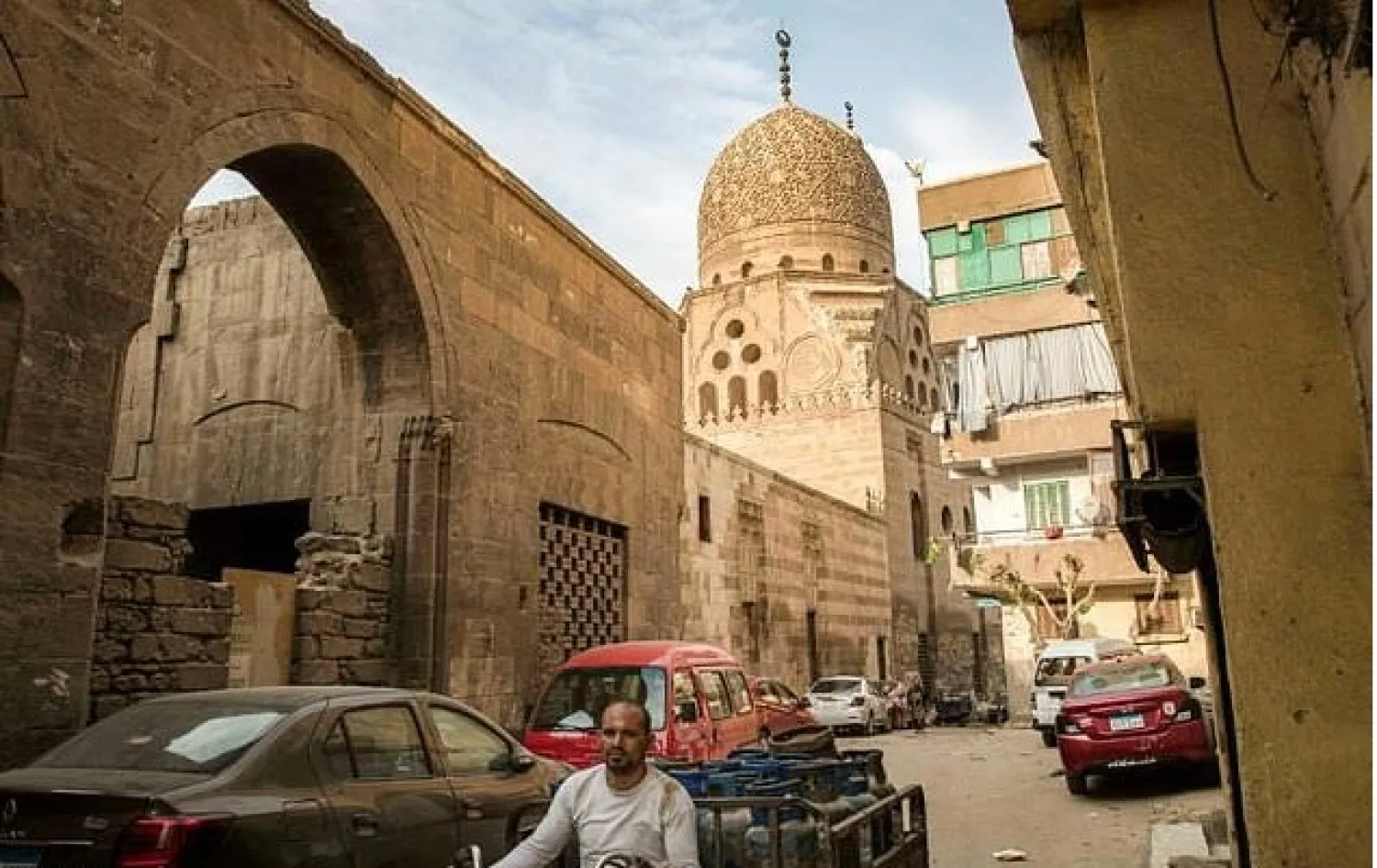
From the Mamluk period, the celebrated Sultan Qaitbay mosque -- featured on Egypt's one-pound notes -- is surrounded by monumental tombs, dusty alleys and informal housing. AFP
TT

Cairo's 'City of the Dead' Brought Back to Life

From the Mamluk period, the celebrated Sultan Qaitbay mosque -- featured on Egypt's one-pound notes -- is surrounded by monumental tombs, dusty alleys and informal housing. AFP

In Egypt's "City of the Dead", centuries-old monuments are being restored and artisanal heritage revived, turning a corner of the vast historical cemetery into a vibrant neighborhood full of life.

Wood, leather and jewelry workshops have joined those of glassblowers and others near the 15th-Century mosque of Sultan Qaitbay, in the east of the capital Cairo.

From the Mamluk period, the celebrated structure -- featured on Egypt's one-pound notes -- is surrounded by monumental tombs, dusty alleys and informal housing, AFP reported.

Since 2014, a series of projects financed by the European Union has changed the face of this small section of the sprawling necropolis -- home to many people who are unable to afford Cairo's prohibitively high rents.

Authorities began construction on a major road in July a short distance from the Qaitbay mosque, drawing strong criticism online for the resulting demolitions and evictions of residents of the "City of the Dead".

A final resting place for illustrious figures, including singer Farid al-Atrash and writer Ihsan Abdel Kouddous as well as ordinary Egyptians, the Islamic necropolis founded in the seventh century stretches over 6.5 kilometres (four miles).

"Before the projects, there was rubbish all over the streets," said 57-year-old Issem Abou Rami, who owns a small restaurant facing the mosque. "Now, a truck comes every day to collect it."

Products made in the impoverished neighborhood are now sold in elegant booths under restored stone arches -- and even online.

The renovation efforts started six years ago with the refurbishment of a drinking trough for animals, and then, the reception area of a residential complex of the sultan.

The EU contributed nearly a million euros ($1.1 million) toward the latest project, "The Heritage for the Living, in the 'City of the Dead'", which launched in 2018 and focuses on social development.

The project coordinator, architect Agnieszka Dobrowolska, was a linchpin to the area's metamorphosis.

She supervised the restorations of the monuments and the renovation of the workshop and their signage, as well as designed jewelry and leather products inspired by Mamluk motifs.

"When we first came here, our main object was to conserve the monuments," she told AFP.

"And we quickly realized that we cannot simply conserve the monuments, in disrespect to the people who live and work in the area," added Dobrowolska, founder of Archinos Architecture, which has worked on numerous conservation projects in Cairo.

Work in the ateliers was interrupted for several weeks due to the Covid-19 pandemic, but now the workshops are again up and running, with some 50 women making leather products and jewelry, all stamped with the local brand Mishka.

Aida Hassan, 45, has worked in the leather workshop for three years, and said she is happy to be earning "1,500 pounds ($96) per month -- and sometimes more".

"This project has helped improve my income," she added, saying she had gone on to train other women in leatherwork.

Hundreds of women and children in the neighborhood have benefited from courses and workshops on subjects as diverse as science and technology, English language and sports.

For the EU, the primary donor to the project -- due to end in 2021 -- the social elements of the program were key, said Christian Berger, head of the EU delegation in Egypt.

"Our intention is to support this type of project that benefits immediately vulnerable groups and disadvantaged groups, projects that have a broader socio-economic impact," Berger said.

The neighborhood has hosted concerts, from jazz to folk and traditional Egyptian music, and visual artists from Egypt and abroad have come to show their work.

The aim is to bring "contemporary art and culture here to enhance diversity of cultural expression (and) artistic expression, to build bridges between east and west," said Dobrowolska.

Another hope of the project in transforming the neighborhood is to draw in tourists.

The "City of the Dead" is sometimes an object of superstition due to its status as a necropolis, and is not a usual stop on mainstream Cairo tours.

But it is the tourists who are looking for something out of the ordinary that Dobrowolska said the project is counting on.

"We seek to attract tourists who are off-track from the mass tourism destinations -- people who might appreciate and enjoy the unique urban character of the necropolis," she said.



Beirut's 'Mother of Cats' Who Rescues Felines

Diana Abadi, known as "the mother of cats," sits with felines waiting for adoption at her small pet food and plant shop in Hadath, in Beirut's southern suburbs known as Dahiyeh, in Lebanon, Saturday, Feb. 7, 2026. (AP Photo/Bilal Hussein)
TT

Beirut's 'Mother of Cats' Who Rescues Felines

Diana Abadi, known as "the mother of cats," sits with felines waiting for adoption at her small pet food and plant shop in Hadath, in Beirut's southern suburbs known as Dahiyeh, in Lebanon, Saturday, Feb. 7, 2026. (AP Photo/Bilal Hussein)

Diana Abadi is known in the southern suburbs of Beirut as the “Mother of Cats.”

For the past 12 years, she has turned her home and shop into a refuge for abandoned felines who now number between 50 and 70, and she often sleeps beside the cats as she cares for them full time.

Abadi began by taking in a single kitten.

Word spread, and residents started bringing her injured and unwanted animals, especially during periods of crisis. At its peak, the shelter housed more than 150 cats, especially during the COVID-19 pandemic and the recent Israel-Hezbollah war, when fear and displacement led many people to abandon their pets.

Her plant and pet food shop in the southern suburbs known as Dahiyeh serves as both her livelihood and the cats’ shelter. Among those currently in her care are Joujou, 13, the oldest, as well as cats named Loulou, Fluffy, Emma and Panda.

One of the most challenging cases involves a cat that was completely blind when abandoned. A woman offered to cover the animal’s expenses if Abadi would take him in. After months of treatment, the cat has partially regained vision in one eye.

Social media has recently helped improve adoption rates, reducing the number of cats under Abadi's care. Rising costs, however, threaten the shelter’s future. Monthly rent has climbed to $800, up from $250 before the war, forcing Abadi to cover most expenses herself.

“These are living beings,” she said. “I don’t take holidays or Sundays off.”


Face of 400-Year-Old 'Vampire' Recreated

Scientists have given a face to a decapitated skull which was uncovered in Croatia. (Croatia’s excavation team)
TT

Face of 400-Year-Old 'Vampire' Recreated

Scientists have given a face to a decapitated skull which was uncovered in Croatia. (Croatia’s excavation team)

The face of a "vampire", whose remains were posthumously mutilated to prevent them from rising from the dead, can be seen for the first time in more than 400 years, reported Sky News.

Discovered in a grave at Racesa, a fortress in eastern Croatia, the body had been exhumed, beheaded and reburied face down beneath heavy stones.

And since the desecration cannot be explained by environmental factors, experts believe it was done to stop the dead man returning as a vampire.

Now the face of the deceased can be seen for the first time in centuries, after scientists rebuilt his likeness from his skull.

Archaeologist Natasa Sarkic, part of the excavation team, said the fear inspired by the man in death may stem from the fear he inspired in life.

She said: “Bioarchaeological analysis showed that this man often participated in violent conflicts, and died a violent death. He experienced at least three episodes of serious interpersonal violence during his lifetime.”

“One of those attacks left his face disfigured, which could cause fear and repulsion, leading to social exclusion. Before even recovering from the penultimate trauma, he sustained a final fatal attack,” she revealed.

“Individuals who died violently, behaved violently in life, or were considered sinful or socially deviant, were believed to be at risk of becoming vampires,” she continued.

“He may have been regarded as a 'vampire', or a supernatural threat due to his facial disfigurement and his marginal lifestyle, characterized by repeated interpersonal violence,” Sarkic explained.

She said such beings were thought to be restless, vengeful, and capable of harming the living, spreading disease and killing people or livestock.

Sarkic said that, in the Slavic tradition, the soul remains attached to the body for about 40 days after death.


Caffeinated Beverages May Help Protect the Brain, Study Says

A cup of coffee and a cappuccino are seen at a Juan Valdez store in Bogota, Colombia June 5, 2019. (Reuters)
TT

Caffeinated Beverages May Help Protect the Brain, Study Says

A cup of coffee and a cappuccino are seen at a Juan Valdez store in Bogota, Colombia June 5, 2019. (Reuters)

Drinking a few cups of caffeinated coffee or tea every day may help in a small way to preserve brain power and prevent dementia, researchers reported on Monday.

People with the highest daily intake of caffeinated coffee had an 18% lower risk of developing dementia compared to those with the lowest such intake, according to a study based on responses to questionnaires by 132,000 U.S. adults spanning four decades.

The study, published in JAMA, also found that the people with the highest intake had a lower rate - by nearly 2 percentage points - of ‌self-perceived memory ‌or thinking problems compared to those with ‌the ⁠lowest intake.

Results were ‌similar with caffeinated tea, but not with decaffeinated beverages, the researchers said.

While the findings are encouraging, the study does not prove caffeine helps protect the brain, they said.

The magnitude of caffeine's effect, if any, was small, and there are other better-documented ways to protect cognitive function as people age, study leader Dr. Daniel Wang ⁠of Harvard Medical School said in a statement.

Lifestyle factors linked with lower risks of ‌dementia include physical exercise, a healthy diet ‍and adequate sleep, according to previous ‍research.

"Our study suggests that caffeinated coffee or tea consumption can ‍be one piece of that puzzle," Wang said.

The findings were most pronounced in participants who consumed two to three cups of caffeinated coffee or one to two cups of caffeinated tea daily, the researchers reported.

Those who drank caffeinated coffee also showed better performance on some objective tests of cognitive function, according to the ⁠study funded by the National Institutes of Health.

Further research is needed to validate the factors and mechanisms responsible for the findings, the researchers said.

They noted that bioactive ingredients in coffee and tea such as caffeine and polyphenols have emerged as possible factors that reduce nerve cell inflammation and damage while protecting against cognitive decline.

"We also compared people with different genetic predispositions to developing dementia and saw the same results - meaning coffee or caffeine is likely equally beneficial for people with high and low genetic risk of developing ‌dementia," study coauthor Dr. Yu Zhang of the Harvard T.H. Chan School of Public Health said in a statement.