
Israeli Army Looks Forward to Biden’s Support to Resume Coordination with PA

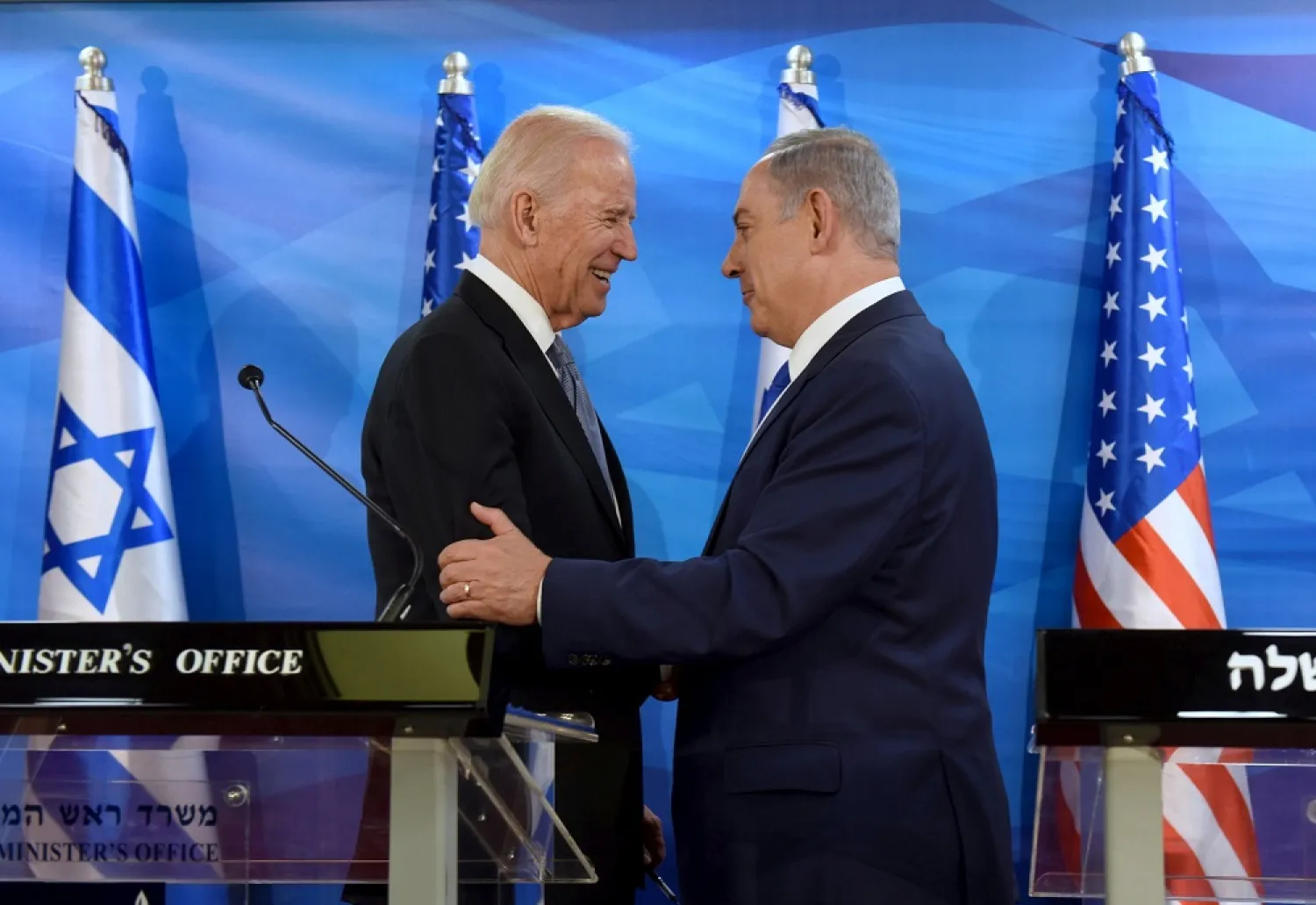
Then-Vice President Joe Biden shakes hands with Israeli Prime Minister Benjamin Netanyahu. (Reuters file photo)
TT

Israeli Army Looks Forward to Biden’s Support to Resume Coordination with PA

Then-Vice President Joe Biden shakes hands with Israeli Prime Minister Benjamin Netanyahu. (Reuters file photo)

Israeli army and intelligence top officials asked the government to seek the support of the US administration of President-elect, Joe Biden, to restore security coordination with the Palestinian Authority (PA), revealed security sources.

They said that top Israeli security officials want to resume the coordination with the Palestinians, in light of the damage the suspension caused to both sides.

In May, President Mahmoud Abbas ended the coordination with Israel after Prime Minister Benjamin Netanyahu announced his plans to annex 30 percent of the occupied West Bank.

The sources said the army and intelligence services had doubled their work since then, and that Palestinian officials and the general public were having issues with travel and transportation, which was raising public discontent.

Top Israeli security officials met to assess the situation after Biden’s election as president and its impact on security in the Middle East and Israel.

They believe the relations between the PA and the new US administration would resume, which could include the restoration of security coordination between the Preventive Security Service (PPS) and US intelligence - also suspended by Abbas.

They predicted that the resumption of relations would lead to restoration of US financial support to Palestine, stressing that they do not expect dramatic developments in political negotiations.

However, they do expect important developments, such as Abbas allowing the collection of Palestinian tax and customs, which Israel collects and the Authority refuses to receive according to Israeli conditions.

The officials believe that this will gradually contribute to stabilizing the economic and security situations.

Israel Hayom quoted a security source as saying that Israel is concerned about possible international pressure to make concessions to the Palestinians, which, if not made, could have a negative impact on its relations with Arab countries.

The report addressed the Iran, noting that officials are concerned that the Biden administration might bring back the nuclear deal. However, they said that if Trump had won a second term, he would have also moved towards a deal with Tehran.

Tel Aviv fears that the new administration might accept conditions similar to those included in the original agreement reached under former President Barack Obama.

They stated that an agreement with Iran on its nuclear program is not necessarily a negative approach, as long as it leads to a better deal curbing its missile program and role in the region.

They suggested that the government should take a positive approach towards the Biden administration in order to adopt the Israeli demands for these negotiations.

In its second half, the report focused on bilateral political, military and strategic relations with Washington.

It expressed Israeli confidence that the cooperation between US and Israeli security ministries, armies and intelligence services will not be affected by the change of administration in Washington.

The Biden administration will continue to maintain Israel's military superiority in the Middle East, and the annual US military aid, which was approved during Obama’s term at $3.8 billion per year.



Abdelatty Receives Al-Sheikh as Egypt Steps Up Efforts for Palestinian Reconciliation

Egyptian Foreign Minister Badr Abdelatty receives Palestinian Vice President Hussein al-Sheikh on Tuesday. (Egyptian Foreign Ministry)
TT

Abdelatty Receives Al-Sheikh as Egypt Steps Up Efforts for Palestinian Reconciliation

Egyptian Foreign Minister Badr Abdelatty receives Palestinian Vice President Hussein al-Sheikh on Tuesday. (Egyptian Foreign Ministry)

Egypt is pressing ahead with intensive diplomatic efforts to achieve Palestinian reconciliation through a series of meetings with the Palestinian Authority (PA) in the Egyptian city of El Alamein, a day after an Egyptian source told Asharq Al-Awsat that preparations were underway for a Palestinian national dialogue.

Egyptian Foreign Minister Badr Abdelatty received Palestinian Vice President Hussein al-Sheikh in El Alamein, Palestinian National Council President Rawhi Fattouh and Fatah Central Committee member and Palestinian intelligence chief Majed Faraj as part of continuing consultations on developments in the Palestinian Territories and efforts to support the legitimate rights of the Palestinian people, Egypt’s Foreign Ministry said Tuesday.

The meeting addressed efforts to achieve Palestinian reconciliation, restore Palestinian unity and continue the ongoing political reform process.

The officials also discussed the “catastrophic situation in the Gaza Strip resulting from the inhumane Israeli practices”, as well as the need for the international community to pressure Israel to fulfill its obligations under US President Donald Trump’s peace plan.

These include allowing humanitarian aid to flow unhindered and carrying out withdrawals from Gaza to pave the way for the PA to resume full responsibility for the enclave.

The Egyptian statement quoted al-Sheikh as praising Cairo’s efforts and contacts to halt escalation, advance implementation of the peace plan and support the PA.

He stressed the importance of maintaining close coordination and consultations with Egypt in the coming period.

On Sunday evening, Egyptian General Intelligence Service chief Hassan Rashad received a PA delegation headed by al-Sheikh and including Fattouh and Faraj as part of Cairo’s efforts to promote Palestinian unity.

The talks covered developments in the West Bank and upcoming Palestinian elections. They agreed to coordinate national efforts to confront the challenges facing the Palestinian cause, according to Egypt’s official news agency.

In a related development, an informed Palestinian source told Asharq Al-Awsat on Tuesday that Egypt was engaged in intensive contacts with the PA and factions aimed at unifying Palestinian ranks.

The source stressed that Cairo’s efforts to arrange a meeting between Fatah and Hamas in Egypt were continuing.

Three Hamas sources said Monday that the movement had been informed that Fatah had canceled a meeting scheduled to take place in El Alamein to discuss several issues, foremost among them legislative elections set for November 28.

The three sources separately told Asharq Al-Awsat that Egypt had arranged the bilateral meeting for Monday, but it was canceled at Fatah’s request. They offered no explanation for the cancellation.

Efforts to reconcile the Palestinian factions have been pursued for years, with Cairo sponsoring several rounds of talks that failed to produce a final agreement.

Hamas is now moving toward an alliance with Palestinian politician Mohammed Dahlan, who previously broke with Fatah, ahead of the elections.

On Monday, an informed Egyptian source told Asharq Al-Awsat that Egypt was preparing for an intra-Palestinian dialogue that Palestinian President Mahmoud Abbas could attend.


Syria, Lebanon Revive Rail Link Plans, Eye Connections to Iraq, Gulf and Türkiye

Syrian Transport Minister Yarub Badr and Lebanese Public Works and Transport Minister Fayez Rasamny speak at a press conference at the Syrian Transport Ministry. (SANA)
TT

Syria, Lebanon Revive Rail Link Plans, Eye Connections to Iraq, Gulf and Türkiye

Syrian Transport Minister Yarub Badr and Lebanese Public Works and Transport Minister Fayez Rasamny speak at a press conference at the Syrian Transport Ministry. (SANA)

Lebanese Public Works and Transport Minister Fayez Rasamny announced Tuesday that Lebanon and Syria had set the broad outlines for rail connectivity between the two countries, with a technical committee to examine a unified route linking them to Iraq, the Gulf states and Türkiye.

Speaking at a joint news conference in Damascus with Syrian Transport Minister Yarub Badr, Rasamny explained that a specialized committee would study the technical aspects of preparing the route.

Badr noted that the two sides had reached understandings paving the way for practical steps to serve their transport sectors and agreed to form a joint technical team to follow up on implementation.

He added that cooperation between Syria and Lebanon could help attract donor support and secure financing for joint projects, while efforts were underway to remove obstacles hindering progress.

Badr met Rasamny at the Transport Ministry in Damascus to discuss improving transport links between the two countries. Their talks covered several key files, foremost among them strengthening road and rail connections.

Badr reviewed the state of Syria’s land transport sector and prospects for its development under the national sustainable land transport policy, based on economic efficiency, competitiveness, social integration, safety and environmental considerations.

He outlined plans to rehabilitate and expand the main road network, advance digital transformation, regulate the sector and develop railway projects.

Badr stressed the importance of closer coordination and intensified efforts to improve transport links with Lebanon, facilitate the movement of people and goods, stimulate trade and strengthen connectivity with the wider region.

Rasamny called for accelerating work, exchanging ideas and expertise, and setting clear, time-bound objectives. He said that such steps would strengthen Syrian-Lebanese cooperation, support economic prosperity in both countries and expand commercial transport links with their regional surroundings.

Lebanese government sources had earlier told Syria TV that the official visit was devoted to discussing joint transport and infrastructure files and reviving technical cooperation between the relevant ministries and institutions in both countries.


Israel Defense Minister Vows to Keep Troops in Syria During Visit

25 June 2024, Jerusalem: Israeli Defense Minister Israel Katz is pictured in Jerusalem. (dpa)
TT

Israel Defense Minister Vows to Keep Troops in Syria During Visit

25 June 2024, Jerusalem: Israeli Defense Minister Israel Katz is pictured in Jerusalem. (dpa)

Israeli Defense Minister Israel Katz made a rare visit to troops in southern Syria on Tuesday, reiterating a pledge to keep forces in the area as long as there were "threats" to his country's security.

Damascus slammed Katz's "illegal entry" into the country, which came a week after Israel bombed the disused Abu al-Duhur base in northwestern Syria, claiming it wanted to prevent Turkish troops deploying to the facility. Ankara has denied any visit to the site.

In southern Syria, Israeli forces have been stationed in a "security zone" since the fall of longtime ruler Bashar al-Assad in December 2024.

They occupy what was previously a buffer zone patrolled by the United Nations that had separated Israeli and Syrian forces in the Israeli-occupied Golan since 1974.

"There is daily activity here to thwart threats, to eliminate remnants of the old regime, to prevent dangerous consolidation of the new regime," Katz said according to a video statement from his office.

"The message is clear to the president of Syria as well: when you wake up in the morning in your palace in Damascus, look up at Mount Hermon and see the Israeli army -- you know we are here to protect our communities and our border," he added.

"As long as there are threats, the army will remain here to guarantee our security -- this is what we have done and this is what we intend to continue doing in the future," Katz said.

Syria's foreign ministry said Katz's visit was a "flagrant violation of the country's sovereignty and territorial integrity".

It went on to urge the international community to take "the necessary measures to force the occupying authorities to halt these repeated violations".

Israel has carried out hundreds of strikes in Syria since the fall of Assad and made repeated incursions into Syrian territory.

Officials have also repeatedly vowed to keep troops in the security zone, where Israel is seeking a broader demilitarized area.

Israeli army chief Lieutenant General Eyal Zamir visited troops in the security zone last week, saying the military would not allow threats to "establish themselves" on the border.

During his visit on Tuesday, Katz addressed the strike on the Abu al-Duhur air base, saying Israel had "acted against a Turkish attempt to entrench itself in Syria, at the risk of Israel's security interests".