
How Shows Resumed Filming in Pandemic N.Y.C.

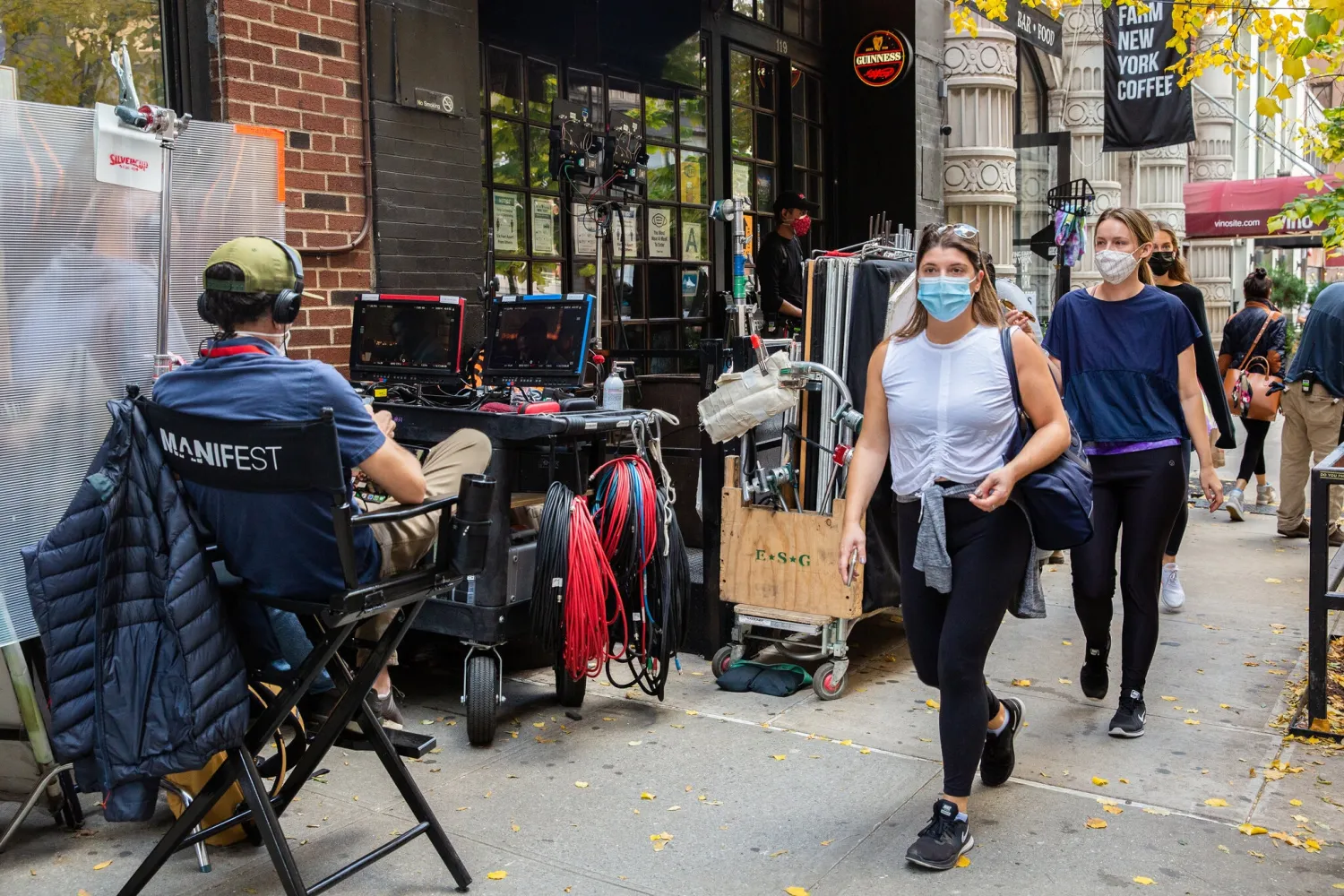
Pedestrians passing through a set for the TV series “Manifest” in Manhattan.Credit...Sarah Stacke for The New York Times
TT

How Shows Resumed Filming in Pandemic N.Y.C.

Pedestrians passing through a set for the TV series “Manifest” in Manhattan.Credit...Sarah Stacke for The New York Times

Across from Bellevue Hospital in Manhattan recently, dozens of crew members in yellow safety vests filmed a scene for the TV medical drama, “New Amsterdam," as real doctors and nurses skirted past them. A few blocks away, the television series “Manifest” wrapped up a morning shoot inside a cozy bar, then set up a crane to light a night shoot at a Midtown playground.

With Broadway dark, concert venues closed and live performances strictly limited, New York’s powerhouse arts and entertainment industry has been devastated by the coronavirus pandemic. But amid the downturn, film production has been a bright spot, with television and streaming series again filling the city’s sound stages and, increasingly, the city’s streets, despite a rise in virus cases in New York and across the nation.

The film and television industry, which brought $60 billion to the city in the year before the pandemic, is not yet back to its old heights. Of the nearly 80 series that were filming or planning to film in New York City in the 2019-2020 season, 35 were back at work by early November — including popular shows like “Younger and “Blue Bloods” — with another five expected back by the end of the year, according to the Mayor’s Office of Media and Entertainment.

A virus surge could threaten that recovery, particularly if Gov. Andrew M. Cuomo declares New York a “red zone” and orders all nonessential businesses closed again.

Still, in a pandemic-weary Manhattan, whose streetscapes are pockmarked by boarded-up storefronts and “for rent” signs, the sight of dozens of shiny production trucks and the hum of workers rolling equipment on and off film sets is giving the city a glimpse of its former self. It is also getting thousands of people back to work, and burnishing the image of New York as a resilient metropolis to the millions who watch New York-based television shows worldwide.

The city’s major studios — Kaufman Astoria Studios in Queens, Steiner Studios in the Brooklyn Navy Yard and Silvercup Studios in Long Island City — all report that they are full, though each stage can only function at 50 percent of its regular occupancy under state rules.

“It’s a very mobile industry; they don’t have to be in New York,” said Hal Rosenbluth, the president of Kaufman Astoria Studios in Queens, of his studio being full again. “The thing that made me feel good, is that the executives that make these decisions were still confident to come back to New York, and that is the best statement you can say.”

The overlapping safety protocols of the industry’s labor unions, the Hollywood parent companies and the New York state and city government have led to robust safety protections, at least for major studio projects. While near daily virus testing is turning up coronavirus cases among the crew and actors, the productions, for the most part, have continued with few delays. To satisfy homebound audiences eager for new content, studios been willing to pay big for safety measures, with production costs ballooning by around 30 percent.

“Just the Covid division alone for each production could be up to 40 people,” said Doug Steiner, the chief executive of Steiner Studios, where seven series, including Amazon’s “The Marvelous Mrs. Maisel” and Showtime’s “City on a Hill," are back in business.

About one person every week or two test positive somewhere on the lot, Mr. Steiner said. But so far, he said, the productions have managed to isolate cases and their contacts, and continue filming. Studios pay for testing, and their coronavirus teams do their own contact tracing.

The city said that at least one production had shut down for two weeks because of virus cases, while others have shut down for a day or two.

It’s impossible to get a complete picture of how often the coronavirus is appearing on set, as no one is tracking that number fully. Daniel Hank, a New York producer and a member of the Directors Guild of America, cited informal numbers put out by the organization internally, which reported a total of 113 virus “events”— which could include anything from a false positive to multiple positive tests — on film and television sets across North America, 59 of which resulted in a pause in production. The Directors Guild said that those numbers were anecdotal and not intended for public release.

Projects have found a way to keep filming because it is too costly just to stop, said Mr. Hank, who leads a weekly call for producers to share advice on filming during a pandemic. “It adds a level of complexity that’s one more challenge to overcome in an industry filled with challenges,” he said.

On-location shooting in New York has been slower to return, with the logistical puzzle of filming in a busy city made even more difficult by new social distancing requirements and increased demands on outdoor space. Outdoor dining structures, for example, now cover many sidewalks and parking spots.

(Filming in Los Angeles is also recovering, although permit requests remain at about half the levels analysts would expect in a typical year, according to FilmLA, the partner film office for the city of Los Angeles.)

The interplay between the public and the film crew in the city has also been transformed. Film crews are used to dealing with a mix of curious onlookers and “real New Yorkers” who walk right through the set without noticing.

“Now, I see people do a double take and walk the other way,” said Kelly Mahoney, the first assistant director on the set of the NBC series “Manifest,” which was back shooting in Manhattan for the first time in mid-November. “It was really strange to me.”

On set, the most obvious change is that masks are mandatory, as are face shields for the crew closest to the actors. Portable sinks have become a new must-have street accessory. Color-coded bracelets or lanyards mark what zone a crew member is assigned to, in order to limit contact between workers and those allowed near the action. Actors take off their own masks to film scenes, and then put them on again when a crew member yells cut.

“Manifest" has not yet had a virus case on set, said Harvey Waldman, one of the show’s producers, “but it is a little bit like playing Russian roulette, all the time.” At the same time, he said, “you also feel this comradeship, and you feel that people are watching out for each other.”

The productions have mostly stuck to filming inside sound stages, where they can tightly control the environment. Script writers have also made adjustments, limiting intimate scenes, extras and shifting some shoots to more spacious settings outside the city.

Before the pandemic, the Mayor’s Office of Media and Entertainment generally issued about 1,000 permits per month for outdoor filming on public property. After a complete spring shutdown, the numbers began to rebound in September, when film crews of up to 100 were allowed to work. Last month, 559 permits were granted.

“Slow and steady wins the race, and that’s what we are seeing right now,” said Anne del Castillo, the city’s media and entertainment commissioner. “It’s one of the bright spots in the recovery, and I love talking about it.”

But the return to the city streets in the last few weeks has offered a sometimes worrying level of interaction between the crews and the public, with both sides wary.

On the set of “New Amsterdam” on a recent Tuesday, for example, the large crew found it impossible to perfectly socially distance while setting up for the actors in a small park and traffic lane on First Avenue. Bikers kept rolling through the set, and the lighting crane was temporarily stored right next to the active Citi Bike rental station.

“Please stay at least six feet away — we have all been tested,” one crew member warned a lingering pedestrian.

With the extra cost of everything from testing to transportation, many projects, particularly smaller ones or those not yet filming, are pausing until the spring, said Flo Mitchell Brown, the chair of the industry group New York Production Alliance.

Commercials and smaller projects do not have to abide by the same safety protocols agreed to by the major studios, so their virus protections can be more variable. False positives have also caused closures on some sets, to the point where some major studios have stopped using rapid tests, Mr. Hank said.

Inside the city’s live television studios, frequent testing, social distancing and masks have also enabled a return to production, though with huge changes from the pre-pandemic era. Candi Carter, the executive producer of the “Tamron Hall” show, which broadcasts from the Upper West Side, uses an empty green room as her makeshift office, because all the guests and audience on the show are virtual. Everyone who can work from home does.

Though things feel “bizarre, to say the least,” Ms. Carter said, it is an improvement over the many weeks this spring Ms. Hall was filming from her New York City kitchen. Audiences seem to agree, and ratings are up.

“I think people want to see regular TV again,” she said. “Everyone on our staff is completely on board. And that’s how we are able to do it.”

The New York Times


Nepal Halts Search after Guide Killed, Iranian Climber Missing

A tourist looks at a view of Mt. Everest from the hills of Syangboche in Nepal December 3, 2009. REUTERS/Gopal Chitrakar
TT

Nepal Halts Search after Guide Killed, Iranian Climber Missing

A tourist looks at a view of Mt. Everest from the hills of Syangboche in Nepal December 3, 2009. REUTERS/Gopal Chitrakar

Bad weather forced Nepali rescuers to suspend the search Monday for an Iranian climber missing for four days after an accident which killed a Nepali team member, expedition organizers said.

Extreme conditions, including fierce winds, made rescue efforts impossible on the 8,481-meter (27,825-feet) high Mount Makalu, the world's fifth highest mountain.

Iranian climber Abolfazl Gozali, 42, and Nepali guide Phurba Ongel Sherpa, 44, were part of a rare winter expedition on the peak.

The four-member team successfully summited on Thursday, but during the descent the guide fell to his death.

Team lead Sanu Sherpa, who has climbed all 14 highest peaks in the world at least twice, and Lakpa Rinji Sherpa went to his aid but found that he had fallen hundreds of meters and did not survive.

When they returned to where they had left Gozali, he was no longer there.

"A team of eight experienced climbers have been sent but the wind has been very strong and affected the search," Madan Lamsal of expedition organizer Makalu Adventure told AFP.

"We hope to resume soon."

Lamsal said the rescuers intend to find Gozali, as well as recover the guide's body.

Phurba Ongel Sherpa was a highly experienced mountaineering guide with multiple summits of Everest and other major peaks.

Gozali is also an accomplished climber, who has climbed two of world's highest peaks and completed the "snow-leopard peaks" -- the five mountains of over 7,000 meters between Tajikistan and Kyrgyzstan.

This was his second attempt to summit Makalu in winter. Last year, freezing temperatures and high winds forced the team to turn back, just 800 meters short of the summit.

Nepal is home to eight of the world's 10 highest peaks, including Mount Everest, and welcomes hundreds of climbers every year during the spring and autumn climbing seasons.

Dangerous terrain and extreme weather can make winter expeditions particularly risky.


Shark Mauls Surfer in Sydney, 3rd Attack in Two Days

People stand next to warning signs in place, and beaches are closed after a surfer suffered a shark attack at Dee Why Beach in Sydney, Australia, January 19, 2026. REUTERS/Jeremy Piper
TT

Shark Mauls Surfer in Sydney, 3rd Attack in Two Days

People stand next to warning signs in place, and beaches are closed after a surfer suffered a shark attack at Dee Why Beach in Sydney, Australia, January 19, 2026. REUTERS/Jeremy Piper

A shark mauled a surfer off an ocean beach in Sydney on Monday in the Australian city's third shark attack in two days, authorities said.

The surfer, believed to be in his 20s, was in a critical condition in hospital with serious leg injuries after the attack at a northern Sydney beach, police said.

"The man was pulled from the water by members of the public who commenced first aid before the arrival of emergency services," New South Wales state police said in a statement.

All of Sydney's northern beaches were closed until further notice.

The attack at North Steyne Beach in the suburb of Manly came hours after a shark bit a large chunk out of a young surfer's board about 4 kilometers (2.5 miles) north along the coast at Dee Why Point.

That surfer, reportedly a boy aged about 11, was uninjured but the beach was closed immediately, AFP reported.

On Sunday, a large shark bit a 12-year-old boy in the legs as he played with friends at a beach in Sydney harbor, leaving him fighting for survival in hospital.

The boy and his friends were jumping from a six-meter (20-foot) rock into the water off Shark Beach in the eastern suburb of Vaucluse when the predator struck, police said.

"It was a horrendous scene at the time when police attended. We believe it was something like a bull shark that attacked the lower limbs of that boy," said Superintendent Joseph McNulty, New South Wales marine area police commander.

"That boy is fighting for his life now," he told reporters on Monday.

Recent heavy rain had drained into the harbor, and authorities believed the combination of the brackish seawater and the children's splashing created a "perfect storm" for a shark attack, McNulty said.

He warned people not to go swimming in the harbor or other river systems in New South Wales because of the risks.

He praised the boy's "brave" young friends for pulling him out of the water on Sunday.

Officers put the unconscious child in a police boat and gave him first aid, applying two tourniquets to stem the bleeding from his legs, McNulty said.

They tried to resuscitate the boy as they sped across the harbor to a wharf where ambulance paramedics were waiting.

The child, confirmed by police to be 12 years old, was in intensive care at Sydney Children's Hospital surrounded by family and friends, McNulty said.


China’s Population Falls Again as Births Drop to Lowest Rate Since 1949 Communist Revolution

 Women push baby strollers as they walk along a street in Beijing on January 4, 2026. (AFP)
Women push baby strollers as they walk along a street in Beijing on January 4, 2026. (AFP)
TT

China’s Population Falls Again as Births Drop to Lowest Rate Since 1949 Communist Revolution

 Women push baby strollers as they walk along a street in Beijing on January 4, 2026. (AFP)
Women push baby strollers as they walk along a street in Beijing on January 4, 2026. (AFP)

How do you persuade a population to have more babies after generations of limiting families to just one?

A decade after ending China's longtime one-child policy, authorities are pushing a range of ideas and policies to try and encourage more births — tactics that range from cash subsidies to taxing condoms to eliminating a tax on matchmakers and day care centers.

The efforts haven't paid off yet. At least, that's what population figures released Monday show for what is now the world's second-most populous nation. China's population of 1.4 billion continued to shrink, marking the fourth straight year of decrease, new government statistics show. The total population in 2025 stood at 1.404 billion, which was 3 million less than the previous year.

Measured another way, the birth rate in 2025 is the lowest on record since 1949, the year that Mao Zedong’s Communists overthrew the Nationalists and began running China. Figures before that, under the previous Nationalist government, were not available. The rate of 5.63% is the number of births per 1,000 people.

China was long the world’s most populous nation until 2023, when it was surpassed by regional neighbor and sometime rival India. Monday's statistics illustrate the stark demographic pressures faced by the country as it tries to pivot from a problem it is working hard to overcome: status as a nation with a growing but transitional economy that, as is often said, is “getting old before it gets rich.”

Is a snake involved? The number of new babies born was just 7.92 million in 2025, a decline of 1.62 million, or 17%. The latest birth numbers show that the slight tick upwards in 2024 was not a lasting trend. Births declined for seven years in a row through 2023.

Most families cite the costs and pressure of raising a child in a highly competitive society as significant hurdles that now loom larger in the face of an economic downturn that has impacted households struggling to meet their living costs. Another potential factor in the numbers: last year in China was the year of the snake, considered one of the least favored years for having a child under the Chinese zodiac.

Like many other countries in Asia, China has faced a declining fertility rate, or the average number of babies a woman is expected to have in her lifetime. While the government does not regularly publish a fertility rate, last saying it was 1.3 in 2020, experts have estimated it is now around 1. Both figures are far below the 2.1 rate that would maintain the size of China's population.

For decades, the Chinese government barred people from having more than one baby and often sanctioned those who did — a policy that produced more than two generations of only children. In 2015, the government raised the permitted amount of offspring to two and then, facing demographic pressure, further revised the limit to three kids in 2021.

The push for more births is about the economy. China now has 323 million people over 60, or 23% of the entire population. That number has continued to rise, while the working-age population is shrinking, meaning there are fewer workers to support the older population.

This demographic shift is happening while China is in the process of trying to transition away from labor-intensive industries like farming and manufacturing into a consumer-driven economy built with high-tech manufacturing. The difficulty is in trying to get richer as a country, while this population shift likely means a slowing economy.

Officials have had limited success with policy changes to incentivize families to have more children. In July, the government announced cash subsidies of 3,600 yuan ($500) per child to families.