


Circular Carbon Economy: Global Saudi Initiative for Energy Sustainability, Environmental Protection

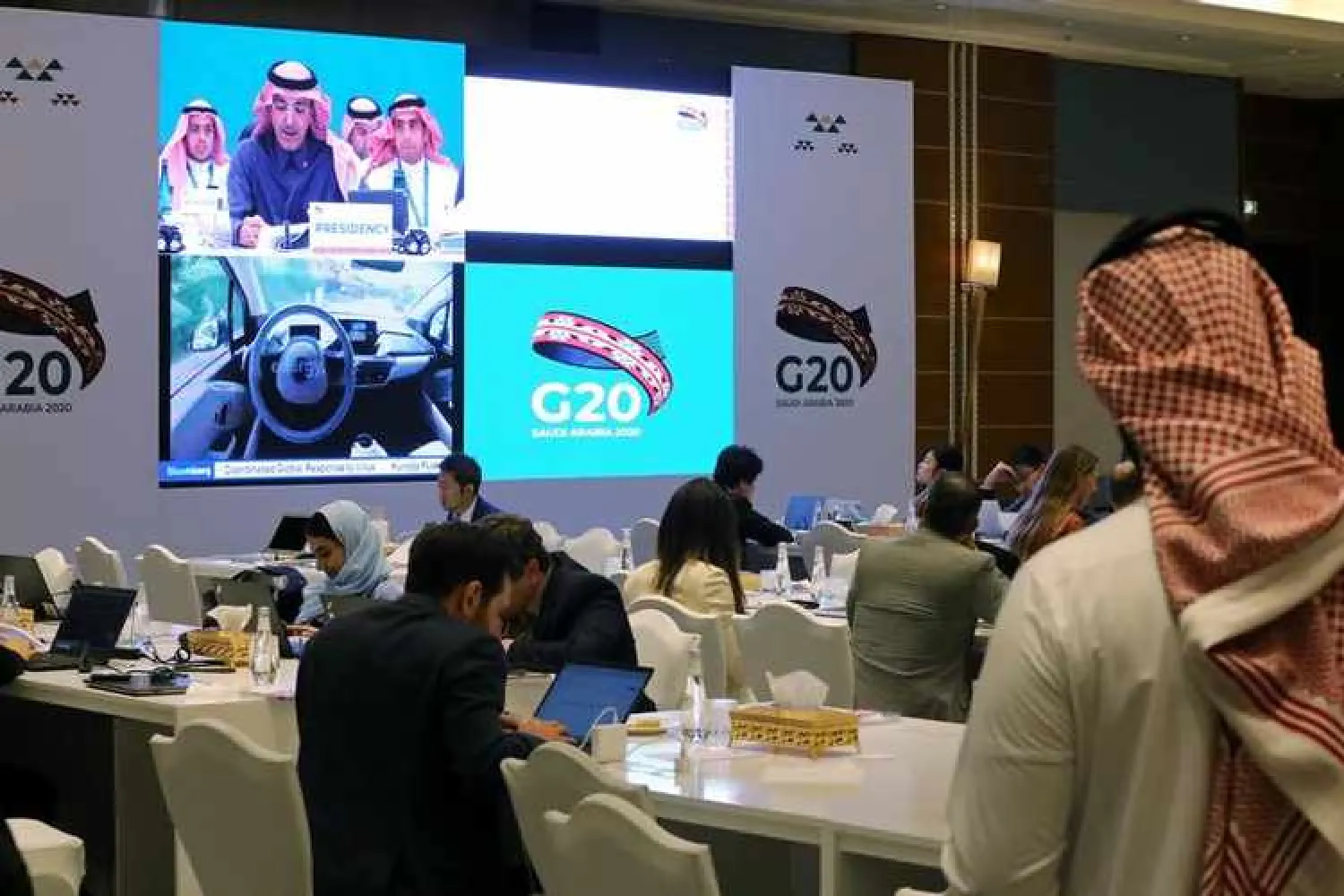
Journalists sit in the media center during a G20 meeting in Riyadh, Saudi Arabia, February 22, 2020. REUTERS/Ahmed Yosri
TT

Circular Carbon Economy: Global Saudi Initiative for Energy Sustainability, Environmental Protection

Journalists sit in the media center during a G20 meeting in Riyadh, Saudi Arabia, February 22, 2020. REUTERS/Ahmed Yosri

Saudi Arabia’s concept of circular carbon economy strategy has found an international welcome during the Saudi G20 Summit. The proposal constitutes a revolutionary innovation in reducing the rate of carbon emissions, as it included a new supporting component for the three existing principles.

The circular carbon economy is an idea that emerged from Riyadh, and aims to encourage the use of all types of energy existing on the surface of the earth but within controls that ensure their sustainability and at the same time reduce climate change.

The Saudi efforts concluded by adding the “reuse” component within the three elements: “reduction”, “recycling” and “disposal”; thus completing the tight circular system and helping to restore balance to the carbon cycle in the same way that occurs in nature.

More practically, the circular carbon economy project will convert the greenhouse gases that are one of the main contributors to global warming into a fully-fledged economy, based on a high-precision technical treatment of carbon emissions from all industrial sectors through the mentioned four strategies.

The circular carbon economy system would help restore the balance of the carbon cycle in the same way that it occurs in nature, which would make this industrial innovation mitigate the accumulations of carbon in the atmosphere and limit its negative effects on public health.

The idea of a circular carbon economy, which includes the ‘reuse’ component that is proposed by Saudi Arabia, would mean that carbon emissions are captured and stored underground, and then converted into useful products, such as fertilizers and methanol.

Eric Williams, energy and environmental economist at the King Abdullah Petroleum Studies and Research Center told Asharq Al-Awsat the reports prepared on the circular economy of low carbon emissions have been submitted to the Saudi G20 meetings, adding that the center has launched, in cooperation with five international organizations, a guide to carbon circular economy.

“We have worked with the International Energy Agency, the International Renewable Energy Agency, the Nuclear Energy Agency, the Organization for Economic Cooperation and Development, as well as the Global Carbon Capture and Storage Institute, to clarify the opportunities presented by the circular carbon economy approach that includes the principles of reduction, reuse, recycling and disposal,” he said.

Williams noted that the studies also covered the need to take into account the local conditions of each country when implementing the new concept, in a manner that does not conflict with sustainable global development.

He added that Saudi Arabia has achieved a clear and complete approach that would create an integrated and practical framework for managing the carbon emissions process and move towards a comprehensive, flexible, sustainable energy system free of emission leaks.



Egypt Says it Will Pay $1.3 Billion in Arrears to Oil Companies by June

Egypt had accumulated about $6.1 billion in arrears to foreign oil companies by June 30, 2024  (Ministry of Petroleum)
Egypt had accumulated about $6.1 billion in arrears to foreign oil companies by June 30, 2024 (Ministry of Petroleum)
TT

Egypt Says it Will Pay $1.3 Billion in Arrears to Oil Companies by June

Egypt had accumulated about $6.1 billion in arrears to foreign oil companies by June 30, 2024  (Ministry of Petroleum)
Egypt had accumulated about $6.1 billion in arrears to foreign oil companies by June 30, 2024 (Ministry of Petroleum)

Egypt will settle $1.3 billion in arrears to international oil companies by June, the petroleum ministry said on Saturday, accelerating its previous timetable for repayments.

Egypt had accumulated about $6.1 billion in arrears to foreign oil companies by June 30, 2024 due to a prolonged foreign currency shortage that delayed payments and weighed on investment and gas output. The shortage has since eased, ⁠though some companies have ⁠said that arrears have been once again accumulating.

Under its prior timetable, announced in January this year, the government had expected to still have arrears of some $1.2 billion by June.

Clearing debt may encourage ⁠foreign oil and gas companies to resume drilling, which would boost local production that has been steadily falling since peaking in 2021.

More local production would help the country to reduce its energy imports.


China's Premier Vows to Expand Global 'Trade Pie'

Chinese Premier Li Qiang is seen on a big screen live broadcasting his speech at the opening of the China Development Forum 2026 held at the Diaoyutai State Guesthouse in Beijing on March 22, 2026. (Photo by Ng Han Guan / POOL / AFP)
TT

China's Premier Vows to Expand Global 'Trade Pie'

Chinese Premier Li Qiang is seen on a big screen live broadcasting his speech at the opening of the China Development Forum 2026 held at the Diaoyutai State Guesthouse in Beijing on March 22, 2026. (Photo by Ng Han Guan / POOL / AFP)

China's number two leader Li Qiang said Sunday that his country was willing to help expand the global "trade pie" by further opening up, state media reported, while he slammed unilateralism from certain countries.

Many of China's key trading partners have increasingly called on Beijing to reduce its soaring trade surplus owing to its impact on local competition.

Its trade surged by a fifth in the first two months of the year, official data showed earlier this month, significantly outpacing forecasts.

China "will steadfastly advance high-level opening up, import more high-quality foreign goods, and work alongside all parties to promote the optimized and balanced development of trade", Premier Li Qiang told business executives in Beijing on Sunday, according to Xinhua.

Li was speaking at the opening of the annual China Development Forum, attended this year by prominent business leaders including Apple CEO Tim Cook, AFP reported.

The Chinese premier added that Beijing would work with other countries to "join forces to make the global economic and trade pie larger for everyone".

He slammed growing unilateralism and protectionism, which he said was "no panacea for resolving problems".

Beijing has been seeking to steer a shaky economy onto a more stable path since the end of the pandemic, particularly by boosting consumption.

It had been locked in a blistering trade war last year with Washington after President Donald Trump imposed tariffs on countries including China.

The recent trade boost is a lifeline for China, the world's second-largest economy, as domestic consumer activity has slumped, and adds to the record surplus achieved last year.

The China Development Forum convenes as the Middle East war, triggered by US and Israeli strikes on Iran, rages on.

Tehran has retaliated with strikes across the region and beyond in a conflict that has threatened global energy security as well as China's oil supplies.

Li told the Chinese officials and global business executives the international rules-based order was suffering "severe disruption" with power politics "running rampant".

Chinese Vice Premier He Lifeng met with senior representatives of multinational companies including HSBC, UBS, Schneider Electric and Standard Chartered on Saturday, Xinhua reported.


EU Urges Reduced Gas-storage Target

Europe's largest gas storage facility in Rehden, Germany (Reuters)
TT

EU Urges Reduced Gas-storage Target

Europe's largest gas storage facility in Rehden, Germany (Reuters)

The European Commission on Saturday urged EU member countries to lower their target for filling natural gas storage in the coming months, to alleviate price pressures caused by the war in the Middle East.

EU energy commissioner Dan Jorgensen sent a letter asking to "consider reducing your filling target to 80 percent as early as possible in the filling season to provide certainty and reassurance to market participants", down from the usual 90 percent goal.

Iran's retaliation for the US-Israeli war launched against has included attacks on Gulf neighbors, effectively closing the strategic Strait of Hormuz to tankers.

Oil prices have soared more than 50 percent since the start of the war, which was triggered on February 28, and natural gas prices in the EU have risen by more than 30 percent.

The price shock is expected to lead to a higher pace of inflation, and dampen economic growth.

While Europe is entering its warmer months, this is the period its countries refill their gas storage in preparation for winter.

With higher gas prices, though, and elevated risk for supply, the EU is facing competition with Asia for supply.

"Developments in Iran and the wider region threaten regional and global security," Jorgensen said in his letter.

"When it comes to energy, this situation and the attacks on energy infrastructure are significantly impacting global oil and gas markets."

He said that the EU's gas supply "remains relatively protected at this stage", as it gets most of its liquefied natural gas from the United States.

"But, as a net energy importer on global markets, the resulting high and volatile global prices may also impact the EU gas storage projections."

Consequently, Jorgensen said, EU countries should look to refill stores early, and do so over a longer period, "to mitigate pressure on prices and avoid (an) end-of-summer rush".

He noted that, in case of "difficult conditions" and a commission assessment, the countries can deviate from the target by up to 20 percent.