


Israeli Army Warns of Jewish Terrorist Attacks against Palestinians

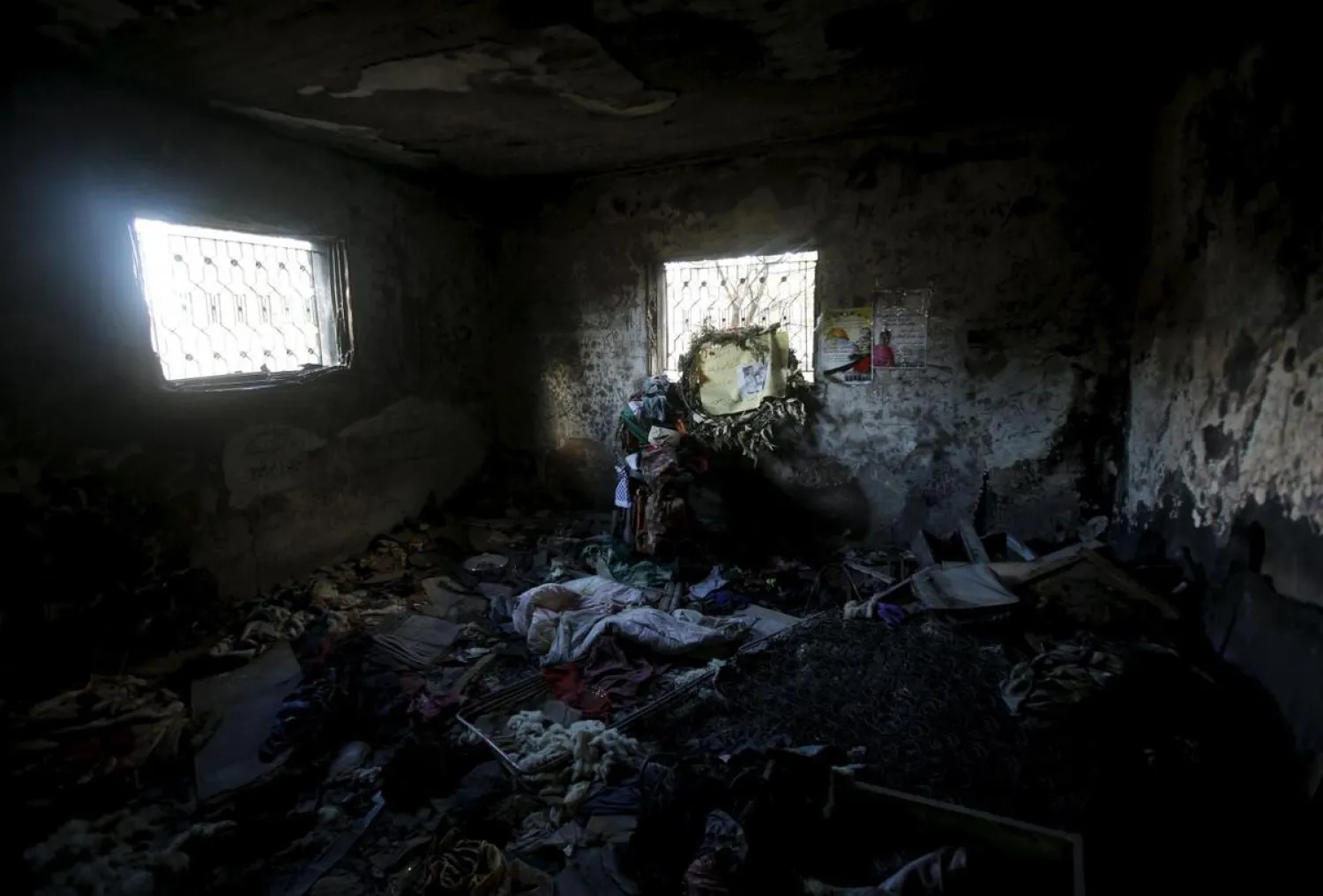
The interior of the Dawabsheh family house after it was burnt down by Hilltop Youth” terrorist group (File photo: Reuters)
TT

Israeli Army Warns of Jewish Terrorist Attacks against Palestinians

The interior of the Dawabsheh family house after it was burnt down by Hilltop Youth” terrorist group (File photo: Reuters)

Far-right Jewish groups are planning to execute a number of terrorist attacks against Palestinians in the West Bank, according to Israeli military sources.

They indicated that the so-called “Hilltop Youth” group could execute terrorist operations similar to the one they carried out against al-Dawabsheh in 2015 when the terrorist settlers burned the family's home while its members were asleep.

Walla military correspondent, Amir Bohbot, reported that some Israeli military officials and other security forces believe that a number of settlers could pressure the political leadership to resume the implementation of the annexation plan of Palestinian areas and impose Israeli sovereignty over the settlements.

As part of their campaign, the settlers will start with violent protests and later carry out terrorist operations that will shock the region.

Last week, a “Hilltop Youth” member was killed following a car crash as he tried to flee police after throwing rocks at Palestinians in the central West Bank.

Settlers took to the streets and members of the organization attacked Palestinians, threw rocks at their cars, and punctured the tires of a car that was transporting Palestinian workers in the Hebron area.

A number of Palestinians filed a complaint indicating that five to seven “Hilltop Youth" terrorists threw stones and attacked a shepherd in the northern West Bank, leaving him with severe injuries.

Since last Tuesday, the Israeli army has increased its reinforcements in the West Bank.

Following a full assessment of the situation, the army assigned guards to monitor the settlements and nearby roads to prevent Palestinian-Israeli clashes and ensure that no extremist settlers will carry out attacks against Palestinians or the Israeli occupation forces.

Meanwhile, Palestinians warned of a dangerous escalation in settlers' attacks and refused to consider the army's position neutral.

They said that the settlers would not have dared to carry out attacks had it not been for the army's protection and support.

They emphasized that since the beginning of this year, the Israeli occupation authorities, along with the army intelligence and settlers, had escalated attacks against Palestinians in various locations.

They indicated that several Palestinian farmers were targeted in different regions of the northern Jordan Valley, in an attempt to seize their lands and deprive them of their source of livelihood.

Settlers directly carry out the attacks under the protection - and sometimes - support of the Israeli army.

Contractor Ayman Gharib, who works in road construction, said that the occupation authorities have seized several of his bulldozers during the past two months while they were paving agricultural roads in Atouf and al-Maleh areas.

He said that he suffered significant losses this year due to the fines he pays to recover his equipment, noting that the longer the detention period, the higher the fine.

Gharib also reported that the drivers and workers were beaten and arrested.

The occupation authorities seized this year 27 tractors and five bulldozers while they were paving agricultural roads in several areas of the Jordan Valley.

Human rights activist Aref Daraghmeh reported that the occupation regularly seizes tractors and equipment from Ibziq, al-Ras al-Ahmar, al-Farsiyah, Humsa, and al-Maleh.

The occupation aims to prevent basic services and ban Palestinians from accessing their lands for cultivation, according to Daraghmeh, who noted that Israeli forces also want to terrorize the citizens and threaten their existence.



France to Back Implementation of Ceasefire Deal in Syria, Says Macron

Members of the Kurdish-led Syrian Democratic Forces (SDF) queue to settle their status with Syrian government in Raqqa, Syria January 27, 2026. REUTERS/Karam al-Masri
TT

France to Back Implementation of Ceasefire Deal in Syria, Says Macron

Members of the Kurdish-led Syrian Democratic Forces (SDF) queue to settle their status with Syrian government in Raqqa, Syria January 27, 2026. REUTERS/Karam al-Masri

France's President Emmanuel Macron on Friday welcomed a deal that paves the way for a ceasefire between the Syrian government and Kurdish-led forces, adding that France will back its implementation, Reuters reported.

Macron, whose country has been part of mediation efforts between Damascus and the Kurds, made the comments in a post on X.

The Syrian government and Kurdish-led forces declared a ceasefire deal on Friday that sets out a phased integration of Kurdish fighters into the state, averting a potentially bloody battle and drawing US praise for a "historic milestone".


World Must Tackle 'Dire' Conditions in Gaza, Says Red Cross

A Red Cross vehicle, as part of a convoy believed to be carrying hostages abducted by Hamas armed men during the Oct. 7 attack on Israel, arrives at the Rafah border, amid a hostages swap deal between Hamas and Israel, in the southern Gaza Strip, Nov. 24, 2023. (Reuters)
TT

World Must Tackle 'Dire' Conditions in Gaza, Says Red Cross

A Red Cross vehicle, as part of a convoy believed to be carrying hostages abducted by Hamas armed men during the Oct. 7 attack on Israel, arrives at the Rafah border, amid a hostages swap deal between Hamas and Israel, in the southern Gaza Strip, Nov. 24, 2023. (Reuters)

The world must scale up efforts to alleviate the human suffering in Gaza, building on the momentum from the ceasefire's first phase, the head of the Red Cross said Friday.

The US-brokered ceasefire, which sought to halt the fighting between Israel and Hamas sparked by the group's October 2023 attack, has been in place for more than three months despite both sides accusing the other of repeated violations.

Earlier in January, Washington announced the truce had progressed to its second phase, intended to bring a definitive end to the war.

"States must harness the momentum generated by the first phase of the agreement between Israel and Hamas to urgently improve the dire humanitarian conditions in Gaza," Mirjana Spoljaric, president of the International Committee of the Red Cross, said in a statement, AFP reported.

Over the last 15 weeks, the ICRC worked with Israel, Hamas and the ceasefire mediators to help bring hostages, detainees, and the remains of the deceased back to their families, as outlined in the first phase of the agreement, Spoljaric said.

The remains of the final Israeli hostage, Ran Gvili, were returned earlier this week.

"These actions allowed families to be reunited with their loved ones and properly mourn those they lost. This work, however difficult, demonstrates the irreplaceable role of humanitarian steps in the long path towards peace," said Spoljaric.

"The international community must now seize every opportunity to scale up efforts that alleviate suffering in Gaza."

Spoljaric said this included Israel easing entry restrictions on so-called dual-use material and equipment, such as water pipes and generators, to restore basic infrastructure.

"Many people in Gaza are still living in the rubble without basic services, struggling to stay warm amid harsh winter conditions," the ICRC chief said.

"Thousands of families continue to wait for news about their loved ones. Hospitals, homes, schools and water systems need to be repaired, and unexploded ordnance must be cleared."

Most of the population in the Gaza Strip, a territory of more than two million people, is displaced, with many living in tents with little or no sanitation amid harsh winter weather.

"All states and parties to conflict have a responsibility to ensure the boundaries and protections enshrined in international humanitarian law are upheld," said Spoljaric.

"This is essential for saving lives, restoring human dignity and laying the foundations on which lasting peace can be built."


Israel Reopening Gaza’s Border Crossing with Egypt on Sunday after Long Closure

A truck enters the Egyptian gate of the Rafah crossing, heading for inspection by Israeli authorities before entering the Gaza Strip, Tuesday, Jan. 27, 2026. (AP Photo/Mohamed Arafat)
TT

Israel Reopening Gaza’s Border Crossing with Egypt on Sunday after Long Closure

A truck enters the Egyptian gate of the Rafah crossing, heading for inspection by Israeli authorities before entering the Gaza Strip, Tuesday, Jan. 27, 2026. (AP Photo/Mohamed Arafat)

Israel said Friday that it will reopen the pedestrian border crossing between the Gaza Strip and Egypt in both directions over the weekend, marking an important step forward for US President Donald Trump’s Gaza ceasefire plan.

COGAT, the Israeli military body in charge of coordinating aid to Gaza, said in a statement that starting on Sunday a “limited movement of people only” would be allowed through the Rafah crossing, Gaza’s main gateway to the outside world.

The announcement followed statements from Israeli Prime Minister Benjamin Netanyahu and Ali Shaath, newly appointed to head the Palestinian administrative committee governing Gaza’s daily affairs, that it would likely open soon, The AP news reported.

COGAT said both Israel and Egypt will vet individuals for exit and entry through the crossing, which will be supervised by European Union border patrol agents. In addition to screenings at the crossing, Palestinians leaving and returning will be screened by Israel in the adjacent corridor, which remains under Israeli military control.

The crossing has been under a near complete closure since Israel seized it in May 2024, saying the step was part of a strategy to halt cross-border arms smuggling by Hamas. It was briefly opened for the evacuation of medical patients during a short-lived ceasefire in early 2025.

Israel had resisted reopening the crossing, but the recovery of the remains of the last hostage in Gaza on Monday cleared the way to move forward. A day later, Netanyahu said the crossing would soon open in a limited and controlled fashion.

Thousands of Palestinians inside Gaza are trying to leave the war-battered territory, while tens of thousands who fled the territory during the heaviest fighting say they want to return home.

An Israeli official who spoke on condition of anonymity in accordance with policy told The AP that dozens of Palestinians would initially be allowed through each way, starting with medical evacuees and Palestinians who fled during the war.

Gaza’s health system was decimated in the war, rendering advanced surgical procedures out of reach. Roughly 20,000 sick and wounded Palestinians need treatment outside Gaza, according to the territory’s health ministry. In the past, those prioritized for evacuation have been mostly children, cancer patients and people suffering from physical trauma.

The reopening is one of the first steps in the second phase of last year's US-brokered ceasefire agreement, which includes challenging issues ranging from demilitarizing Gaza to putting in place an alternative government to oversee rebuilding the mostly destroyed enclave.

Netanyahu said this week that Israel's focus is on disarming Hamas and destroying its remaining tunnels. Without these steps, he said that there would be no reconstruction in Gaza, a stance that could make Israel’s control over Rafah a key point of leverage.