

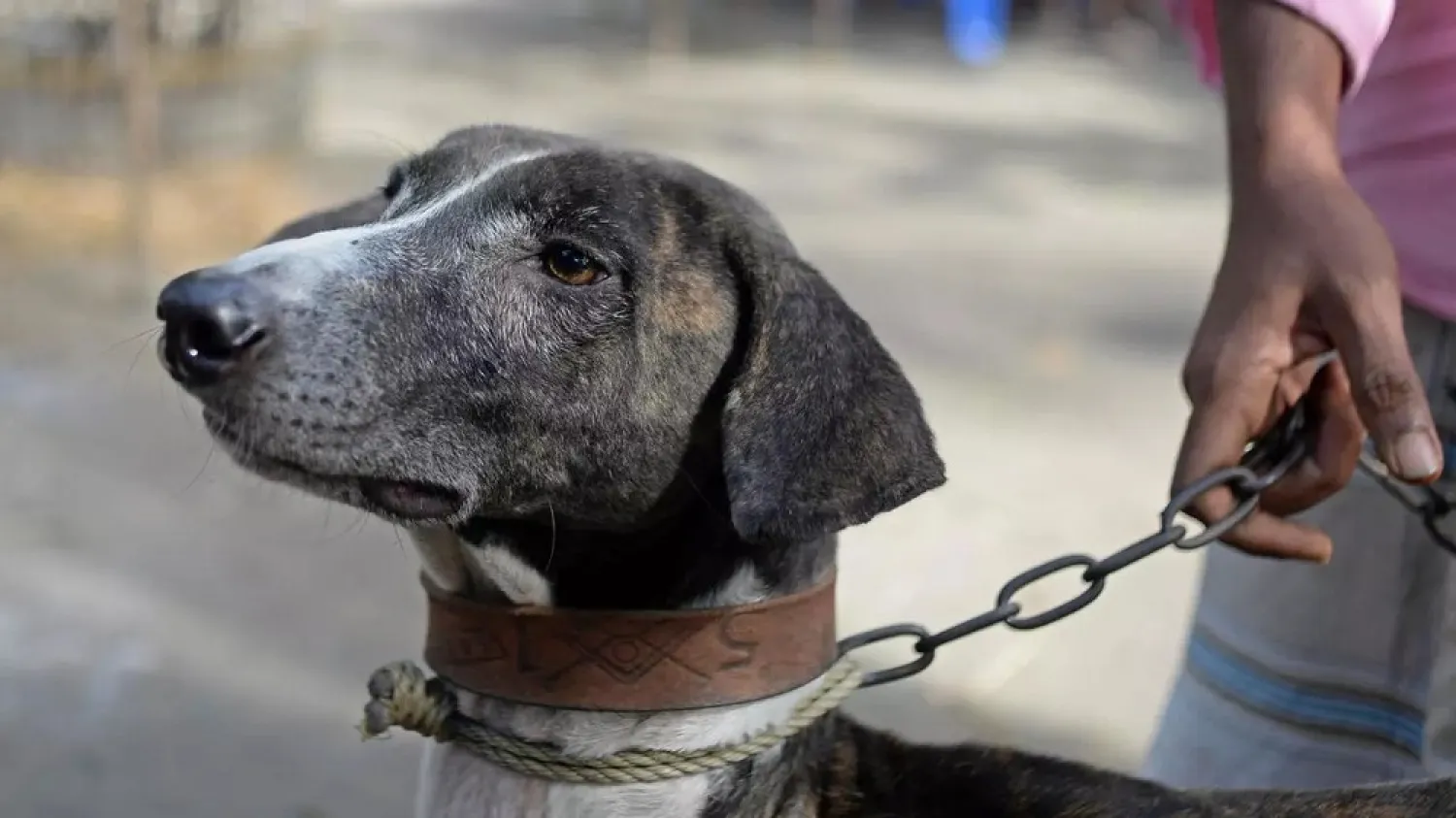

Race to Save Bangladesh Hound from Extinction

The rare Sarail hound is a breed on the brink of extinction. (AFP)
TT

Race to Save Bangladesh Hound from Extinction

The rare Sarail hound is a breed on the brink of extinction. (AFP)

In a rickety hut on the border with Bangladesh and India, two brothers are among the last local breeders of the Sarail hound, a dog on the brink of extinction.

Tall and lean with a powerful chest, pointed ears and bi-colored fur, the rare hound -- named after the border town of Sarail -- has been treasured in the South Asian nation for centuries.

Their sharp eyesight and renowned hunting skills have earned them roles with the military and police, and as guard dogs, while masters love them for their devotion.

M.A.G. Osmani, who led Bangladesh's freedom fighters to victory against Pakistan in the 1971 war of independence, is said to have been saved by one of two Sarails he owned when he was attacked.

But pure-bred Sarails -- believed to have descended from English greyhounds and sighthounds owned by Mughal-era feudal landlords, or from hunting dogs brought by Arab traders -- are dwindling in numbers with just dozens remaining in Bangladesh, according to some estimates.

"Many families in this town once had Sarail (hounds)," Topon Rabidas, the younger brother, told AFP.

"But nowadays only a few... families keep it, often for guarding or to ornament their houses with a piece of local history."

Topon, 38, and his brother Joton, 40, are proud of their family's legacy of keeping Sarails for generations.

But the cost of rearing their dogs -- a pair of two-year-old males both named Lion -- is taking its toll on the poor family.

In the densely populated country of 168 million where some 30 percent of people live below the poverty line and access to land is scarce, Sarails are viewed as a luxury beyond the reach of ordinary Bangladeshis.

The brothers, both cobblers, say they mate the pair with bitches owned by neighbors and sell the puppies for up to US$500 each so they can buy the huge amounts of chicken and beef devoured by them.

'Uphill battle'
About 100 kilometers (62 miles) away in the capital Dhaka, wealthy owners are trying to save the breed, with few government resources devoted to conservation since a failed attempt to breed Sarails collapsed in the 1970s.

More recently, they have set up a Facebook group to exchange information about their dogs and to arrange mating sessions.

Kaiser Tamiz Amin, a 58-year-old banker who manages the group, has owned Sarails for two decades and believes just 30 to 40 pure-breds are left.

"This is going to continue to be an uphill battle but we will get there," Amin told AFP at his home in one of Dhaka's most expensive neighborhoods.

"With the help of (genetics) experts, we hope to restore this breed to its original perfection."

Back in the Rabidas' tiny tin and bamboo shanty home, the brothers are worried their children might not carry on the family tradition of rearing Sarails due to the high cost.

"My grandfather told us to keep at least two of these hounds at home in memory of your ancestors," Joton Rabidas said.

"When a dog dies, our entire family mourns. Every pup is just like a family member to us... But I am not sure whether our next generation would continue breeding these hounds."



Hiker's Dog Lost in New Zealand Forest Rescued by Helicopter after Strangers Fund Search

In this photo released by Precision Helicopters Ltd, Molly peers out of the door of a helicopter after her rescue from a waterfall on the Arahura River on the West Coast of the South Island of New Zealand, Tuesday, March 31, 2026. (Precision Helicopters Ltd via AP)
TT

Hiker's Dog Lost in New Zealand Forest Rescued by Helicopter after Strangers Fund Search

In this photo released by Precision Helicopters Ltd, Molly peers out of the door of a helicopter after her rescue from a waterfall on the Arahura River on the West Coast of the South Island of New Zealand, Tuesday, March 31, 2026. (Precision Helicopters Ltd via AP)

When a hiker fell from a 55-meter (180-foot) waterfall in wild New Zealand bush, rescuers were forced to evacuate the badly hurt woman without her dog, which couldn't be found.

After strangers raised thousands of dollars for a search, border collie Molly was flown to safety by a helicopter pilot who was determined to reunite pet and owner.

A week earlier, an emergency rescue helicopter found the woman with bruises and lacerations after a fall at a rocky spot at the waterfall on the South Island’s West Coast. She was airlifted on March 24 but they were forced to leave without her pet, The Associated Press reported.

Molly was bedraggled and hungry when she was found Tuesday, just a few meters from the spot where the hiker had been lucky to survive.

“I contacted her in hospital and said I’d go for a look for it,” said Matt Newton, the owner-operator of Precision Helicopters New Zealand, which is based at Hokitika Gorge near the Arahura River where Molly went missing. “I went and looked for the dog several times and no avail.”

Unwilling to give up, Newton and his family launched a fundraiser to pay for more flying hours and advanced search gear. Offers of help and donations poured in, with strangers pledging more than 11,000 New Zealand dollars ($6,300) for a search.

It was enough to fund three more hours in a helicopter using thermal imaging equipment. On Tuesday, Newton took to the skies with a veterinary nurse, volunteer searchers and a dog named Bingo in a renewed search for Molly.

“We struck jackpot within about an hour,” he said. “As we made our way up the river, we could see the dog in the thermal and then we could visually see it.”

There had been no sign of Molly at the waterfall when Newton previously searched the spot, he said. It wasn’t clear if the dog had also fallen from the waterfall or if she had eventually made her way to the spot where her injured owner landed.

The helicopter dropped low enough for a volunteer to disembark with the rescue dog Bingo to help coax Molly to safety and keep her calm.

Newton thought the dog had survived by eating feral animals during her week in the wilderness.

“She knew what we were up to, I think,” he said. “She behaved real well. She didn’t run away and she was pleased to be rescued.”

The dog was in “surprisingly good condition,” the pilot said. He sent word back to the helicopter base, where other volunteers waited to take turns in the search. “Instead we just had a big barbecue and all had a cuddle with Molly."

Hours after the dog’s rescue, her owner, still battered from her fall, arrived for a tearful reunion.

“I think that’ll speed up her healing process somewhat,” Newton said. “Having your dog back, that’s for sure.”


Germany Halts Rescue Efforts for Stranded Whale

Seagulls fly above a humpback whale that managed to free itself overnight from a sandbank in shallow waters of Wismar Bay in the Baltic Sea, near Wismar, Germany March 31, 2026. REUTERS/Annegret Hilse
TT

Germany Halts Rescue Efforts for Stranded Whale

Seagulls fly above a humpback whale that managed to free itself overnight from a sandbank in shallow waters of Wismar Bay in the Baltic Sea, near Wismar, Germany March 31, 2026. REUTERS/Annegret Hilse

Experts said Wednesday they were halting rescue efforts for a humpback whale struggling in shallow waters off the German coast and had given up hope for its survival.

The 13.5-metre (44-foot) animal has been floundering off Germany's Baltic Sea coast for more than a week, having first been spotted stuck on a sandbank on March 23 near the city of Luebeck.

The creature managed to free itself but then became stuck again several more times near the city of Wismar. Coverage of its struggle for survival has gripped much of the German public.

Experts had hoped the whale's odyssey would end with it finding its way back to its natural habitat in the Atlantic Ocean, AFP reported.

But on Wednesday scientist Burkard Baschek, who had taken part in the rescue efforts, told reporters: "We are convinced that the animal is going to die" near Wismar.

The whale's ordeal had severely weakened it, its breathing had become "very, very irregular" and it was exhibiting "virtually no" reaction to the presence of human beings, he added.

The chances of it freeing itself again were "very low" and any further rescue efforts would therefore "be pure animal cruelty".

Since it was spotted last week the whale had prompted a large-scale rescue operation involving firefighters, scientists and the maritime police.

"Now we have the task of giving him some peace," said Till Backhaus, the environment minister for the state of Mecklenburg-Western Pomerania.

The animal will now "have to depart this life," he said.

An exclusion zone of 500 metres will be put in place around the whale in order to avoid disturbing it.

The authorities have ruled out putting the whale to sleep, saying this would be too dangerous both for the whale itself and those taking part in the operation.

In the case of its death, Backhaus said it would be transferred ashore for investigations to determine the cause of death.


NASA Counts Down for First Crewed Lunar Mission in Half a Century

NASA's Artemis II lunar flyby mission, with the next-generation moon rocket, the Space Launch System (SLS) rocket and the Orion crew capsule, sits on Pad 39B ahead of the launch of the Artemis II mission at the Kennedy Space Center in Cape Canaveral, Florida, US, March 31, 2026 - Reuters
TT

NASA Counts Down for First Crewed Lunar Mission in Half a Century

NASA's Artemis II lunar flyby mission, with the next-generation moon rocket, the Space Launch System (SLS) rocket and the Orion crew capsule, sits on Pad 39B ahead of the launch of the Artemis II mission at the Kennedy Space Center in Cape Canaveral, Florida, US, March 31, 2026 - Reuters

NASA is set to launch four astronauts as soon as Wednesday evening on a 10-day flight around the moon, marking the most ambitious US space mission in decades and a major step toward returning humans to the lunar surface before China's first crewed landing.

NASA mission managers on Monday polled "go" to launch the Artemis II mission's towering, 322-ft (98-m) Space Launch System (SLS) rocket topped with the astronauts' Orion crew capsule as early as 6:24 p.m. EDT (2224 GMT) on Wednesday.

It will launch from NASA's Kennedy Space Center in Florida just one pad away from where the last moon-bound astronauts of the US Apollo program lifted off more than half a century ago, Reuters reported.

The Artemis II crew includes NASA astronauts Christina Koch, Victor Glover and Reid Wiseman and Canadian astronaut Jeremy Hansen, who landed in Florida from Houston on Friday.

They had been in a two-week quarantine leading up to liftoff and spent time with their families over the weekend at the Kennedy Space Center's beach house, a spot where astronauts rest before blasting off into space.

"Certainly all indications are right now, we are in excellent, excellent shape as we get into count," launch director Charlie Blackwell-Thompson told reporters on Monday.

Weather conditions appeared favorable for an on-time liftoff, with only a 20% chance of souring within the agency's two-hour launch window on Wednesday. If the weather worsens and triggers a scrub, NASA could try again to launch any day until April 6, after which it would wait until April 30 for its next opportunity.

The launch had originally been planned for as early as February 6, and then March 6, until a pesky hydrogen leak prompted NASA to roll the rocket back to its vehicle assembly building for scrutiny.

FARTHEST TRIP IN HISTORY

The Artemis II mission will send the crew on a winding, nearly 10-day journey around the moon and back, sending them some 252,000 miles (406,000 km) into space - the farthest humans have ever traveled.

The current record for the farthest spaceflight at roughly 248,000 miles is held by the three-man crew of the Apollo 13 lunar mission in 1970, which was beset by technical problems after an oxygen tank exploded and was unable to land on the moon as planned.

Humans have not left Earth's orbit since the final Apollo mission in 1972.

NASA launched its first Artemis mission without crew in 2022, sending the gumdrop-shaped Orion spacecraft on a similar path around the moon and back.

Artemis II will pose a greater test of Orion and the SLS rocket. The astronauts on board will test critical life-support systems, crew interfaces and communications. They will also take manual control of Orion in space roughly three hours after launch to test its steering and maneuverability, a key feature should its automated systems fail.

Lockheed Martin builds Orion, while Boeing and Northrop Grumman have led the development of SLS since 2010, a program partly known for its ballooning costs at an estimated $2 billion to $4 billion per launch.

Elon Musk's SpaceX and Jeff Bezos' Blue Origin are racing to develop lunar landers that NASA will use to put its astronauts on the lunar surface.

The Artemis II mission is a key early step in the agency's multibillion-dollar Artemis program that envisions a long-term settlement on the lunar south pole. NASA is pressing hard to land its first crew of astronauts there on the Artemis IV mission by 2028, before China does around 2030.

Artemis III had been set to be the agency's first astronaut moon landing, but new NASA Administrator Jared Isaacman in February added an extra test mission before the landing.