


Biden to Assume US Presidency amid Deep Division and Raging Pandemic

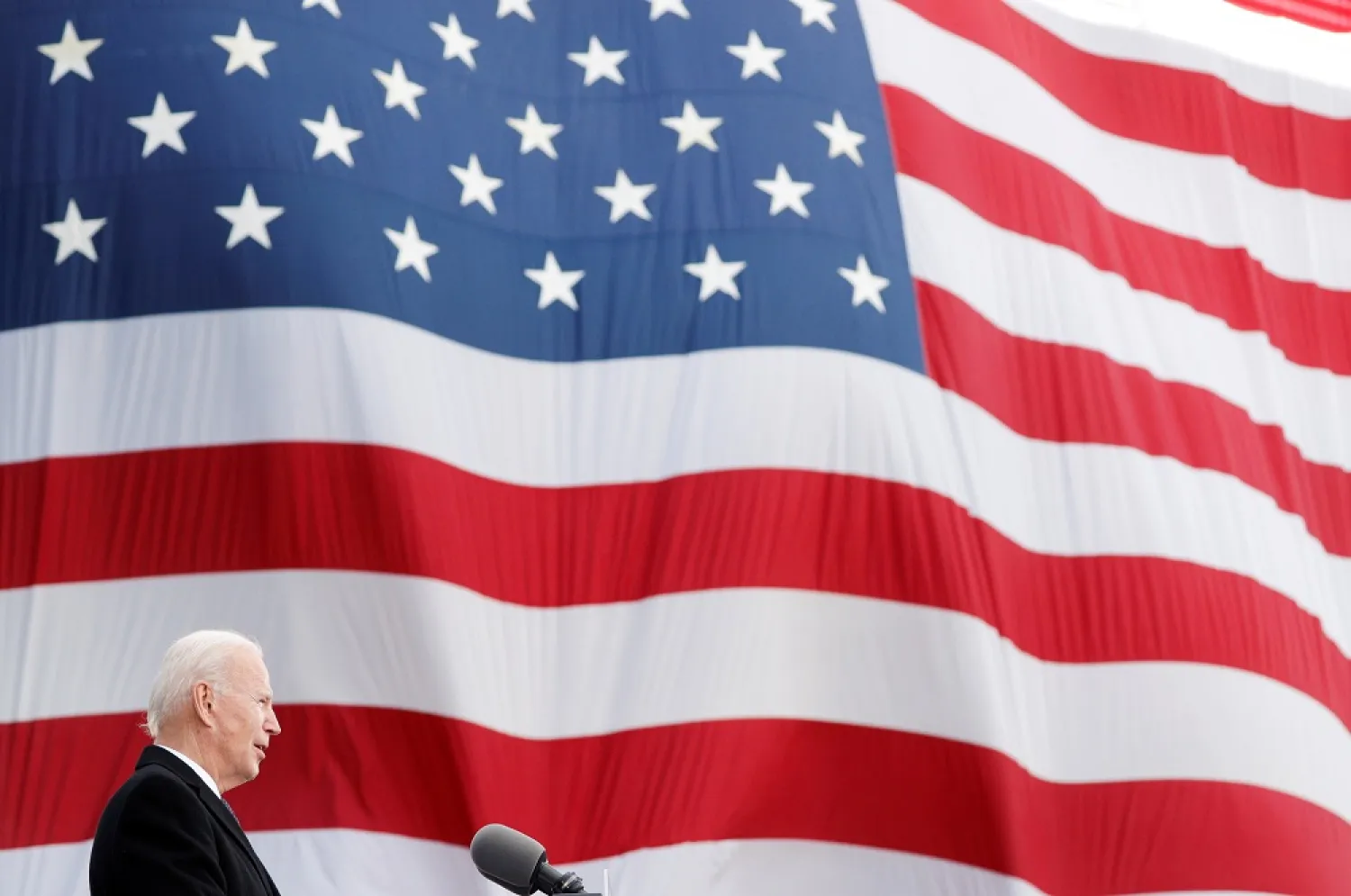
US President-elect Joe Biden speaks during an event in New Castle, Delaware, US January 19, 2021. (Reuters)
TT

Biden to Assume US Presidency amid Deep Division and Raging Pandemic

US President-elect Joe Biden speaks during an event in New Castle, Delaware, US January 19, 2021. (Reuters)

Democrat Joe Biden will be sworn in as the 46th president of the United States on Wednesday, assuming the helm of a country beset by deep political divides and battered by a raging coronavirus pandemic.

Biden, 78, will become the oldest US president in history at a scaled-back ceremony in Washington that has been largely stripped of its usual pomp and circumstance, due both to the coronavirus as well as security concerns following the Jan. 6 assault on the US Capitol by supporters of outgoing President Donald Trump.

With only a small number of attendees present, the Democrat will take the oath of office before US Chief Justice John Roberts just after noon (1700 GMT), placing his hand on an heirloom Bible that has been in the Biden family for more than a century.

His running mate, Kamala Harris, the daughter of immigrants from Jamaica and India, will become the first Black person, first woman and first Asian American to serve as vice president after she is sworn in by US Supreme Court Justice Sonia Sotomayor, the court’s first Latina member.

The ceremony will unfold in front of a heavily fortified US Capitol, where a mob of Trump supporters stormed the building two weeks ago, enraged by his false claims that November’s election was stolen with millions of fraudulent votes. The violence prompted the Democratic-controlled US House of Representatives to impeach Trump last week for an unprecedented second time.

Thousands of National Guard troops were called into the city after the siege, which left five people dead and briefly forced lawmakers into hiding. Instead of a throng of supporters, the National Mall will be covered by nearly 200,000 flags and 56 pillars of light meant to represent people from US states and territories.

Biden, who has vowed to “restore the soul of America,” will call for American unity at a time of crisis in his inaugural address, according to advisers.

In an early sign of his plan to reach across the political aisle, Biden has invited top congressional leaders, including House Republican leader Kevin McCarthy and Senate Republican leader Mitch McConnell, to join him at church on Wednesday morning.

In a break with more than a century and a half of political tradition, Trump plans to depart the White House ahead of the inauguration, declining to meet with his successor and affirm the peaceful transfer of power.

Vice President Mike Pence, former US Presidents George W. Bush, Barack Obama and Bill Clinton, and both McCarthy and McConnell are all expected to attend Biden’s inauguration ceremony.

Trump, who has grown increasingly isolated in the waning days of his tenure, has still not formally conceded the Nov. 3 election. He will hold a sendoff event at Joint Air Force Base Andrews in the morning, although top Republicans, including Pence, are not expected to attend.

Grim milestones
For Biden, who long harbored presidential ambitions, the inauguration is the zenith of a five-decade career in public service that included more than three decades in the US Senate and two terms as vice president under former President Barack Obama.

But he will confront a set of overlapping crises that would challenge even someone of his political experience.

The novel coronavirus reached a pair of grim milestones on Trump’s final full day in office on Tuesday, reaching 400,000 US deaths and 24 million infections - the highest of any country. Millions of Americans are out of work because of pandemic-related shutdowns and restrictions.

Biden has vowed to bring the full weight of the federal government to bear on the crisis, including a more robust testing and tracing program and a massive vaccination drive. His top priority is a $1.9 trillion plan that would enhance jobless benefits and provide direct cash payments to households. It will require approval from a deeply divided Congress, where Democrats will hold slim advantages in both the House and Senate.

He also plans a series of executive orders on his first day in the White House, including rolling back Trump’s ban on travelers and immigrants from some Muslim-majority countries, rejoining the Paris climate accord and issuing a mask mandate for federal property.

Although Biden has laid out an ambitious agenda for his first 100 days, including delivering 100 million COVID-19 vaccinations, the Senate could be consumed by Trump’s upcoming impeachment trial, which will move ahead even though he has left office.

The trial could serve as an early test of Biden’s promise to foster a renewed sense of bipartisanship in Washington.



Tehran Rejects Trump's Talk of Negotiation, as Israel and Iran Launch Airstrikes

This satellite image from Planet Labs PBC shows damage after airstrikes targeting Mehrabad International Airport in Tehran, Iran, March 7, 2026. (Planet Labs PBC via AP)
TT

Tehran Rejects Trump's Talk of Negotiation, as Israel and Iran Launch Airstrikes

This satellite image from Planet Labs PBC shows damage after airstrikes targeting Mehrabad International Airport in Tehran, Iran, March 7, 2026. (Planet Labs PBC via AP)

Israel and Iran exchanged airstrikes on Wednesday, as Iran's military rejected President Donald Trump's claim Washington was in negotiations to end to the war, saying the US is negotiating with itself.

The rejection of negotiations by the unified command of the Iranian Armed Forces, which is dominated by the Revolutionary Guards, comes amid reports the US has sent a 15-point plan for discussion to Tehran.

"Has the level of your inner struggle reached the stage of you (Trump) negotiating with yourself?" the top spokesperson for Iran's joint military command, Ebrahim Zolfaqari, said on Iranian state TV.

"People like us can never get along with people like you."

"As we have always said... no one like us will make a deal with you. Not now. Not ever."

Iran's leadership has previously said it cannot negotiate with the US as it has attacked the country twice during high level negotiations in the past two years.

Four weeks into the war that has killed thousands, created the worst energy shock in history and sparked global inflation fears, there was no letup in airstrikes from Iran and Israel on Wednesday.

The Israeli Defense Forces said in a Telegram post it had launched a wave of strikes targeting infrastructure across Tehran. The semi-official Iranian SNN News Agency said the strikes hit a residential ⁠area in the ⁠city, with rescuers searching the rubble.

Iran's Revolutionary Guards said it had launched a new wave of attacks against locations in Israel including Tel Aviv and Kiryat Shmona, as well as U.S. bases in Kuwait, Jordan and Bahrain, Iranian state media reported.

Trump told reporters at the White House on Tuesday the US was in "negotiations" with "the right people" in Iran to end the war, adding the Iranians wanted to reach a deal very badly.

Stocks rose and oil prices fell on Wednesday on reports the US is seeking a month-long ceasefire and had sent a 15-point plan to Iran for discussion, raising hopes for a ⁠resumption of oil exports out of the Arabian Gulf.

The New York Times reported on Tuesday that Washington sent Iran a 15-point plan to end the war in the Middle East. Israel's Channel 12, quoting three sources, said the US was seeking a month-long ceasefire to discuss the 15-point plan.

A source familiar with the matter confirmed that the US had sent a plan to Iran but provided no further details.

The Israeli media outlet said the plan would include the dismantling of Iran's nuclear program, ceasing support for proxy groups, such as Lebanon's Hezbollah, and the reopening of the Strait of Hormuz.

The US and Israel launched strikes on Iran on February 28 after saying they had failed to make enough headway in talks aimed at ending Iran's nuclear program, although mediator Oman said significant progress had been made.

The US struck Iran's nuclear facilities in June 2025.

Since the start of "Operation Epic Fury" by the US in February, Iran has attacked countries that host US bases, struck Gulf energy infrastructure and effectively closed the Strait of Hormuz, conduit for a fifth of the world's oil and liquefied natural gas.


Iran Tells UN: 'Non-Hostile' Ships Can Transit Strait of Hormuz

A map showing the Strait of Hormuz is seen in this illustration taken March 23, 2026. REUTERS/Dado Ruvic/Illustration
TT

Iran Tells UN: 'Non-Hostile' Ships Can Transit Strait of Hormuz

A map showing the Strait of Hormuz is seen in this illustration taken March 23, 2026. REUTERS/Dado Ruvic/Illustration

Iran has told the United Nations Security Council and the International Maritime Organization that “non-hostile vessels” may transit the Strait of Hormuz if they coordinate with Iranian authorities, according to a note seen by Reuters on Tuesday.

The US-Israeli war against Iran has all but halted shipments of about one-fifth of the world's oil and liquefied natural gas through the strait, causing oil supply disruption.

The note from Iran's Foreign Ministry ⁠was sent to the 15-member Security Council and UN Secretary-General Antonio Guterres on Sunday.

It was then circulated on Tuesday among the 176 members of the London-based UN shipping agency responsible for regulating the safety and security of international shipping and preventing pollution.

“Non-hostile vessels, including those belonging to or associated with other States, may - provided that they neither participate in nor support acts of aggression against Iran and fully ⁠comply with the declared safety and security regulations - benefit from safe passage through the Strait of Hormuz in coordination with the competent Iranian authorities,” it read.

Iran has “taken necessary and proportionate measures to prevent the aggressors and their supporters from ⁠exploiting the Strait of Hormuz to advance hostile operations against Iran,” the note read, adding vessels, equipment, and any assets belonging to the US or Israel, “as ⁠well as other participants in the aggression, do not qualify for innocent or non-hostile passage.”

The Financial Times first reported that the letter had ⁠been circulated among IMO member states on Tuesday.


Rubio Plans Travel to France to Sell Iran War to Skeptical G7 Allies

US Secretary of State Marco Rubio listens to US President Donald Trump (not pictured) speaking to the media, as Trump departs the White House for Florida, in Washington, DC, US, March 20, 2026. (Reuters)
TT

Rubio Plans Travel to France to Sell Iran War to Skeptical G7 Allies

US Secretary of State Marco Rubio listens to US President Donald Trump (not pictured) speaking to the media, as Trump departs the White House for Florida, in Washington, DC, US, March 20, 2026. (Reuters)

Secretary of State Marco Rubio will travel to France this week to try to sell America’s skeptical Group of Seven allies on the strategy of the Iran war that has sent global fuel prices soaring, the State Department said Tuesday.

Rubio will attend a G7 foreign ministers meeting near Versailles outside of Paris on Friday “to advance key US interests” and “discuss shared security concerns and opportunities for cooperation,” the department said.

“Areas of focus will include the Russia-Ukraine war, the situation in the Middle East, and threats across the world to peace and stability,” the department said in a statement released amid conflicting accounts over whether the US and Iran are talking about a resolution to the conflict.

President Donald Trump said Monday that the US and Iran have had discussions, although Iran has denied it. And numerous other countries are involved in nascent efforts to find an off-ramp to the crisis, which has caused the price of oil to skyrocket with the closure of the Strait of Hormuz to most shipping, including tankers.

Nearly all of the other G7 nations — Britain, Canada, France, Germany, Italy and Japan — have reacted coolly at best to the US-Israeli military operation against Iran and have declined to participate, drawing Trump's ire even as he maintains the US doesn't need their help.

Trump has lashed out a number of G7 members and NATO allies for not responding to his calls for help in reopening the Strait of Hormuz, although in recent days several of them had indicated a willingness to back appropriate action to restore the key waterway to normal traffic.