

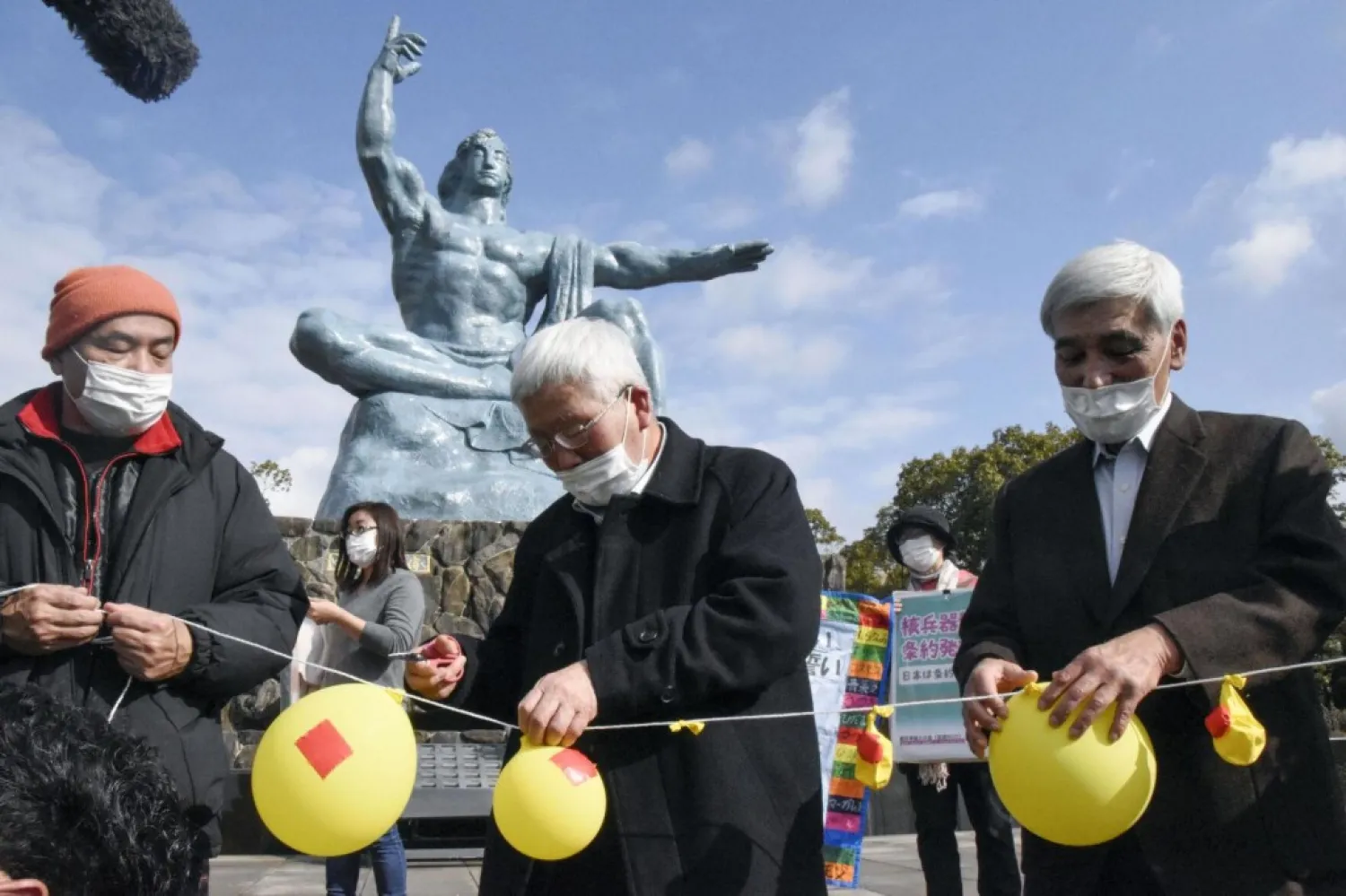

First-Ever Treaty to Ban Nuclear Weapons Enters into Force

Participants deflate balloons in hope of neutralizing and demolishing nuclear warheads, during a memorial gathering at Peace Park in Nagasaki, southern Japan, Jan. 22, 2021. (AP)
TT

First-Ever Treaty to Ban Nuclear Weapons Enters into Force

Participants deflate balloons in hope of neutralizing and demolishing nuclear warheads, during a memorial gathering at Peace Park in Nagasaki, southern Japan, Jan. 22, 2021. (AP)

The first-ever treaty to ban nuclear weapons entered into force on Friday, hailed as a historic step to rid the world of its deadliest weapons but strongly opposed by the world's nuclear-armed nations.

The Treaty on the Prohibition of Nuclear Weapons is now part of international law, culminating a decades-long campaign aimed at preventing a repetition of the US atomic bombings of Hiroshima and Nagasaki at the end of World War II. But getting all nations to ratify the treaty requiring them to never own such weapons seems daunting, if not impossible, in the current global climate.

When the treaty was approved by the UN General Assembly in July 2017, more than 120 approved it. But none of the nine countries known or believed to possess nuclear weapons — the United States, Russia, Britain, China, France, India, Pakistan, North Korea and Israel — supported it and neither did the 30-nation NATO alliance.

Japan, the world's only country to suffer nuclear attacks, also does not support the treaty, even though the aged survivors of the bombings in 1945 strongly push for it to do so. Japan on its own renounces use and possession of nuclear weapons, but the government has said pursuing a treaty ban is not realistic with nuclear and non-nuclear states so sharply divided over it.

Nonetheless, Beatrice Fihn, executive director of the International Campaign to Abolish Nuclear Weapons, the 2017 Nobel Peace Prize-winning coalition whose work helped spearhead the treaty, called it “a really big day for international law, for the United Nations and for survivors of Hiroshima and Nagasaki.”

The treaty received its 50th ratification on Oct. 24, triggering a 90-day period before its entry into force on Jan. 22.

As of Thursday, Fihn told The Associated Press that 61 countries had ratified the treaty, with another ratification possible on Friday, and “from Friday, nuclear weapons will be banned by international law” in all those countries.

The treaty requires that all ratifying countries “never under any circumstances ... develop, test, produce, manufacture, otherwise acquire, possess or stockpile nuclear weapons or other nuclear explosive devices.” It also bans any transfer or use of nuclear weapons or nuclear explosive devices — and the threat to use such weapons — and requires parties to promote the treaty to other countries.

Fihn said the treaty is “really, really significant” because it will now be a key legal instrument, along with the Geneva Conventions on conduct toward civilians and soldiers during war and the conventions banning chemical and biological weapons and land mines.

UN Secretary-General Antonio Guterres said the treaty demonstrated support for multilateral approaches to nuclear disarmament.

“Nuclear weapons pose growing dangers and the world needs urgent action to ensure their elimination and prevent the catastrophic human and environmental consequences any use would cause,” he said in a video message. “The elimination of nuclear weapons remains the highest disarmament priority of the United Nations.”

But not for the nuclear powers.

As the treaty was approaching the 50 ratifications needed to trigger its entry into force, the Trump administration wrote a letter to countries that signed it saying they made “a strategic error” and urging them to rescind their ratification.

The letter said the treaty “turns back the clock on verification and disarmament" and would endanger the half-century-old Nuclear Nonproliferation Treaty, considered the cornerstone of nonproliferation efforts.

Fihn countered at the time that a ban could not undermine nonproliferation since it was "the end goal of the Nonproliferation Treaty.”

Daryl Kimball, executive director of the Arms Control Association, said the treaty’s arrival was a historic step forward in efforts to free the world of nuclear weapons and “hopefully will compel renewed action by nuclear-weapon states to fulfill their commitment to the complete elimination of nuclear weapons.”

Fihn said in an interview that the campaign sees strong public support for the treaty in NATO countries and growing political pressure, citing Belgium and Spain. “We will not stop until we get everyone on board,” she said.

It will also be campaigning for divestment — pressuring financial institutions to stop giving capital to between 30 and 40 companies involved in nuclear weapons and missile production including Airbus, Boeing and Lockheed Martin.



UN Demands Accountability for Violations of Rules of War in Middle East

Smoke rises from the sites of Israeli airstrikes in Beirut and its southern suburbs on April 8, 2026. (AFP)
TT

UN Demands Accountability for Violations of Rules of War in Middle East

Smoke rises from the sites of Israeli airstrikes in Beirut and its southern suburbs on April 8, 2026. (AFP)

UN agency chiefs on Saturday demanded an end to impunity for widespread international law violations in the Middle East, as casualties pile up six weeks into the war unleashed by US-Israeli strikes on Iran.

In a joint statement, the heads of multiple United Nations agencies said they were "alarmed by the sustained violations of the rules of war and international humanitarian law" in the region.

"Even wars have rules, and these rules must be respected," the statement from the UN Inter-Agency Standing Committee said.

The joint statement -- penned by UN humanitarian chief Tom Fletcher along with the heads of the UN agencies for human rights, health, food, refugees and children among others -- decried the soaring toll since the Middle East war erupted on February 28.

"In just the last month across the Middle East, thousands of civilians have been killed and injured. Hundreds of thousands have been displaced, many multiple times," it said.

"The numbers continue to rise and essential services are increasingly difficult to access.

"Health workers, hospitals and ambulances have been targeted. Schools have been struck. Civilian infrastructure - including bridges, residential buildings, houses, water facilities and power plants - has been destroyed," it said.

The agency chiefs voiced particular concern about the impact on "women and children and others with specific needs", as well as on global supply chains, "with food and fuel prices on the rise."

At the same time, they highlighted that "our humanitarian colleagues have been caught up in hostilities."

Just since the beginning of this year, they said, "14 aid workers have been killed or injured in the Occupied Palestinian Territory, eight in Iran and five in Lebanon."

"This is an alarming toll."

The agency chiefs said they "strongly condemn all attacks on civilians, including humanitarian and health workers, as well as civilian objects."

"We demand that all parties - whether Member States of the United Nations or armed groups - respect their legal obligation to protect civilians, including humanitarian personnel, and civilian infrastructure," they said.

"All violations must be met with accountability."


Ukraine Can Play Useful Role in Strait of Hormuz, Britain Says

FILE PHOTO: A map showing the Strait of Hormuz is seen in this illustration taken June 22, 2025. REUTERS/Dado Ruvic/Illustration/File Photo
TT

Ukraine Can Play Useful Role in Strait of Hormuz, Britain Says

FILE PHOTO: A map showing the Strait of Hormuz is seen in this illustration taken June 22, 2025. REUTERS/Dado Ruvic/Illustration/File Photo

Ukraine can play a useful role in international efforts to secure the Strait of Hormuz, Britain's armed services minister said, praising its drone technology as among the best in the world.

Britain has organized discussions this month among more than 30 nations on how to reopen the strait, amid an Iranian blockade that has choked oil supplies to the global economy following US and Israeli strikes on Iran, Reuters reported.

President Volodymyr Zelenskiy said this week Kyiv had participated in consultations on safeguarding navigation, drawing on expertise from four years of war with ‌Russia. Ukraine has already ‌deployed more than 200 experts to the Middle East, where ‌they ⁠have downed Iran's ⁠long-range Shahed drones.

"Ukraine has some of the best technology in the world that it's developed here in the war. I think that could provide utility in the Middle East, as we're seeing already against Shahed drones, all the way through to the Strait of Hormuz," Al Carns said during a visit to Kyiv on Friday.

Carns, who served as a colonel in Britain's armed forces before being elected to parliament two years ⁠ago, said his visit was intended to reassure Kyiv that the ‌war in Ukraine remained Britain's top defense and ‌security priority.

He played down tensions within the NATO military alliance following US President Donald Trump's ‌criticism of European allies for not joining the Iran war, saying NATO was ‌still the "backbone of our security".

'REVOLUTION IN MILITARY AFFAIRS'

While Britain is providing funding, training and military capability to Ukraine, Carns said there was also much the UK could learn from Kyiv's battlefield innovations, particularly in drone technology, the use of data and AI.

"It's a revolution in military ‌affairs, and we need to move faster," Carns said.

Incorporating advances in warfare into Britain's 10-year defense investment plan - due late ⁠last year - is ⁠taking time but the report will be ready this spring, Carns said.

Carns urged Ukraine to accelerate exports of its cutting-edge technology to capture a corner of the global market before other nations catch up, and to facilitate learning and development with NATO allies.

Ukraine issued its first export licenses in February. Kyiv hopes to raise funds to expand its defense industry while using its weapons as diplomatic leverage with allies.

However, some industry executives have complained Kyiv is dragging its heels in approving licenses and risks missing the opportunity presented by the Iran war.

"Ukraine needs to speed up its capacity to export," Carns said. "I still believe the best systems sit in Ukraine, but the rest of the world is catching up."

Britain is home to a plant making Ukrainian interceptor drones that started production in February. Another UK-headquartered Ukrainian military tech company, UForce, produces the Magura sea drone.


North Korean Leader Kim Backs China’s Push for ‘Multi-polar World’ in Talks with FM

This picture taken on April 10, 2026 and released by North Korea's official Korean Central News Agency (KCNA) on April 11, 2026, shows Chinese Foreign Minister Wang Yi (L) shaking hands with North Korean leader Kim Jong Un at the headquarters of the Workers' Party of Korea in Pyongyang.  (KCNA / KCNA via KNS / AFP)
This picture taken on April 10, 2026 and released by North Korea's official Korean Central News Agency (KCNA) on April 11, 2026, shows Chinese Foreign Minister Wang Yi (L) shaking hands with North Korean leader Kim Jong Un at the headquarters of the Workers' Party of Korea in Pyongyang. (KCNA / KCNA via KNS / AFP)
TT

North Korean Leader Kim Backs China’s Push for ‘Multi-polar World’ in Talks with FM

This picture taken on April 10, 2026 and released by North Korea's official Korean Central News Agency (KCNA) on April 11, 2026, shows Chinese Foreign Minister Wang Yi (L) shaking hands with North Korean leader Kim Jong Un at the headquarters of the Workers' Party of Korea in Pyongyang.  (KCNA / KCNA via KNS / AFP)
This picture taken on April 10, 2026 and released by North Korea's official Korean Central News Agency (KCNA) on April 11, 2026, shows Chinese Foreign Minister Wang Yi (L) shaking hands with North Korean leader Kim Jong Un at the headquarters of the Workers' Party of Korea in Pyongyang. (KCNA / KCNA via KNS / AFP)

North Korean leader Kim Jong Un voiced support for China’s push to build a “multi-polar world” and called for deeper ties between the traditional allies during a meeting with Chinese Foreign Minister Wang Yi, state media said Saturday.

During the meeting Friday, Kim said his government will fully support Chinese efforts to achieve territorial integrity based on its “one-China principle,” a reference to Beijing’s official position that Taiwan is an inalienable part of China’s territory, according to North Korea’s official Korean Central News Agency.

Kim also outlined North Korea’s position on unspecified regional and international issues of “mutual concern” and said sustained development of ties between the two countries has become more crucial in the current geopolitical environment, KCNA said.

Wang, on a two-day trip to North Korea, said the countries’ relations were entering a “new phase” following a summit last year between Kim and Chinese President Xi Jinping.

Embracing the ideas of a “new Cold War” and a “multi-polarized world,” Kim has sought to break out of international isolation and push a more assertive foreign policy by expanding ties with governments locked in confrontations with the United States.

While Russia has been Kim’s top foreign policy priority in recent years, sending thousands of troops and large weapons shipments to support its war against Ukraine, he has also been cozying up to China, the North’s traditional main ally and economic lifeline.

Kim joined Russian President Vladimir Putin at a World War II ceremony in Beijing in September and held his first summit with Xi Jinping in six years, moves that supported his efforts to portray North Korea as part of a united front against Washington.

North Korea and China last month resumed direct flight and passenger train services, which had been suspended since the beginning of the COVID-19 pandemic in 2020.

Wang arrived in Pyongyang on Thursday in his first visit to North Korea in seven years. He earlier met with North Korean Foreign Minister Choe Sun Hui and discussed ways to facilitate further cooperation and exchanges and holding “in-depth” talks on international issues, state media from both countries said.

The state media outlets did not mention whether Wang and North Korean officials discussed issues related to the US or the ongoing war in the Middle East.

Wang’s trip to North Korea came before US President Donald Trump travels to Beijing for a rescheduled summit with Xi Jinping in May. Some South Korean officials have expressed hope the Trump-Xi meeting could provide a diplomatic opening with Pyongyang.

Kim has suspended all meaningful dialogue with the US and South Korea since the collapse of his diplomacy with Trump in 2019 during the American president’s first term. Kim has since taken a hard-line stance toward South Korea, which he now defines as his “most hostile” adversary, and rejected US offers to resume talks, calling on Washington to drop its demand for North Korea’s denuclearization as a precondition.