The ‘Impossible’ Relationship and History of Disputes between Lebanon’s Aoun, Jumblatthttps://english.aawsat.com/home/article/2761451/%E2%80%98impossible%E2%80%99-relationship-and-history-disputes-between-lebanon%E2%80%99s-aoun-jumblatt
The ‘Impossible’ Relationship and History of Disputes between Lebanon’s Aoun, Jumblatt
President Aoun meets with PSP leader Jumblatt at the presidential palace in May 2020. (NNA)
The relationship between two of Lebanon’s most influential leaders, head of the Progressive Socialist Party Walid Jumblatt and President Michel Aoun, has always been fraught with tensions and a lack of “chemistry”.
The tensions go back to when Aoun served as army commander during the 1975-90 civil war and peaked ahead of his return to Lebanon from exile in 2005. They have continued to be strained with meetings between Aoun and Jumblatt far and few between ever since 2005.
Ties between Aoun and other Lebanese parties are not any better, but the way in which the Druze leader has chosen to wage his confrontation with the founder of the Free Patriotic Movement has set him apart from the rest. Jumblatt even went so far as to demand that Aoun be ousted as president, before retracting his statement, not for political reasons, but for practical ones, such as the sectarian Lebanese system and the cover provided by Hezbollah to the president – the Iran-backed party’s key Christian ally.
Just two days ago when commenting on Aoun and the FPM – which is now headed by the president’s son-in-law Jebran Bassil - Jumblatt openly declared “I don’t like them and they don’t like me.”
The statement sparked renewed accusations between MPs from Jumblatt and Aoun’s camp.
Impending ‘tsunami’
Going back in history, Jumblatt openly opposed Aoun’s heading of the army and a military cabinet in 1988, even deeming it a declaration of war. Aoun would soon after be exiled to France, during which he and Jumblatt witnessed a brief period of rapprochement.
That was later blown up when Jumblatt warned of an impending “tsunami” when Aoun announced that he would return to Lebanon in 2005. That would mark the beginning of a new phase of ebbs and flows in their relations.
The ties were often strained, with a few attempts at reconciliation and some brief meetings between the two leaders.
The cool relations were reflected in the very few meetings the Druze leader and Aoun have held over the years. They have been limited to official occasions and attempts at maintaining calm between Druze and Christian areas. In fact they can be listed in a short paragraph: Aoun met Jumblatt in al-Chouf in 2010 and took part in a mass service in Deir al-Qamar in 2017 to mark the 16th anniversary of the Mount Lebanon reconciliation. Jumblatt then paid a visit to Aoun at his Beiteddine summer residence and the president then repaid the visit by meeting him at his Mokhtara residence.
This last meeting was only held in wake of the 2019 Qabr Shmoun incident that witnessed clashes between Druze and Christians and threatened to ignite civil strife in the country.
Jumblatt last met Aoun at the presidential palace in May in an attempt to address “differences”, said the PSP leader at the time.
Every time they met, the two officials would talk about reconciliation and calm. But whenever Lebanon approaches a significant political development tensions would boil over again and the digging up of war acts would come up, casting doubt on the possibility that the two leaders would ever truly reconcile.
‘Policy of spite’
Each side of the divide has their own view of the dispute and each accuses the other of corruption.
The PSP believes that Aoun’s term and policies have led Lebanon to its current state of collapse, while the FPM says that Jumblatt is being so critical because he no longer enjoys the role of kingmaker at parliament.
PSP MP Hadi Abou al-Hassan told Asharq Al-Awsat that Aoun and the FPM object to criticism against their performance during the president’s term.
Calamities befell Lebanon ever since Aoun headed the military government and launched his “elimination war” and “war of liberation” in 1988-90, he charged. Both wars cost hundreds of lives and allowed Syria to tighten its grip over Lebanon.
He then returned from exile after striking a deal under the table with the Syrian regime and allied himself with Hezbollah in order to become president, reneging on all of his previous statements and stances.
“We have seen nothing but setbacks, missteps, crises and losses on all levels from him,” said Abou al-Hassan.
“Despite all of this, they (the FPM) claim to pursue reform and accuse everyone of corruption, while they are the most corrupt figures. The problem lies in the policy of spite that they adopt. They say one thing and do the other. This is what caused all attempts at reconciliation and rapprochement between the FPM and PSP to fail,” he stressed, criticizing the movement for questioning the sincerity of the Mount Lebanon reconciliation.
On the other side of the divide, FPM MP George Atallah said the PSP is attacking Aoun and the movement because of the political crisis Jumblatt is enduring.
He rejected all accusations of corruption directed at the president.
“At every turn they verbally attack and defame us because of the current political situation the PSP is going through after Jumblatt lost the influential position he had occupied for years,” he told Asharq Al-Awsat.
“The parliamentary elections returned him to his natural size and he fears being prosecuted for his actions throughout those years,” he added, accusing Jumblatt of corruption.
Abou al-Hassan acknowledged that other forces besides the FPM have led Lebanon to the dire situation it is in right now, “but the movement, its allies and the president are in control and they have seized main ministries.” This includes the energy ministry that they have controlled for ten years and accounts for half of the country’s debts.
As for how long the confrontation between the PSP and FPM will end, Abou al-Hassan said: “We are not keen on pursuing futile disputes, but we cannot remain silent over what is taking place.”
“Reason demands that the president alter his course of action, otherwise be confronted with the need to change this team, starting with him,” he explained. “We realize how difficult this is due to sectarian reasons and the cover Hezbollah provides him.”
Atallah rejects such demands, saying those dreaming of the toppling of the president are “deluded”.
“Our policy will not change because it is based on the firm vision of breaking the entrenched system that the PSP is a part of,” he stated.
Israel’s Scorn of Nobel Peace Prize Laureate Highlights its Combative Relationship with UN Bodieshttps://english.aawsat.com/features/5327871-israel%E2%80%99s-scorn-nobel-peace-prize-laureate-highlights-its-combative-relationship-un
09 October 2026, Bavaria, Nürnberg: South African lawyer Navanethem "Navi" Pillay speaks at the Nuremberg Forum in Nuremberg following the announcement that she is the recipient of the 2026 Nobel Peace Prize. (dpa)
TT
TT
Israel’s Scorn of Nobel Peace Prize Laureate Highlights its Combative Relationship with UN Bodies
09 October 2026, Bavaria, Nürnberg: South African lawyer Navanethem "Navi" Pillay speaks at the Nuremberg Forum in Nuremberg following the announcement that she is the recipient of the 2026 Nobel Peace Prize. (dpa)
The decision to award this year's Nobel Peace Prize to veteran jurist Navi Pillay has exposed the vast gulf between Israel and global institutions charged with upholding international law, a rift that has widened over the war in Gaza.
Over a decades-long career, Pillay served at the highest levels of international organizations created in the wake of World War II to prevent a recurrence of its horrors. As a young lawyer in her native South Africa, she campaigned against apartheid and for the release of Nelson Mandela, and as an international jurist she helped sentence dozens of people convicted of taking part in the 1994 Rwandan genocide.
But her leadership of a UN-backed panel that determined Israel committed genocide in Gaza — allegations it vehemently denies — has led many in Israel to see the Nobel nod as a high-profile rebuke of the country just days after the anniversary of the Oct. 7, 2023, Hamas attack that triggered the war.
Allegations of genocide are particularly explosive in Israel, which was founded in part as a refuge for survivors of the Nazi Holocaust.
“Awarding Pillay the Nobel Peace Prize isn’t a recognition of justice. It’s the grotesque weaponization of an award to legitimize anti-Israel hatred and prejudice,” Israel's Foreign Ministry said on X. “Joseph Goebbels is certainly applauding from hell,” it added, referring to the Nazi propagandist.
The vitriol comes from the widespread perception in Israel that the United Nations and other international bodies are biased against it. The United States has echoed that criticism and announced a raft of sanctions aimed at dismantling the International Criminal Court hours after the Nobel Prize announcement.
But Pillay's findings over the years were largely consistent with those of major human rights groups and other international bodies, and the facts she cited in reaching her conclusions had been widely reported.
Pillay led a panel that accused Israel of genocide in Gaza
Pillay led a three-member expert panel commissioned by the UN Human Rights Council that concluded last year that Israel had committed genocide in Gaza.
Their 22-page report cited the death toll; Israeli restrictions on humanitarian aid that led to widespread hunger; a policy of “systematically destroying” the healthcare system; the direct targeting of children and “explicit statements” of intent by Israeli civilian and military authorities.
Human rights groups and many experts on genocide have reached similar conclusions.
The commission has also issued reports accusing Hamas of war crimes during its Oct. 7, 2023, attack, when gunmen killed some 1,200 people and abducted 251 others. Israel’s retaliatory offensive has killed over 74,000 Palestinians, according to Gaza’s Health Ministry. The ministry, part of the Hamas-run government, maintains detailed records seen as generally reliable by UN agencies and many independent experts.
Israel has vehemently denied the allegations, casting them as an antisemitic blood libel. The Israeli military says it takes extraordinary measures to prevent harm to civilians and blames their deaths on Hamas because it operates in densely populated areas.
The International Court of Justice, the UN's top court, is investigating genocide allegations brought by South Africa, and the International Criminal Court has issued an arrest warrant for Israeli Prime Minister Benjamin Netanyahu, for war crimes and crimes against humanity.
Pillay currently serves as an ad hoc judge in the ICJ's ongoing genocide case against Myanmar and served as an ICC judge from 2003-2008.
Israel has rejected the commission since its inception
The commission was created after the 2021 Israel-Hamas war and is the first to have an open-ended mandate. Critics say such permanent scrutiny shows anti-Israel bias, while supporters say it's needed to keep tabs on injustices faced by Palestinians under decades of Israeli rule.
Israel has refused to cooperate with the commission or other UN-endorsed investigations. It has pointed to the presence of notoriously repressive countries on the 47-member Human Rights Council and accused it of relentlessly singling out Israel while ignoring violations elsewhere.
A member of the commission, Indian jurist Miloon Kothari, sparked controversy in 2022 when he referred to a “Jewish lobby” in a media interview and questioned Israel's UN membership, citing its alleged violations of member state obligations.
Pillay issued a letter at the time saying Kothari had been misquoted and that the commission does not question Israel's status or UN membership.
She addressed the wider criticism in an interview with The Associated Press last year after she and the other commission members resigned, citing personal reasons and the need for change. They have since been replaced.
“We’re an independent panel,” she said. “People who accuse us of being antisemitic ... they twist the facts, they invent facts, falsify facts. I would like to see them challenge the report: Which of the facts that we have set out are incorrect?” she said.
Pillay also investigated Israel's decades-long occupation of the West Bank
Even before the latest Israel-Hamas war, Pillay had repeatedly taken Israel to task over its open-ended military rule over millions of Palestinians.
In a report released more than a year before the Oct. 7 attack, the commission accused Israel of de facto annexation of the West Bank, which it captured alongside Gaza and east Jerusalem in the 1967 Middle East war. The Palestinians want an independent state encompassing all three territories.
The International Court of Justice later issued a landmark ruling that Israel's occupation of the territories was unlawful.
The commission had said Israel's continuous expansion of Jewish settlements, its demolition of Palestinian homes and its fragmentation of Palestinian life were aimed at securing permanent rule over the territory, which is home to some 3 million Palestinians and 500,000 Israeli settlers.
Palestinians in the West Bank live under Israeli military rule, with the Palestinian Authority administering population centers. The settlers have Israeli citizenship, including freedom of movement and the right to vote.
Israel's UN mission rejected the report at the time of its release, calling it part of an “anti-Israel agenda” at the international body.
But Israel's current government and most of its political class is opposed to Palestinian statehood, and Netanyahu has repeatedly said Israel will maintain permanent control over the territories.
Israel views the West Bank as the biblical and historical cradle of Judaism, and says its withdrawal would pave the way for a Hamas-run state that would threaten its existence. The last substantive Israeli-Palestinian peace talks broke down in 2009, after Netanyahu returned to office.
Pillay's commission had also raised concerns about Israel's potential annexation of Gaza, saying its efforts to carve out buffer zones and military corridors were “vastly disproportionate to any reasonable military objective.”
It said calls by Israeli officials for the “voluntary migration” of much of Gaza's population from the war-ravaged territory, if implemented, would amount to forcible transfer, a crime against humanity.
Nasrallah...The Legend That Was Buried With Himhttps://english.aawsat.com/features/5327420-nasrallahthe-legend-was-buried-him
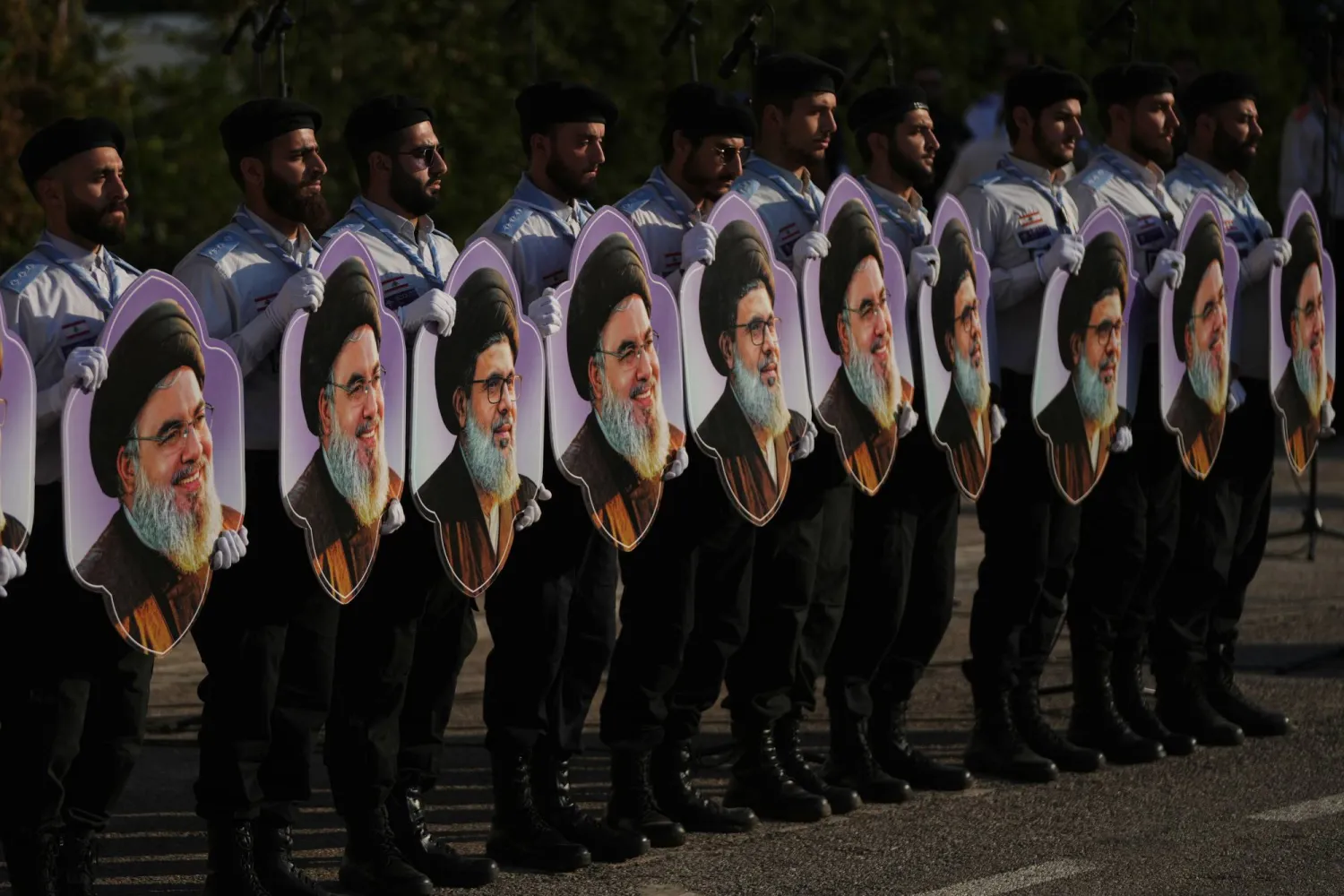
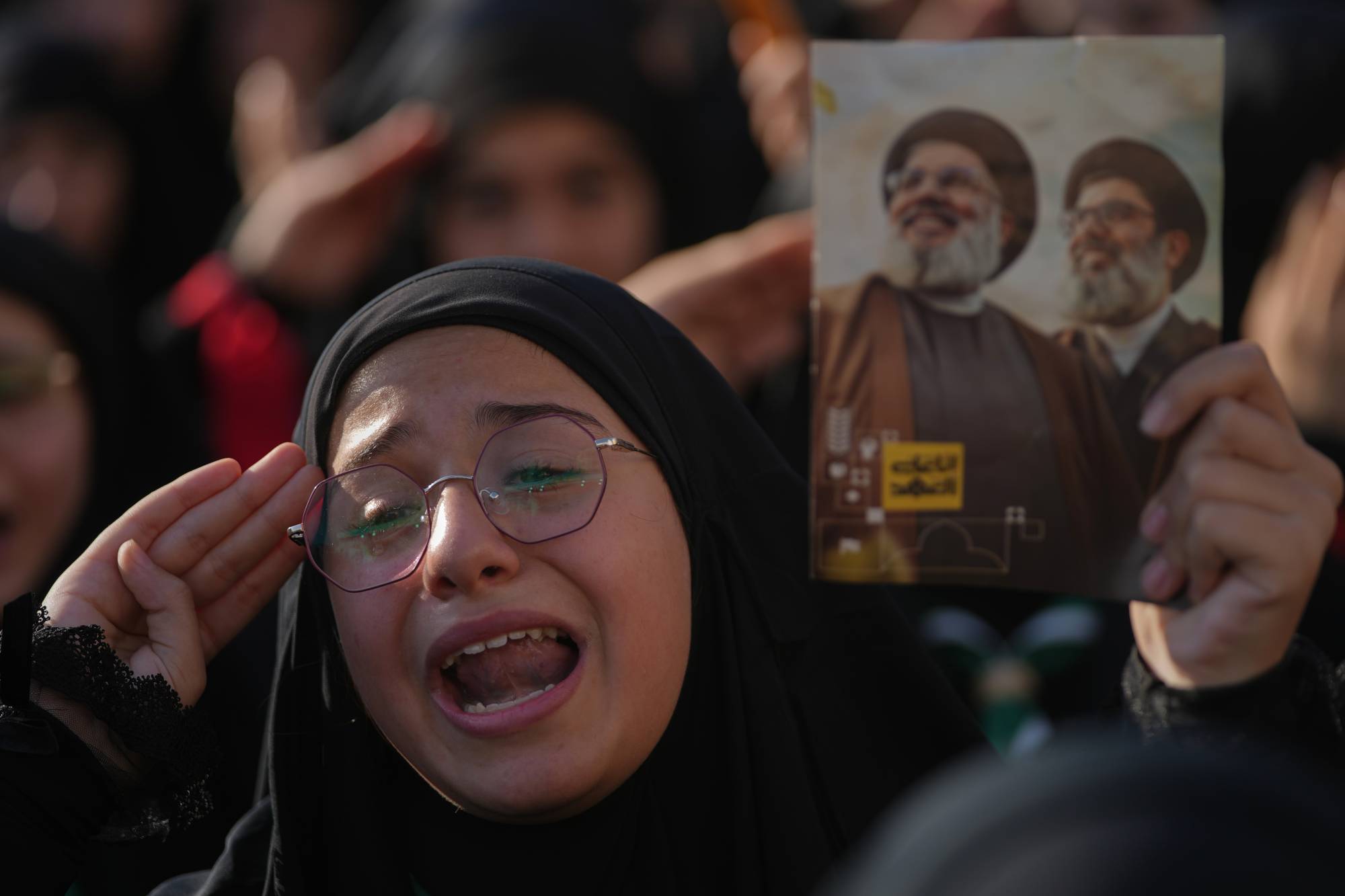
Members of Hezbollah's al-Mahdi Scouts hold portraits of Hezbollah leaders Hassan Nasrallah and his cousin and successor, Hashem Safieddine, during a gathering marking the second anniversary of their assassinations in Israeli airstrikes, in Dahiyeh, a southern suburb of Beirut, Lebanon, Sunday, Oct. 4, 2026. (AP Photo/Hassan Ammar)
Members of Hezbollah's al-Mahdi Scouts hold portraits of Hezbollah leaders Hassan Nasrallah and his cousin and successor, Hashem Safieddine, during a gathering marking the second anniversary of their assassinations in Israeli airstrikes, in Dahiyeh, a southern suburb of Beirut, Lebanon, Sunday, Oct. 4, 2026. (AP Photo/Hassan Ammar)
“Imagine if he had not died,” my interlocutor says over the phone from Beirut. He has close knowledge of Hezbollah and is in daily contact with its broader social environment.
He poses a hypothetical question: What if Hassan Nasrallah had survived and had been the one required to lead the confrontation?
He does not mean a military confrontation with Israel. “That is what the party is doing, and that is its playing field,” but rather “a confrontation with himself, his supporters and his community over this catastrophe he brought upon them.”
Would he have signed a ceasefire agreement? Would he have agreed to negotiations or opposed them as his successor does today? Would he have been able to return to the “If I had known” line he used after the 2006 July War?
A torrent of questions that will never find answers, and “an enormous void the size of the hole that swallowed him and his comrades in the southern suburbs,” says another source from southern Lebanon who witnessed all the Israeli wars on Lebanon, lost family members, friends and homes, and stands on the opposite political side from Hezbollah.
He continues: “Two years have passed, and the community and its surroundings are still in a state of shock and complete denial... a state of collective delirium. It is as if people did not lose a military commander or a religious leader, but rather the person who gave them a narrative about their circumstances.”
There is broad agreement over Nasrallah’s ability to “theatricalize” the war and its losses, transforming the costs borne by the afflicted, the grieving and the bereaved into an epic moment of euphoria and victory. That, it seems, is what his supporters and followers miss most today. It is as though their involvement in the war of support and the price they paid for it remains a detail compared with the absence of the person who could dictate its favorable narrative.
That rhetorical void is not due only to the fact that Hezbollah Secretary-General Naim Qassem lacks his predecessor’s ability, but also because Nasrallah himself had begun losing his public space, image and public presence well before his assassination. In this sense, “the moment of his assassination came as a rescue from many losses and enormous obligations.”
The source says: “Nasrallah actually died before the moment of his assassination... He died with the pager operation and the series of assassinations that followed. He died when he lost his ability to mobilize and justify, when he was no longer able to offer people a narrative, and when no one cared about his speeches or waited for them as they once did.”
Here, the source points to a role he considers more important than the organizational position Nasrallah held within the party. He “was neither a military tactician nor a religious man in the conventional sense, so much as a ‘man of mobilization’ who gave the party a power normally enjoyed by states, not parties or armed organizations.”
Such an overwhelming presence, of course, does not emerge overnight.
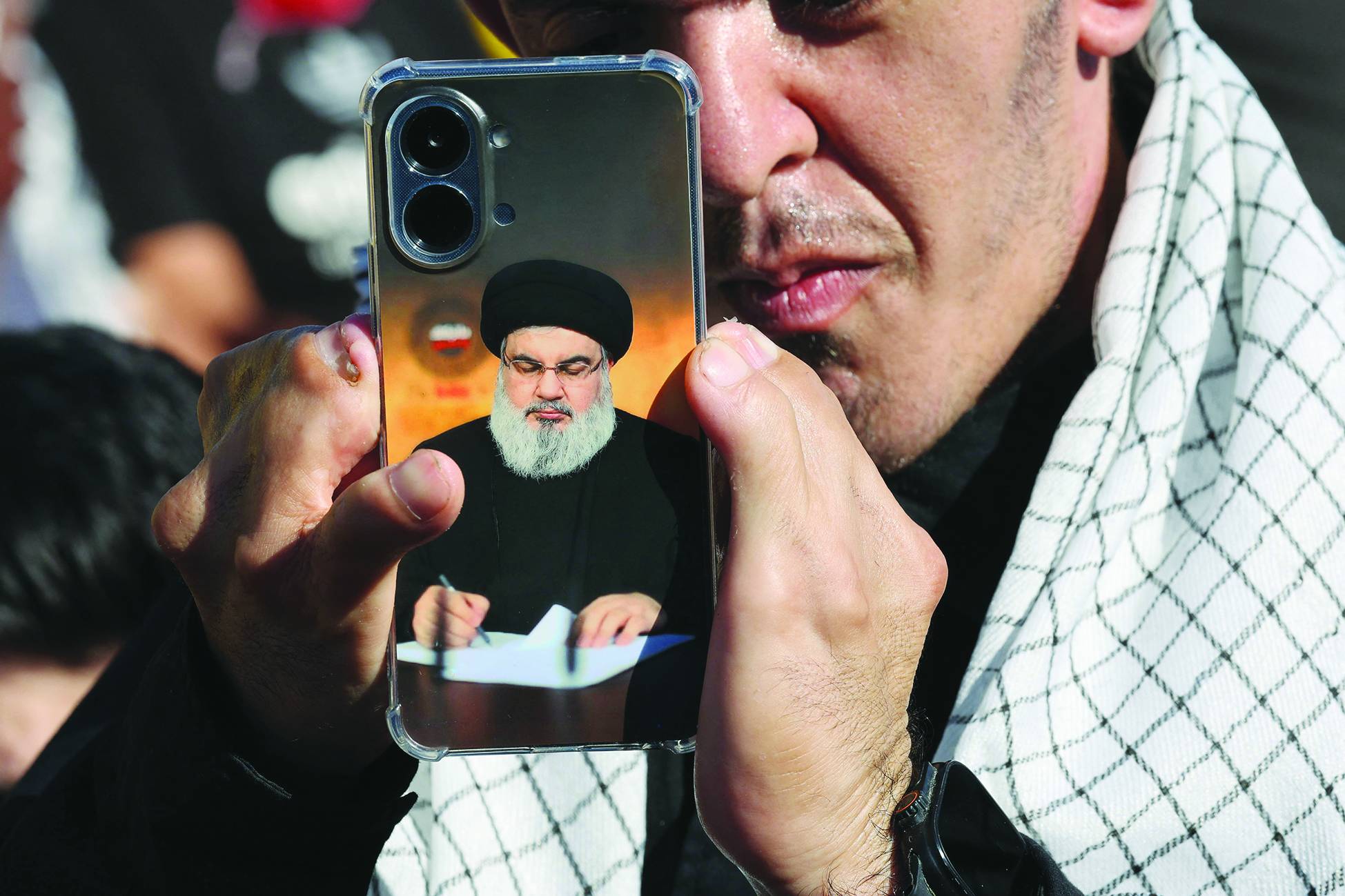
A supporter of Hezbollah, who was injured in the Israeli pager operation against the group, uses his phone whose back cover bears the image of slain leader Hassan Nasrallah during a ceremony held to mark the second anniversary of Nasrallah's killing in a strike by Israel, in Beirut's southern suburbs on September 27, 2026. (Photo by Anwar AMRO / AFP)
“As Though He Never Existed”
A sociologist and writer who follows transformations within Hezbollah and its social environment recalls Nasrallah between 2000 and 2006 and describes him as closer to a “party activist” before he gradually built a presence that, in his view, was consolidated with the assassination of Rafik Hariri, when his words acquired regional weight.
Since the 2000 liberation, Nasrallah had cultivated this aura and “worked tirelessly on it,” relying on the party’s full media apparatus to establish an image “closer to a legend and demigods,” thereby justifying the continuation of carrying arms.
Until quite recently, his television appearances were like “Umm Kulthum evenings. The streets would empty, people would sit transfixed in front of their screens, and they would be enthralled by what they heard.”
Paradoxically, those listening were not Hezbollah members, nor were they all part of its immediate social environment. At different stages, Nasrallah had become a public event: “His supporters listened to him, his opponents listened to him, neighboring countries listened to him, and everyone waiting to know what would happen the next day listened to him.”
Today, two years later, “it is as though he never existed.”
A woman from southern Lebanon belonging to a family with considerable social and religious standing traveled to Tyre and Nabatieh one day before the second anniversary commemorating the assassinations. She says: “I did not see his pictures on the streets or buildings as was customary. Had I not caught sight of a small picture of him, tucked away to the side in a small shop, I would not have noticed his complete absence from the public scene at all.”
She adds: “Even in private gatherings, no one talks about him anymore. What seemed even stranger to me was that this coincided with the anniversary... It may seem at first that there is indifference toward him, but I believe he has become that absent figure who is ‘not spoken of.’ He is now the quintessential Shiite ‘taboo.’”
According to the woman, who is close to the party’s social environment and trusted within its small community without being part of it, it seems that “there are no longer many who love the ‘Sayyed’ outside the hard core of party supporters and those on the party payroll.”
Even his former broad base of supporters did not go to the condolence gatherings, which are “a central ritual for Shiites.”
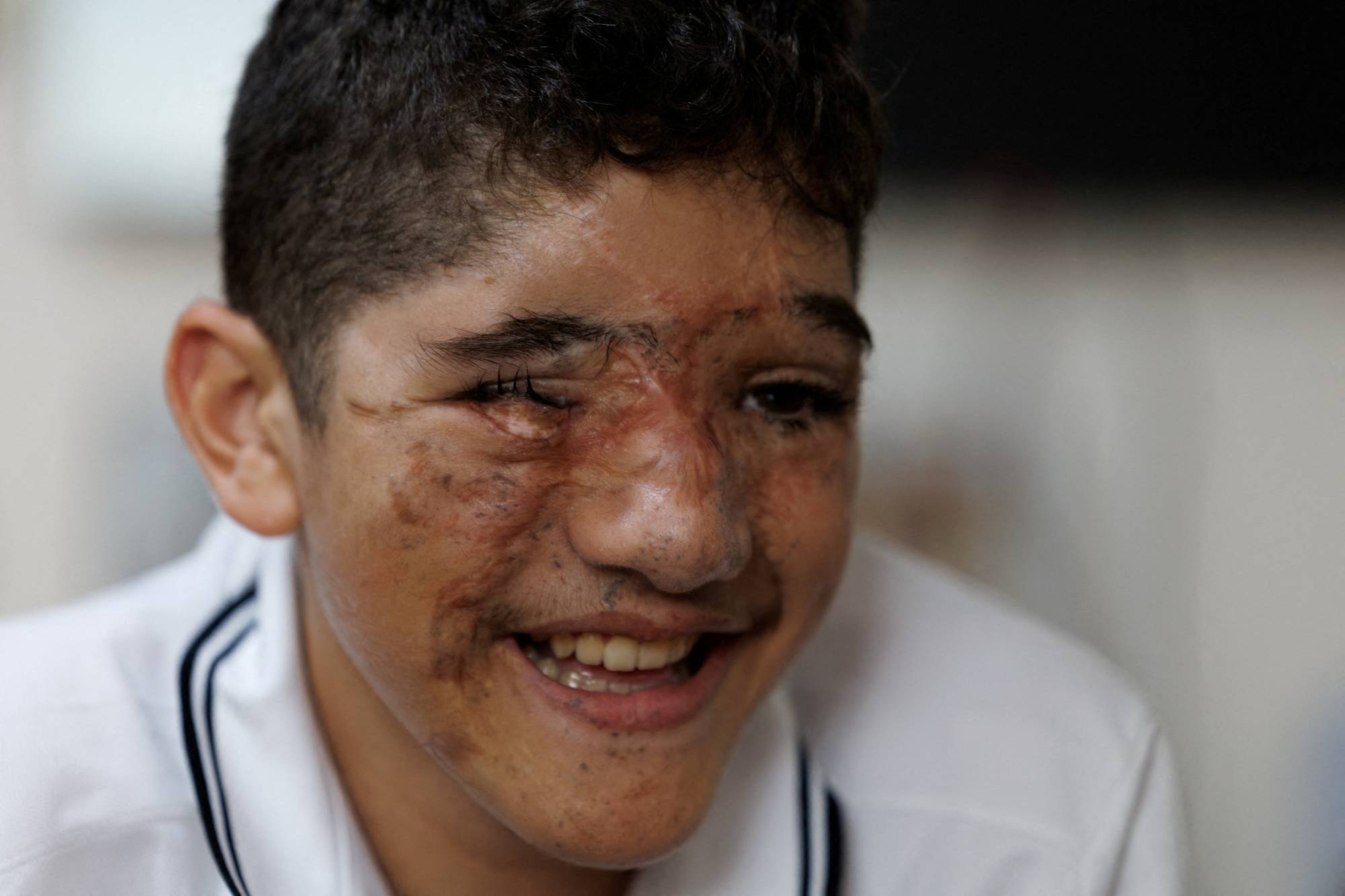
Ali Abbas, 14, who lost his right eye with severe damage to his right lower eyelid and lost some fingers in pager attacks across Lebanon on September 17, 2024, recovering at his home, in Barish, in the Tyre district, southern Lebanon, September 1, 2026. REUTERS/Zohra Bensemra
“Only the Guard Remains”
My interlocutor from the south brings me back to Nasrallah’s legacy, saying that “there is no one left to inherit him... even Hezbollah as we knew it died with him.”
To explain this view, he elaborates: “In politics, Nasrallah caused unprecedented political embarrassment for his closest allies by declaring the war of support after personally assuring Parliament Speaker Nabih Berri that he would do the opposite. Then, after the six rockets were launched, Berri made calls and tried to persuade the party not to issue a statement claiming responsibility for the rockets. He obtained another explicit commitment, which did not survive even a few hours before it too was broken.”
Until October 7, 2023, Nasrallah played a regional role with a relatively comfortable margin for maneuver. He was “the trusted intermediary between Iran and Lebanon, government, sects, people and institutions. He played roles in relations with the surrounding region and the outside world, sparing Tehran many direct confrontations with neighboring countries. He would pass on decisions and absorb the shocks in its place.”
But that, the source says, gradually began to change after October 7, and then fundamentally after Nasrallah was killed, to the point that “today, only the Revolutionary Guard remains. Nothing else. The Guard directly controls every part of the party, its leadership, fighters and strategy. Naim Qassem is unable to play the role of intermediary or messenger.”
As for the party’s structure, the source continues: “Hassan Nasrallah is the last black-turbaned figure in the secretary-general’s office. Naim Qassem wears a white turban, and that reflects a different religious hierarchy. His [reported] deputy is Mohammed Raad, a member of Parliament and not even a religious cleric.”
If we exclude the person who had been a candidate for the secretary-generalship before Qassem but was excluded, or removed himself, as some say, Ibrahim Al-Sayyed Amin, who was the closest to the position after Hashem Safieddine, one might turn to Nasrallah’s son, Mohammed Mahdi. He is a young cleric with a turban and an active party cadre.
“But he has not been prepared for that role and has not yet matured,” according to several sources who agree on the point.
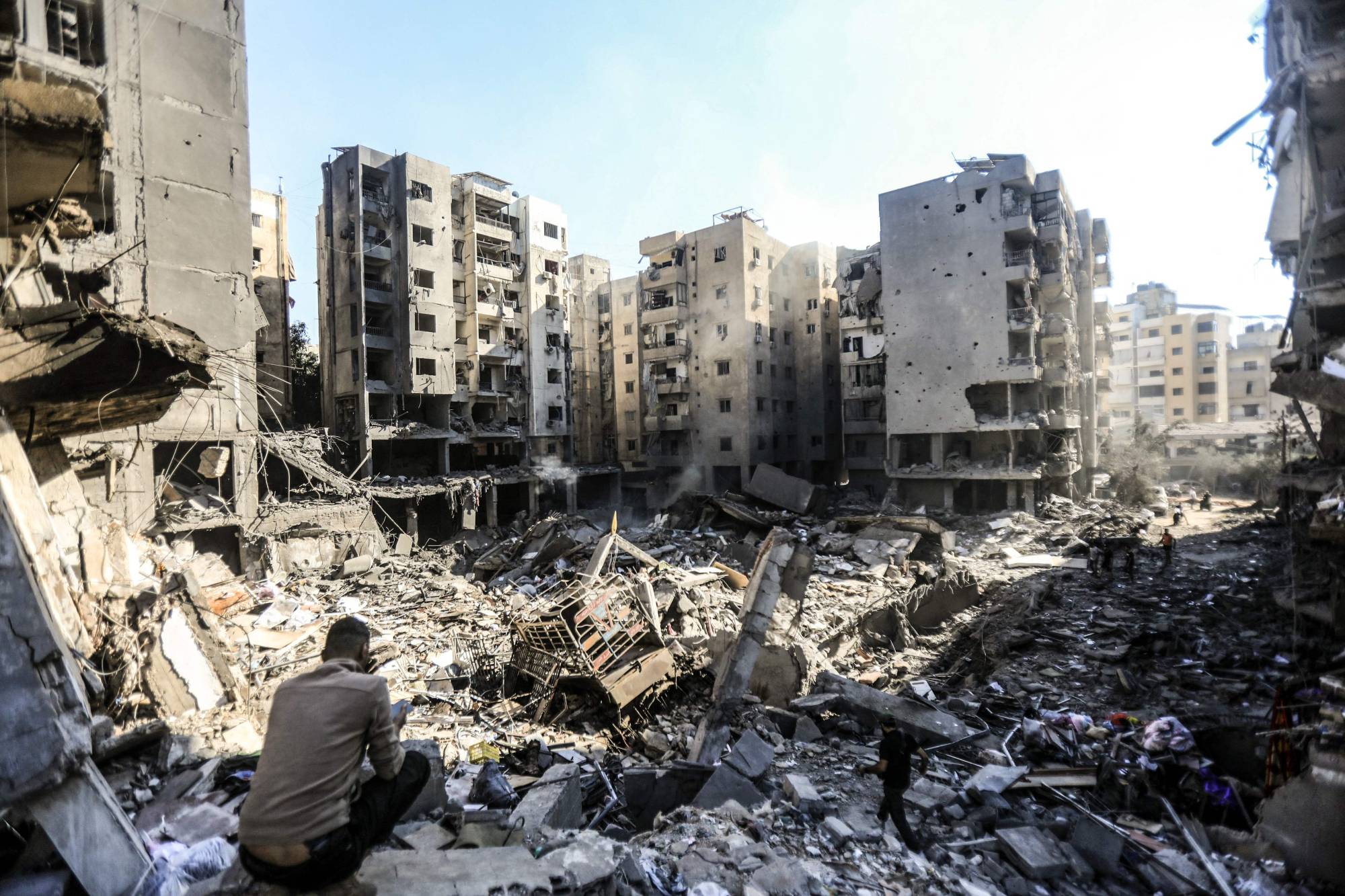
People check the rubble of buildings which were levelled on September 27 by Israeli strikes that targeted and killed Hezbollah leader Hassan Nasrallah in the Haret Hreik neighbourhood of Beirut's southern suburbs, on September 29, 2024. (Photo by AFP)
Nasrallah’s Sons... The Burden of the Legacy
One source explains: “After his death and the deaths of those around him, we can see the importance of family ties within the circle of trust that surrounded him, and which turned out to underpin the party’s leadership.” According to the source, “what Nasrallah destroyed by choosing to remain in his position surrounded by these close leaders, and by waiting for the death that was inevitably approaching him, was the fabric of family, clan and party together. It is difficult, if not impossible, to repair.”
What is striking is that throughout all this, he did not include his sons or work to prepare any of them to succeed him.
According to the sociologist and writer, “historical leaders of this magnitude do not think about succession, perhaps because of some form of narcissism in them, leaving their children struggling with their identities and with managing the weight of the legacy on their shoulders.”
The sons, specifically Jawad and Mohammed Mahdi, who have increased their public presence recently, are “a phenomenon worth pausing over, particularly as each tries to humanize the father and imitate his image... but in reality, with little success.”
A close examination of the social media accounts the two young men have recently turned to shows a determined effort to borrow from their father’s behavior, from imitating the movement of his hand and his manner of speaking to something resembling a division of roles. One, for example, appears to emulate a religious authority in his turban, while the other invokes Guevara and the liberation of peoples at times, then the martyrs and the righteous, along with his certainty that his father will return with them, at others.
“The Spell of the Eyes”... Just a Bubble
Today, instead of building on that “legend,” “Nasrallah’s narrative has become a farce... and is now at the mercy of the wind,” one source says. He continues: “Two years after his death, all we have to do is look at the ease with which his immediate circle is handling his legacy to realize that there is no custodian of this legacy... All those narratives about his leadership charisma, his commanding presence and the spell of his eyes, the common comparison used to describe Nasrallah, drawn from descriptions of Gamal Abdel Nasser, have suddenly vanished. As if they were merely a bubble.”
“All it takes is for a marginal politician to claim on television that he used to sit with him for around seven hours. What kind of exaggeration is that? Or, for example, his son Mahdi talking about how he would prepare breakfast for him, or the video showing him driving around in a car in the southern suburbs, for which we do not know the context, date or source. Was it the party media? Al-Manar TV? Who decided that these stories should be made public today?”
The Loss of Voice and Image
More questions all point to the same issue: the opening up of the narrative that Nasrallah had monopolized. His narrative about himself and his party, whose rhythm he controlled through a committed media machine that did not depart from what he dictated.
Was that why the slogan of the anniversary was “We Remain Committed to the Pledge”? And was that why Qassem launched an institution to preserve and publish Nasrallah’s legacy?
Perhaps the aim was to “humanize” the man and make him an accessible figure, conveying a message to the grieving popular base that he was like them and among them despite his absence.
But in practice, the result was exactly the opposite.
The “void the size of the hole” and the leadership crisis are viewed by the sociologist through the lens of the mass of people that was once strongly present and has become “more obscure and closed than ever,” and “completely unknown to anyone outside its close members.”
He says: “It is as though the Shiites as a whole have withdrawn, leaving a void in the mechanisms of daily life, in their relationship with other parties, other sects and the broader Lebanese sphere.” Apart from the small number who appear on social media and fiercely defend the war of support, the social mass that Nasrallah once represented appears, in his view, less visible and less present.
He says: “It is as though, with the loss of Nasrallah, they lost the voice and the image.”
But what appears from the outside to be a decline reveals, within the narrow circles of trust, another ordeal.
A girl, a member of Hezbollah's al-Mahdi Scouts cries as she holds up a poster during a gathering marking the second anniversary of the assassinations of Hezbollah leaders Hassan Nasrallah and his cousin and successor, Hashem Safieddine, who were killed in Israeli airstrikes, in Dahiyeh, a southern suburb of Beirut, Lebanon, Sunday, Oct. 4, 2026. (AP Photo/Hassan Ammar)
Is “Shelter” Inevitably Coming?
The woman from southern Lebanon says that “the void in the party’s leadership today seems like a luxury compared with the void in the forces that drive daily life for southerners.” She continues: “It is as though Amal has inherited the streets and the scene in Tyre in particular instead of the party. What the party members once represented as a deterrent to the activists is no longer there today, so these people have become a de facto authority controlling everything... and there is much bitterness in that.”
Today, many people in southern Lebanon want to believe their new secretary-general’s statement that “shelter” is inevitably coming, and that Iran will not abandon them or stop supporting them with money, weapons and influence. But they remain silent about the fact that the money will not come, and that the mere use of the word “shelter” instead of the “decent housing and decent furnishings” Nasrallah promised them after the 2006 July War says a great deal about their circumstances.
Between denial and the deep mourning suffered by the party’s community, the greatest shock remains “the loss of the power and the ‘surplus of power’ they enjoyed for more than two decades and wielded as a daily weapon against the rest of the Lebanese... Therefore, their social contract today appears to be based on treating that narcissistic wound by directing all their anger at the agents.”
It is as though the excessive talk of traitors and agents compensates them for the deafening silence about everything else. In their view, these are the Lebanese, all Lebanese outside their own community, and everyone who did not support them in their support effort. So they erupt in anger whenever they are mentioned, seeking relief from their misery through more insults and threats.
Scars from Oct. 7 Fuel Deep Divisions Over Netanyahu Ahead of Israeli Electionhttps://english.aawsat.com/features/5327173-scars-oct-7-fuel-deep-divisions-over-netanyahu-ahead-israeli-election
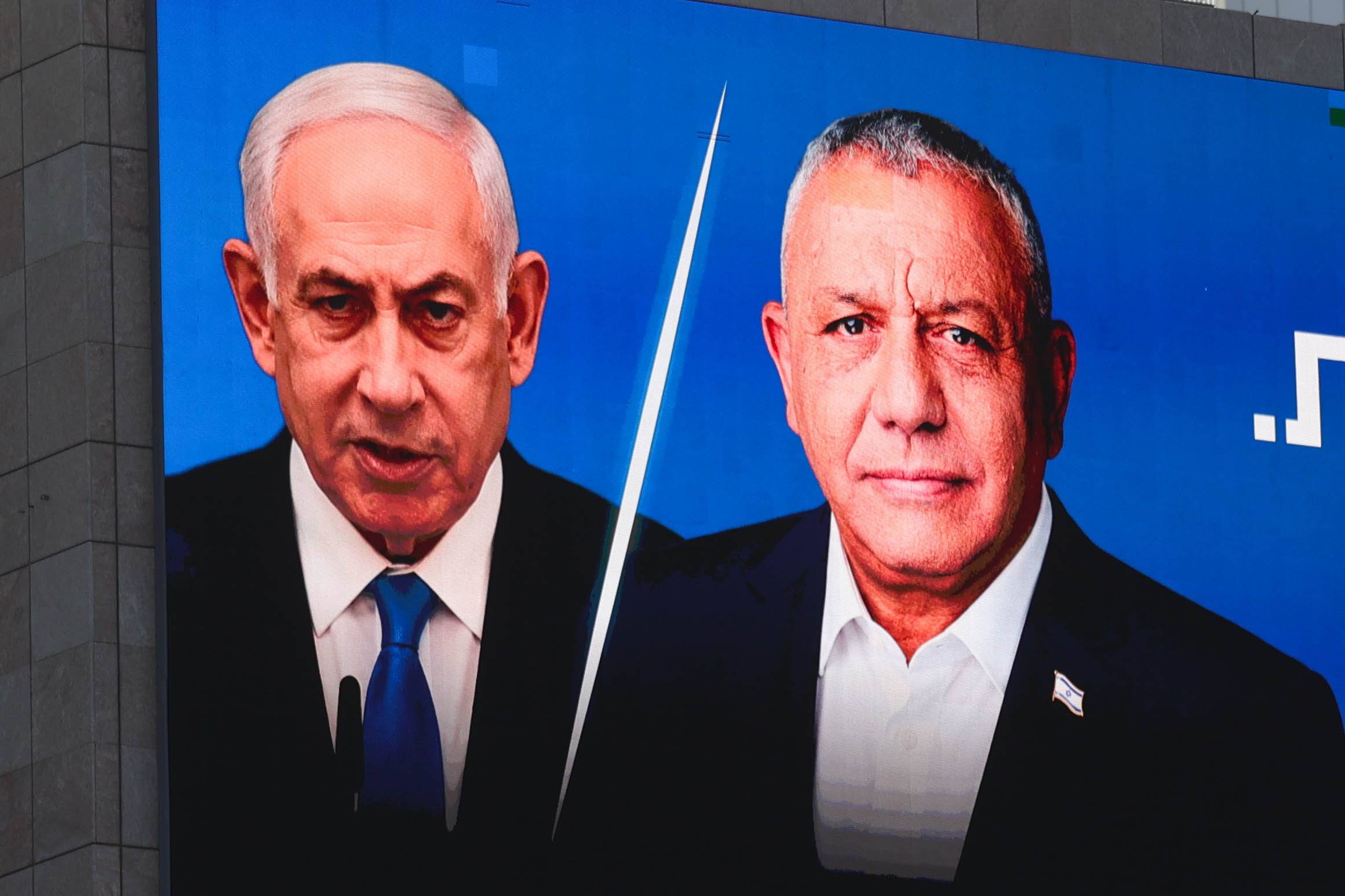
People walk past an election billboard showing Israeli Prime Minister Benjamin Netanyahu with the Hebrew phrase "We will not surrender" in Tel Aviv, Israel, 06 October 2026. (EPA)
TT
TT
Scars from Oct. 7 Fuel Deep Divisions Over Netanyahu Ahead of Israeli Election
People walk past an election billboard showing Israeli Prime Minister Benjamin Netanyahu with the Hebrew phrase "We will not surrender" in Tel Aviv, Israel, 06 October 2026. (EPA)
As Israel gears up for its first elections since the Hamas-led Oct. 7, 2023 attack, Prime Minister Benjamin Netanyahu and his opponents are putting it at the heart of their campaigns.
Nearly every poster, stump speech or televised debate seems to reference the attack, which has scarred the country and remains fresh in the minds of voters. Three years on, the worst security failure in Israel’s history now threatens to end the career of its longest-serving prime minister.
“October 7 is kind of a framework for the entire political discussion that is going on,” said Tamar Hermann, an expert on Israeli public opinion at the Israel Democracy Institute, a Jerusalem think tank. “All of us are post-traumatic in a way.”
Netanyahu’s opponents want him to pay for the failures that led to the deadliest day in Israel’s 78-year history and plunged the country into a series of inconclusive wars. His defenders say Netanyahu was betrayed by the military establishment and that he has led Israel through a dramatic rebound from its darkest hour.
A loss in the Oct. 27 election would likely end the career of the soon-to-be 77-year-old Netanyahu. A victory would mark the greatest turnaround yet for a man who has defied naysayers for three decades.
A deadly day that has shaken an entire region
On the morning of Oct. 7, Hamas militants fired several thousand rockets into Israel and thousands of fighters attacked through holes blown in the border fence or with boats or motorized paragliders. Some 1,200 people were killed and 251 others taken hostage.
Israel responded with a military offensive that has killed over 74,000 Palestinians in the Gaza Strip, according to local health authorities, left the territory in ruins and sparked an ongoing humanitarian catastrophe. Israel later went to war against Hezbollah in Lebanon, seized a chunk of Syria, attacked targets in Yemen and joined the US in two wars against Iran.
Hundreds of Israelis, mostly young soldiers, have died, and nearly every household has been touched by the violence. Netanyahu promised “total victory,” but Hamas, Hezbollah and Iran’s theocratic government all remain intact.
Israel’s international standing has plummeted, a number of foreign governments have accused it of genocide — a charge it vehemently rejects — and Netanyahu is now wanted by the International Criminal Court.
After a string of resignations by top security officials, Netanyahu is the only senior figure from Oct. 7 still in office, making this month’s election in many ways a referendum on his leadership.
It's the focus of the campaign for both sides Netanyahu and his opponents have put Oct. 7 at the forefront of their campaigns — for different reasons.
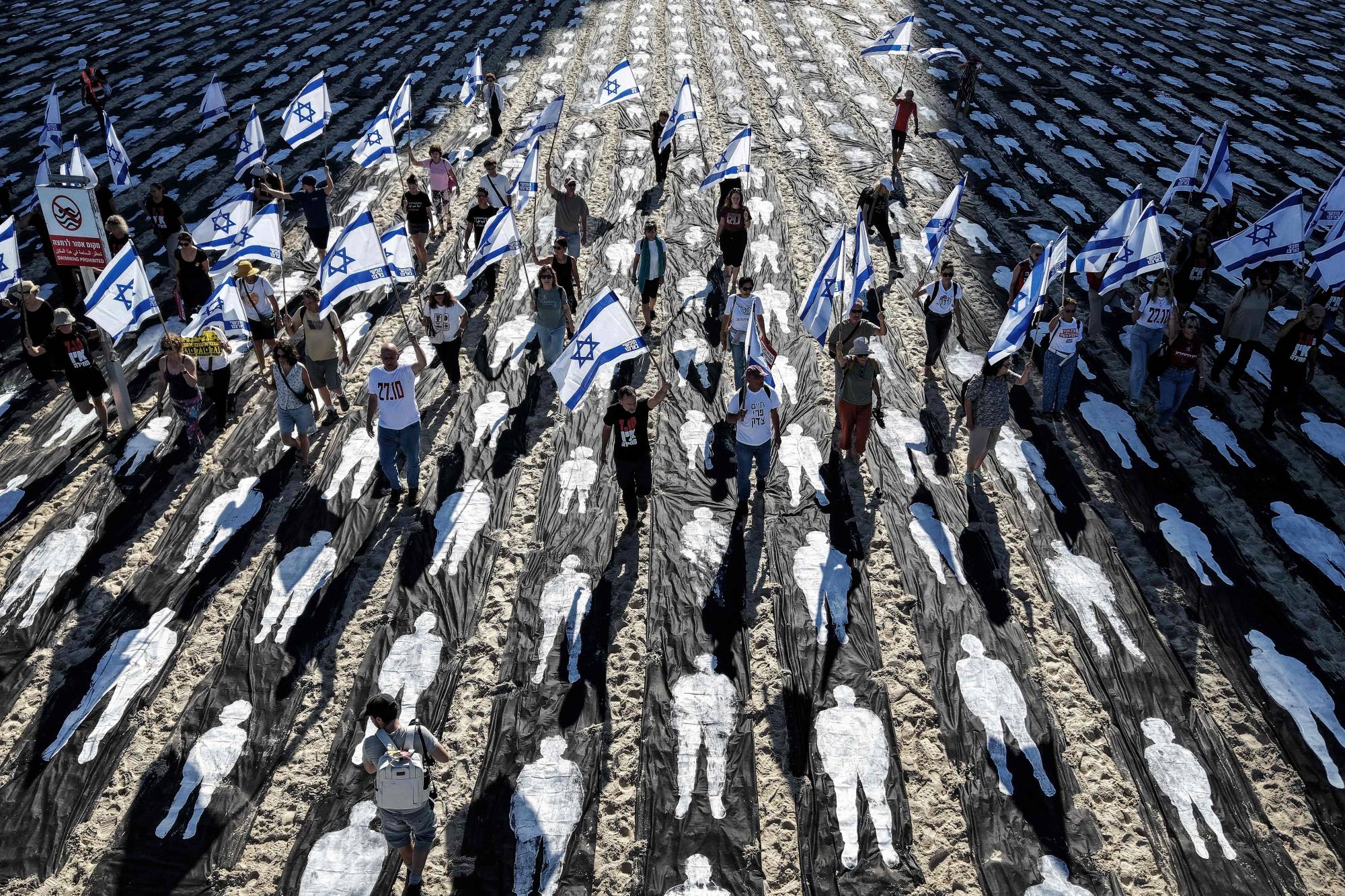
An aerial view shows people waving Israeli flags as they stand on a commemorative installation set up on the beach to mark the third anniversary of Hamas's October 7 attack on Israel, in Tel Aviv on October 7, 2026. (AFP)
His opponents — from across the political spectrum — call his outgoing coalition “the massacre government,” a reference to the Oct. 7 attack occurring on their watch. Netanyahu says he has led a “war of redemption.”
His chief rival is Gadi Eisenkot, a former military chief whose son and nephew were killed in battle in Gaza. The opponents have pledged to form a government of “repair and reconstruction” — beginning with the formation of an official commission of inquiry into Oct. 7.
They also have vowed to end draft exemptions for ultra-Orthodox religious men, a long-standing policy that has outraged the secular majority at a time of war, and accuse Netanyahu of threatening Israel's democratic institutions.
“The most fateful elections in the history of the State of Israel are between evasion and enlistment,” Eisenkot wrote on X. “Between taking responsibility and fleeing from responsibility.”
Netanyahu has repeatedly rejected calls for a commission of inquiry while trying to shift the blame to security officials. He recently accused the then-head of the Shin Bet security service, Ronen Bar, of withholding information ahead of the attack. Bar has vowed to file a defamation lawsuit.
Netanyahu insists the country is stronger than ever.
“Our enemies expected us to collapse,” he said in a recent address to the United Nations. “Well, we didn’t collapse. Instead, we rose and fought like lions.”
Oct. 7 victims are seeking seats in parliament
Eisenkot’s new Yashar party list includes two parents who lost children on Oct. 7. Netanyahu’s Likud party also includes two grieving parents, among them the mother of a policeman killed in battle on Oct. 7 whose remains were the last to be returned to Israel as part of a ceasefire. Another Likud candidate lost both legs while serving in Gaza.
The leader of the dovish Democrats party, Yair Golan, is a retired general who put on his uniform and rushed to the southern border to fight on Oct. 7. The centrist Together party’s list has another former general, Noam Tibon, who also battled militants as he rescued his son’s family, and the mother of a soldier killed that day.
Other parties have also added people directly impacted by the attack.
Organizers, including victims' relatives, say they are keeping politics out of a mass memorial service in Tel Aviv on Wednesday. But they have hardly concealed their anger at the country’s leadership.
“We will not let anyone evade responsibility,” Yonatan Shamriz, whose brother was taken hostage and mistakenly killed by Israeli soldiers after escaping captivity, said in a radio interview.
A large election billboard shows Israeli Prime Minister Benjamin Netanyahu (C-L) and leader of the Yashar party, Gadi Eisenkot (C-R), in Tel Aviv, Israel, 06 October 2026. (EPA)
There is little discussion of the Palestinians
Largely missing from the Israeli public discourse is any discussion of the dire situation in Gaza or the fate of the Palestinians.
Israeli leaders have said little about the unprecedented death toll in Gaza, the humanitarian catastrophe and the lack of reconstruction. Instead, they have focused largely on the country’s pain over Oct. 7.
There is almost no mention of peace talks, and even Netanyahu’s challengers largely oppose the establishment of a Palestinian state alongside Israel, the international community's preferred solution for the decades-old conflict.
When a pair of Israeli filmmakers released a documentary last month about civilian deaths in Gaza, party leaders across the spectrum, including Eisenkot, accused them of treason.
Oct. 7 has hardened the bitter split over Netanyahu
Polling suggests a close race between Netanyahu and his chief rival, Eisenkot, with an uncertain outcome.
According to the Israel Democracy Institute, over 60% of Israelis say their attitudes toward Oct. 7 are a central factor in whom to vote for. That number jumps to 68% among the Jewish majority; Arab voters are most concerned with a crime wave in their communities.
But Hermann, the IDI polling expert, said this doesn’t necessarily mean bad news for Netanyahu. She says the past three years have hardened attitudes on both sides.
Just because everyone says Oct. 7 is important, she said, “doesn’t mean that they will come out with the same conclusion.”
لم تشترك بعد
انشئ حساباً خاصاً بك لتحصل على أخبار مخصصة لك ولتتمتع بخاصية حفظ المقالات وتتلقى نشراتنا البريدية المتنوعة