

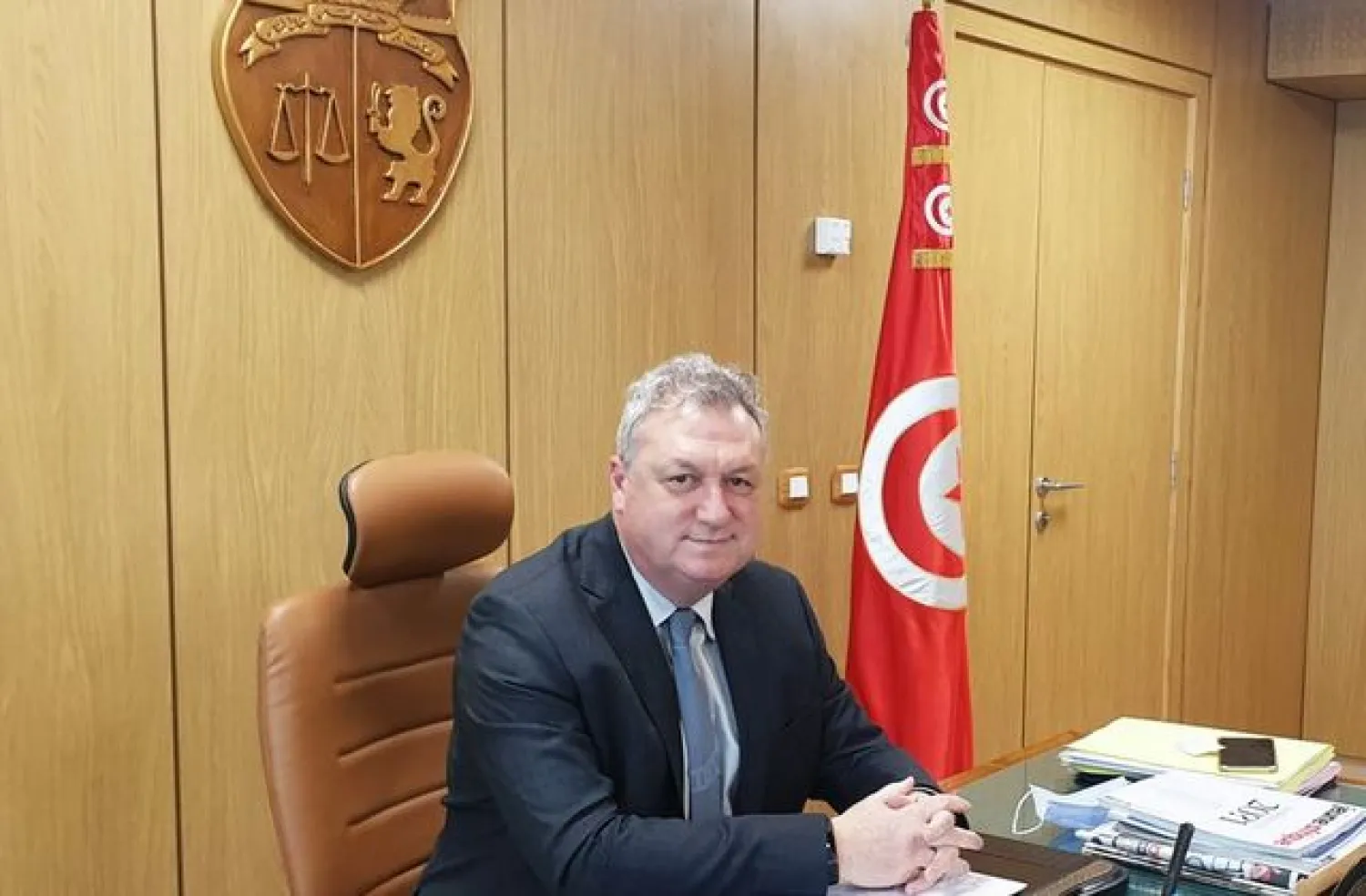

Tunisia to Issue up to $3bln Debt, Push Reforms This Year, Finance Minister Says

Tunisia's Finance Minister Ali Kooli attends an interview with Reuters in Tunis, Tunisia January 29, 2021. REUTERS/Tarek Amara
TT

Tunisia to Issue up to $3bln Debt, Push Reforms This Year, Finance Minister Says

Tunisia's Finance Minister Ali Kooli attends an interview with Reuters in Tunis, Tunisia January 29, 2021. REUTERS/Tarek Amara

Tunisia will issue debt worth up to $3 billion this year and aims to roll over some existing credit arrangements while setting in train wider economic reforms, Finance Minister Ali Kooli told Reuters in an interview.

With a deficit estimated at 11.5% of gross domestic product last year and public debt at 90% of GDP, Tunisia plans reforms to cut its high public wage bill and subsidies and restructure poorly performing state-owned companies, Kooli said.

The COVID-19 pandemic, political infighting, and ongoing protests over inequality have added to the pressure on the government, while foreign lenders and the powerful labor union have often made competing demands on reform.

"Our situation is tough, but it doesn't mean that we aren't in a position to pay salaries or reimburse our debt", said Kooli, adding that Tunisia could comfortably meet repayments due in the first half of 2021.

Tunisia's 2021 budget forecasts borrowing needs at 19.5 billion Tunisian dinars ($7.2 billion), including about $5 billion in foreign loans. It puts debt repayments due this year at 16 billion dinars, up from 11 billion dinars in 2020.

Kooli said Tunisia wants a new $1 billion loan guarantee arrangement from the United States, which he said could help it secure the $3 billion in bond issuance, the first time he has given that figure.

The government also hopes to reach agreement with the International Monetary Fund on a new financing program, and he said recent Article IV consultations were a step towards that.

However, Kooli said Tunisia had not yet decided how much new international debt to seek and that it was taking steps to improve its credit rating and gain IMF blessing for the move.

"I believe there is a real possibility to go to the markets for at least $1 billion during 2021," he said, adding that the higher sum of $3 billion would also be possible.

Tunisia is looking at various instruments including a Sukuk for the first time, a club deal, a specific action for the Asian market, or a dollar-denominated bond issue, Kooli said, without elaborating.

The government may also issue, separately, a Sukuk for the domestic market before July, he said, adding that it could be in the region of around 300 million dinars.

REFORMS

Tunisia will switch to targeted subsidies in coming months, he said, and will announce restructuring plans for state-owned companies after Ramadan, which this year ends in mid-May.

However, the pandemic may delay some reforms both to avoid increasing the economic pain for ordinary Tunisians and because it is not a good time to attract potential investment in state companies.

Targeted subsidies will involve distributing digital cards for lower-income Tunisians as well as other measures, he said.

However, the government is still assessing how many people require help, what price different products should be and how to avoid a big rise in inflation, he said.

Although Prime Minister Hichem Mechichi has already announced a new unit to take over state-owned companies from direct control by government ministries, the details of reforms will not be announced until they are finalized, Kooli said.

He confirmed the government would sell its share in some firms but did not identify them. He questioned whether the state needed to hold minority shares in companies, whether it needed to own stock in 12 banks, as now, or in gambling.

Any revenues raised by privatization would be pumped back into other state-owned companies that the government wants to restructure, he said.

Tunisia's main labor union, the UGTT, has previously resisted any privatization, but Kooli said he expected no trouble there, adding the government was "not looking for a fight".

On the public sector wage bill, Kooli said the government was looking at different ways to reduce it, for example by offering slightly lower pay for greatly reduced hours.

"The possibility to work half time and be paid a little bit more than half salary is an avenue we are considering," he said. ($1 = 2.7014 Tunisian dinars)



Saudi-Canadian Business Forum Explores Opportunities to Strengthen Investment

The Saudi-Canadian Business and Investment Forum was held on Sunday. (SPA)
TT

Saudi-Canadian Business Forum Explores Opportunities to Strengthen Investment

The Saudi-Canadian Business and Investment Forum was held on Sunday. (SPA)

The Saudi-Canadian Business and Investment Forum was held on Sunday in Riyadh under the “Invest Saudi” umbrella, with the participation of Minister of Investment Eng. Khalid Al-Falih, Canadian Minister of International Trade Maninder Sidhu, and several senior officials and representatives from major companies in both countries.

The forum reviewed prospects for investment partnerships across a number of key sectors, including digital transformation, infrastructure, defense, and other areas of mutual interest, with a focus on strengthening cooperation and increasing investment flows between Saudi and Canadian companies, the Saudi Press Agency reported.

Six memoranda of understanding were signed during the forum in the fields of communications, information technology, cybersecurity, education, and manufacturing. In addition, private-sector workshops were held to facilitate dialogue between investors, exchange expertise, and explore opportunities for joint ventures and long-term cooperation.


Saudia to Launch Riyadh-Kozhikode Flights in February

Saudi Arabian Airlines plane, is seen at the airport of the Red Sea resort of Sharm el-Sheikh, Egypt, August 9, 2021. Picture taken through a window. REUTERS/Mohamed Abd El Ghany/File Photo
TT

Saudia to Launch Riyadh-Kozhikode Flights in February

Saudi Arabian Airlines plane, is seen at the airport of the Red Sea resort of Sharm el-Sheikh, Egypt, August 9, 2021. Picture taken through a window. REUTERS/Mohamed Abd El Ghany/File Photo

Saudia Airlines has added Kozhikode, India, to its network of scheduled international destinations, marking its seventh destination in the country alongside Bangalore, Mumbai, Kochi, Delhi, Hyderabad, and Lucknow, as part of the airline’s strategy to reach new international markets, connect the Kingdom to the world through its modern fleet, and strengthen its global competitive position, SPA reported.

Flights to Kozhikode will begin on February 1, 2026, with four weekly departures from King Khalid International Airport in Riyadh.

Reservations are available through the airline’s website and mobile applications.

The addition of Kozhikode further expands Saudia's growing operational network, which now covers over 100 destinations across four continents and operates more than 550 domestic and international flights daily.


Egypt Signs Renewable Energy Deals Worth $1.8 Billion

The Wolf Moon, the first supermoon of 2026, lights up the night sky in Cairo, Egypt, January 3, 2026. REUTERS/Mohamed Abd El Ghany
TT

Egypt Signs Renewable Energy Deals Worth $1.8 Billion

The Wolf Moon, the first supermoon of 2026, lights up the night sky in Cairo, Egypt, January 3, 2026. REUTERS/Mohamed Abd El Ghany

Egypt has signed renewable energy deals worth a combined $1.8 billion, state TV reported on Sunday.

Among the deals were contracts with Norwegian renewable energy developer Scatec and China's Sungrow.

Egypt hopes to have renewable energy reach 42% of its electricity generation mix by 2030, but officials say the goal will be ⁠at risk without more international support.

The first project will be the construction by Scatec of a solar energy plant to generate electricity and energy storage stations in Upper Egypt's Minya, ⁠an Egyptian cabinet statement said.

It would have a generation capacity of 1.7 gigawatts supported by battery storage systems with total capacity of 4 gigawatt hours.

A second project will be a Sungrow factory to manufacture energy storage batteries at the Suez Canal Economic Zone. A share of the factory's output ⁠would be supplied to the first project, the cabinet said.

The deals also include power purchase agreements, with Scatec signing a deal for total capacity of 1.95 gigawatts and 3.9 gigawatt hours of battery storage systems, the Norwegian company said in a statement.