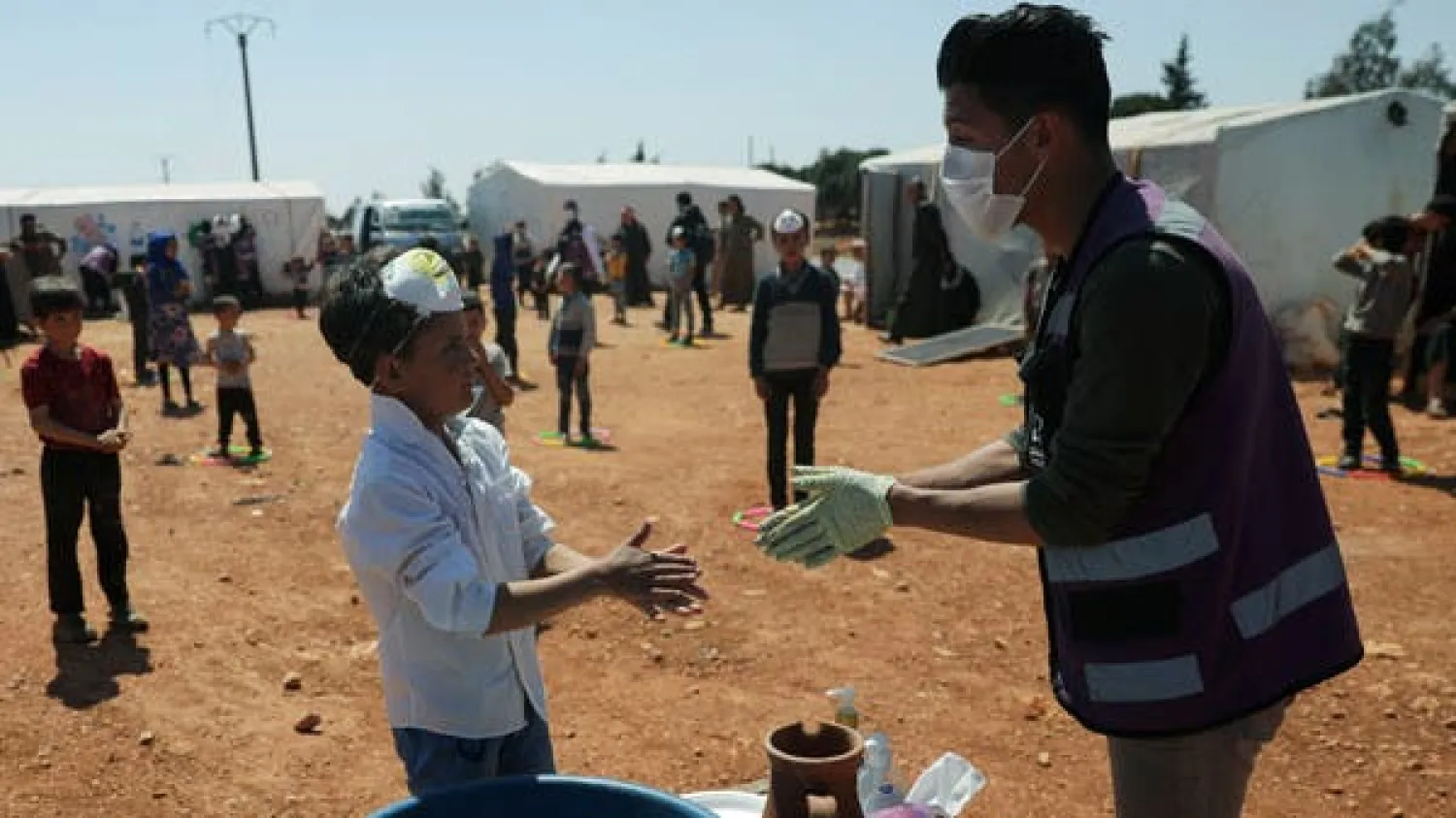
WHO Deploying Teams Across Syria for COVID-19 Vaccination Program

A displaced boy takes part in event organzied by Violet Organization, in an effort to spread awareness and encourage safety amid coronavirus disease (COVID-19) fears, at a camp in the town of Maarat Masrin in northern Idlib, Syria April 14, 2020. Picture taken April 14, 2020. (Reuters)
TT

WHO Deploying Teams Across Syria for COVID-19 Vaccination Program

A displaced boy takes part in event organzied by Violet Organization, in an effort to spread awareness and encourage safety amid coronavirus disease (COVID-19) fears, at a camp in the town of Maarat Masrin in northern Idlib, Syria April 14, 2020. Picture taken April 14, 2020. (Reuters)

The World Heath Organization is deploying teams across Syria for a vaccination program that will be rolled out both in government-held areas and territory outside state control, perhaps as soon as April, it said on Wednesday.

Dr. Akjemal Magtymova, WHO representative in Damascus, said the body’s COVAX program plans to immunize 5 million Syrians -- 20 percent of the population across all parts of the country -- despite the conflict now entering its 11th year.

“We are preparing our vaccine deployment plan with the ministry of health to make sure the program goes well,” Magtymova said, adding the priority was first to vaccinate high risk health workers, social workers and the most vulnerable, Reuters reported.

The GAVI alliance, the group that co-leads COVAX with the WHO, said last week it aimed to deliver 2.3 billion vaccines worldwide by the end of 2021, including 1.8 billion free doses to lower-income countries.

“I am really hopeful it will (begin) in April but it might take even longer depending on so many factors,” Magtymova told Reuters in a phone interview from Damascus, of the plan to roll out the vaccine program in Syria.

“We have to juggle with so many unknowns.”

Like other countries that are awaiting vaccines through COVAX, Syria can also obtain supplies directly from companies. But so far it has yet to announce any such bilateral agreements. Health officials say Damascus has been engaged in talks with Russia and China over vaccine supplies.

Apart from the logistics of arranging vaccinations across combat frontlines, Syria faces the additional hurdle of international financial sanctions.

Medicines are generally exempt from sanctions, but UN sources said the sanctions have left Damascus without much financial clout to negotiate deliveries, and have slowed the process by creating additional legal risks.

Magtymova said any supplies of safe and effective vaccines Syria could obtain would help make vaccines more available. The WHO has no role in such bilateral deals.


Egyptian President Urges UN Security Council Reforms for Africa's Larger Role

In this photo, provided by Egypt's presidency media office, Egyptian President Abdel-Fattah el-Sisi, front right, greets Russian Foreign Minister Sergei Lavrov, left, before their meeting at the Presidential Palace in Cairo, Egypt, Saturday, Dec. 20, 2025. (Egyptian Presidency Media Office via AP)
TT

Egyptian President Urges UN Security Council Reforms for Africa's Larger Role

In this photo, provided by Egypt's presidency media office, Egyptian President Abdel-Fattah el-Sisi, front right, greets Russian Foreign Minister Sergei Lavrov, left, before their meeting at the Presidential Palace in Cairo, Egypt, Saturday, Dec. 20, 2025. (Egyptian Presidency Media Office via AP)

Egypt’s President Abdel-Fattah el-Sisi on Saturday reiterated calls for structural changes in the UN Security Council to grant Africa a larger role in shaping global decisions.

El-Sisi made the plea for a “more pluralistic” world order at a conference of the Russia-Africa partnership held in Cairo, which was attended by Russian Foreign Minister Sergei Lavrov and ministers from more than 50 African countries along with representatives from several African and regional organizations.

“The voice of Africa should be present and influential in making global decisions given the continent’s human, economic, political and demographic weight,” el-Sisi said in a statement read out by his foreign minister at the plenary session of the conference.

According to The Associated Press, he added that international financial institutions need to undergo similar reforms to ensure Africa an equitable representation.

Since 2005, the African Union has been demanding that Africa be granted two permanent seats with veto powers in the Security Council, arguing that such reforms would contribute to achieving peace and stability on the continent, which has been struggling with wars for decades.

The Security Council, which is charged with maintaining international peace and security, has not changed from its 1945 configuration: 10 non-permanent members from all regions of the world elected for two-year terms without veto power, and five countries that were dominant powers at the end of World War II are permanent members with veto power: The United States, Russia, China, Britain and France.

In his statement, el-Sisi said that the Russia-Africa ministerial conference will develop a plan to consolidate the partnership ahead of next year’s summit of heads of state.

“We remain a reliable partner for African states in strengthening their national sovereignty, both politically and in matters of security, as well as in other dimensions,” Lavrov said at the plenary session. “We’re committed to further unlocking the existing enormous potential of our practical cooperation.”


Türkiye, Hamas Discuss Reaching 2nd Phase of Gaza Peace Plan

Destroyed buildings, amid a ceasefire between Israel and Hamas, in Khan Younis in the southern Gaza Strip November 18, 2025. (Reuters)
TT

Türkiye, Hamas Discuss Reaching 2nd Phase of Gaza Peace Plan

Destroyed buildings, amid a ceasefire between Israel and Hamas, in Khan Younis in the southern Gaza Strip November 18, 2025. (Reuters)

Türkiye's MIT intelligence agency chief met Hamas' ​negotiating team head Khalil Al-Hayya on Saturday and discussed necessary measures to be taken for proceeding to the ‌second phase ‌of the ‌Gaza ⁠peace ​plan, ‌Turkish security sources said.

The sources, speaking on condition of anonymity, said MIT chief Ibrahim Kalin met the ⁠Hamas delegation in Istanbul ‌within the scope ‍of the ‍Gaza ceasefire agreement, ‍and they discussed steps to be taken to prevent what they ​said were Israel's ceasefire violations.

They also discussed ⁠measures to be taken to resolve existing issues for proceeding to the second phase of the plan, the sources also told Reuters, without giving details.

Israel retained control of 53% of Gaza under the first phase of US President Donald Trump's plan, which involved the release of hostages held by militants in Gaza and of Palestinians detained by Israel.

The final hostage remains to be handed over are those of an Israeli police officer killed on October 7, 2023 fighting Gazan militants who had invaded Israel.

According to the plan, Israel is to pull back further in the second phase as a transitional authority is established in Gaza and a multinational security force is deployed, Hamas is disarmed, and reconstruction begins.


Lebanon: 1st Phase of Plan to Confiscate Weapons South of Litani River to End Within Days

A Lebanese Army vehicle near a destroyed position in the town of Naqoura in South Lebanon (AFP)
TT

Lebanon: 1st Phase of Plan to Confiscate Weapons South of Litani River to End Within Days

A Lebanese Army vehicle near a destroyed position in the town of Naqoura in South Lebanon (AFP)

The first phase ​of the plan to confiscate weapons south of the Litani ‌River ‌will ‌end ⁠in ​a "few days," ‌Lebanese Prime Minister Nawaf Salam said in a ⁠statement on Saturday.

A ‌US-backed ceasefire ‍agreed ‍in November ‍2024 required the disarmament of Hezbollah, beginning in areas south ⁠of the river, the area adjacent to Israel.

The committee overseeing the ceasefire between Israel and Lebanon, known as the “mechanism,” convened on Friday its 15th meeting in Naqoura, the second to include civilian representatives, with renewed focus on the return of residents to their homes on both sides of the border.

The statement issued after the meeting highlighted the importance of the return of residents on both sides of the border to their homes, and said Lebanese and Israeli representatives reaffirmed their commitment to continue efforts to support stability and work toward a permanent halt to hostilities, according to the US Embassy in Beirut.

Earlier this month, two civilian representatives, one Lebanese and one Israeli, joined the committee’s meetings in the first direct talks between the two countries in decades. The committee is led by the United States and includes representatives from France and the United Nations Interim Force in Lebanon (UNIFIL).

Secretary of State Marco Rubio said on Friday the US hoped talks between Lebanese authorities and ⁠Israel would lead to a strong Lebanese government and see Hezbollah disarmed.

"We are hopeful that talks between Lebanese authorities and Israelis will create outlines and a ⁠way forward that prevents further conflict," Rubio told a press conference.

Lebanon is facing mounting pressure from the United States and Israel to accelerate the disarmament of Hezbollah under a plan approved by the government as part of implementing the ceasefire agreement.

The Lebanese army is expected to complete the first phase of the plan in the border area south of the Litani River by the end of the year.