


Police in Myanmar Crack down on Crowds Defying Protest Ban

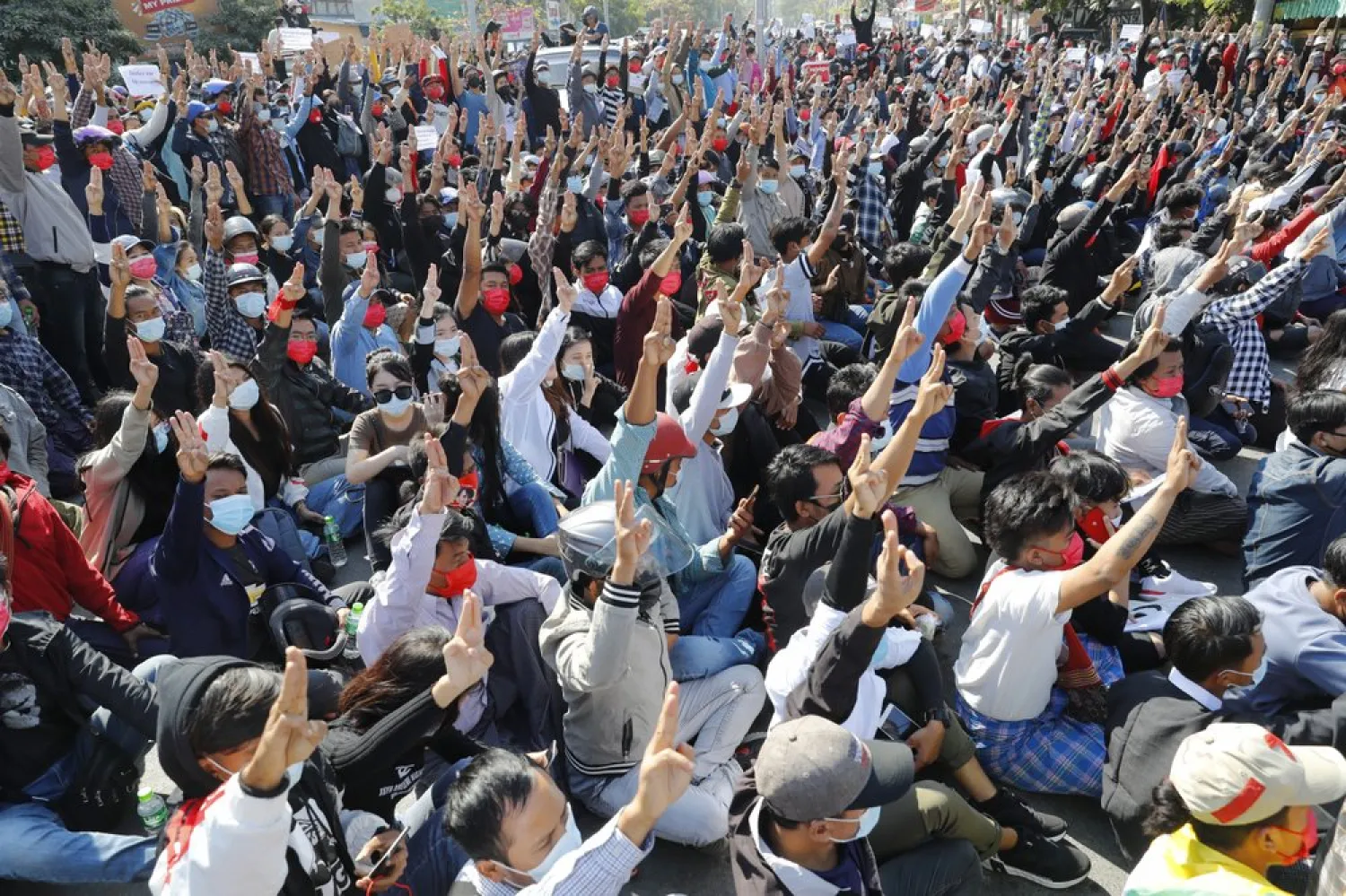
Protesters flash the three-fingered salute, a symbol of resistance, during a protest in Mandalay, Myanmar, Tuesday, Feb. 9, 2021. (AP)
TT

Police in Myanmar Crack down on Crowds Defying Protest Ban

Protesters flash the three-fingered salute, a symbol of resistance, during a protest in Mandalay, Myanmar, Tuesday, Feb. 9, 2021. (AP)

Police cracked down on crowds of demonstrators against Myanmar’s military takeover who took to the streets again Tuesday in defiance of rules making the protests illegal.

Water cannons were used in Mandalay, Myanmar’s second-biggest city, where witnesses said at least two warning shots were fired to try to make the crowd disperse. Reports on social media said police arrested more than two dozen people there. They also used water cannons in the capital Natpyitaw for a second day running and fired shots into the air.

The protesters are demanding that power be restored to the deposed civilian government and are seeking freedom for the nation’s elected leader Aung San Suu Kyi and other ruling party members detained since the military took over and blocked the new session of Parliament from convening on Feb. 1.

The growing defiance is striking in a country where past demonstrations have been met with deadly force and are a reminder of previous movements in the Southeast Asian country’s long and bloody struggle for democracy. The military used deadly force to quash a massive 1988 uprising against military dictatorship and a 2007 revolt led by Buddhist monks.

The decrees issued Monday night for some areas of Yangon and Mandalay banned rallies and gatherings of more than five people, along with motorized processions, while also imposing a 8 pm to 4 am curfew. It was not immediately clear if regulations have been imposed for other areas.

Demonstrations Tuesday were also held in other cities, including Bago — where city elders negotiated with police to avoid a violent confrontation — and Dawei, and in northern Shan state.

In Magwe in central Myanmar, where water cannons were also used, unconfirmed reports on social media claimed several police officers had crossed over to join the protesters’ ranks. A police officer in Naypyitaw was also said to have switched sides.

Crowds also gathered in Yangon, the country’s biggest city where thousands of people have been demonstrating since Saturday, despite a heightened security presence. No violence was reported.

Soldiers do not appear to have been deployed yet to stop the demonstrations, a small indicator of restraint by the military government. The army has a record of brutality in crushing past revolts as well as in fighting ethnic minorities in border areas seeking self-determination. It also has been accused of carrying out genocide in its 2017 counterinsurgency campaign that drove more than 700,000 members of the Muslim Rohingya minority across the border to seek safety in Bangladesh.

State media for the first time on Monday referred to the protests, claiming they were endangering the country’s stability.

“Democracy can be destroyed if there is no discipline,” declared a statement from the Ministry of Information, read on state television station MRTV. “We will have to take legal actions to prevent acts that are violating state stability, public safety and the rule of law.”

However, the military commander who led the coup and is now Myanmar’s leader made no mention of the unrest in a 20-minute televised speech Monday night, his first to the public since the takeover.

Senior Gen. Min Aung Hlaing instead repeated the claims about voting fraud that have been the justification for the military’s takeover, allegations that were refuted by the state election commission. He added that his junta would hold new elections as promised in a year and hand over power to the winners, and explained the junta’s intended policies for COVID-19 control and the economy.



Fighting Reaches Outskirts of Ukraine’s Stronghold Kostiantynivka

 This photograph shows a barbed wire defense line running across a field at an undisclosed location in the Kharkiv region, eastern Ukraine, on May 1, 2026, amid the Russian invasion of Ukraine. (AFP)
This photograph shows a barbed wire defense line running across a field at an undisclosed location in the Kharkiv region, eastern Ukraine, on May 1, 2026, amid the Russian invasion of Ukraine. (AFP)
TT

Fighting Reaches Outskirts of Ukraine’s Stronghold Kostiantynivka

 This photograph shows a barbed wire defense line running across a field at an undisclosed location in the Kharkiv region, eastern Ukraine, on May 1, 2026, amid the Russian invasion of Ukraine. (AFP)
This photograph shows a barbed wire defense line running across a field at an undisclosed location in the Kharkiv region, eastern Ukraine, on May 1, 2026, amid the Russian invasion of Ukraine. (AFP)

Russian troops are ‌inching towards the city of Kostiantynivka in Ukraine's eastern Donetsk region, trying to establish a foothold close to a heavily defended area, Ukraine's top army official said on Saturday.

Kostiantynivka, along with other cities, forms a so-called fortress belt in the country's east - an area well-fortified by the Ukrainian military.

"We are repelling the Russian occupiers' persistent attempts to gain a foothold in the outskirts of Kostiantynivka using infiltration tactics. Counter-sabotage measures are going on in the ‌city," Oleksandr Syrskyi, ‌Ukraine's army chief, said on the Telegram ‌app.

A ⁠Ukrainian battlefield mapping ⁠project called DeepState shows Russian troops control an area around only one kilometer (0.6 mile) from the city's southern outskirts.

Small chunks of Kostiantynivka in the southeast are marked as a grey zone, meaning neither Ukraine nor Russia has full control over them.

Russia's defense ministry said on ⁠Wednesday its forces had taken control of ‌Novodmytrivka, just north of Kostiantynivka. Moscow's ‌top general Valery Gerasimov said in April that troops were ‌advancing in the north and south of the ‌city.

Syrskyi said that Russian offensive attempts had risen noticeably in April. Since Monday, Russian troops have carried out 83 assaults in this sector using small infantry groups, he added.

Russia demands that ‌Ukraine pull back from areas in the Donetsk and neighboring Luhansk regions that it ⁠failed to capture ⁠in its four-year full-scale war. US-brokered peace talks stalled over the issue as Ukrainian officials say Kyiv will not cede land it still controls.

For the past few years, Russian troops have not managed to capture any big city agglomerations in Ukraine, inching forward and taking control over small settlements, mostly in Ukraine's east.

The small city of Pokrovsk, whose more than 60,000 pre-war population mostly fled, was the most significant gain in the past year. It took Moscow's troops months to advance, and Kyiv says it still has some positions in the city.


Report: Explosion of Bombs Left Over from Strikes Kill 14 Iranian Revolutionary Guard Members

Smoke billows from an Israeli strike on Tehran. (Reuters file)
TT

Report: Explosion of Bombs Left Over from Strikes Kill 14 Iranian Revolutionary Guard Members

Smoke billows from an Israeli strike on Tehran. (Reuters file)

An explosion of leftover bombs from strikes during the war against Iran killed 14 members of the Revolutionary Guard, Iranian media reported Friday.

A report by the Nournews website, believed to be close to Iran’s security, said the explosion happened near the northern city of Zanjan, which is northwest of Tehran.

It was the largest number of Revolutionary Guard members reported to be killed since the ceasefire began on April 7.

The report said the ammunition included cluster bombs and air mines dropped during the fighting.


US, Philippines Deploy Anti-Ship Missile System in Batanes Near Taiwan for War Games

 A vehicle used for the Navy-Marine Expeditionary Ship Interdiction System (NMESIS), stands during joint Philippine-US military exercises in Basco, Batanes province, Philippines, May 2, 2026. (Reuters)
A vehicle used for the Navy-Marine Expeditionary Ship Interdiction System (NMESIS), stands during joint Philippine-US military exercises in Basco, Batanes province, Philippines, May 2, 2026. (Reuters)
TT

US, Philippines Deploy Anti-Ship Missile System in Batanes Near Taiwan for War Games

 A vehicle used for the Navy-Marine Expeditionary Ship Interdiction System (NMESIS), stands during joint Philippine-US military exercises in Basco, Batanes province, Philippines, May 2, 2026. (Reuters)
A vehicle used for the Navy-Marine Expeditionary Ship Interdiction System (NMESIS), stands during joint Philippine-US military exercises in Basco, Batanes province, Philippines, May 2, 2026. (Reuters)

Philippine and US forces on Saturday showcased the NMESIS anti-ship missile system in Batanes province, near Taiwan, during annual war games, as tensions simmer over the self-governed island that China views as its own territory.

The Philippines' northernmost province, with about 20,000 residents, sits around 100 miles south of Taiwan, along the Luzon Strait, a strategic corridor on the frontline of the great power competition between the US and China for dominance in the Asia-Pacific region.

"Training out here in Batanes allows us a different environment than what we're normally allowed to operate in," said US Staff Sergeant Darren Gibbs.

"So it gives us unique opportunities to actually utilize the system and train within our capabilities, and it offers experiences we don't normally get offered in our day-to-day training."

Gibbs said the NMESIS is designed for remote operation, and that "the purpose of this system is for it to be ‌fully autonomous, for us ‌not to require a driver or passenger inside the vehicle itself."

"We will tell it ‌where ⁠to go and ⁠then we program what it needs to do," he said.

The NMESIS, a highly mobile coastal anti-ship missile system designed to target surface vessels from land-based positions at ranges of about 185 km (115 miles), was flown into Batanes on a US C-130 transport aircraft, and positioned in the capital Basco, which has one of the island province's two small runways.

Francisco Lorenzo, Philippine exercise director, told Reuters that deployment of US weapons such as the NMESIS to Batanes was part of efforts to test operational feasibility in remote locations. The NMESIS was also deployed to Batanes in last year's war games.

"It is part of training so ⁠as to test the feasibility or rehearse their deployment there when need arises," Lorenzo ‌said. One of the objectives of the Balikatan, as the annual "shoulder-to-shoulder" drills ‌of US and Philippine forces are called, is to practice "defense of our territory with our allies", he said.

The NMESIS would not ‌be used in live exercise operations and was brought to Batanes only for deployment rehearsal and simulation support during ‌the war games.

He said the system would be withdrawn from Batanes once the drills were finished. The US also deployed its Typhon missile system to the Philippines in 2024 for use in joint exercises.

Beijing routinely criticizes the deployment of US weapons in the Philippines, saying it heightens regional tension.

Security analyst Chester Cabalza, founder and president of the Manila-based think tank International Development and Security Cooperation, told ‌Reuters "the NMESIS can spark a powder keg for Beijing and asymmetric deterrence for Manila and Taipei in the Bashi Channel along the Luzon Strait."

The system can be ⁠airlifted and deployed to ⁠any coastline in the Philippine archipelago within hours, Cabalza said, and its placement in Batanes is likely viewed by Beijing as part of the "US-led encirclement" of China.

WAR GAMES INVOLVE 17,000 TROOPS

Philippine and US forces also carried out maritime strike drills in Itbayat, a Batanes municipality about 155 km from Taiwan and the northernmost part of the country.

More than 17,000 troops are taking part in this year's war games, including about 10,000 from the US, even as Washington remains heavily engaged in the Middle East.

China recently intensified its activities in the South China Sea and the Taiwan Strait, increasing its naval presence around Taiwan and sending an aircraft carrier through the strait. It also put up a barrier this month at the mouth of the Scarborough Shoal, according to satellite images reviewed by Reuters.

Philippine President Ferdinand Marcos Jr has said Filipinos working and living in Taiwan would have to be evacuated in the event of war over the self-governed island and that would "drag the Philippines kicking and screaming into the conflict."

Philippine Defense Secretary Gilberto Teodoro said in an April 28 interview with Reuters that Manila has a contingency plan to evacuate Filipinos in Taiwan if conflict erupts but gave no further details.