


US Architect Designs Modern Buildings With Vertical Framing Platform

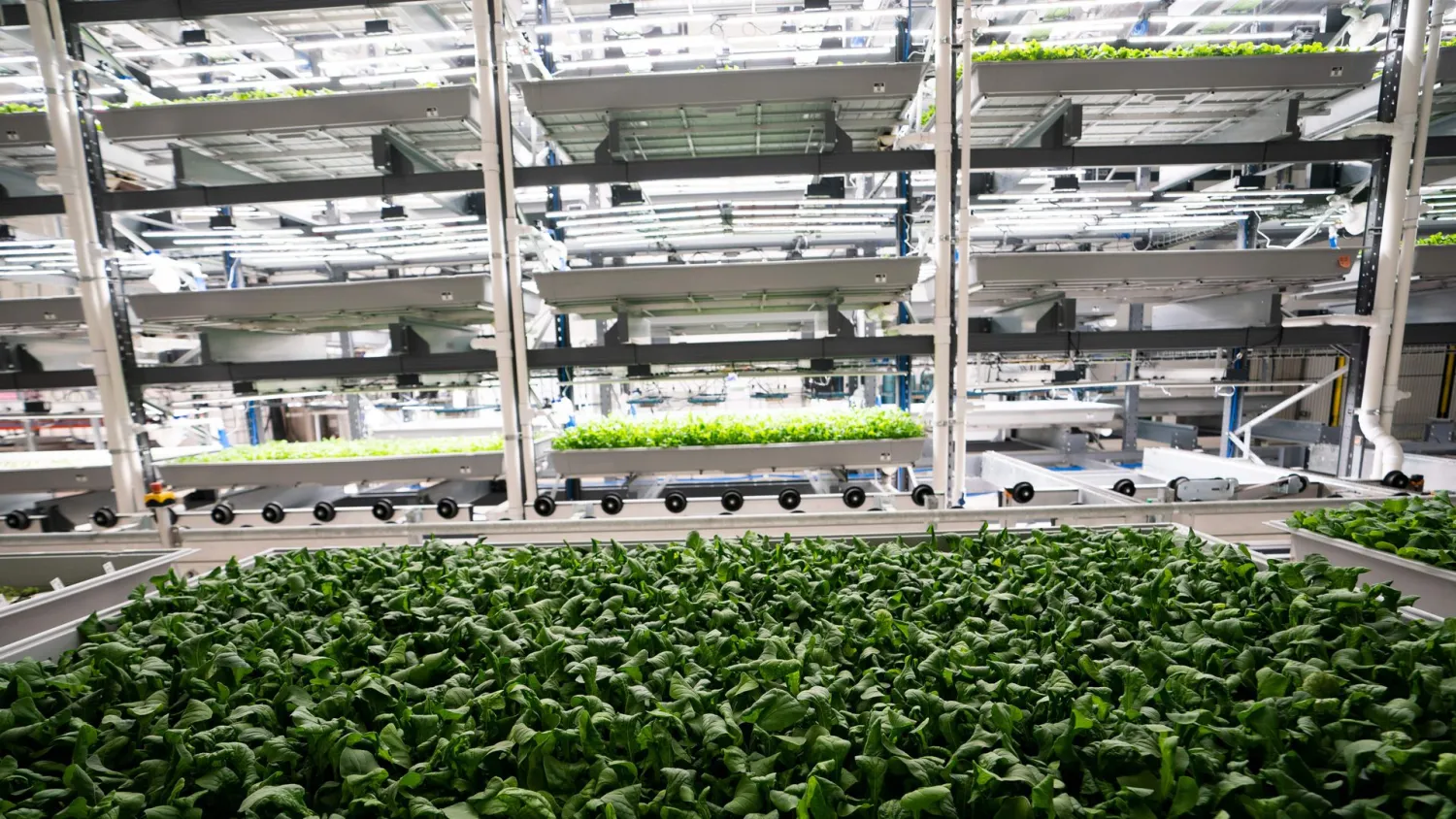
Greens are grown at Bowery Farming, a vertical farm in Kearny, New Jersey. Photo: Don Emmert/AFP via Getty Images
TT

US Architect Designs Modern Buildings With Vertical Framing Platform

Greens are grown at Bowery Farming, a vertical farm in Kearny, New Jersey. Photo: Don Emmert/AFP via Getty Images

A housing project designed by US architect Nona Yehia promises to provide over 460,000 kg of produce a year, along with housing and jobs. Some vertical farms grow greens in old warehouses, former steel mills, or other sites set apart from the heart of cities. But a new series of projects will build multistory greenhouses directly inside affordable housing developments. Nona Yehia is the CEO of Vertical Harvest, a company that will soon break ground on a new building in Westbrook, Maine, that combines a vertical farm with affordable housing. "Bringing the farm back to the city center can have a lot of benefits," she said.

Similar developments will follow in Chicago and in Philadelphia, where a farm-plus-housing will be built in the Tioga District.

"I think what we've truly understood in the past year and a half, although we've been rooted in it all along, is that we have in this country converging economic, climate, and health crises that are rooted in people's access to healthy food, resilient, nourishing jobs, and fair housing. And we saw this as an urban redevelopment tool that has the potential to address all three," Yehia told Adele Peters in an interview cited by the Tribune Media Services.

"Part of this is providing healthy, nutritious food, but also jobs at livable wages," she added.

Inside each building, the ground level will offer community access, while the greenhouse fills the second, third, and fourth floors, covering 70,000 square feet and growing around 460,000 kg of produce a year. The amount of housing varies by site; in Maine, there will be only 15 units of housing, though the project will create 50 new jobs. In Chicago, there may be a community kitchen on the first level.

In each location, residents will be able to buy fresh produce on-site; Vertical Harvest also plans to let others in the neighborhood buy greens directly from the farm. It will also sell to supermarkets, restaurants, hospitals, and other large customers.



Saudi Arabia Launches First Biological Samples from the Middle East to Space

The milestone strengthens the Kingdom's role in microgravity research and expands the use of space science and technology in health and life sciences research. (Saudi Space Agency)
TT

Saudi Arabia Launches First Biological Samples from the Middle East to Space

The milestone strengthens the Kingdom's role in microgravity research and expands the use of space science and technology in health and life sciences research. (Saudi Space Agency)

Saudi Arabia, represented by the Saudi Space Agency (SSA) and King Abdullah University of Science and Technology (KAUST), has launched the first biological samples of their kind from the Middle East to space as part of the BioGravity-1 mission aboard SpaceX CRS-35 to the International Space Station, with support from NASA. The launch is part of a long-term research program supporting scientific efforts against Alzheimer's disease and multiple sclerosis through three consecutive missions.

The milestone strengthens the Kingdom's role in microgravity research and expands the use of space science and technology in health and life sciences research, reported the Saudi Press Agency on Wednesday.

The mission marks the program's first phase. It sends reference human samples from healthy donors to space to establish a scientific baseline for later phases, and uses the unique properties of microgravity to study cellular changes associated with aging and neurodegenerative diseases. The biological experiments developed by KAUST include two experiments, SSA-1 and SSA-2.

The program is carried out through an international scientific partnership with the US-based National Stem Cell Foundation (NSCF) and Axiom Space, with support from NASA, alongside national scientific participation from the Saudi Space Agency and KAUST, connecting national capabilities with the global research community.

General Supervisor of Microgravity Research at the Saudi Space Agency and Saudi Astronaut Rayyanah Barnawi said: “The launch of these samples is an important scientific step toward harnessing the space environment to serve human health, and reflects the growth and readiness of national capabilities to take part in advanced research.”

“Through the BioGravity program, we aim to turn knowledge gained in orbit into research opportunities that deepen our understanding of diseases and support the development of future therapies,” Barnawi added.

Professor of Bioscience at KAUST Professor Imed Gallouzi, who is also the lead scientist of the project, said the mission enables researchers to test disease models in an environment that cannot be replicated on Earth, and strengthens the university's contribution to discoveries that benefit patients in the Kingdom and around the world.

Scientific Advisor to the National Stem Cell Foundation and Global Head of Biomanufacturing and Biotechnology at Axiom Space Dr. Pinar Mesci said: “I am especially excited about this mission, as the NSCF team will test the 'Brain Organoid Village' concept in microgravity for the first time. Combining multiple individual cell lines within a single organoid enables population-level studies and makes it possible to run what could be described as clinical trials in a dish.

The mission included samples from Saudi Arabia through a collaboration with the Saudi Space Agency and KAUST.

The program spans three interconnected research missions: the first studies healthy reference samples, the second will study models derived from patients with Alzheimer's disease and multiple sclerosis, and the third will focus on therapeutic responses and explore potential drug targets in microgravity.

The BioGravity program is part of the SSA's efforts to build national capabilities in microgravity research and life sciences, expand international scientific partnerships, and harness space science and technology to serve human health, contributing to a knowledge-based economy, innovation and quality of life in line with Saudi Vision 2030.


Interior Ministry Medical Services Perform Saudi Arabia's 1st Robot-Assisted Lumbar Spine Surgery

The achievement marks one of the first milestones for Prince Naif Center for Medical Excellence and Innovation, which operates under the Ministry of Interior's Medical Services program responsible for operating medical cities. (SPA)
TT

Interior Ministry Medical Services Perform Saudi Arabia's 1st Robot-Assisted Lumbar Spine Surgery

The achievement marks one of the first milestones for Prince Naif Center for Medical Excellence and Innovation, which operates under the Ministry of Interior's Medical Services program responsible for operating medical cities. (SPA)

A specialized medical team from the Ministry of Interior's Medical Services successfully performed Saudi Arabia's first minimally invasive robot-assisted lumbar spine surgery at Prince Naif Center for Medical Excellence and Innovation, reported the Saudi Press Agency on Wednesday.

The procedure was performed on a patient suffering from severe degeneration of the lumbar vertebrae using the ExcelsiusGPS robotic surgical system.

The advanced technology enabled the patient to regain mobility and walk within the first hour after surgery while minimizing damage to surrounding tissues.

The ExcelsiusGPS system combines advanced surgical navigation with a robotic arm, allowing surgeons to plan procedures and precisely guide surgical instruments during operations.

The achievement marks one of the first milestones for Prince Naif Center for Medical Excellence and Innovation, which operates under the Ministry of Interior's Medical Services program responsible for operating medical cities.

The center aims to advance spinal surgery services by integrating cutting-edge medical technologies and drawing on national expertise and international experience to improve surgical practices and facilitate knowledge transfer, ultimately enhancing the quality of specialized healthcare provided to beneficiaries.


Saudi Arabia Stresses Importance of Integrating National, Regional Efforts to Boost Environmental Sustainability

Officials are seen at the 28th Meeting of Ministers Responsible for Environmental Affairs in the Gulf Cooperation Council (GCC) countries in Bahrain. (SPA)
TT

Saudi Arabia Stresses Importance of Integrating National, Regional Efforts to Boost Environmental Sustainability

Officials are seen at the 28th Meeting of Ministers Responsible for Environmental Affairs in the Gulf Cooperation Council (GCC) countries in Bahrain. (SPA)

Saudi Arabia stressed its commitment to advancing environmental action at the national, regional, and international levels through the Saudi Green Initiative and the National Environment Strategy, supporting environmental protection, natural resource conservation, and environmental sustainability.

It made its statement at the 28th Meeting of Ministers Responsible for Environmental Affairs in the Gulf Cooperation Council (GCC) countries, held in Bahrain.

Deputy Minister for Environment at the Ministry of Environment, Water and Agriculture Dr. Osama Faqeeha highlighted the achievements resulting from these efforts.

This includes a fourfold increase in the area of terrestrial and marine protected areas, a nearly 300% rise in waste recycling, more than one million hectares of degraded land rehabilitated, more than 180 million trees planted, and over 10,000 endangered wildlife species released into the wild.

Faqeeha commended GCC countries for supporting the Middle East Green Initiative, which has attracted the participation of 35 countries.

He noted that the Kingdom’s hosting of the 16th Conference of the Parties (COP16) to the United Nations Convention to Combat Desertification (UNCCD) in Riyadh marked a turning point for the convention. The conference adopted 37 resolutions and launched key initiatives, most notably Business4Land (B4L) and the Riyadh Global Drought Resilience Partnership.

Faqeeha added that the COP16 presidency continued to follow up on the implementation of these decisions ahead of the 17th session, held in Mongolia in September. He also noted that more than 200 initiatives worldwide had joined the Riyadh Action Agenda.

Faqeeha welcomed Egypt hosting the 18th Conference of the Parties (COP18) in 2028, as well as the Kingdom hosting the upcoming meeting of environment ministers from GCC member states.