Faceplanting to Fame: New Zealand Livestream Catches Albatross in Awkward Landing

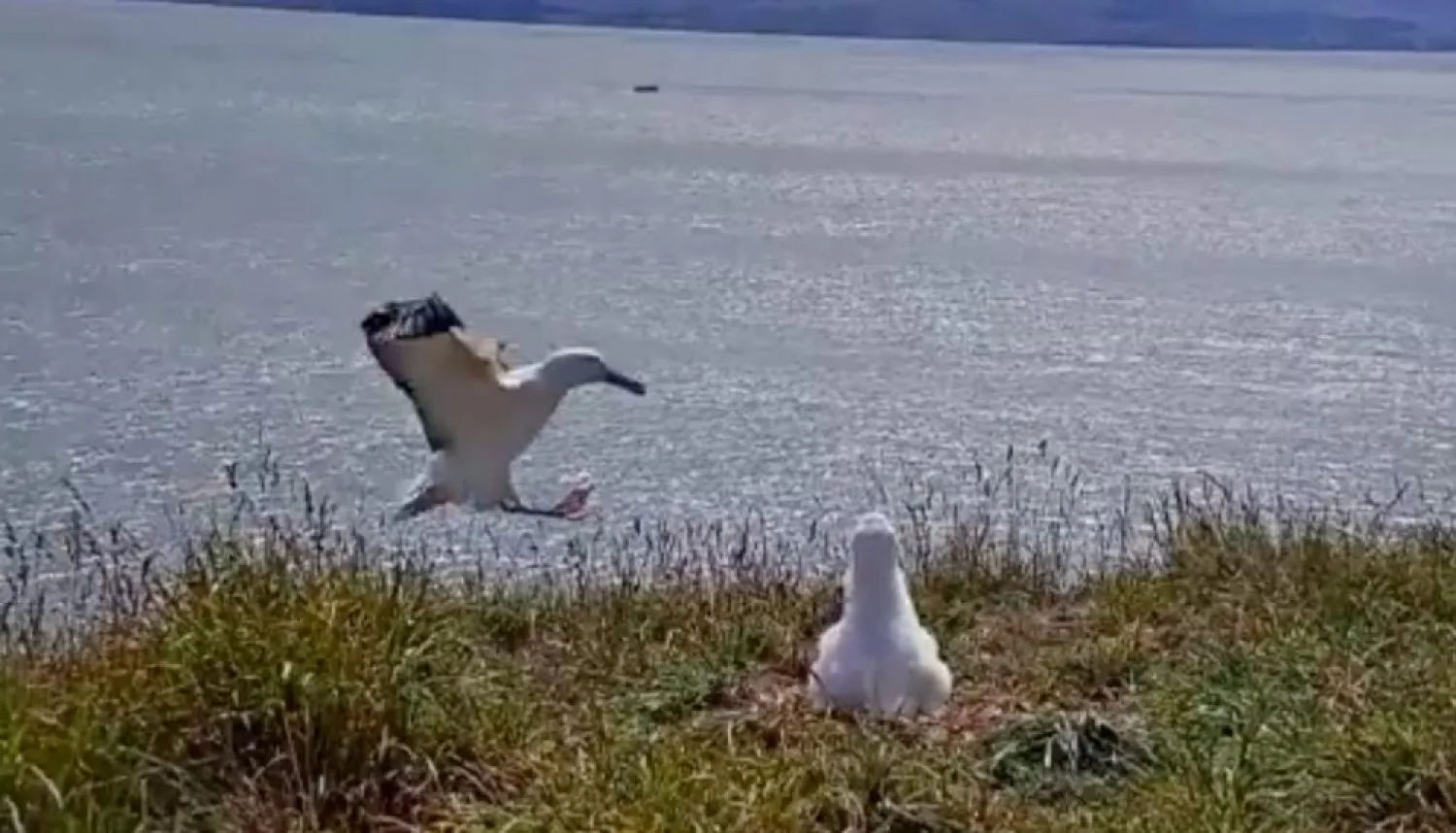
An albatross falls over while attempting to land at Taiaroa Head nature reserve, as a chick looks on, in South Island, New Zealand March 6, 2021, in this still image obtained from a video. Courtesy of The New Zealand Department Of Conservation & The Cornell Lab Of Ornithology/Handout via Reuters
TT

Faceplanting to Fame: New Zealand Livestream Catches Albatross in Awkward Landing

An albatross falls over while attempting to land at Taiaroa Head nature reserve, as a chick looks on, in South Island, New Zealand March 6, 2021, in this still image obtained from a video. Courtesy of The New Zealand Department Of Conservation & The Cornell Lab Of Ornithology/Handout via Reuters

A livestream camera at a New Zealand nature reserve has caught a Royal Albatross making an awkward landing, with the video of the faceplanting now propelling the bird to fame.

The video, shot at the Taiaroa Head Nature Reserve in Dunedin on New Zealand’s South Island, shows an albatross landing on its face, legs flailing, before it manages to right itself as a chick watches on.

It has been watched over 660,000 times since being posted on Saturday, with several people on Twitter commenting on their similar experiences while skiing or speculating what the albatrosses might have been thinking.

“Flying for the albatross is mainly effortless, landing can be a little bit harder,” is the wry commentary on the Twitter post accompanying the video by the Royal Albatross Cam.

Set up in 2016, the Royal Cam, as it is known for short, is a 24-hour livestream of the albatross nest during breeding season set up by the New Zealand Department of Conservation (DOC) and the Cornell Lab of Ornithology.

Royal albatrosses are among the largest seabirds in the world and regularly live into their 40s, according to the DOC website. They are considered “at risk” by the DOC.

“Lucky for the somersaulting alby, recovery was quick and only the chick was watching!!,” was the final word from the Royal Cam account.


Dresden City Center Cleared to Defuse Unexploded WWII Bomb

 11 March 2026, Saxony, Dresden: A police officer cordoned off Grosse Meissner Strasse at an evacuation of the city center, during an operation to defuse a World War II bomb at the former Carola Bridge. (dpa)
11 March 2026, Saxony, Dresden: A police officer cordoned off Grosse Meissner Strasse at an evacuation of the city center, during an operation to defuse a World War II bomb at the former Carola Bridge. (dpa)
TT

Dresden City Center Cleared to Defuse Unexploded WWII Bomb

 11 March 2026, Saxony, Dresden: A police officer cordoned off Grosse Meissner Strasse at an evacuation of the city center, during an operation to defuse a World War II bomb at the former Carola Bridge. (dpa)
11 March 2026, Saxony, Dresden: A police officer cordoned off Grosse Meissner Strasse at an evacuation of the city center, during an operation to defuse a World War II bomb at the former Carola Bridge. (dpa)

Officials in Dresden evacuated 18,000 people Wednesday after the discovery of an unexploded World War II bomb, the largest such operation yet in the eastern German city, emergency services said.

A bomb squad was set to try to defuse the 250-kilogramme (550-pound) British bomb which was found during work in the city center to rebuild an Elbe river bridge that collapsed in 2024.

The exclusion zone had been fully established by 9:00 am (0800 GMT), said police in the Saxony state capital.

More than 400 police along with other emergency services were deployed, backed up by a helicopter and a drone, to check that homes, shops, schools, care homes and offices were empty inside a one-kilometer radius of the device.

The bomb was discovered on Tuesday during clearance and construction work following the partial collapse of the Carola Bridge in September 2024.

The evacuation affected major historic sites including the city's Zwinger Palace and the Frauenkirche church, as well as residential buildings, hotels and government offices.

Because the bomb's detonator is damaged, a water jet cutter has to be used which will "naturally delay" the operation, police spokesman Marko Laske told public broadcaster MDR.

If that doesn't work, bomb squad experts will have to consider detonating the bomb on site, he added.

Dresden was heavily bombed by the Allies on February 13 and 14, 1945, killing up to 25,000 people and destroying large parts of the old town known for its Baroque architecture.

World War II bombs were previously found and defused at the site in January and August 2025, with thousands of people affected each time.


Punch the Baby Monkey Isn’t Being Bullied, Says Japan Zoo

 Punch, right a Japanese macaque born on July 26, 2025, sits with others in the monkeys' playground at the Ichikawa city zoo in Tokyo's eastward neighboring city, Tuesday, March 3, 2026. (AP)
Punch, right a Japanese macaque born on July 26, 2025, sits with others in the monkeys' playground at the Ichikawa city zoo in Tokyo's eastward neighboring city, Tuesday, March 3, 2026. (AP)
TT

Punch the Baby Monkey Isn’t Being Bullied, Says Japan Zoo

 Punch, right a Japanese macaque born on July 26, 2025, sits with others in the monkeys' playground at the Ichikawa city zoo in Tokyo's eastward neighboring city, Tuesday, March 3, 2026. (AP)
Punch, right a Japanese macaque born on July 26, 2025, sits with others in the monkeys' playground at the Ichikawa city zoo in Tokyo's eastward neighboring city, Tuesday, March 3, 2026. (AP)

A Japanese zoo caring for a baby monkey who has become an internet sensation was forced to issue a statement denying he was being bullied, following an outpouring of concern online.

Punch, a seven-month-old baby macaque, was abandoned by his mother and shot to stardom after he began clinging to a plush orangutan toy from IKEA for comfort at Ichikawa City Zoo outside Tokyo.

But after the zoo posted on X last month that Punch "had been scolded many times by other monkeys", videos showing him being chased by members of the troop were spread online, alongside claims that he was being bullied.

"As a result, we have received many voices of concern from people both in Japan and overseas," the zoo said in a statement Tuesday.

The zoo added that Punch was becoming less reliant on the stuffed orangutan toy because increasing numbers of monkeys were looking after or playing with him.

"While dominant individuals may show disciplining actions toward their subordinates, as macaques do naturally, these actions in the macaque society 'differ from human abuses'," it said.

"Punch spends most of the day peacefully," the zoo added.

The zoo also warned that "Punch has become accustomed to living in this troop, so separating him now would create the risk that he would never be able to return to the group and would have to continue living that way for the rest of his life".

Spurned by its mother, Punch was raised in an artificial environment after being born in July, and began training to rejoin his troop earlier this year.

Punch's predicament sparked huge interest online, spawning a devoted fanbase under the hashtag #HangInTherePunch, as large crowds thronged the zoo, and sales of his IKEA orangutan toy boomed.

However, animal rights group People for the Ethical Treatment of Animals (PETA) said Punch's plight has highlighted the cruelty of zoos and called for his relocation to a "reputable sanctuary, where he could live in a more natural environment".


Thousands of Authors Publish ‘Empty’ Book to Protest AI Using their Work

Thousands of authors published an “empty” book to protest AI (Shutterstock)
TT

Thousands of Authors Publish ‘Empty’ Book to Protest AI Using their Work

Thousands of authors published an “empty” book to protest AI (Shutterstock)

Thousands of authors including Kazuo Ishiguro, Philippa Gregory and Richard Osman have published an “empty” book to protest against AI firms using their work without permission.

About 10,000 writers have contributed to Don’t Steal This Book, in which the only content is a list of their names.

Copies of the work were distributed to attenders at the London book fair on Tuesday, a week before the UK government is due to issue an assessment on the economic cost of proposed changes in copyright law.

By March 18, ministers must deliver an economic impact assessment as well as a progress update on a consultation about the legal overhaul, against a backdrop of anger among creative professionals about how their work is being used by AI firms.

The organizer of the book, Ed Newton-Rex, a composer and campaigner for protecting artists’ copyright, said the AI industry was “built on stolen work ... taken without permission or payment.”

He added: “This is not a victimless crime – generative AI competes with the people whose work it is trained on, robbing them of their livelihoods. The government must protect the UK’s creatives, and refuse to legalize the theft of creative work by AI companies.”

Other authors who have contributed their names to the book include the Slow Horses author, Mick Herron; the author Marian Keyes; the historian David Olusoga; and Malorie Blackman, the writer of Noughts and Crosses.

“It is not in any way unreasonable to expect AI companies to pay for the use of authors’ books,” said Blackman.