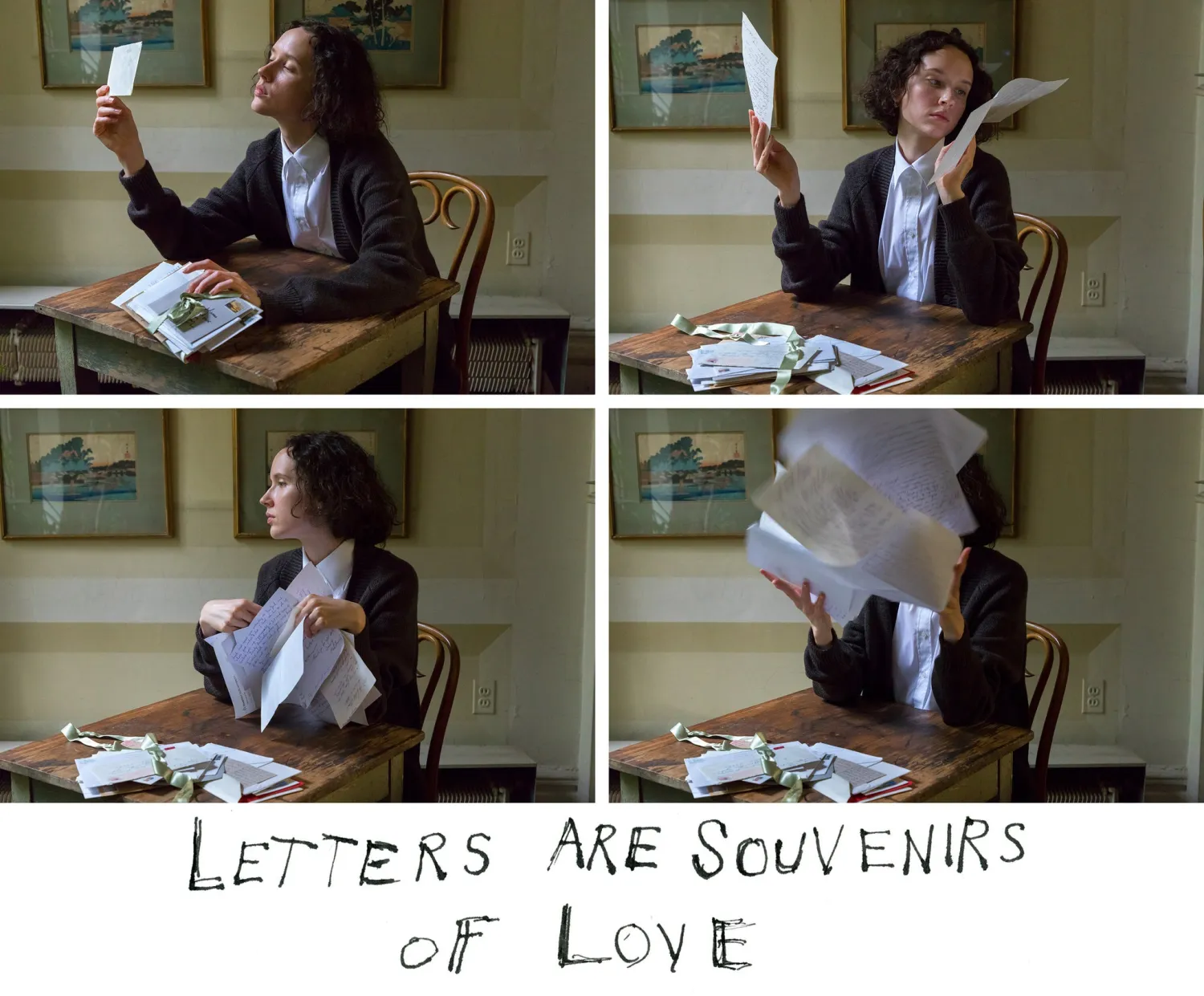

“LETTERS ARE ABOVE all useful as a means of expressing the ideal self; and no other method of communication is quite so good for this purpose,” wrote the novelist and critic Elizabeth Hardwick in a 1953 essay about literary correspondence. “In conversation, those uneasy eyes upon you, those lips ready with an emendation before you have begun to speak, are a powerful deterrent to unreality, even to hope.” Only in our letters are we able to frame our cleverest selves, to pose both the questions and answers, to make ourselves known as we wish to be known. Those of us experiencing a serious uptick in our email correspondence right now — it seems all it took for us to re-embrace the epistolary form was a global pandemic — are freshly acquainted with the clever breeziness, the missives framed as “just checking in,” from people we once knew far better than we do now.
If letters are acts of self-imagining, why, one might wonder, do we read literary letters? But as even the letters inspired by today’s crisis remind us, letters have the primacy they do precisely because they tend to illuminate a great deal more than the author might have intended. As Hardwick herself would later, very painfully, grasp — they can illuminate our attitudes toward our work, our lovers, and ourselves. Additionally, there’s a drama to the form: the back-and-forth of letters (or email) creates a natural suspense — the wait for a response, for the letter that might change everything — as well as a kind of temporal suspension: In sitting down to gather one’s thoughts, one strikes life’s pause button, creating space for reflection; the roving mind seeks its release. A note of luxuriant relish isn’t uncommon, the empty page like a beautifully lined drawer in which to carefully tuck away the inner life. Anyone who has drafted a long email, allowing their thoughts to run amok, only to delete most of it in mild embarrassment before sending will understand the impulse; in the days of the typewriter or pen, that forward momentum, the “how can I tell what I think till I see what I say?” as E. M. Forster put it, isn’t quite so easily forestalled.
I think we read letter collections in large part for the pleasure of seeing other, humanizing sides of our literary heroes: Henry James’s catty gossip; Sylvia Plath’s sewing projects; James Joyce’s raunchiness. Letters are leaky in all sorts of ways — the baby wakes from the nap and cries; the air-raid siren sounds; the social mores and psychodynamics of other eras filter in. Even the most pragmatic and logistical of exchanges tend to have a gravity about them due in no small part to their near obsolescence of form. It’s hard to imagine that in 50 years we’ll be picking up “The Collected Emails of Zadie Smith.” It also seems unlikely that any contemporary author would want that. Email — already an old-fashioned form — isn’t really the electronic replacement of the letter but a different mode of communication entirely: fleeter, tactical, somehow both more and less disposable. It is unwise to commit too much of oneself to electronic code, which lives on in some ether or another, unflung into the fireplace.
It’s especially for these moments of uncorked interiority, I think, that we still read literary letters. In short: it’s about the voyeurism. Some of us might admit that we read our literary heroes’ letters also in the way some might watch reality television, waiting for the moments when the persona drops in the high heat of emotion, for the letters dashed off in passion or rage. When Princeton released T. S. Eliot’s letters to Emily Hale — all 30 years’ worth — last October, 50 years after Hale’s death, it triggered the release of Eliot’s disclaimer by his estate, penned in anticipation of the letters’ posthumous release. He had not really loved her, he just thought he had, he wrote, unconvincingly. “Emily Hale would have killed the poet in me. I had already observed that she was not a lover of poetry, certainly that she was not much interested in my poetry. I had already been worried by what seemed to me evidence of insensitiveness and bad taste.” He had not slept with that woman, he went on.
A collective cringe met Eliot’s untimely disavowal, but surely any of us who carry a certain dread of cleaning out our inboxes — old email, that bitterest of madeleines — will understand Eliot’s horror at imagining, even posthumously, the publication of his lovelorn notes. Who among us can really pretend to be so constant in our affections, in our selves, that we wouldn’t want to delete evidence of our own first loves? And yet, as historians and biographers know well, a body of letters written over time is often the best clue we have to art’s mysterious origin points. To reread Plath’s “Ariel” in the context of her last letters before her death, the brilliant, bristling style falling away, is to marvel at the triumph of creativity amid despair. Letters reveal, if not “the authentic self” — one imagines the shiny gold seal — then certain key tensions that ignite expression (or suppression, in the case of the writer Alice James, who arguably bested her brothers Henry and William in her powers of observation and self-scrutiny). From Eliot’s letters, we can’t help but imagine what kind of emotional kindling his unfulfilled longing for Hale might have provided for some of his best work, written during a bad marriage.
WE WANT TO know, we want to be known. Letters are so often metaphorized into birds of flight, traveling across vast distances of geography, class and feeling, which is why so many 19th-century novels depend on them in order to move the plot forward. Letters reveal not only the vagaries of feeling but the vicissitudes of the self, the gaps that can be filled with validating words and those that can’t. In many ways, the silences are as powerful as the nearly 200 letters, cards, and poems the author Ingeborg Bachmann exchanged with the poet Paul Celan, which were rereleased last fall in “Correspondence”; the effort to maintain the tenderness of the largely epistolary relationship, which began with poppies and poems in 1948, continued for over a decade, filled with playfulness and adoration even after they had established relationships with others. He was Jewish; she was the daughter of a Nazi. Their aesthetic struggles to create meaning — their sense of the inadequacy of language amid the ashes of Central Europe — seemed to echo their foiled attempts, logistical and otherwise, to be together. (Celan threw himself into the Seine in 1970.)
Another counter to Hardwick’s idea of the literary letter as an idealized self-portrait is her own wrenching correspondence with her husband of 23 years, the confessional poet Robert Lowell. Lowell’s side of the story has long been known, but it is only recently that Hardwick has fully had her say. Published last fall, “The Dolphin Letters, 1970-1979” spans the decade in which Lowell left her and their daughter, Harriet, for the aristocrat and novelist Lady Caroline Blackwood, as detailed in his book of poetry “The Dolphin.” In that 1973 volume, which won him his second Pulitzer Prize, Lowell quoted at length from Hardwick’s private letters to him, many of them written in piercing anguish, revising or recasting them to suit his purpose. When Lowell sent the manuscript to his longtime friend the poet Elizabeth Bishop, she wrote in shocked reply, “You have changed her letters. That is ‘infinite mischief,’ I think. . . . But art just isn’t worth that much.” In a 1973 piece about the published book, Adrienne Rich — up to that point, also a friend and confidante of Lowell’s — called his adaption of her letters “one of the most vindictive and mean-spirited acts in the history of poetry.” Hardwick conferred on Lowell the eloquent force of her pain and rage — but also the astonishing constancy of her love, even while knowing, as she must have, that it was possible her missives would one day be read by others.
A deeply psychological critic who wrote definitive portraits of Plath, Zelda Fitzgerald and other creative women warped by the men in their lives, Hardwick was especially concerned by limitations of the usual measures with which we tell stories of others: the subjectivity of personal impressions; the rigidity, or prurience, of biographical facts — insufficient measures for our complex fluidity of being. One wonders what, then, she would have thought about the future of collected letters in the 21st century. Whose will be our last — Philip Roth’s? Toni Morrison’s? It’s hard not to feel this is a loss — but at the same time, the carefully curated portrait of a writer that emerges in a letter collection feels not all that different from the way in which we all interact today, which is to say deliberately, methodically and probably not altogether honestly. Though here’s the thing about the self: The more we try to deconstruct it, the more we notice the architecture and draperies.
Privacy, in the memoir age, has become almost quaint, and our contemporary literary forms blur all kinds of boundaries of truth and subjectivity. Personal narrative is often reframed and marketed these days as fiction (for both legal and other reasons) — Karl Ove Knausgaard’s “My Struggle” is but one example. And yet the debate endures over whether or not the personal outweighs the productive, as does our basic human need to record and confess. The self-exploration that once was poured into correspondence finds other outlets — namely, the “infinite mischief” of the auto-fictional novel. As such, we’re unlikely to need to read the correspondence of an author like Knausgaard, or any other author who has toyed with shedding artifice from the literary self-portrait, edging the mirror closer and closer to some kind of authentic self. What would be the point? At last, we simply do not need to know more.
Which is something that Hardwick, in the wake of her betrayal, understood better than most of us do now: that obliqueness is an under-sung tool of truth. Her letters with Lowell feel resonant today not only as a portrait of a marriage between two brilliant 20th-century writers but as an inquiry into the terms in which we compose the self in art — and of the ongoing effort of women to narrate themselves, to take up space in the cultural story rather than appear as supporting characters within it. Two years after Lowell’s death, Hardwick published her landmark autobiographical novel, 1979’s “Sleepless Nights,” an essential precursor to today’s auto-fictional movement: a self-portrait and an argument for privacy in one, filled with bladed understatement (Lowell appears in it mostly as an absence). “Sometimes I resent the glossary, the concordance of truth, many have about my real life, have like an extra pair of spectacles,” says the narrator, waking in the night to write letters to the friends she can’t wait to call in the morning. “Otherwise, I love to be known by those I care for.”
(The New York Times)