

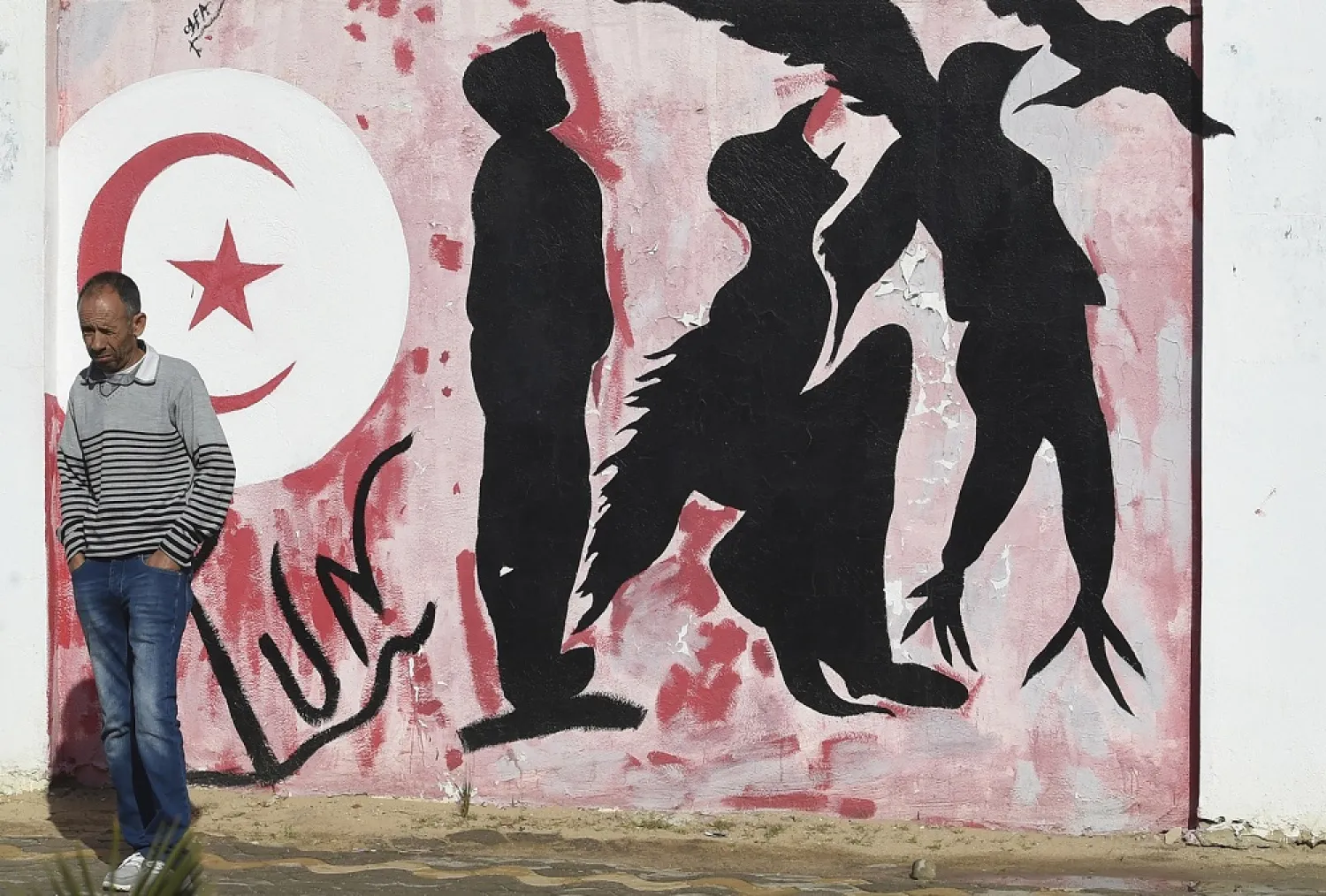

Official Count: Tunisia Revolution Cost 129 Lives

A man stands in front of graffiti in Mohamed Bouazizi Square in the town of Sidi Bouzid, cradle of the 2011 Tunisian revolution. (AFP)
TT

Official Count: Tunisia Revolution Cost 129 Lives

A man stands in front of graffiti in Mohamed Bouazizi Square in the town of Sidi Bouzid, cradle of the 2011 Tunisian revolution. (AFP)

Tunisia's government has finally given an official toll of 129 dead and 634 injured in its 2011 revolution, in what an independent body called "a strong signal" of a democratic transition.

The tally, long demanded by victims' families, was published late Friday on the eve of the 65th anniversary of Tunisia's independence.

"It is recognition by the state of the sacrifices made by the people for the fall of the dictatorship" of the late president Zine El Abidine Ben Ali, the head of an independent association for "martyrs and the injured" of the revolution, lawyer Abderrazak Kilani, told AFP.

He said publication of the list clears the way for about 1,500 people who allege they have been wrongly excluded to submit claims to the authorities.

A preliminary toll of 338 dead and 2,147 injured had been issued in 2012.

The official list covers the period of anti-government demonstrations that resulted in clashes with security forces between December 17, 2010 and January 14, 2011 when Ben Ali fled abroad.

The return to power of Ben Ali-era figures is seen as having impeded efforts towards justice and reconciliation in Tunisia.

Dozens of cases opened before special courts in 2018, including several over killings of protesters, but no verdicts have been reached.

The next stage is to compensate victims and their families, Kilani stressed.


Lebanese Army Says Soldier Killed in Israeli Attack in Southern Lebanon

A Lebanese army soldier inspects the site of an Israeli airstrike that targeted their checkpoint in Aamriyeh, south of the coastal city of Tyre, on March 30, 2026. (Photo by KAWNAT HAJU / AFP)
TT

Lebanese Army Says Soldier Killed in Israeli Attack in Southern Lebanon

A Lebanese army soldier inspects the site of an Israeli airstrike that targeted their checkpoint in Aamriyeh, south of the coastal city of Tyre, on March 30, 2026. (Photo by KAWNAT HAJU / AFP)

The Lebanese army said on Sunday that a soldier had been killed in an Israeli strike on southern Lebanon.

Meanwhile, an Israeli strike hit south Beirut on Sunday, Lebanese state media reported, with a medical source telling AFP it made impact about 100 metres away from a public hospital.

The strike hit Beirut's Jnah neighborhood near Rafik Hariri University Hospital, the largest public medical facility in the country.

Israel's military earlier warned it was carrying out strikes on Beirut.


Israeli Fire Kills Four Palestinians in Gaza, Medics Say

Palestinians inspect a vehicle targeted by an Israeli strike in Maghazi camp for Palestinian refugees in the central Gaza Strip on April 4, 2026. (AFP)
TT

Israeli Fire Kills Four Palestinians in Gaza, Medics Say

Palestinians inspect a vehicle targeted by an Israeli strike in Maghazi camp for Palestinian refugees in the central Gaza Strip on April 4, 2026. (AFP)

An Israeli airstrike ‌killed four Palestinians in the northern Gaza Strip on Sunday, local health authorities said, in the latest violence to overshadow a fragile ceasefire amid a new push by mediators to bolster the agreement.

Medics said the airstrike targeted a group of people in Jaffa Street, near the Darraj neighborhood in Gaza City, killing four people and wounding others.

The Israeli military did not immediately comment on ‌the incident.

Palestinian ‌group Hamas and Israel have ‌traded blame ⁠for violations of ⁠the ceasefire agreed last October, which halted two years of full-blown war.

The Gaza health ministry says Israeli fire has killed at least 700 people since the ceasefire began. Israel says four soldiers have been killed by gunmen in Gaza ⁠over the same period.

A Hamas delegation met ‌Egyptian, Qatari and ‌Turkish mediators in Cairo last week to give its initial ‌response to a disarmament proposal presented to the ‌group last month, two Egyptian sources and a Palestinian official said.

The group has told mediators it will not discuss giving up arms without guarantees that Israel ‌will fully quit Gaza as laid out in a disarmament plan from ⁠US President ⁠Donald Trump's "Board of Peace", three sources told Reuters on Thursday.

Hamas' disarmament is a sticking point in talks to implement Trump's plan for the Palestinian enclave and cement the ceasefire.

Hamas' October 7, 2023, attacks on Israel killed 1,200 people, according to Israeli tallies.

Israel's ensuing two-year campaign killed more than 72,000 Palestinians, most of them civilians, according to Gazan health authorities, and has spread famine, demolished most buildings, and displaced most of the territory's population, in many cases numerous times.


Easter in Jerusalem Disrupted by War and Restrictions at Holy Sepulchre

 Members of the clergy make their way to the Church of the Holy Sepulchre for prayers on Palm Sunday, following restrictions on gatherings in large groups, amid the US-Israel conflict with Iran, in Jerusalem's Old City April 5, 2026. (Reuters)
Members of the clergy make their way to the Church of the Holy Sepulchre for prayers on Palm Sunday, following restrictions on gatherings in large groups, amid the US-Israel conflict with Iran, in Jerusalem's Old City April 5, 2026. (Reuters)
TT

Easter in Jerusalem Disrupted by War and Restrictions at Holy Sepulchre

 Members of the clergy make their way to the Church of the Holy Sepulchre for prayers on Palm Sunday, following restrictions on gatherings in large groups, amid the US-Israel conflict with Iran, in Jerusalem's Old City April 5, 2026. (Reuters)
Members of the clergy make their way to the Church of the Holy Sepulchre for prayers on Palm Sunday, following restrictions on gatherings in large groups, amid the US-Israel conflict with Iran, in Jerusalem's Old City April 5, 2026. (Reuters)

In the usually lively alleyways of Jerusalem's Old City, silence reigned on Easter Sunday, with the holiday overshadowed by war and restrictions on access to the Holy Sepulchre, where the faithful commemorate Christ's crucifixion and resurrection.

On routes approaching the church, police at checkpoints screened a small number of worshippers allowed near the site.

All shops in the area were closed, heightening the sense of emptiness.

"Happy Easter," said the Latin Patriarch of Jerusalem, Cardinal Pierbattista Pizzaballa, shortly after dawn as he entered the church surrounded by a modest group of clergy, according to AFP journalists at the site.

Outside, a few Catholics and Orthodox Christians tried to reach the church but were kept at a distance by security forces.

"How can you tell me I cannot go to church, it is unacceptable," said one Catholic from Tel Aviv who had attended Easter worship at the site in previous years.

Security has been stepped up in the Old City, located in annexed east Jerusalem and home to sites sacred to Jews, Christians and Muslims.

Israel has also imposed restrictions on large gatherings as a security precaution due to the constant threat of strikes during the ongoing Middle East war.

On Palm Sunday, Cardinal Pizzaballa was prevented by Israeli police from entering the Holy Sepulchre for mass, provoking outrage, before Prime Minister Benjamin Netanyahu ordered he be allowed in.

Since the start of the war on February 28, debris from Iranian missiles or interceptors has fallen in the Old City, including near the Holy Sepulchre, Al-Aqsa Mosque, and in the Jewish Quarter.

Most Palestinian Christians belong to the Orthodox faith, which celebrates Easter on April 12.

But for many other Christians, the curbs on worship have stripped the Easter celebrations of substance.

"It's very hard for all of us because it's our holiday... It's really hard to want to pray but to come here and find nothing. Everything is closed," said Christina Toderas, 44, from Romania.

Like many other worshippers, she had resigned herself to watching the mass at the Holy Sepulchre on television.

Father Bernard Poggi, who was preparing to attend mass in another church near the holy site, said he understood the security measures but added that "it seems to be more and more that there's an unevenness in how the laws are put into practice".

Inside the Holy Sepulchre, the celebrations were being held behind closed doors in front of a very small congregation, far removed from the crowds that usually gather.

Around the Old City, where hymns and processions usually dominate at Easter, only whispers could be heard among the faithful moving discreetly through its passages.
