


Exclusive – In his Memoir, Berri Recalls Informing Aoun that He Will Not Vote for Him as President

Asharq Al-Awsat Publishes Excerpts of the Lebanese Parliament Speaker’s Memoir

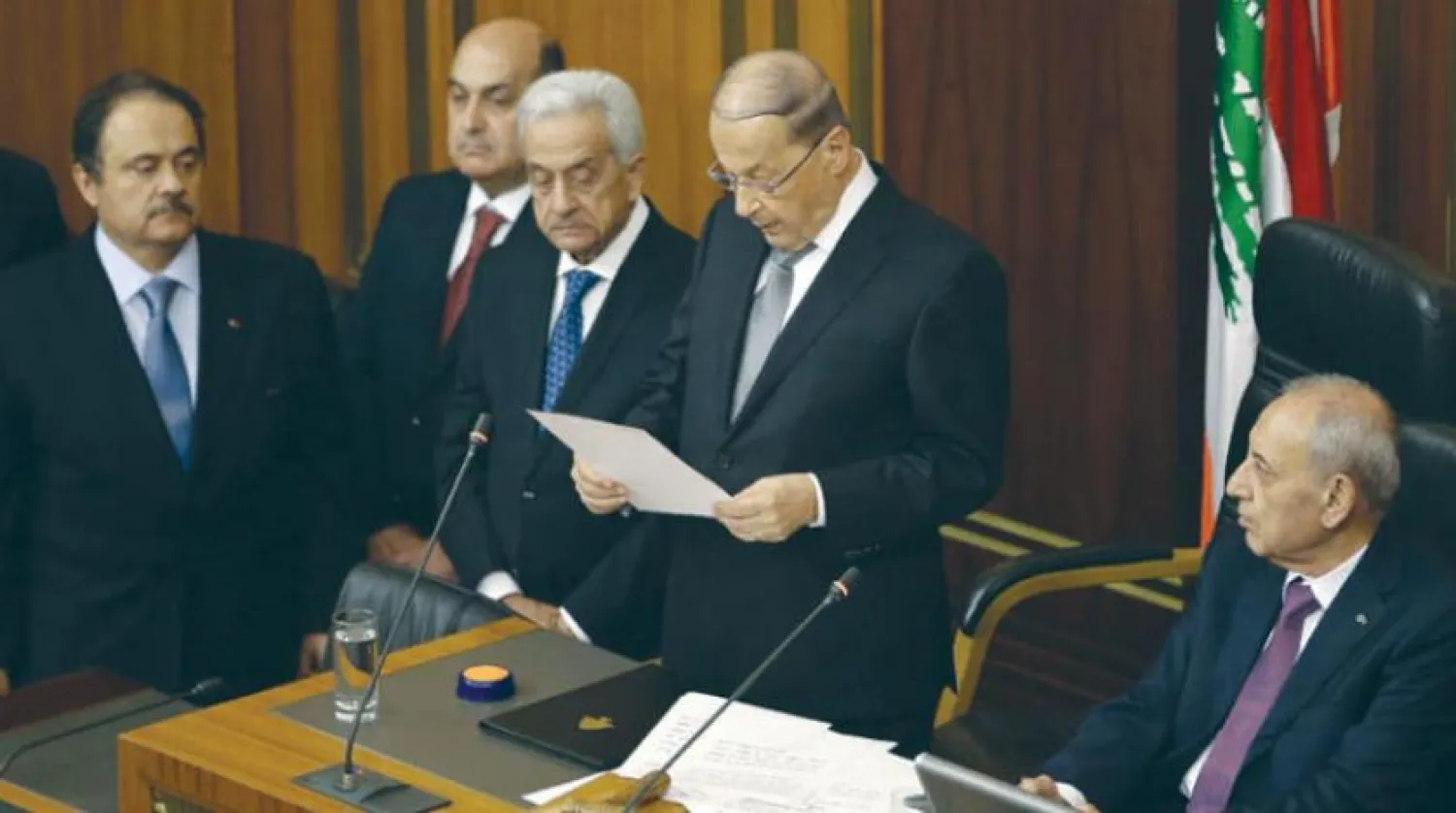
Michel Aoun is sworn in as president as Speaker Nabih Berri (right) looks on. (AFP)
TT

Exclusive – In his Memoir, Berri Recalls Informing Aoun that He Will Not Vote for Him as President

Michel Aoun is sworn in as president as Speaker Nabih Berri (right) looks on. (AFP)

In the second and last episode of excerpts from the memoirs of Lebanon’s parliament Speaker Nabih Berri, Asharq Al-Awsat focuses on the agreements that paved the way for the election of Michel Aoun as president following two-and-half-years of presidential vacuum.

In his memoirs, which will soon be published by Dar Bilal, Berri recalls how then-Prime Minister Saad Hariri decided to go back on his decision to support the election of former Minister Suleiman Franjieh in favor of Aoun.

He also talks about his frank discussion with Aoun, when he told him that he would not vote for him as president.

Berri begins the narration, citing a festival for his Amal movement in the coastal city of Tyre on August 31, 2016, two months before Aoun’s election:

“This festival was an opportunity for me to talk about political futility that some parties were practicing with regard to disrupting the government and the parliament. I said at the time: I hear words from here and there about building a state; it is beautiful indeed. But heading towards a state demands stopping political stalling and removing the idea that each one of us has the power or veto over national decisions.

“I also tell you, stop disrupting the institutions and let us avoid political meddling and abide by the constitution. I honestly tell you that faced with the forces that continue to revolt against various political principles, we will confront all this with the power of the people…

“I cannot forget that day. I was following up on the preparations for the festival and was ready to head to the square of the Imam Mousa al-Sadr Festival in Tyre. Suddenly the phone rang, and I was informed that an explosive device had detonated in the Zahle region. I was shaken by the news… I learned that a bus transporting Amal movement supporters had been targeted. My deep regret was for the lady who was martyred, as well as for the wounded. It was a bloody message.

“From the Imam’s square in Tyre, I almost couldn’t control myself in front of the crowds that gathered for the festival, as well as those who flooded the streets leading to the square. At the beginning of the speech, I found myself addressing the hundreds of thousands of people and telling them if I could only change the celebration into prayer… The scene of the people in front of me was touching, and I could not express the extent of my affection in front of these young people who defied the explosion and came from all over the country…”

Political stalling
Berri recounts how some parties have exploited the opportunity to manipulate his speech at the event.

“In my speech I referred to political stalling and coyness, so they started to project this description on whatever suited their political interests, although my words on this matter were very clear... I did not mean any particular person or side. That day, I replied to them, saying I will teach you the Arabic language… Didn’t I say each of us? Didn’t I say, let’s avoid political tampering and abide by the constitution?”

He continues: “I was shocked by their attempt to manipulate my words and suggest that I was trying to put preconditions on the government formation.”

The Lebanese speaker says in his memoirs that he made sure to tell all sides that it was necessary to admit that much time had been lost and that it was crucial to reach an agreement over the presidential elections.

“I remember that I gave them an example and told them: let’s suppose that the president was elected without prior agreement, and a person was assigned to form the government, also without prior agreement… In this case, we would have done nothing but complicate the situation…

“During that period, the presidential elections were like a vicious cycle… At the beginning of October 2016, Prime Minister Saad Hariri was still committed to nominating MP Suleiman Franjieh, based on the agreement that was concluded between them in Paris. Had the presidential election session taken place at that time, Franjieh would have been elected, because he had the support of more than 70 deputies, and [Berri’s] Development and Liberation bloc publicly endorsed his candidacy. However, the session was not convened due to lack of consensus.

“Samir Geagea then surprised everyone by endorsing the candidacy of General Michel Aoun. The speculation at the time was that Hariri would stick to Franjieh’s nomination. I remember that during that period, I met Hariri and told him I support you, but no more than that, this is your battle, and you have to assume responsibility. I am ready to help you if you continue to support Franjieh. Hariri did not conceal the fact that he was feeling overwhelmed and under pressure, so I urged him to persevere.

The retreat

“However, the situation soon changed and my predictions turned to be true. Hariri began to go back on supporting Franjieh’s candidacy and prepare for Aoun’s nomination. The first signs were evident in the lengthy meeting that Hariri held with Aoun at Rabieh in late September 2016. That day, before Hariri headed to Rabieh, he met with Franjieh.

“I would like to point out here again that Hezbollah had already publicly announced his support for General Aoun as the final candidate. Basically, our position was not the same regarding the presidential elections: the party had its candidate, and I had my own.”

Berri recounts how Aoun’s Free Patriotic Movement (FMP) launched a campaign against him, accusing him of violating the constitution.

“I was surprised at that time by a campaign by the FPM and its media, accusing me of working against the constitution. They said that while a near consensus on Aoun was reached, Berri was still rejecting his election. I did not let these words slide, so I refuted the allegations and told them that it was not the time for political games.

“I, Nabih Berri, am the keenest on the constitution, and the most committed to its provisions. I challenge you to prove your credibility.

“In the second week of October and as I faced negative responses to my request for a package of prior understandings, I decided to take a step back and watch Hariri announce his final position on Aoun’s nomination.

“After Hariri formally adopted his candidacy, General Aoun visited me in Ain al-Tineh, and we held a friendly meeting and a very frank conversation. I insisted on my position that the safest way to hold the presidential elections was the understanding package that I had proposed, which would pave the way for the new presidential term and remove all obstacles.

“When he asked me about my position on the election session that I scheduled for Oct. 31, 2016, I told him: You know, Your Excellency, the extent of my affection and respect for you, but I tell you frankly that I will not vote for you.

“He asked me: Why, I know that your relationship with Gebran [Bassil, Aoun’s son-in-law] has improved.

“I replied: I will not vote for you, because of my commitment to others.

“He said: I understand your position.

“But I stressed: In any case, I assure you, Your Excellency, that disrupting the quorum of the presidential election session is in my hands, but I will not do so.”



Iran War Has Complicated Plans for an Int’l Force in Gaza That Has Yet to Materialize

Palestinians inspect the damage at the site of an Israeli strike on Wednesday in Gaza City, May 28, 2026. (Reuters)
TT

Iran War Has Complicated Plans for an Int’l Force in Gaza That Has Yet to Materialize

Palestinians inspect the damage at the site of an Israeli strike on Wednesday in Gaza City, May 28, 2026. (Reuters)

The International Stabilization Force for Gaza was announced with great aplomb at the inaugural meeting of US President Donald Trump's Board of Peace in February. The American general tapped to lead the 20,000-strong force said it would ensure “future prosperity and enduring peace” after the devastating Israel-Hamas war.

Three months on, he still has no force to lead as none of the five countries that pledged troops have come through with any significant contributions.

Efforts to shore up the fragile ceasefire have stalled as Hamas has refused to disarm and Israel has seized more territory while continuing to strike what it says are militant targets, often killing civilians.

Indonesian commitment on indefinite hold

The biggest blow to the planned force came about a week after the US and Israel attacked Iran on Feb. 28, when Indonesia put its commitment of 8,000 troops on indefinite hold. Some 1,000 were to have been sent in April, followed by the remainder in June.

Indonesian's pledge was by far the largest of the group, which also includes Morocco, Kazakhstan, Kosovo and Albania. US Maj. Gen. Jasper Jeffers, who spoke at the Board of Peace event, was to command the force.

Indonesia suspended its plans over what Defense Minister Sjafrie Sjamsoeddin said last week seemed to be a lack of commitment from a distracted Washington, saying “we have not yet received any implementation guidelines.”

“New dynamics have emerged,” he told parliament. “Because the intensity of the conflict between US and Iranian forces remains very high, the BoP has tended to be left behind. Since the BoP has been left behind, the ISF has also been left behind.”

US attack on Iran influenced Indonesia's decision

Domestic issues may have factored into Indonesia's decision, said Muhammad Zulfikar Rakhmat, director of the Indonesia-Middle East/North Africa desk at Jakarta's Center for Economic and Law Studies.

The Iran war is extremely unpopular in Indonesia, the most populous Muslim country. The economy is suffering from soaring prices as a result of the conflict, and there is widespread skepticism of the Board of Peace.

“If you talk to the people on the street, I don’t think they believe that the Board of Peace will actually help the people of Gaza,” Rakhmat said. There are also concerns about sending troops to the Middle East when the economy is faltering, he added.

Indonesia lost four peacekeepers who were part of the United Nations mission in Lebanon during fighting between Israel and the Iran-backed Hezbollah. That has further soured public opinion on such international commitments, he said.

Board of Peace blames stalled ceasefire on Hamas

The US military’s Central Command declined to comment or make Jeffers available for an interview, referring all queries to the Board of Peace.

Board of Peace spokesman Brad Klapper also declined to comment on Indonesia's decision or the future of the stabilization force, pointing instead to May 21 remarks made at the UN by Nickolay Mladenov, a former Bulgarian defense minister who Trump appointed director of the Board of Peace.

Mladenov said the international force would not be able to begin operations until there was agreement and implementation of a second phase of the ceasefire, which would see Hamas disarm and Israel begin to withdraw. Israeli troops control some 60% of Gaza.

Mladenov has blamed the deadlock on Hamas, saying its disarmament is “non-negotiable” and is holding up progress on other fronts, including Israel's withdrawal and reconstruction.

“You cannot build a future with armed groups running the streets, hiding in tunnels and stockpiling weapons,” Mladenov said in Jerusalem this month. “You cannot deliver reconstruction with militias on every corner.”

Hamas blames delays on Israel

Hamas says Israel has repeatedly violated the ceasefire, holding up its further implementation, and has accused Mladenov of siding with Israel.

Israeli strikes have killed more than 880 Palestinians since the ceasefire, according to local health officials. Israel says it was responding to violations of the truce.

Hamas is also demanding Israel withdraw from areas seized since the start of the ceasefire, according to an Egyptian official with knowledge of the discussions, speaking on condition of anonymity to discuss closed-door talks. Egypt has long served as a mediator with Hamas.

Many of the countries that have pledged forces have refused to send troops without a deal on Hamas disarming, the official said.

Token forces committed and none yet known to be on the ground

Kazakhstan has said its support for the stabilization force would be limited to “the humanitarian component,” including sending medical units with a field hospital. Its Foreign Ministry did not respond to a request for comment.

Albania's Defense Ministry also declined to comment on its troop commitment, saying it was a “dynamic and ongoing process.”

Earlier this month, its chief of staff, Lt. Gen. Arben Kingji, told reporters that while the military had “participated in reconnaissance activities,” no troops had yet been sent. He said only a few would be dispatched as part of the stabilization force headquarters, without giving numbers, adding that further contributions would be considered.

Kosovo, which is expected to send 20 troops, said in April that it was in the “final phase of preparations.” The Defense Ministry did not reply to a request for an update.

Morocco's Foreign Ministry also did not reply. At the inaugural meeting of the Board of Peace, Foreign Minister Nasser Bourita said it would deploy “high-level military officers to the joint military command of the ISF.”

Indonesian turnaround can't be ruled out

Despite the delays from Indonesia, Rakhmat said it was too early to rule out eventual participation in the stabilization force.

President Prabowo Subianto is a former army general who has been keen to raise Indonesia’s profile on the world stage and wants to avoid jeopardizing economic ties with the US, Rakhmat said.

“Prabowo wants to strengthen ties to Washington and sign different agreements with the US, so to completely withdraw and completely cancel the plan, I don't think it's on the table,” he said.


What We Know and Don't Know about the Emerging Deal to End the Iran War

Government supporters hold Iranian flags and pictures of Iran's Supreme Leader, Mojtaba Khamenei, during a ceremony honoring the armed forces and those killed in the war with Israel and the US in Tehran, Iran, Sunday, May 24, 2026. (AP)
TT

What We Know and Don't Know about the Emerging Deal to End the Iran War

Government supporters hold Iranian flags and pictures of Iran's Supreme Leader, Mojtaba Khamenei, during a ceremony honoring the armed forces and those killed in the war with Israel and the US in Tehran, Iran, Sunday, May 24, 2026. (AP)

A deal appears to be emerging between the United States and Iran to end the war and open the Strait of Hormuz, and US President Donald Trump over the weekend said it had been “largely negotiated.”

It is not clear when or how the deal might be finalized and when its various parts will take effect. Trump spoke after calls with allies in the Middle East, including a separate call with Israel. Details come from two regional officials and a US official who spoke on condition of anonymity to discuss the sensitive negotiations.

Here’s what we know and don’t know:

The war would end

In the 12 weeks since the US and Israel launched the war with attacks on Iran that killed senior officials including Supreme Leader Ali Khamenei, Tehran has insisted that any deal focus on ending the fighting on all fronts. That includes Lebanon, where the Iranian-backed Hezbollah militant group has been fighting Israel since two days into the war.

A fragile ceasefire has held since April 7. An end to the war would ease concerns throughout a region that saw Gulf states like the United Arab Emirates struck by Iranian missiles and drones. It would allow for global shipping, including an estimated 20% of the world's oil and natural gas, to begin flowing through the Strait of Hormuz again. It also would allow the rebuilding of energy and other infrastructure in the region.

Both regional officials said the draft deal includes an end to the war between Israel and Hezbollah, as well as a commitment to not interfere in the domestic affairs of countries in the region including Iran. That’s a critical reference to Iran’s support for proxies, which also include the Houthi militants in Yemen, Hamas militants in Gaza and Shiite armed groups in Iraq.

The US wants Israel to have a free hand to respond to what it views as threats in Lebanon while Iran rejects it, one regional official said. The US official said the deal would guarantee Israel’s right to act against imminent threats in self-defense.

The Strait of Hormuz would reopen gradually

Iran’s nuclear program, missile program and support for armed proxies were the stated reasons for the US and Israel attacking Iran. But Tehran’s retaliatory grip on the Strait of Hormuz quickly shot to the top of global concerns as hundreds of ships carrying oil, natural gas, fertilizer and other supplies were stranded.

Under the emerging agreement, the strait would gradually reopen in parallel with the US ending the blockade of Iran’s ports it launched on April 17, the regional officials said. The blockade has limited Iran’s ability to ship its oil and bring in badly needed cash for its long-suffering economy.

The US would allow Iran to sell its oil through sanctions waivers, said one of the officials, who has been briefed on the negotiations. Sanctions relief and the release of Iran’s billions of dollars in frozen funds would be negotiated during a 60-day period, the official said.

Iran would give up its stockpile of highly enriched uranium

Iran’s nuclear program and international concerns over its possible pursuit of a nuclear weapon underlie all tensions, and the US and Israel have considered highly complex military operations to go in and take out its highly enriched uranium.

Under the potential deal, Tehran would agree to give up that stockpile of highly enriched uranium, according to the regional officials. One official, with direct knowledge of the negotiations, said how Iran would give it up would be subject to further talks over the 60-day period. Some would likely be diluted and the rest transferred to a third country, potentially Russia, the official said. Russia has offered to take it.

A US official confirmed the 60-day period and said if Iran doesn’t give up its stockpile, there will be no sanctions relief.

Iran has 440.9 kilograms (972 pounds) of uranium that is enriched up to 60% purity, a short, technical step from weapons-grade levels of 90%, according to the International Atomic Energy Agency.

Iran says it has an “inalienable” right to nuclear technology while insisting its program is peaceful. On Sunday, President Masoud Pezeshkian told state TV they were ready “to assure the world that we are not after a nuclear weapon.”

Trump on Sunday on social media said that “our relationship with Iran is becoming a much more professional and productive one. They must understand, however, that they cannot develop or procure a Nuclear Weapon or Bomb.”

What appears to be missing

Other issues have not been mentioned in descriptions of the emerging deal, including the status of Iran's uranium enrichment.

Another is Iran's missile program, which Israel in particular has sought to destroy.

And while the United States and Israel entered the war with stated ambitions of seeing Iranians rise up against their government after nationwide protests early in the year, any discussion of leadership change in Tehran appears to be out.

As for Iran's past stated aims during negotiations, there appears to be no mention of any withdrawal of US forces from the region, or for reparations for the damage the war has caused.


Attacks on Ebola Treatment Centers Are One of Several Problems Affecting Congo’s Outbreak Response

People wait to be attended at the Mongbwalu General Referral Hospital, as aid agencies intensify efforts to contain an Ebola outbreak caused by the Bundibugyo virus in Mongbwalu, Democratic Republic of Congo, May 23, 2026. (Reuters)
TT

Attacks on Ebola Treatment Centers Are One of Several Problems Affecting Congo’s Outbreak Response

People wait to be attended at the Mongbwalu General Referral Hospital, as aid agencies intensify efforts to contain an Ebola outbreak caused by the Bundibugyo virus in Mongbwalu, Democratic Republic of Congo, May 23, 2026. (Reuters)

Arson attacks on Ebola treatment centers in eastern Congo show how authorities are faced with a number of serious complications — including a backlash in local communities — as they try to stop an outbreak of an infectious disease that has been declared a global health emergency.

The burning of the centers in two towns at the heart of the outbreak shows the anger in a region beset by violence linked to armed rebel groups, the displacement of a large number of people, the failure of local government and international aid cuts that experts say have stripped health facilities in vulnerable communities.

"A devastating set of emergencies are converging," said the Physicians for Human Rights nonprofit.

Here's a look at the longstanding crises in eastern Congo that have made it home to one of the world's worst humanitarian disasters, and how they are now affecting the response to a rare type of Ebola:

The region has a constant threat of violence

Eastern Congo has seen violence by dozens of separate rebel groups for years, some of them with links to foreign countries or Islamic State.

The Rwanda-backed M23 rebels are in control of parts of the region. While the Congolese government still largely controls the northeastern Ituri Province, which is the epicenter of the Ebola outbreak, that control is tenuous. The Allied Democratic Forces, a Ugandan group linked to ISIS, is one of the dominant rebel groups there and responsible for violent attacks against civilian targets.

Before the outbreak, Doctors Without Borders said in an assessment of the situation in Ituri that the insecurity had worsened recently, causing doctors and nurses to flee and leaving overwhelmed health facilities and "catastrophic" conditions in some parts.

Nearly a million people are displaced in Ituri

Nearly 1 million people in Ituri have been displaced from their homes by conflict, according to the United Nations humanitarian office.

That means this Ebola outbreak is "unfolding in communities already facing insecurity, displacement and fragile health care systems," said Gabriela Arenas, Regional Operations Coordinator at the International Federation of Red Cross and Red Crescent Societies.

It's a significant concern that the disease might spread to the large displacement camps near the city of Bunia, where the first cases were reported.

Authorities have announced more than 700 suspected Ebola cases and more than 170 suspected deaths, mostly in Ituri. But cases have been reported in two other eastern provinces, North Kivu and South Kivu, where M23 are in control, and also in the neighboring country of Uganda.

That means that part of the outbreak in Congo is being managed by the government and part by rebel authorities, with an array of aid agencies also helping.

Aid cuts were devastating for eastern Congo

Health experts say international aid cuts last year by the United States and other rich nations were devastating for eastern Congo because it has so many problems.

The cuts "reduced the capacity to detect and respond to infectious disease outbreaks," said Thomas McHale, public health director at Physicians for Human Rights. Congo has had more than a dozen previous Ebola outbreaks.

Aid groups fighting this outbreak on the ground say they don't have the equipment they need, like face shields and suits to protect health workers from infection, testing kits, and body bags and other materials needed to safely bury the bodies of victims, which can be highly contagious.

"We have made requests to different partners, but we have not yet really received anything," said Julienne Lusenge, president of Women’s Solidarity for Inclusive Peace and Development, an aid group operating a small hospital near Bunia.

"We only have hand sanitizer and a few masks for the nurses."

The Bundibugyo type of Ebola virus responsible for the outbreak has no approved vaccine or treatment.

Health and aid workers also face anger from local communities

The burning of two treatment centers by people in the Rwampara and Mongbwalu areas — which have the highest case counts — show how a backlash in some communities is further complicating the response.

Colin Thomas-Jensen, director of impact at the Aurora Humanitarian Initiative, said the attacks may reflect the "built-in skepticism and anger" of people in eastern Congo over how the region has been treated, with years of violence from foreign-linked rebel groups and a failure of their government and international peacekeepers to protect them, he said.

Another source of anger has been the strict protocols around the burial of suspected victims of Ebola, which authorities are taking charge of wherever they can to prevent further spread of the disease when families prepare the bodies and people gather for a funeral.

The first burning of an Ebola center in Rwampara was by a group of local youths trying to retrieve the body of a friend who died, according to witnesses and police. The witnesses said the crowd accused the foreign aid group operating there of lying about Ebola.

Authorities in northeastern Congo have now banned funeral wakes and gatherings of more than 50 people in an effort to curb the spread, and armed soldiers and police are guarding some burials carried out by aid workers.