


Iran Exploiting Economic Crisis to Recruit Syrians to its Militias

Syrians displaced by pro-regime strikes, join a convoy driving toward the Deir al-Ballut checkpoint in Syria on April 11, 2020. (Getty Images)
TT

Iran Exploiting Economic Crisis to Recruit Syrians to its Militias

Syrians displaced by pro-regime strikes, join a convoy driving toward the Deir al-Ballut checkpoint in Syria on April 11, 2020. (Getty Images)

A rights group said Iran was exploiting the economic crisis in Syria to entrench itself in areas west of the Euphrates River, Aleppo countryside and areas between the capital, Damascus, and the Lebanese border.

Tehran was seeking to recruit youths to its militias, added the Syrian Observatory for Human Rights, revealing that Iranian militias west of the Euphrates now boast some 25,000 members, including some 10,000 Syrians.

It said that pro-Iran militias had brought in reinforcements to the area on March 2. Three buses had also arrived there from Iraq. The passengers were transported to the headquarters of the Sayyid al-Shuhada militia in the Alboukamal countryside on the Syrian-Iraqi border.

Coinciding with the arrival of the reinforcements, the militants carried out military trainings last month in the Deir Ezzor region, which is close to the border with Iraq.

In late March, a new weapons shipment headed to the militias and arriving from Iraq was spotted in the al-Mayadeen region. The weapons were concealed in a fruit and vegetable shipment. The arms were unloaded in the al-Mazare region, which is the largest militant hub in al-Mayadeen. The pro-Iran militants stored the weapons in tunnels that had been dug up by ISIS when it controlled the area.

The region west of the Euphrates is witnessing constant trade between Iranians and allied militias on the Iraqi side of the border. Legal and Illegal border crossings are used for the shipment of fruits, vegetables and other goods.

The Observatory said the militias are exploiting the busy trade to bring in weapons concealed in the food shipments.

Iran is continuing to “entrench” itself in the region west of the Euphrates that stretches from al-Mayadeen to Alboukamal. It is focusing its efforts on recruiting youths, whose poverty it exploits to further its agenda, and confiscating and purchasing the properties of displaced people.

The militias have even forced residents to leave the area. They recently issued an eviction notice to the owners of some 50 homes in Alboukamal. The residents are opponents of Damascus and had taken part in anti-regime protests during the beginning of the country’s uprising.

They were displaced from Alboukamal after ISIS swept through the region. The Iranians now control the area. The homes are now occupied by relatives of the displaced. The eviction was issued by an office that is directly affiliated with the Iranian Revolutionary Guards Corps. The people were given until next week to leave the homes.

The youth, meanwhile, are lured into joining the militias with a promise of a salary. Iran is also vying for the loyalty of tribes in the area, in direct competition with Russia. As it stands, the Iranian militias hold sway on the ground over the Russians.

Near the border with Lebanon, in the Damascus countryside, pro-Iran militias, led by Hezbollah, are buying territories along the Lebanese-Syrian border.

The militias have so far bought 200 pieces of real estate in the al-Zabadani area and no less than 305 in the al-Tufail region. Some 120 apartments and villas have been either purchased or seized.

Similar purchases of real estate are taking place near Aleppo in what is see as an attempt to introduce demographic change in the region, said the Observatory.
Khartoum Markets Back to Life but 'Nothing Like Before'

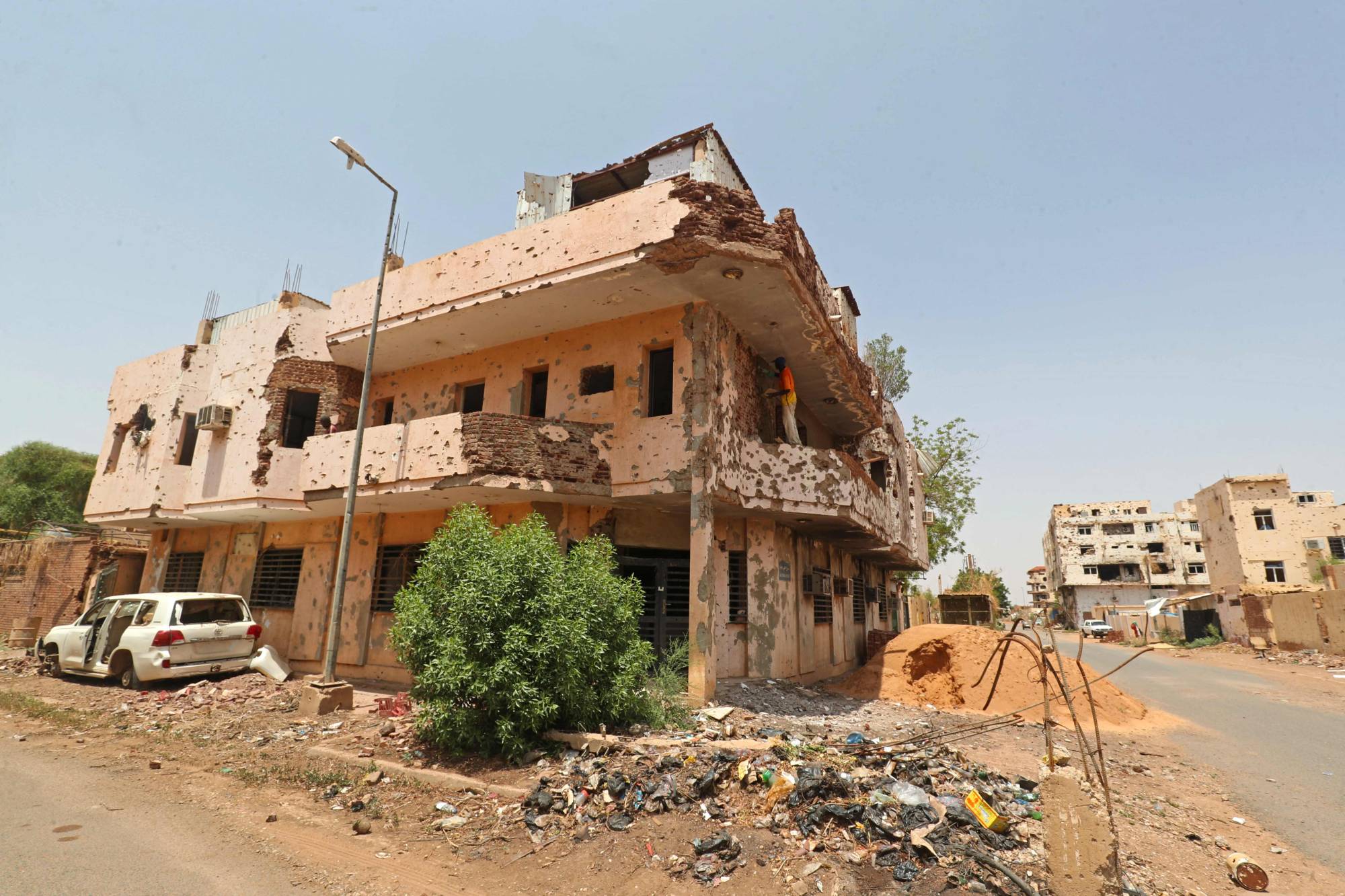
Men walk along a street past destroyed high-rise building, as efforts to restore the city's infrastructure resumes after nearly three years of devastation caused by war, in the Sudanese capital Khartoum on January 17, 2025. (AFP)
TT

Khartoum Markets Back to Life but 'Nothing Like Before'

Men walk along a street past destroyed high-rise building, as efforts to restore the city's infrastructure resumes after nearly three years of devastation caused by war, in the Sudanese capital Khartoum on January 17, 2025. (AFP)

The hustle and bustle of buyers and sellers has returned to Khartoum's central market, but "it's nothing like before," fruit vendor Hashim Mohamed told AFP, streets away from where war first broke out nearly three years ago.

On April 15, 2023, central Khartoum awoke to battles between the Sudanese army and the paramilitary Rapid Support Forces, who had been allies since 2021, when they ousted civilians from a short-lived transitional government.

Their war has since killed tens of thousands and displaced millions. In greater Khartoum alone, nearly 4 million people -- around half the population -- fled the city when the RSF took over.

Hashim Mohamed did not.

"I had to work discreetly, because there were regular attacks" on businesses, said the fruit seller, who has worked in the sprawling market for 50 years.

Like him, those who stayed in the city report living in constant fear of assaults and robberies from fighters roaming the streets.

Last March, army forces led an offensive through the capital, pushing paramilitary fighters out and revealing the vast looting and destruction left behind.

"The market's not what it used to be, but it's much better than when the RSF was here," said market vendor Adam Haddad, resting in the shade of an awning.

In the market's narrow, dusty alleyways, fruits and vegetables are piled high, on makeshift stalls or tarps spread on the ground.

- Two jobs to survive -

Khartoum, where entire neighborhoods were once under siege, is no longer threatened by the mass starvation that stalks battlefield cities and displacement camps elsewhere in Sudan.

But with the economy a shambles, a good living is still hard to provide.

"People complain about prices, they say it's too expensive. You can find everything, but the costs keep going up: supplies, labor, transportation," said Mohamed.

Sudan has known only triple-digit annual inflation for years. Figures for 2024 stood at 151 percent -- down from a 2021 peak of 358.

The currency has also collapsed, going from trading at 570 Sudanese pounds to the US dollar before the war to 3,500 in 2026, according to the black market rate.

One Sudanese teacher, who only a few years ago could provide comfortably for his two children, told AFP he could no longer pay his rent with a monthly salary of 250,000 Sudanese pounds ($71).

To feed his family, pay for school, and cover healthcare, he "works in the market or anywhere" on his days off.

"You have to have another job to pay for the bare minimum of basic needs," he said, asking for anonymity to protect his privacy.

For Adam Haddad, the road to recovery will be a long one.

"We don't have enough resources or workers or liquidity going through the market," he said, adding that reliable electricity was still a problem.

"The government is striving to restore everything, and God willing, in the near future, the power will return and Khartoum will become what it once was."


Trump Heads into Davos Storm, with an Eye on Home

FILE - President Donald Trump is illuminated by a camera flash as he gestures while walking across the South Lawn of the White House, Nov. 2, 2025, in Washington, after returning from a trip to Florida. (AP Photo/Mark Schiefelbein, File)
TT

Trump Heads into Davos Storm, with an Eye on Home

FILE - President Donald Trump is illuminated by a camera flash as he gestures while walking across the South Lawn of the White House, Nov. 2, 2025, in Washington, after returning from a trip to Florida. (AP Photo/Mark Schiefelbein, File)

Donald Trump returns to the Davos ski resort next week after unleashing yet another avalanche on the global order. But for the US president, his main audience is back home.

Trump's first appearance in six years at the gathering of the world's political and global elite comes amid a spiraling crisis over his quest to acquire Greenland.

Fellow leaders at the mountain retreat will also be eager to talk about other shocks from his first year back in power, from tariffs to Venezuela, Ukraine, Gaza and Iran.

Yet for the Republican president, his keynote speech among the Swiss peaks will largely be aimed at the United States.

US voters are angered by the cost of living despite Trump's promises of a "golden age," and his party could be facing a kicking in crucial midterm elections in November.

That means Trump will spend at least part of his time in luxurious Davos talking about US housing.

A White House official told AFP that Trump would "unveil initiatives to drive down housing costs" and "tout his economic agenda that has propelled the United States to lead the world in economic growth."

The 79-year-old is expected to announce plans allowing prospective homebuyers to dip into their retirement accounts for down payments.

Billionaire Trump is keenly aware that affordability has become his Achilles' heel in his second term. A CNN poll last week found that 58 percent of Americans believe his first year back in the White House has been a failure, particularly on the economy.

Trump's supporters are also increasingly uneasy about the "America First" president's seemingly relentless focus on foreign policy since his return to the Oval Office.

But as he flies into the snowy retreat, Trump will find it impossible to avoid the global storm of events that he has stirred since January 20, 2025.

Trump will be alongside many of the leaders of the same European NATO allies that he has just threatened with tariffs if they don't back his extraordinary quest to take control of Greenland from Denmark.

Those threats have once again called into question the transatlantic alliance that has in many ways underpinned the western economic order celebrated at Davos.

- 'Economic stagnation' -

So have the broader tariffs Trump announced early in his second term, and he is set to add to the pressure on Europe in his speech.

Trump will "emphasize that the United States and Europe must leave behind economic stagnation and the policies that caused it," the White House official said.

The Ukraine war will also be on the cards.

Ukrainian President Volodymyr Zelensky is hoping for a meeting with Trump to sign new security guarantees for a hoped-for ceasefire deal with Russia, as are G7 leaders.

But while the largest-ever US Davos delegation includes Secretary of State Marco Rubio, special envoy Steve Witkoff and son-in-law Jared Kushner, who have all played key roles on Ukraine, no meeting is assured.

"No bilateral meetings have been scheduled for Davos at this time," the White House told AFP.

Trump is meanwhile reportedly considering a first meeting of the so-called "Board of Peace" for war-torn Gaza at Davos, after announcing its first members in recent days.

Questions are also swirling about the future of oil-rich Venezuela following the US military operation to topple its leader Nicolas Maduro, part of Trump's assertive new approach to his country's "backyard."

But Trump may also pause to enjoy his time in the scenic spot he called "beautiful Davos" in his video speech to the meeting a year ago.

The forum has always been an odd fit for the former New York property tycoon and reality TV star, whose brand of populism has long scorned globalist elites.

But at the same time, Trump relishes the company of the rich and successful.

His first Davos appearance in 2018 met occasional boos but he made a forceful return in 2020 when he dismissed the "prophets of doom" on climate and the economy.

A year later he was out of power. Now, Trump returns as a more powerful president than ever, at home and abroad.


Russia, China Unlikely to Back Iran Against US Military Threats

A man stands by the wreckage of a burnt bus bearing a banner (unseen) that reads "This was one of Tehran’s new buses that was paid for with the money of the people’s taxes,” in Tehran's Sadeghieh Square on January 15, 2026. (AFP)
TT

Russia, China Unlikely to Back Iran Against US Military Threats

A man stands by the wreckage of a burnt bus bearing a banner (unseen) that reads "This was one of Tehran’s new buses that was paid for with the money of the people’s taxes,” in Tehran's Sadeghieh Square on January 15, 2026. (AFP)

While Russia and China are ready to back protest-rocked Iran under threat by US President Donald Trump, that support would diminish in the face of US military action, experts told AFP.

Iran is a significant ally to the two nuclear powers, providing drones to Russia and oil to China. But analysts told AFP the two superpowers would only offer diplomatic and economic aid to Tehran, to avoid a showdown with Washington.

"China and Russia don't want to go head-to-head with the US over Iran," said Ellie Geranmayeh, a senior policy expert for the European Council on Foreign Relations think tank.

Tehran, despite its best efforts over decades, has failed to establish a formal alliance with Moscow and Beijing, she noted.

If the United States carried out strikes on Iran, "both the Chinese and the Russians will prioritize their bilateral relationship with Washington", Geranmayeh said.

China has to maintain a "delicate" rapprochement with the Trump administration, she argued, while Russia wants to keep the United States involved in talks on ending the war in Ukraine.

"They both have much higher priorities than Iran."

- Ukraine before Iran -

Despite their close ties, "Russia-Iranian treaties don't include military support" -- only political, diplomatic and economic aid, Russian analyst Sergei Markov told AFP.

Alexander Gabuev, director of Carnegie Russia Eurasia Center, said Moscow would do whatever it could "to keep the regime afloat".

But "Russia's options are very limited," he added.

Faced with its own economic crisis, "Russia cannot become a giant market for Iranian products" nor can it provide "a lavish loan", Gabuev said.

Nikita Smagin, a specialist in Russia-Iran relations, said that in the event of US strikes, Russia could do "almost nothing".

"They don't want to risk military confrontation with other great powers like the US -- but at the same time, they're ready to send weaponry to Iran," he said.

"Using Iran as a bargaining asset is a normal thing for Russia," Smagin said of the longer-term strategy, at a time when Moscow is also negotiating with Washington on Ukraine.

Markov agreed. "The Ukrainian crisis is much more important for Russia than the Iranian crisis," he argued.

- Chinese restraint -

China is also ready to help Tehran "economically, technologically, militarily and politically" as it confronts non-military US actions such as trade pressure and cyberattacks, Hua Po, a Beijing-based independent political observer, told AFP.

If the United States launched strikes, China "would strengthen its economic ties with Iran and help it militarize in order to contribute to bogging the United States down in a war in the Middle East," he added.

Until now, China has been cautious and expressed itself "with restraint", weighing the stakes of oil and regional stability, said Iran-China relations researcher Theo Nencini of Sciences Po Grenoble.

"China is benefiting from a weakened Iran, which allows it to secure low-cost oil... and to acquire a sizeable geopolitical partner," he said.

However, he added: "I find it hard to see them engaging in a showdown with the Americans over Iran."

Beijing would likely issue condemnations, but not retaliate, he said.

Hua said the Iran crisis was unlikely to have an impact on China-US relations overall.

"The Iranian question isn't at the heart of relations between the two countries," he argued.

"Neither will sever ties with the other over Iran."
