Egypt’s FM Meets Officials in Lebanon Excluding Diab, Bassil, Hezbollah Officials

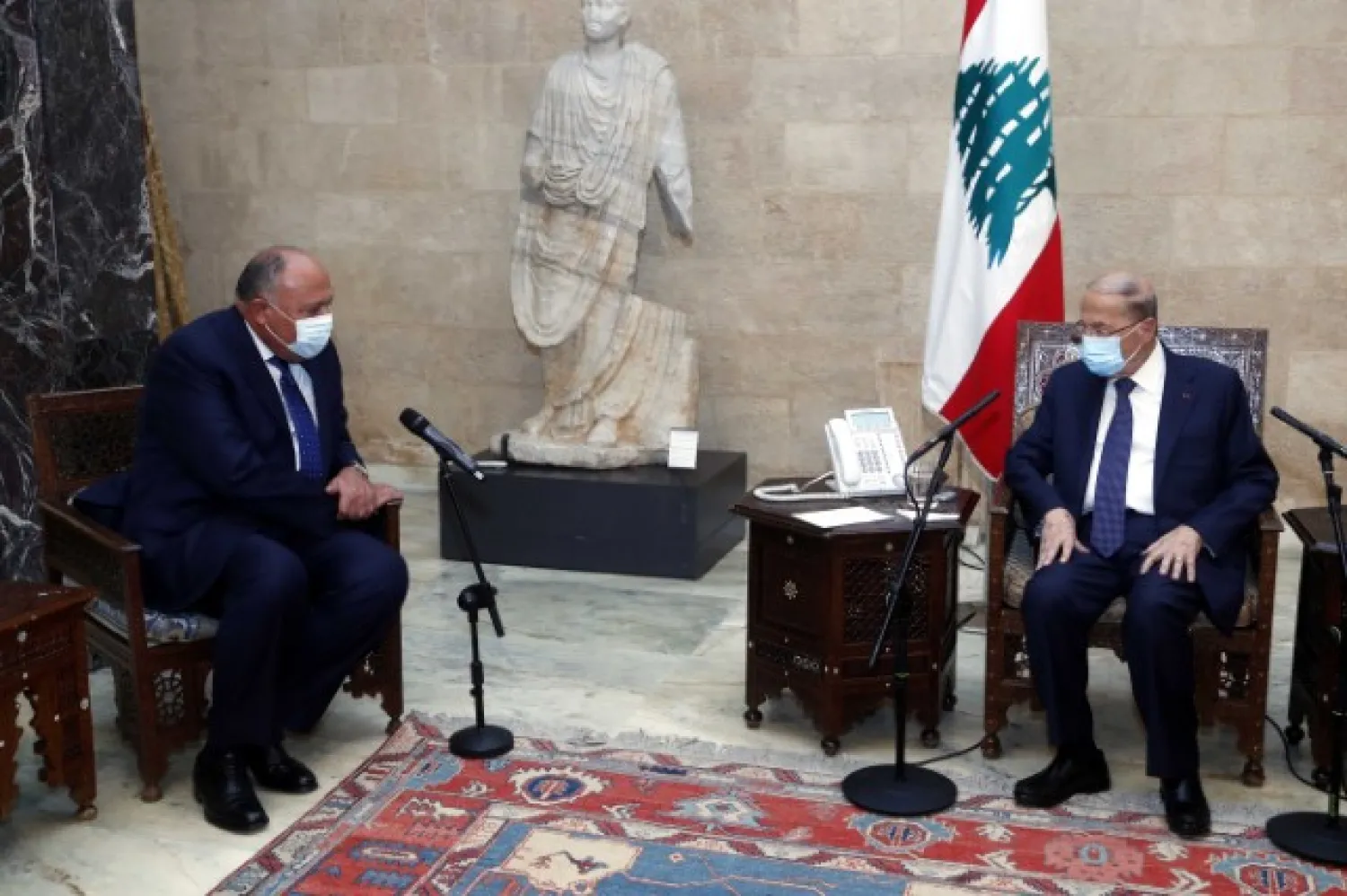
Egyptian FM Sameh Shoukry during his visit to President Michel Aoun (Lebanese Presidency)
TT

Egypt’s FM Meets Officials in Lebanon Excluding Diab, Bassil, Hezbollah Officials

Egyptian FM Sameh Shoukry during his visit to President Michel Aoun (Lebanese Presidency)

Egyptian Foreign Minister Sameh Shoukry said Lebanon’s stability and security are vital for the region, emphasizing the importance of swiftly forming a Lebanese technocratic government that will carry out the required reforms and be responsible for the interest of Lebanese people.

Shoukry visited Lebanon and met with a number of officials including President Michel Aoun, Speaker Nabih Berri, and Prime Minister Saad Hariri. However, he did not include in his meetings the caretaker prime minister, Hassan Diab, the head of the Free Patriotic Movement, MP Gebran Bassil, and Hezbollah officials.

Shoukry passed on a message from Egyptian President Abdel Fattah el-Sisi to his Lebanese counterpart, reiterating Egypt’s solidarity with Lebanon and its support of the efforts exerted to form a new government.

Shoukhry noted that this would "open the door for regional and international support and serve the common interests of the region’s countries, but primarily those of the brotherly Lebanese people.”

Aoun’s office said the president lauded Egypt’s role to help Lebanon address the various crises it is facing, particularly the governmental crisis.

He also expressed the hope that “the efforts will bear positive results through committing to the constitutional and distribution rules upon which the Lebanese system is built and including all the Lebanese parties.”

Aoun stressed the accuracy of the tasks that will be entrusted to the new government, including reforms and audits to hold accountable those who stole the money of both the Lebanese and the state.

During a press conference with Hariri, Shoukry asserted that his country will continue to exert all possible efforts alongside the Lebanese political parties to overcome the crisis facing the formation of the new government.

“The political framework of the upcoming government is ruled by the constitution, the Taif Agreement and the full commitment to those documents, considered the main pillars of stability.”

Shoukry denounced the ongoing political deadlock preventing the formation of a government of specialists capable of meeting the needs of the brotherly Lebanese people and achieving stability, not only for Lebanon but for the region and Egypt.


Israeli Forces Destroy 17 UN Peacekeeper Cameras in South Lebanon

A dog lies an empty road outside a Lebanese army outpost in the area of Naqoura in southern Lebanon on March 27, 2026. (AFP)
TT

Israeli Forces Destroy 17 UN Peacekeeper Cameras in South Lebanon

A dog lies an empty road outside a Lebanese army outpost in the area of Naqoura in southern Lebanon on March 27, 2026. (AFP)

Israeli forces destroyed 17 surveillance cameras linked to the United Nations peacekeepers' main headquarters in southern Lebanon in 24 hours, a UN security official told AFP on Saturday.

Since the start of the Israel-Hezbollah war on March 2, the UN force in Lebanon (UNIFIL) has been caught in the crossfire in the country's south, with Hezbollah launching attacks on Israel and its troops, and Israeli forces pushing into border towns.

The official, who requested anonymity, said "17 of our headquarters' cameras have been destroyed by the Israeli army" in the coastal town of Naqoura.

On Thursday, UNIFIL spokeswoman Kandice Ardiel told AFP peacekeepers had seen "Israeli soldiers conducting demolitions of large parts" of Naqoura since the start of the week.

"Not only have these demolitions destroyed civilian homes and businesses, but the strength of the blasts have caused damage to UNIFIL's headquarters," she added.

Three Indonesian peacekeepers from the UN force have been killed in two separate incidents over the past week.

UNIFIL also reported Friday an "explosion" in one of its bases near Adaisseh in south Lebanon that wounded three personnel, adding that they "do not yet know the origin of the explosion".

The Israeli army accused Hezbollah of firing " a rocket that landed in a UNIFIL outpost".

The UN office in Jakarta said on Saturday the wounded were Indonesian.

Indonesia condemned the incident as "unacceptable", saying "these events underscore the urgent need to strengthen protection for UN peacekeeping forces amid an increasingly dangerous conflict situation".

According to the UN, 97 force members have been killed in violence since its establishment in 1978 to monitor the withdrawal of Israeli forces after they invaded Lebanon.

"This has been a difficult week for peacekeepers working near the central part of UNIFIL's area of operations," Ardiel said in her statement.

She added that UNIFIL "reminds all actors of their obligations to ensure the safety and security of peacekeepers, including by avoiding combat activities nearby that could put them in danger".


Israel Strikes Tyre in South Lebanon After Evacuation Warnings

Damage at the site of an Israeli airstrike in the southern port city of Tyre, Lebanon, 04 April 2026. (EPA)
TT

Israel Strikes Tyre in South Lebanon After Evacuation Warnings

Damage at the site of an Israeli airstrike in the southern port city of Tyre, Lebanon, 04 April 2026. (EPA)

Israel's military renewed its strikes on the southern Lebanese city of Tyre on Saturday after issuing evacuation warnings, following attacks on nearby buildings that damaged a hospital in the city. 

Israel has carried out strikes across Lebanon and launched a ground invasion in the south since March 2, when Hezbollah entered the war in the Middle East on the side of its backer Iran. 

The Israeli army struck three buildings it had warned people to evacuate, according to Lebanon's state-run National News Agency (NNA). 

An AFP correspondent said a missile hit an 11-storey building northeast of Tyre, completely destroying it and reducing it to a pile of rubble that covered a nearby gas station. 

A second raid on a five-storey building near the city levelled half of it, leaving the other half standing. 

The third strike was on the Burj al-Shamali Palestinian refugee camp, southeast of the city. 

Tens of thousands of people have left Tyre, but around 20,000 remain, including 15,000 displaced from surrounding villages, despite Israeli evacuation warnings covering most of the city and a broad swathe of the south. 

Saturday's Israeli warning followed strikes that wounded at least 11 people, including three civil defense members, and damaged a major hospital, the health ministry in Beirut said. 

The director of the Lebanese Italian Hospital told the NNA that it would "remain open to provide the necessary medical care" despite the damage. 

Overnight strikes destroyed two buildings nearby, an AFP correspondent saw, shattering windows and also causing suspended ceilings to collapse in the hospital, management said. 

A wave of attacks hit the Tyre area on Saturday, including one on its port that struck a small boat and damaged others moored nearby, the correspondent said. 

Another Israeli airstrike targeted and completely destroyed a mosque in the town of Baraashit in the Bint Jbeil district, the NNA reported. 

- 'Unacceptable' attacks - 

Dawn strikes also targeted Beirut's southern suburbs, a largely evacuated Hezbollah stronghold that has been attacked repeatedly during more than a month of war. 

In a statement on Saturday, Israel's military said it had "completed an additional wave of strikes targeting command centers belonging to the Quds Force Lebanon corps in Beirut", referring to the Iranian Revolutionary Guards' foreign operations arm, and "two headquarters of the (Palestinian Islamic Jihad)". 

After attacking a bridge in the West Bekaa region in eastern Lebanon on Friday "to prevent the transfer of reinforcements and military equipment", Israel hit it again on Saturday, destroying it completely, the NNA said. 

West Bekaa is right above Lebanon's south, where Israeli troops have been advancing on the ground. 

The NNA also reported that, in Shebaa near the eastern side of the Israeli border, Israeli forces abducted a man at around 3:00 am on Saturday. 

It was at least the third time Israeli forces have seized someone from south Lebanon after infiltrating their home since the war with Hezbollah began. 

The Iran-backed group claimed responsibility Saturday for a series of attacks on northern Israeli towns and Israeli troops in Lebanese border towns, particularly Mar0un al-Ras, H0ula and Ainata. 

The war has displaced upwards of a million people in Lebanon and killed more than 1,400 people in the country, including 54 medics and three Indonesian UN peacekeepers in the south. 

On Saturday, a strike on al-Hawsh near Tyre wounded 18 people, and a strike on Habboush in the Nabatiyeh district killed at least two children and wounded 22 people, according to Lebanon's health ministry. 

The United Nations force said on Friday that three peacekeepers were wounded in a blast inside a UN facility near Odaisseh, and were rushed to hospital. 

Jakarta slammed the incident as "unacceptable" after the UN office there confirmed the wounded were Indonesian. 

Indonesia's government said "these events underscore the urgent need to strengthen protection for UN peacekeeping forces amid an increasingly dangerous conflict situation". 

On Saturday, a UN security official told AFP that Israeli forces destroyed 17 surveillance cameras linked to UNIFIL's main headquarters in Naqoura. 

The UN peacekeeping force has been caught in the crossfire in southern Lebanon since the start of the war, with Hezbollah launching attacks on Israel and its troops, and Israeli forces pushing into border towns. 


Indonesia Receives Bodies of Peacekeepers Killed in Lebanon

Family members of Indonesian soldier who was killed while serving with the United Nations Interim Force in Lebanon (UNIFIL) in southern Lebanon, mourn beside his coffin as the coffins of three Indonesian soldiers arrive at Soekarno-Hatta International Airport in Tangerang on April 4, 2026. (AFP)
TT

Indonesia Receives Bodies of Peacekeepers Killed in Lebanon

Family members of Indonesian soldier who was killed while serving with the United Nations Interim Force in Lebanon (UNIFIL) in southern Lebanon, mourn beside his coffin as the coffins of three Indonesian soldiers arrive at Soekarno-Hatta International Airport in Tangerang on April 4, 2026. (AFP)

Indonesia received the bodies of three peacekeepers Saturday that were killed on deployment in Lebanon as it branded an explosion that injured three other of its blue helmets as "unacceptable". 

The United Nations Interim Force in Lebanon (UNIFIL) said three peacekeepers were wounded in a blast that occurred inside a UN facility near Adaisseh on Friday afternoon, and rushed to hospital. 

Two were seriously wounded. 

The UN Information Center in Jakarta said the "origin of the explosion" was unknown but identified the injured soldiers as Indonesian. 

"Repeated attacks or incidents of this kind are unacceptable," the Indonesian foreign ministry said in a statement. 

"Regardless of their cause, these events underscore the urgent need to strengthen protection for UN peacekeeping forces amid an increasingly dangerous conflict situation." 

The government urged the UN Security Council to investigate the events and "to immediately convene a meeting of troop-contributing countries to UNIFIL to conduct a review and take measures to enhance the protection of personnel serving with UNIFIL". 

Friday's incident came just days after an Indonesian peacekeeper died when a projectile exploded on March 29 in southern Lebanon, where Israel and Hezbollah have been fighting since Lebanon was drawn into the Middle East war. 

A UN security source told AFP on condition of anonymity Tuesday that fire from an Israeli tank was responsible for that attack. 

A day later, two more Indonesian peacekeepers died after an explosion struck a UNIFIL logistics convoy, also in southern Lebanon. 

The bodies of the three men arrived in Jakarta on Saturday. 

- 'Not deployed for war' - 

The soldiers' coffins, draped in the Indonesian flag, were carried into a hall at the international airport on the shoulders of uniformed comrades for a ceremony attended by President Prabowo Subianto. 

Family members of the men wept over the coffins, each fronted by a photograph of the dead soldier in a gold frame. 

Prabowo saluted each portrait and held the hands of grieving loved ones, some weeping unconsolably. 

The father of one of the two fallen soldiers, 33-year-old Zulmi Aditya Iskandar, said this week he was shocked that peacekeepers were losing their lives in the conflict. 

"We were really sad and regretful, because this is a UN troop, a peacekeeping troop, not deployed for war," 60-year-old Iskandarudin told reporters at his house in West Java province. 

The military has promised financial support for the bereaved families. 

After the latest attack that injured three more soldiers, Armed Forces Commander General Agus Subiyanto ordered Indonesian peacekeepers in Lebanon to enter bunkers and refrain from activities outside. 

The Indonesian National Armed Forces has said it will deploy more than 750 personnel to Lebanon next month as part of the scheduled UNIFIL peacekeeping troop rotation.