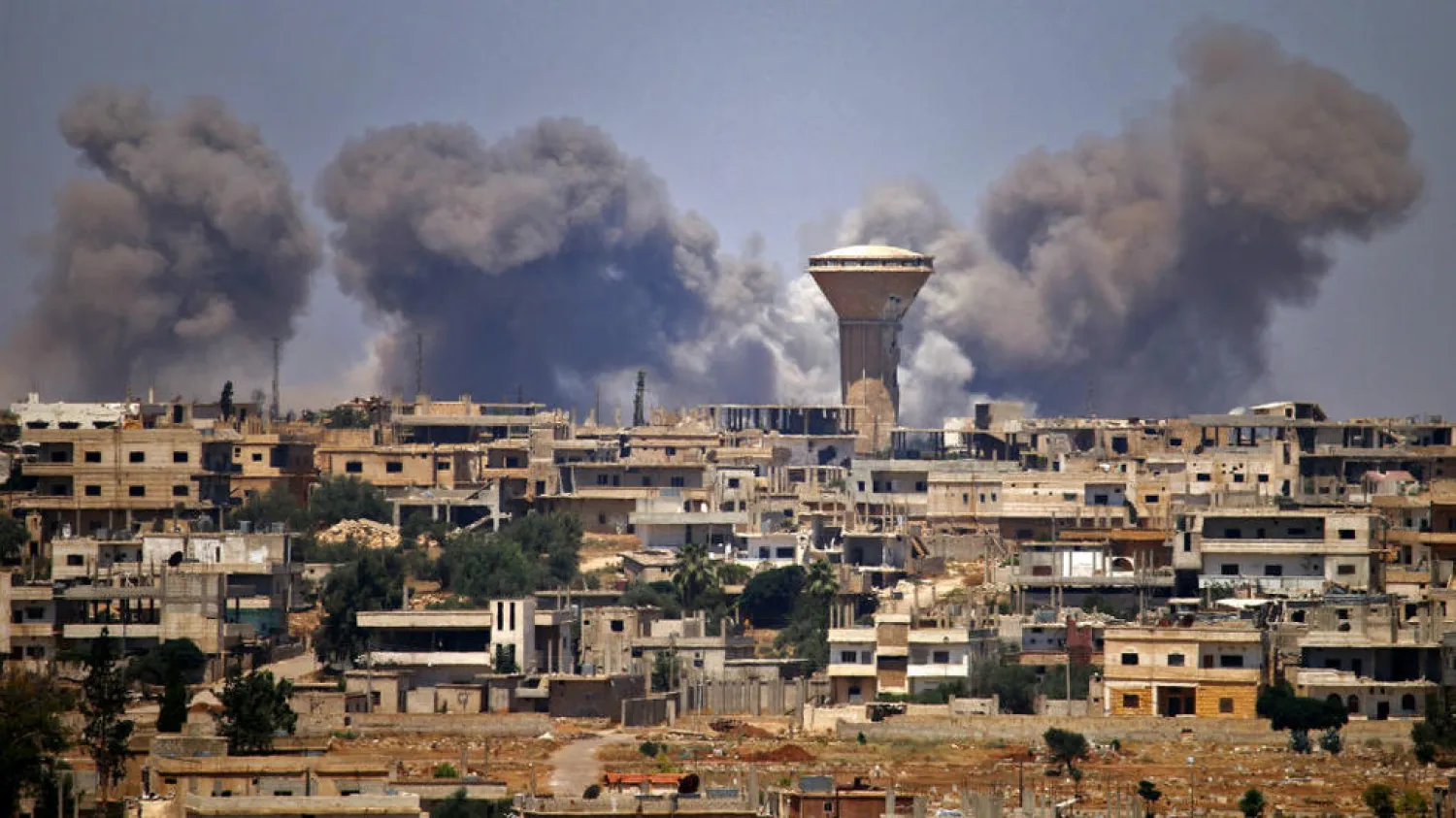
War Ordnance Claims the Lives of More than 100 Syrian Civilians

 Smoke rises above rebel-held areas of the city of Deraa on July 5, 2018 (Mohamad Abazeed, AFP)
Smoke rises above rebel-held areas of the city of Deraa on July 5, 2018 (Mohamad Abazeed, AFP)
TT

War Ordnance Claims the Lives of More than 100 Syrian Civilians

 Smoke rises above rebel-held areas of the city of Deraa on July 5, 2018 (Mohamad Abazeed, AFP)
Smoke rises above rebel-held areas of the city of Deraa on July 5, 2018 (Mohamad Abazeed, AFP)

Syrian war old ordnance, including landmines, IEDs and unexploded objects from previous shelling, continue to claim the lives of civilians in Syria.

The Syrian Observatory for Human Rights (SOHR) said Friday that more than 100 civilians were killed in the explosion of landmines leftover from the war in various areas across Syria since the beginning of 2021, including 20 women and 34 children.

According to the report, at least 42 civilians were also wounded, noting that some were left with serious injuries.

Of the total number, the Syrian Observatory documented the deaths of 44 people, including 13 women and five children, while they were collecting wild truffles.

The Syrian truffles grow in areas that are exposed to heavy rains and are sold at high prices.

According to SOHR, two landmines exploded in March in the eastern desert of Hama, in the Wadi al-Atheeb area, killing 18 people, including ten women, while six others were injured.

In other news, regime forces launched on Friday a rocket attack on areas on the outskirts of Kansafra, Al-Bara, Fleifel, Benin and Safohin in Jabal al-Zawiya in the southern Idlib countryside.

The forces also targeted with heavy machine guns frontlines in Al-Ankawi in Sahl Al-Ghab, north-west of Hama, but no casualties have been reported so far.

Also on Friday, the London-based watchdog said security upheavals continue in the governorate of Deraa since opposition factions and regime forces struck a reconciliation deal in 2018.

The Observatory said that daily attacks and assassinations are documented against military positions and figures close to the regime and Lebanon’s Hezbollah.

On Friday, SOHR activists documented the death of two members of the regime military security service, after unknown gunmen opened fire on their car in Nawa city in the western countryside of Deraa.

Since the beginning of the security chaos in Deraa in early June 2019, SOHR documented more than 993 attacks and assassination attempts by gunfire and detonations of IEDs, motorcycle bombs and car bombs. These attacks and assassinations claimed the lives of 673 persons.


'A Challenge and Blank Ballots': What Is Happening in Hamas’s Leadership Election in Gaza?

This handout picture released by the office of Iran's Supreme Leader Ayatollah Ali Khamenei on February 8, 2025, shows (L to R) member of the Hamas political bureau Nizar Awadallah, deputy chairman of the Hamas political bureau Khalil al-Hayya and the head of the political council of Hamas Mohammad Ismail Darwish, meeting with him in Tehran. (Photo by KHAMENEI.IR / AFP)
TT

'A Challenge and Blank Ballots': What Is Happening in Hamas’s Leadership Election in Gaza?

This handout picture released by the office of Iran's Supreme Leader Ayatollah Ali Khamenei on February 8, 2025, shows (L to R) member of the Hamas political bureau Nizar Awadallah, deputy chairman of the Hamas political bureau Khalil al-Hayya and the head of the political council of Hamas Mohammad Ismail Darwish, meeting with him in Tehran. (Photo by KHAMENEI.IR / AFP)

Four Hamas sources inside and outside the Gaza Strip told Asharq Al-Awsat in separate accounts that the runoff election to choose the head of the movement’s political bureau in Gaza had been suspended after the first round, held three weeks ago, failed to produce a result.

The sources agreed that the first round failed to produce a decisive result because eligible voters cast blank ballots, repeating a phenomenon that had occurred during the election to choose the overall head of the political bureau last May. That election went to a second round, which Khalil Al-Hayya won over Khaled Meshaal.

Three sources from inside and outside the Gaza Strip also said that the suspension of the runoff for the leadership of Hamas’s Gaza political bureau came after Nizar Awadallah, who is based outside Gaza and is running against Ali Al-Amoudi, who is based inside the Strip, challenged some of the procedures followed during the runoff. Both are members of the political bureau.

The fourth source, who is outside Gaza, said that “other disagreements” had also contributed to the temporary suspension of the election, which is expected to resume soon after “some arrangements” are made, without providing further details. The source described these as “normal disagreements, within the framework of the laws and regulations governing any electoral process within the movement.”

Some sources attributed part of the delay in reaching a decision to “the security situation and the circumstances facing the Strip, as well as the challenges of conducting elections in the aftermath of the Gaza war.” Another source said the election was being held while Israel was tracking substantial intelligence aimed at trying to locate participants in the election and others. These factors, the source said, had contributed to legal gaps that led to the current situation.

Why Have Blank Ballots Returned?

Regarding the renewed use of blank ballots, two sources inside the Gaza Strip said this was a normal outcome stemming from differences over the competing figures and the approach they might pursue, which some viewed as unsuitable for the current phase, as had also occurred in the general election.

None of the sources specified whether the head of Hamas’s political bureau, Khalil Al-Hayya, supports either of the two candidates, Ali Al-Amoudi or Nizar Awadallah.

Hamas is going through an exceptionally complex period, unlike any it has experienced since its establishment in 1987, following the October 7, 2023 attack it launched against Israeli sites and towns adjacent to the Gaza Strip, which prompted Israel to wage a prolonged war.

What Do We Know About Ali Al-Amoudi?

Sources told Asharq Al-Awsat in December that Al-Amoudi, a former prisoner and member of the political bureau who was responsible for the movement’s media division before the war, had become responsible for running the political bureau’s affairs in the Gaza Strip. He was appointed, along with a number of associates of the late Hamas leader Yahya Sinwar, to manage the movement in the Strip. Most of them are based in Khan Younis in southern Gaza.

Al-Amoudi, who was released in 2011 as part of the prisoner exchange deal involving Israeli soldier Gilad Shalit, has emerged over the past year as a central figure in the administration of the Gaza Strip. He was among Sinwar’s closest associates during their imprisonment in Israeli prisons and after their release. He frequently accompanied Sinwar at meetings, events and other engagements. He was appointed through an endorsement and consultation process to manage the Strip, while some sources at the time said the move had circumvented the movement’s internal regulations. This may help explain the holding of the internal election in Gaza.

In recent months, considerable controversy has arisen over Al-Amoudi’s decisions in Gaza, including changes he made and the dismissal of officials from their positions. This reportedly caused anger among local leaders in the Strip and prompted some members of the political bureau outside Gaza to intervene in an attempt to resolve the resulting disputes.

What Do We Know About Nizar Awadallah?

Nizar Awadallah is considered one of Hamas’s founding generation. He secretly led the movement’s political bureau during the period from late 2004 to early 2007. He also played a prominent role in several important stages in the movement’s modern history, including leading the negotiations over the Shalit prisoner exchange deal and taking an active and important part in negotiations during the most recent war. He also played a significant role in Palestinian reconciliation talks held in several capitals following Hamas’s takeover of the Gaza Strip in 2007.

Awadallah was very close to Sheikh Ahmed Yassin, the founder of Hamas, as well as Abdel Aziz Al-Rantisi and other early and historic leaders of the movement, of whom he was one.

Awadallah, a 68-year-old architect, rose to prominence. He lives in the Sheikh Radwan neighborhood of Gaza City, and his home has been struck several times during previous wars.

During the last internal elections, held in 2021, Awadallah competed against Yahya Sinwar for leadership of Hamas’s political bureau in the Gaza Strip. He lost to Sinwar after a second runoff was held.

Clarify the opening election sequenceFix Awadallah’s biography paragraph


Palestinian President, again Denied a Visa to Speak at UN, Addresses Leaders on Prerecorded Video

Palestinian President Mahmoud Abbas delivers a video address to the UN General Assembly in September 2025 (EPA)
TT

Palestinian President, again Denied a Visa to Speak at UN, Addresses Leaders on Prerecorded Video

Palestinian President Mahmoud Abbas delivers a video address to the UN General Assembly in September 2025 (EPA)

Palestinian President Mahmoud Abbas addressed the UN General Assembly on Thursday, delivering prerecorded remarks from his office in Ramallah after the United States denied him and other top Palestinian officials visas to attend the gathering for the second year in a row.

Israeli Prime Minister Benjamin Netanyahu was scheduled to speak in person early in the afternoon.

Since 2005, the now-90-year-old Abbas has led the Palestinian Authority, which is the internationally recognized representative of the Palestinian people. But his support among Palestinians has withered during years of corruption and the sometimes violent advance of Israeli settlers in the occupied West Bank, according to The AP news.

Under Abbas, Palestine has been recognized as a country by a majority of UN member states. But on the ground in the West Bank, the mostly symbolic moves have not affected Israel’s decades long military occupation. Throughout the war in Gaza, Abbas and the authority have been largely sidelined from negotiations over its future in favor of a transition process shepherded by President Donald Trump’s Board of Peace.

The Palestinian Authority was created under a series of peace agreements with Israel in the 1990s and administers semiautonomous areas of the West Bank, while relying heavily on foreign aid. It is the internationally recognized representative of the Palestinian people.

It was ousted from Gaza after Hamas won parliamentary elections in 2006 and violently seized control. Abbas was elected to what was supposed to be a four-year term in 2005. The authority has not held presidential or legislative elections since 2006.

Israel captured the West Bank and east Jerusalem in the 1967 war, and the Palestinians want both as part of their future state. The Palestinians and much of the international community view the settlements as illegal and as an obstacle to creating a viable, contiguous Palestinian state.

Abbas recorded the video on Wednesday.


Türkiye will Hand Over Key Base in Iraq in a Gradual Troop Withdrawal Deal

Iraqi border security force personnel patrol in their armoured vehicles along the border with Syria, in Sinjar district, northern Iraq on January 22, 2026, following recent situation in Syria.  (Photo by Zaid AL-OBEIDI / AFP)
Iraqi border security force personnel patrol in their armoured vehicles along the border with Syria, in Sinjar district, northern Iraq on January 22, 2026, following recent situation in Syria. (Photo by Zaid AL-OBEIDI / AFP)
TT

Türkiye will Hand Over Key Base in Iraq in a Gradual Troop Withdrawal Deal

Iraqi border security force personnel patrol in their armoured vehicles along the border with Syria, in Sinjar district, northern Iraq on January 22, 2026, following recent situation in Syria.  (Photo by Zaid AL-OBEIDI / AFP)
Iraqi border security force personnel patrol in their armoured vehicles along the border with Syria, in Sinjar district, northern Iraq on January 22, 2026, following recent situation in Syria. (Photo by Zaid AL-OBEIDI / AFP)

Türkiye has agreed to gradually withdraw forces from a strategic military base in northern Iraq and hand over its control to the Iraqi government, following a meeting between the two countries’ leaders on the sidelines of the UN General Assembly in New York.

Iraq, meanwhile, pledged to remove armed groups that Türkiye considers security threats from the region of Sinjar, in northwestern Iraq, according to a joint statement issued after the meeting late Wednesday between Turkish President Recep Tayyip Erdogan and Iraqi Prime Minister Ali al-Zaidi.

“In light of the progress Iraq has achieved through security measures, Turkish forces will gradually hand over the Bashiqa-Zelikan camp to the Iraqi federal government, in accordance with the agreed-upon mechanism and timeline,” according to the joint statement released by Erdogan and al-Zaidi’s offices.

Türkiye and Iraq also agreed to “fully extend the authority of the Iraqi state in Sinjar and to end the presence of banned foreign armed elements,” the statement read.

The strategically-located Bashiqa base has long been an issue of contention between Türkiye and Iraq, with Türkiye failing to fully withdraw forces, despite previous discussions for their removal. Türkiye established a military presence there in 2015 to support operations against the ISIS group and help secure the region.

Although Türkiye maintains several bases in northern Iraq for operations against the militant Kurdistan Workers’ Party, or PKK, the Bashiqa camp is Türkiye's furthest base from its border.

Türkiye, for its part, has long been pressing Iraq to curb groups with links to the PKK and other non-state armed groups from operating in Sinjar.

The Iraqi government announced earlier this month that the Sinjar Resistance Units, a Yazidi militia affiliated with the PKK, had agreed to disarm and eligible fighters would be integrated into the Iraqi security forces. The group played a significant role in the fight against ISIS, but was seen by Türkiye as a threat because of its PKK affiliation.

The agreement came as the US is ending its decades-long military presence in Iraq, with officials saying the hundreds of troops remaining in northern Iraq will be out by a Sept. 30 deadline.

Türkiye, meanwhile, is engaged in peace efforts with the PKK aimed at ending a decades-long conflict. The group, whose fighters have launched attacks on Turkish targets from bases in northern Iraq, has agreed to disband and lay down arms as part of the effort.