


Pandemic-Constrained Oscars Feature More Oratory, Less Music, Comedy

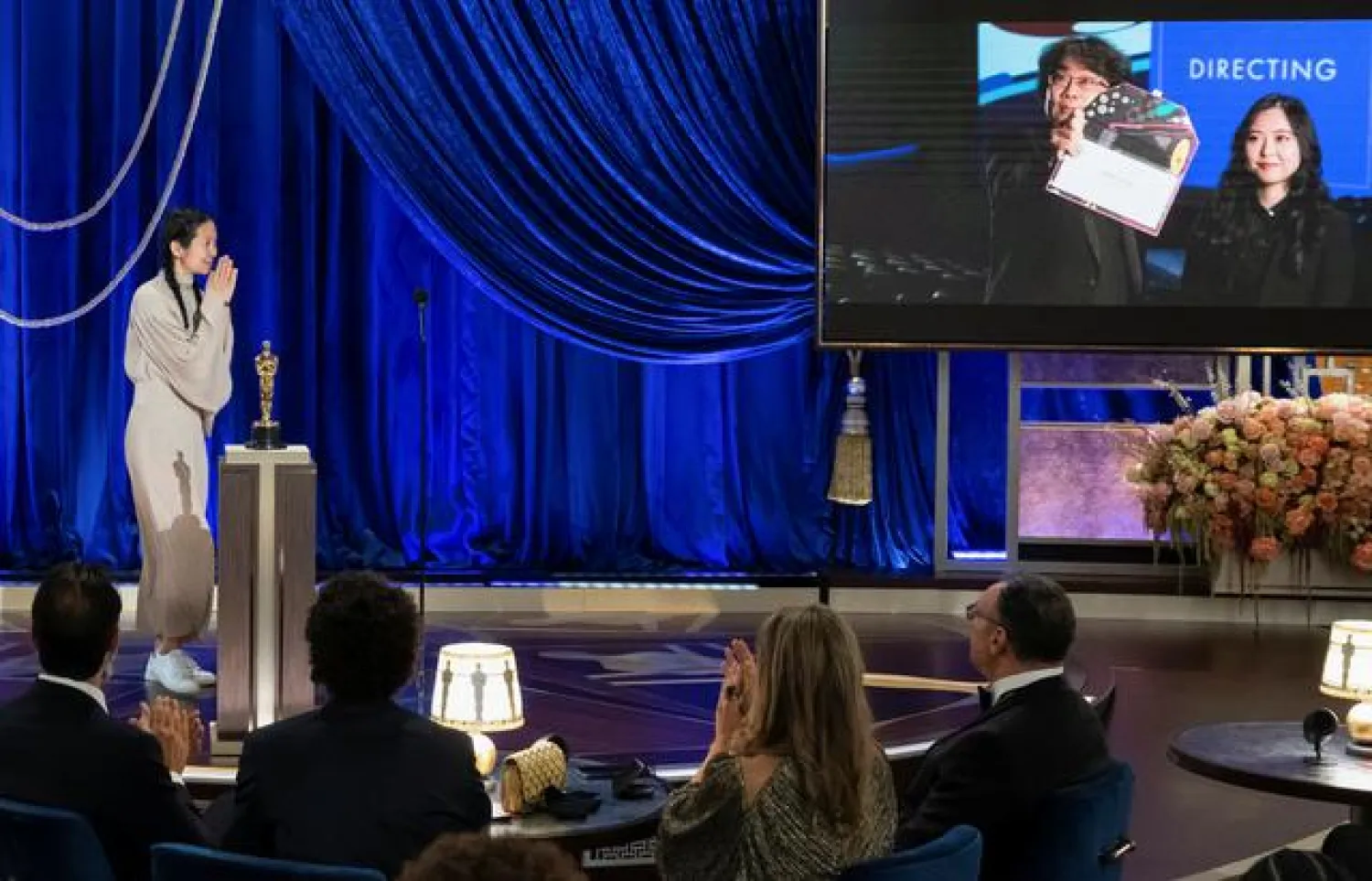
A view of the stage during the live ABC Telecast of The 93rd Oscars in Los Angeles, California, US, April 25, 2021. Todd Wawrychuk/A.M.P.A.S./Handout via REUTERS
TT

Pandemic-Constrained Oscars Feature More Oratory, Less Music, Comedy

A view of the stage during the live ABC Telecast of The 93rd Oscars in Los Angeles, California, US, April 25, 2021. Todd Wawrychuk/A.M.P.A.S./Handout via REUTERS

The Oscars telecast on Sunday, stripped to its bare essentials by constraints of the COVID-19 pandemic, exhibited a look and feel like no others - devoid of the usual comedy and musical performances but chock full of lengthy oratory from the winners.

As the producers had promised, the 93rd annual Academy Awards ceremony marked a dramatic departure from televised Oscar presentations of the past, with no opening monologue, no live orchestra or any of the glitzy song-and-dance numbers that typically fill the show, Reuters reported.

Performances of the five Oscar-nominated best original songs were relegated to pre-recorded presentations broadcast during a two-hour pre-show ahead of the main event on the Disney-owned ABC network.

What the three-hour broadcast lacked in music was more than made up for in talk, with presenters and winners alike given license to indulge their inner story tellers.

Critics’ early reaction was mixed. TVLine’s review ran under the headline: “Hollywood’s biggest night forgets how to entertain with a sluggish, humorless ceremony.” But Deadline Hollywood countered: “Unconventional, intimate ceremony reinvigorates Hollywood’s big night and makes history.”

The New York Times, saying Oscar producers failed to achieve their stated aim of making the telecast more like a film, described the show as “a cross between the Golden Globes and the closing-night banquet of a long, exhausting convention.”

The very setting for Hollywood’s highest honors was unlike any before it, a ballroom decorated in a quasi-cabaret style inside Union Station, the ornate but decidedly less conventional venue of a railway pavilion in downtown Los Angeles.

Coronavirus-related travel restrictions and public health measures forced a complete overhaul of the show, limiting attendance to just a few hundred nominees and presenters, some contenders joining the festivities by satellite from international locations.

The show itself opened with a camera following actress Regina King, dressed in a shimmering blue, sequined evening gown, as she strode through the grand hall of the rail station and onto the stage, surrounded by stars and their guests seated at socially distanced tables and booths arrayed around the room.

King, the 2005 best supporting actress winner whose feature directorial debut “One Night in Miami” was nominated for three awards this year, noted that the celebrities in attendance would be seen without face coverings while on camera.

But she said the stars were, nevertheless, adhering to strict COVID-19 safety guidelines that have allowed Hollywood to resume productions in recent months.

“Tonight we are following all the rigorous protocols that got us back safely,” she said. “Just like on a movie set, when we are rolling, masks off. And when we’re not rolling, masks on.”

Events surrounding the Minneapolis trial of the former policeman convicted of murdering George Floyd, and renewed calls for sustaining the struggle against racial injustice in America, weighed heavily on the Oscars as well.

“If things had gone differently this past week in Minneapolis, I might have traded in my heels for marching boots,” King said in an early moment that sought to strike an awkward balance between celebration and social consciousness.

“I know that a lot of you people at home want to reach for your remotes when you feel like Hollywood is preaching to you,” King said. “But as the mother of a Black son, I know the fear that so many live with, and no amount of fame or fortune changes that.”

While the scaled-back proceedings made for a more subdued and more intimate affair than usual, the evening was not without its lighter moments.

Actor Lil Rel Howery and musician Questlove teamed up to lead a round of Oscar song trivia, ending with veteran actress Glenn Close, nominated this year for her role as an Appalachian grandmother, standing up to shake her backside to a recording of the 1988 funk hit titled “Da Butt.”

One of the greatest changes from traditional Oscar presentations during Sunday’s telecast was a marked expansion in the length of speeches given by the winners, who normally are “played” off by the orchestra if their thank-yous run past 45 seconds.

Filmmaker Steven Soderbergh, one of three co-producers of this year’s event, had encouraged recipients in advance to “tell a story” and personalize their acceptance speeches.

The enlarged oratorical dimension of the show appeared to be welcomed by the star-studded audience at Union Station, but it remained to be seen how it would play at home with television viewers in the Oscar ratings, which have already experienced a steady decline in recent years.



‘Godfather’ and ‘Apocalypse Now’ Actor Robert Duvall Dead at 95 

Actor Robert Duvall arrives at the 72nd Golden Globe Awards in Beverly Hills, California January 11, 2015. (Reuters)
TT

‘Godfather’ and ‘Apocalypse Now’ Actor Robert Duvall Dead at 95 

Actor Robert Duvall arrives at the 72nd Golden Globe Awards in Beverly Hills, California January 11, 2015. (Reuters)

Robert Duvall, who played the smooth mafia lawyer in "The Godfather" and stole the show with his depiction of a surfing-crazed colonel in "Apocalypse Now," has died at the age of 95, his wife said Monday.

His death Sunday was confirmed by his wife Luciana Duvall.

"Yesterday we said goodbye to my beloved husband, cherished friend, and one of the greatest actors of our time. Bob passed away peacefully at home," she wrote.

Blunt-talking, prolific and glitz-averse, Duvall won an Oscar for best actor and was nominated six other times. Over his six decades-long career, he shone in both lead and supporting roles, and eventually became a director. He kept acting in his 90s.

"To the world, he was an Academy Award-winning actor, a director, a storyteller. To me, he was simply everything," Luciana Duvall said. "His passion for his craft was matched only by his deep love for characters, a great meal, and holding court."

Duvall won his Academy Award in 1983 for playing a washed-up country singer in "Tender Mercies."

But his most memorable characters also included the soft-spoken, loyal mob consigliere Tom Hagen in the first two installments of "The Godfather" and the maniacal Lieutenant Colonel William Kilgore in Francis Ford Coppola's 1979 Vietnam War epic "Apocalypse Now."

"It was an honor to have worked with Robert Duvall," Oscar winner Al Pacino, who acted alongside Duvall in "The Godfather" films, said in a statement.

"He was a born actor as they say, his connection with it, his understanding and his phenomenal gift will always be remembered. I will miss him."

As Colonel Kilgore, Duvall earned an Oscar nomination and became a bona fide star after years playing lesser roles, in a performance where he utters what is now one of cinema's most famous lines.

"I love the smell of napalm in the morning," his war-loving character -- bare chested, cocky and sporting a big black cowboy hat -- muses as low-flying US warplanes bomb a beachfront tree line where he wants to go surfing.

That character was originally created to be even more over the top -- his name was at first supposed to be Colonel Carnage -- but Duvall had it toned down, demonstrating his meticulous approach to acting.

"I did my homework," Duvall told veteran talk show host Larry King in 2015. "I did my research."

Cinema giant Francis Ford Coppola -- who directed Duvall in "Apocalypse Now" and "The Godfather" -- called his loss "a blow."

"Such a great actor and such an essential part of American Zoetrope from its beginning," Coppola said in a statement on Instagram.

- A 'vast career' -

Duvall was sort of a late bloomer in Hollywood -- he was already 31 when he delivered his breakout performance as the mysterious recluse Boo Radley in the 1962 film adaptation of Harper Lee's novel "To Kill a Mockingbird."

He would go on to play myriad roles -- a bullying corporate executive in "Network" (1976), a Marine officer who treats his family like soldiers in "The Great Santini" (1979), and then his star turn in "Tender Mercies."

Duvall often said his favorite role, however, was one he played in a 1989 TV mini-series -- the grizzled, wise-cracking Texas Ranger-turned-cowboy Augustus McCrae in "Lonesome Dove," based on the novel by Larry McMurtry.

British actress Jane Seymour, who worked with Duvall on the 1995 film "The Stars Fell on Henrietta," took to Instagram to share a heartfelt tribute to the star.

"We were able to share in his love of barbecue and even a little tango," Seymour captioned a photo of herself with Duvall. "Those moments off camera were just as memorable as the work itself."

US actor Alec Baldwin made a short video tribute to Duvall, speaking about the star's "vast career."

"When he did 'To Kill A Mockingbird' he just destroyed you with his performance of Boo Radley, he used not a single word of dialogue, not a single word, and he just shatters you," Baldwin said.

Film critic Elaine Mancini once described Duvall as "the most technically proficient, the most versatile, and the most convincing actor on the screen in the United States."


Songwriter Billy Steinberg Dies at 75

Grammy-winning songwriter Billy Steinberg (L) was behind several top hits of the 1980s and 1990s including Madonna's 'Like A Virgin'. Paul A. Hebert / GETTY IMAGES NORTH AMERICA/AFP/File
TT

Songwriter Billy Steinberg Dies at 75

Grammy-winning songwriter Billy Steinberg (L) was behind several top hits of the 1980s and 1990s including Madonna's 'Like A Virgin'. Paul A. Hebert / GETTY IMAGES NORTH AMERICA/AFP/File

Award-winning US songwriter Billy Steinberg, who wrote several top hit songs including Madonna's "Like a Virgin," died Monday at age 75, according to media reports.

Steinberg wrote some of the biggest pop hits of the 1980s and 1990s and was behind songs performed by singers from Whitney Houston and Celine Dion to Madonna and Cyndi Lauper.

He died following a battle with cancer, his attorney told the Los Angeles Times and BBC News.

"Billy Steinberg's life was a testament to the enduring power of a well-written song -- and to the idea that honesty, when set to music, can outlive us all," his family said in a statement to the outlets.

Steinberg was born in 1950 and grew up in Palm Springs, California, where his family had a table grape business. He attended Bard College in New York and soon began his career in songwriting.

He helped write five number one singles on the Billboard Hot 100 list. Among those was "Like a Virgin," co-written with Tom Kelly, which spent six consecutive weeks at the top of the charts.

Steinberg won a Grammy Award in 1997 for his work on Celine Dion's "Falling Into You."

He was inducted into the Songwriters Hall of Fame in 2011.


'Train Dreams,' 'The Secret Agent' Nab Spirit Wins to Boost Oscars Campaigns

'Train Dreams' director Clint Bentley speaks to the audience after his film grabbed best feature at the Film Independent Spirit Awards, as it continues its best picture Oscars campaign. KEVIN WINTER / GETTY IMAGES NORTH AMERICA/AFP
TT

'Train Dreams,' 'The Secret Agent' Nab Spirit Wins to Boost Oscars Campaigns

'Train Dreams' director Clint Bentley speaks to the audience after his film grabbed best feature at the Film Independent Spirit Awards, as it continues its best picture Oscars campaign. KEVIN WINTER / GETTY IMAGES NORTH AMERICA/AFP

Period drama "Train Dreams" took home the Spirit Awards win for best feature Sunday, as both it and "The Secret Agent" gathered momentum ahead of the Academy Awards.

"The Secret Agent" notched best international film as its team hopes to win in the same category at the Oscars next month.

The annual Film Independent Spirit Awards ceremony only celebrates movies made for less than $30 million.

"Train Dreams," director Clint Bentley's adaptation of the Denis Johnson novella, follows a railroad worker and the transformation of the American northwest across the 20th century.

The film won three of its four categories, also grabbing wins for best director and best cinematography. The movie's lead, Joel Edgerton, however, did not take home best actor, which went to Rose Byrne for "If I Had Legs I'd Kick You."

"Train Dreams" producer Teddy Schwarzman told AFP the film "is a singular journey, but it hopefully helps bring people together to understand all that life entails: love, friendship, loss, grief, healing and hope."

"Train Dreams" will compete for best picture at the Oscars, among other honors.

Big win for Brazil

After "The Secret Agent" nabbed best international film, director Kleber Mendonca Filho hailed the win as one that hopefully "gives more visibility to Brazilian cinema."

The film follows a former academic pursued by hitmen amid the political turmoil of Brazil under military rule.

It prevailed Sunday over contenders including rave-themed road trip movie "Sirat," which will compete alongside "The Secret Agent" for best international feature film at the Oscars, capping Hollywood's awards season.

"The Secret Agent" will also be up for best picture, best actor and best casting.

Brazil's "I'm Still Here" won best international feature at the Oscars last year.

Other Spirit winners on Sunday included "Lurker," for best first screenplay and best first feature film.

"Sorry, Honey" nabbed best screenplay and "The Perfect Neighbor" scored best documentary.

The Academy Awards will be presented on March 15.