

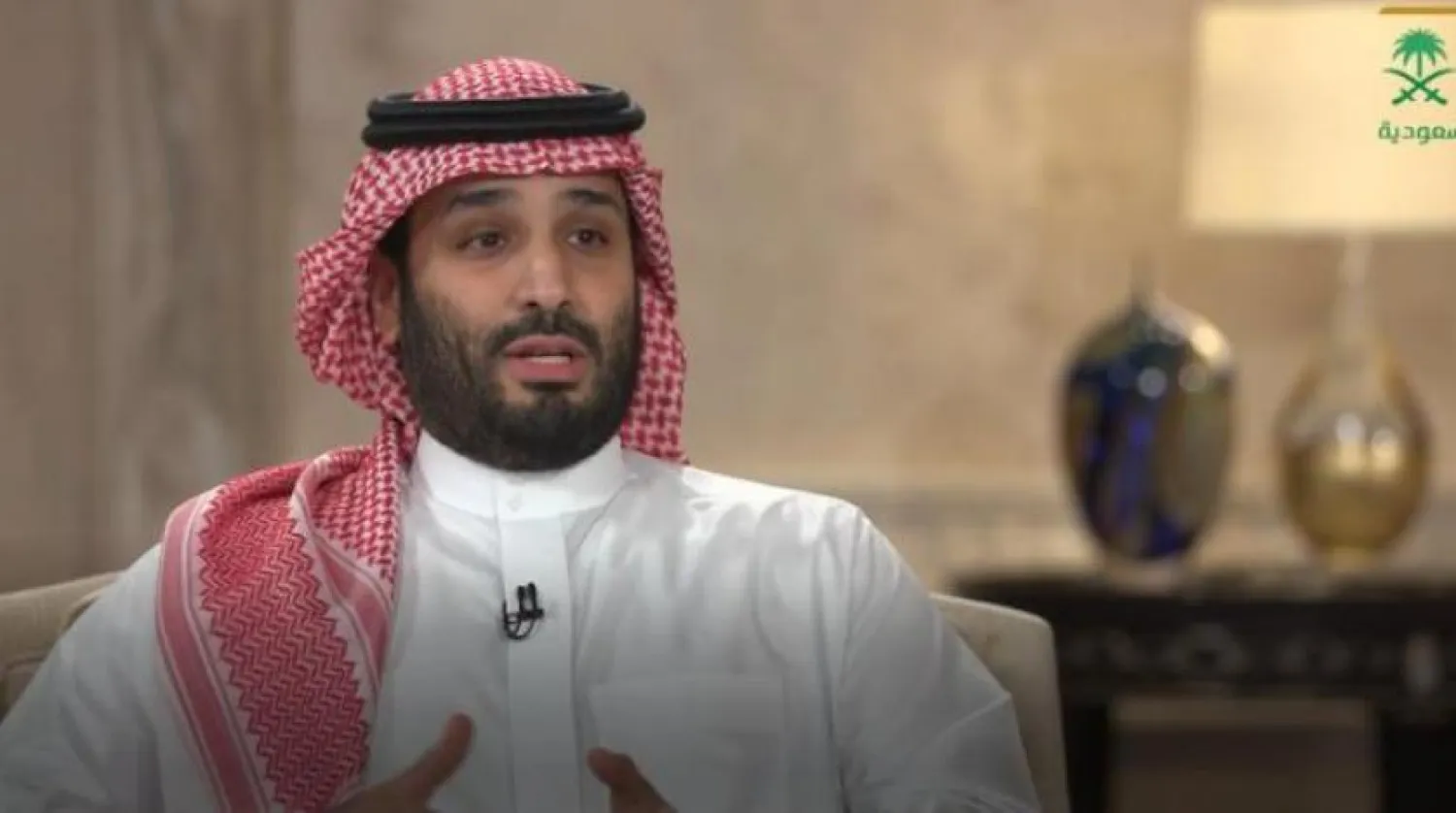

Saudi Crown Prince: Anyone Harboring Extremist Thought Is a Criminal, Will Be Held Accountable

Crown Prince Mohammed bin Salman during his televised interview.
TT

Saudi Crown Prince: Anyone Harboring Extremist Thought Is a Criminal, Will Be Held Accountable

Crown Prince Mohammed bin Salman during his televised interview.

Saudi Crown Prince Mohammed bin Salman, Deputy Prime Minister and Minister of Defense, stressed on Tuesday that “we cannot advance... with the presence of extremist thought in the Kingdom.”

In an interview aired on Saudi TV to mark the fifth anniversary of Vision 2030, he cautioned that any Saudi with extremist views, even if that person hasn't yet committed a crime, “is a criminal.”

Extremism would hamper economic growth and development, he stated.

“Our constitution is the Quran. It has been, it is and will continue to be,” Crown Prince Mohammed said, stressing that religious moderation is key.

“We, as a government, or the Shura Council as a legislator, or the King as a reference for the three authorities, we are bound to implement the Quran in some form or another,” he explained.

“But in social and personal affairs, we are only obliged to implement stipulations that are clearly stated in the Quran. So, I cannot enforce a Sharia punishment without a clear Quranic stipulation or an explicit stipulation from the Sunnah,” he said.

“When we commit ourselves to following a certain school or scholar, this means we are deifying human beings. God did not put a barrier between Himself and people,” he continued.

“If Sheikh Muhammad bin Abdulwahhab were with us today and he found us committed blindly to his texts and closing our minds to interpretation and jurisprudence while deifying and sanctifying him he would be the first to object to this. There are no fixed schools of thought and there is no infallible person.”

“We should engage in continuous interpretation of Quranic texts and the same goes for the sunnah of the Prophet Mohammed, and all fatwas should be based on the time, place, and mindset in which they are issued.”

“Our role is to make sure all the laws passed in Saudi Arabia reflect the following: One, that they do not violate the Quran and the Sunnah; the Quran being our constitution, that they do not contradict our interests, that they preserve the security and interests of citizens, and that they help in the development and prosperity of the country,” stressed Crown Prince Mohammed.

“If you aim to attract 100 million tourists to create three million jobs, and you say that you are following something new other than common laws and international norms, then those tourists will not come to you,” he noted.

“If you want to double foreign investments, as if we have done, from five million to 17 million, and you tell investors to invest in your country that is running on an unknown system that their lawyers do not know how to navigate nor know how those regulations are applied and enforced, then those investors will just cut their losses and not invest all together,” he added.

“If you want millions of jobs, if you want unemployment to decline, if you want the economy to grow, if you want your income to improve, you must eradicate extremism,” he urged.

“Extremists should not be representing our religion, nor our divine principles in any way, shape or form. So, no doubt this is a crime that has resulted in the creation of terrorist groups that have killed people throughout the world, killed Saudis, and wasted so many economic opportunities. This is a criminal act, criminalized based on the laws in Saudi Arabia. So, any person that adopts an extremist approach, even if he were not a terrorist, is a criminal and will face the full force of the law,” he vowed.

“If your identity cannot withstand the diversity of the world, it means your identity is weak and you need to do without it,” he stressed. “If your identity is robust and authentic and you can grow and develop it, and promote its positive sides, then you will have preserved and strengthened your identity.”

“I believe that our identity is very strong, and we are proud of it. It is mainly driven by you, me, and every citizen in Saudi Arabia and the movement taking place in Saudi Arabia and based on our Saudi identity, which is derived from our Islamic, Arabic and historical culture and heritage,” said Crown Prince Mohammed.
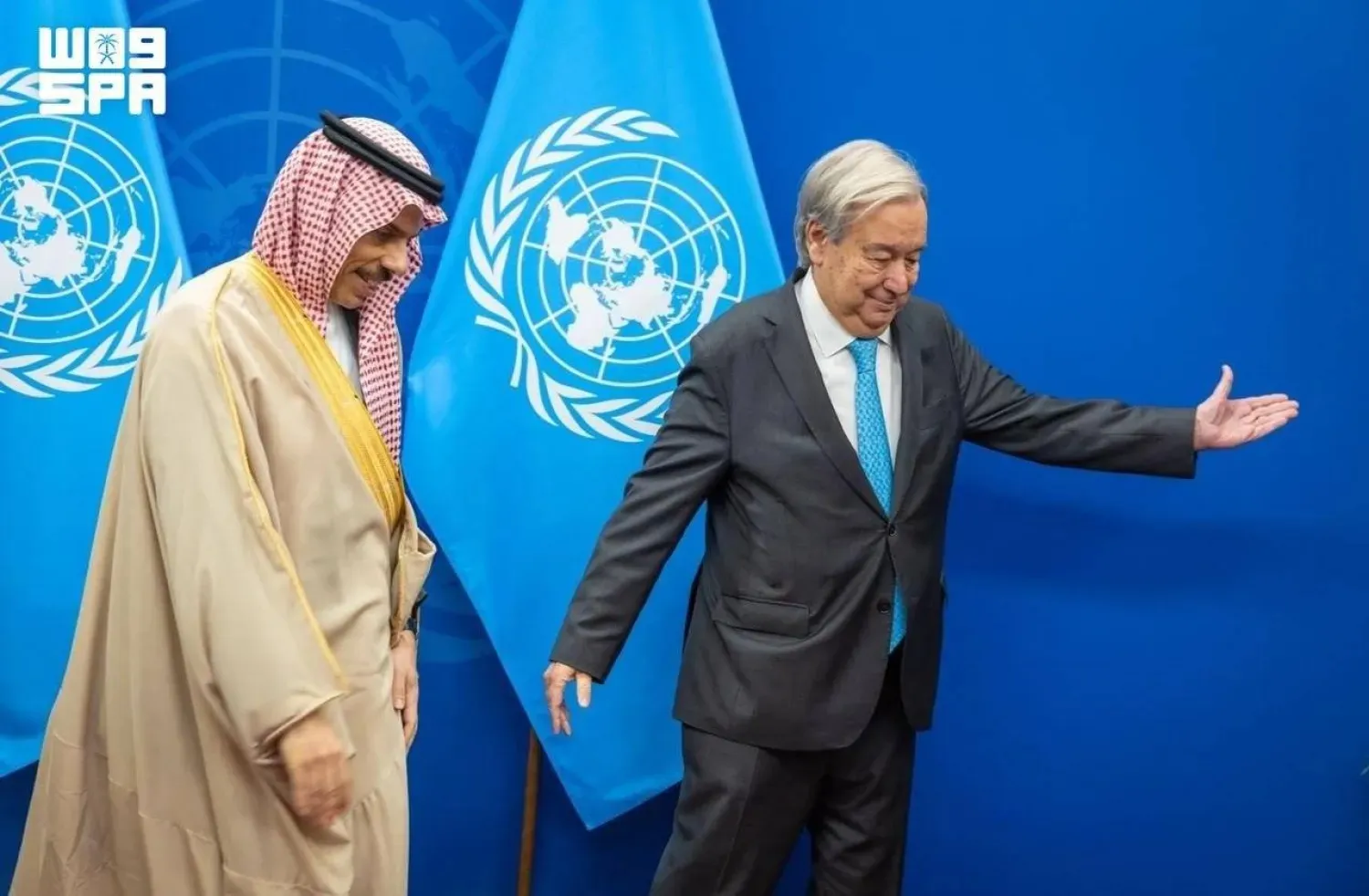


Bin Farhan Discusses Regional and International Developments with Guterres

Saudi Foreign Minister Prince Faisal bin Farhan and UN Secretary-General Antonio Guterres (SPA)
TT

Bin Farhan Discusses Regional and International Developments with Guterres

Saudi Foreign Minister Prince Faisal bin Farhan and UN Secretary-General Antonio Guterres (SPA)

Saudi Foreign Minister Prince Faisal bin Farhan met with UN Secretary-General Antonio Guterres in New York on the sidelines of the high-level week of the 81st UN General Assembly session. 

The two officials discussed areas of cooperation and regional and international developments of mutual interest. 

During the meeting, Prince Faisal expressed his appreciation to Guterres as he nears the end of his term, commending the efforts he made during his tenure. 

The Saudi Minister also held separate meetings with Algerian Foreign Minister Ahmed Attaf, Mexican Foreign Minister Roberto Velasco Alvarez, and Ghanian Minister of Foreign Affairs Samuel Okudzeto Ablakwa. 

The meetings focused on key regional and international issues, with the officials exchanging views on current developments and international efforts to address them. 


Al-Salman Meets Tareq Saleh in Riyadh to Coordinate Yemen Fronts

Lieutenant General Fahd al-Salman during his meeting with General Tariq Saleh in Riyadh on Saturday (The Coalition)
TT

Al-Salman Meets Tareq Saleh in Riyadh to Coordinate Yemen Fronts

Lieutenant General Fahd al-Salman during his meeting with General Tariq Saleh in Riyadh on Saturday (The Coalition)

Saudi Joint Forces Commander Lt. Gen. Fahd al-Salman met on Saturday in Riyadh with Lt. Gen. Tariq Saleh, a member of Yemen’s Presidential Leadership Council and commander of the National Resistance Forces, to discuss the developments in Yemen.

The Coalition to Restore Legitimacy in Yemen said in a statement that the two men met to discuss ways to strengthen and coordinate their joint efforts and bolster the readiness of Yemen’s armed forces on all fronts to restore the state and its national institutions.

The two sides stressed the importance of maintaining unity, coordinating efforts and roles, and continuing joint work to boost morale, retrain military units and improve their combat readiness in the campaign to restore the state and its institutions. They said this would help fulfill Yemenis’ aspirations for renewed security and stability and a better future.

Al-Salman commended Tariq Saleh for his leadership within Yemen’s Presidential Leadership Council and his command of the National Resistance Forces, praising the sacrifices made by the force and its members in efforts to restore state institutions and end Houthi control.


Saudi Arabia Rejects Misuse of Vital Maritime Routes

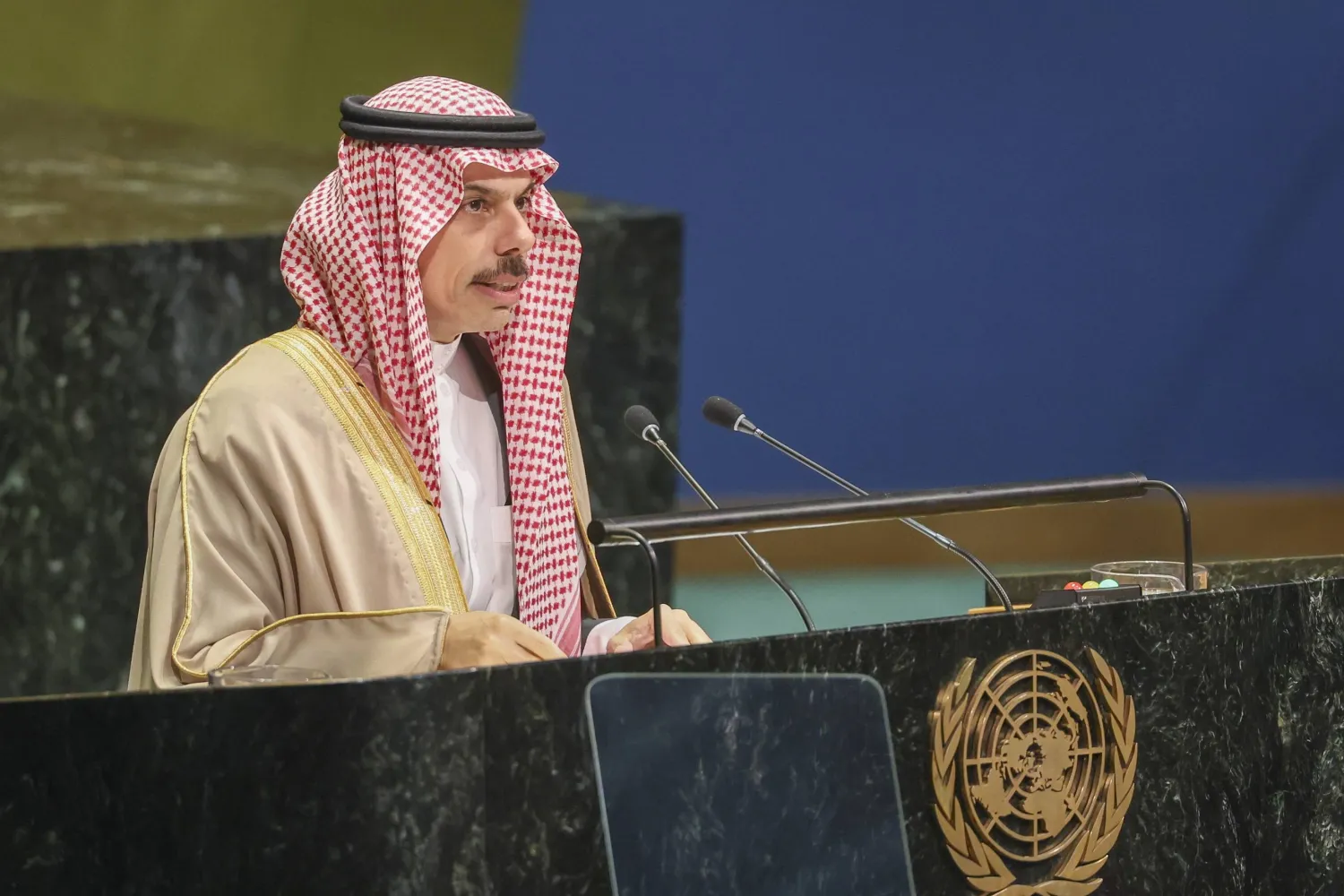
Saudi Foreign Minister Prince Faisal bin Farhan Al-Saud speaks during the General Debate of the 81st session of the United Nations General Assembly (UNGA) at United Nations Headquarters in New York, New York, USA, 26 September 2026.  EPA/SARAH YENESEL
Saudi Foreign Minister Prince Faisal bin Farhan Al-Saud speaks during the General Debate of the 81st session of the United Nations General Assembly (UNGA) at United Nations Headquarters in New York, New York, USA, 26 September 2026. EPA/SARAH YENESEL
TT

Saudi Arabia Rejects Misuse of Vital Maritime Routes

Saudi Foreign Minister Prince Faisal bin Farhan Al-Saud speaks during the General Debate of the 81st session of the United Nations General Assembly (UNGA) at United Nations Headquarters in New York, New York, USA, 26 September 2026.  EPA/SARAH YENESEL
Saudi Foreign Minister Prince Faisal bin Farhan Al-Saud speaks during the General Debate of the 81st session of the United Nations General Assembly (UNGA) at United Nations Headquarters in New York, New York, USA, 26 September 2026. EPA/SARAH YENESEL

Saudi Arabia emphasized on Saturday the importance of ensuring freedom of navigation in all international waterways, particularly the Strait of Hormuz, Bab al-Mandab, the Red Sea and the Gulf of Aden, and restoring conditions to what they were before Feb. 28, without imposing any fees or restrictions.

Riyadh rejected the use of these vital waterways by any party as a tool to exert pressure, issue threats or harm the interests of states, Saudi Foreign Minister Prince Faisal bin Farhan told the UN General Assembly in New York.

He added that the Arabian Gulf is directly linked to global energy security, the continuity of international trade, the resilience of global supply chains and the protection of maritime navigation, stressing that these shared responsibilities require serious international cooperation.

Riyadh also affirmed its full right to protect its security and sovereignty, as well as its citizens, residents and national assets, and called on the international community to shoulder its responsibilities in confronting anything that threatens international peace and security.