


Final Presidential Debate Shows Iran's Political Fissures

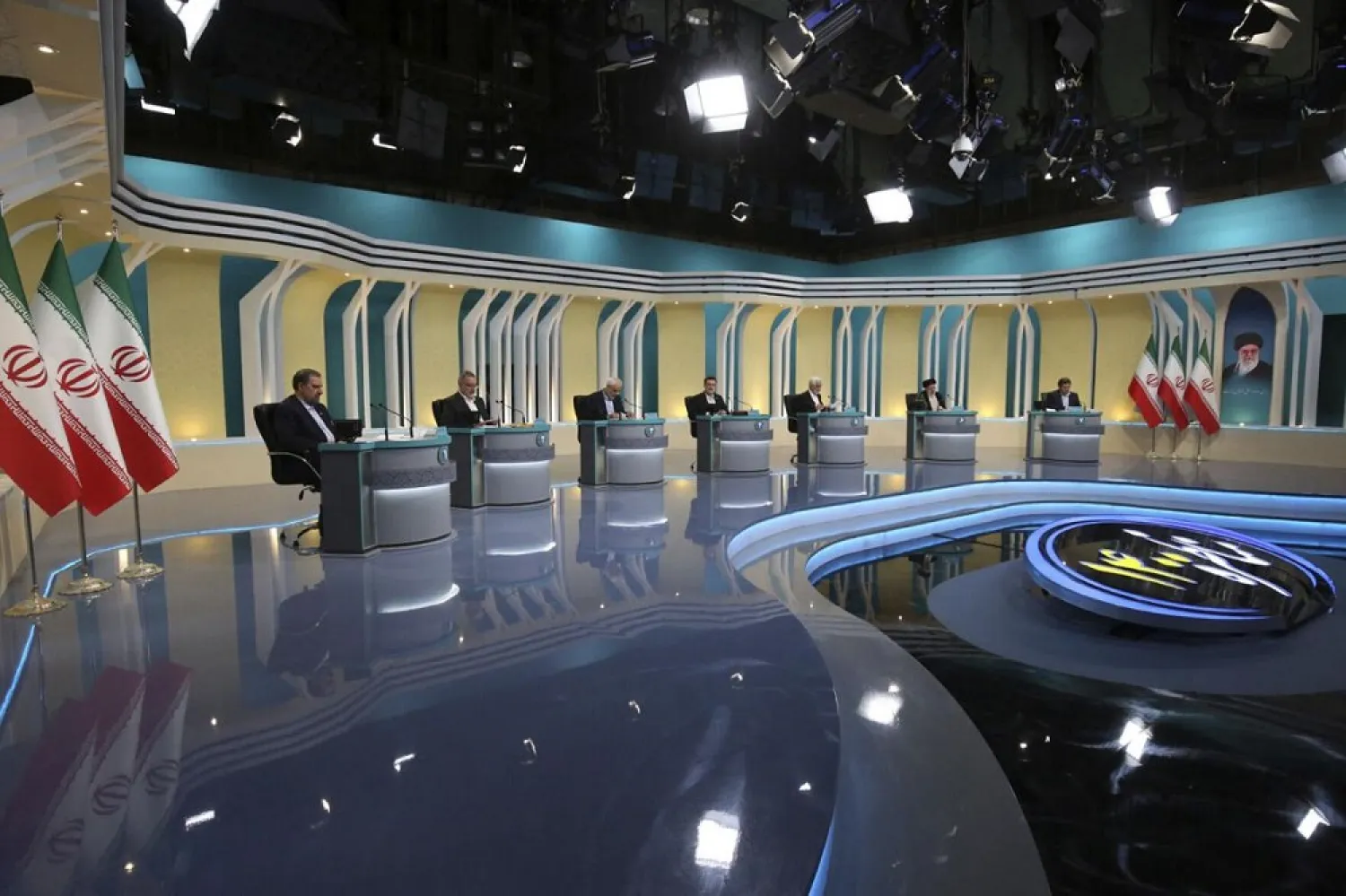
Iran held a final presidential debate Saturday that showed the fissures within the country’s politics. (Young Journalists Club, YJC via AP).
TT

Final Presidential Debate Shows Iran's Political Fissures

Iran held a final presidential debate Saturday that showed the fissures within the country’s politics. (Young Journalists Club, YJC via AP).

Iran held a final presidential debate Saturday that showed the fissures within the country’s politics, as hardliners referred to those seeking ties to the West as “infiltrators” and the race’s two other candidates brought up the unrest that surrounded Tehran’s disputed 2009 election.

Analysts and state-linked polling put hardline judiciary chief Ebrahim Raisi as the clear front-runner in Friday’s upcoming vote, with the public now largely hostile to the relative moderate President Hassan Rouhani after the collapse of Tehran’s nuclear deal with world powers.

But that didn’t stop Rouhani’s former Central Bank chief Abdolnasser Hemmati from harshly criticizing Raisi, at one point getting up from his chair to hand him a list he described as naming individuals who haven’t paid back huge loans from state banks. He again tried to link Raisi to former President Donald Trump, whose decision to unilaterally withdraw America from Iran’s nuclear deal has seen the country crushed by sanctions.

“Mr. Raisi, you and your friends have played in Trump’s ground with your extremist policies,” Hemmati said.

For his part, Raisi called Hemmati’s move a stunt and said he’d make sure the government returns to the nuclear deal.

The deal “would not be executed by you, it needs a powerful government to do this,” Raisi said.

The election Friday will see voters pick a candidate to replace Rouhani, who is term limited from running again. The vote comes amid tensions with the West as negotiations continue to try and resuscitate the nuclear deal, which saw Iran agree to limit its enrichment of uranium in exchange for the lifting of economic sanctions.

The debate took on the pattern of the previous ones, with hardliners focusing their criticism on Hemmati as a stand-in for Rouhani. Hard-liner Alireza Zakani went as far to accuse Hemmati of committing a “huge treason” by sharing financial information to the International Monetary Fund. Hardline former Revolutionary Guard chief Mohsen Rezaei described the Rouhani government as being run by “infiltrators.”

Hemmati has raised eyebrows in recent days after telling The Associated Press in an interview he’d be potentially willing to speak with President Joe Biden. He also warned that without deals with the wider world, Iran’s economy would see no growth.

“What will happen if the hardliners have power?” Hemmati asked. “I tell you there is going to be more sanctions with global consensus.”

It remains unclear if the debates will affect voters’ opinions. The state-linked Iranian Student Polling Agency suggested just 37% of Iranian adults watched the second debate.

There also remains the larger concern about turnout in the election. Officials in the past have pointed to turnout as a sign of popular support for Iran’s theocratic government. As of now, ISPA estimates turnout will be around 41% of Iran’s over 59 million eligible voters. That would the lowest percentage since Iran’s 1979 revolution. ISPA polling also puts Raisi as the front-runner with enough of a percentage to avoid a runoff.

But unlike the earlier debates, both Hemmati and an inconspicuous reformist candidate named Mohsen Mehralizadeh brought up mass protests that directly challenged the government. Mehralizadeh at one point asked Raisi to intervene with Iran’s Supreme Leader Ali Khamenei to pardon people still held after nationwide demonstrations in November 2019 over price rises of state-subsidized gasoline.

Those demonstrations ended with one lawmaker suggesting 7,000 people had been arrested. Amnesty International put the death toll from the violence at at least 208, with the rights group saying security forces killed demonstrators. Iran has yet to offer any definitive account of what happened.

Responding later to Mehralizadeh, Raisi said most of those arrested “have been pardoned by the supreme leader, except those who had relations with other countries or had other issues.” He offered no figures for those pardoned and those still detained.

The 2019 demonstrations were the deadliest since Iran’s 2009 presidential vote that saw hardline President Mahmoud Ahmadinejad re-elected amid a disputed result that gave rise to the Green Movement protests.

“What happened to our youth during these 12 years that changed their chants from ‘Where is my vote?’” to ‘No way I’m voting?’” Hemmati asked at one point.


Seven Killed in Gold Mine Accident in Eastern China, State Media CCTV Reports

Gold mine in China (archive-Reuters)
TT

Seven Killed in Gold Mine Accident in Eastern China, State Media CCTV Reports

Gold mine in China (archive-Reuters)

Seven people were killed in a gold mine accident in China's eastern Shandong province, and authorities were investigating, state-run CCTV reported, sending shares of the mine owner, Zhaojin Mining Industry, down 6% on Tuesday, Reuters said.

The accident occurred on Saturday when a cage fell ‌down a mine ‌shaft, CCTV reported ‌late ⁠on Monday ‌night.

The emergency management and public security departments were investigating the cause of the accident, and whether there had been an attempt to cover it up, the ⁠report added.

The mine is owned by ‌leading gold producer Zhaojin ‍Mining Industry, according ‍to the Qichacha company registry. Shares ‍of the company were down 6.01%, as of 0525 GMT. A person who answered Zhaojin's main phone line told Reuters that the matter was under investigation and ⁠declined to answer further questions.

China's emergency management ministry on Monday held a meeting on preventing accidents during the upcoming Lunar New Year holiday. It announced inspections of mines, chemical companies, and other hazardous operations. Also on Saturday, an explosion at a biotech company ‌in northern China killed eight people.


Still a Long Way to Go in Talks on Ukraine, Russia's Lavrov Says

Russian Foreign Minister Sergei Lavrov attends a meeting with Tanzanian Minister of Foreign Affairs and East African Cooperation Mahmoud Thabit Kombo (not pictured), in Moscow, Russia, 09 February 2026.  EPA/RAMIL SITDIKOV / POOL
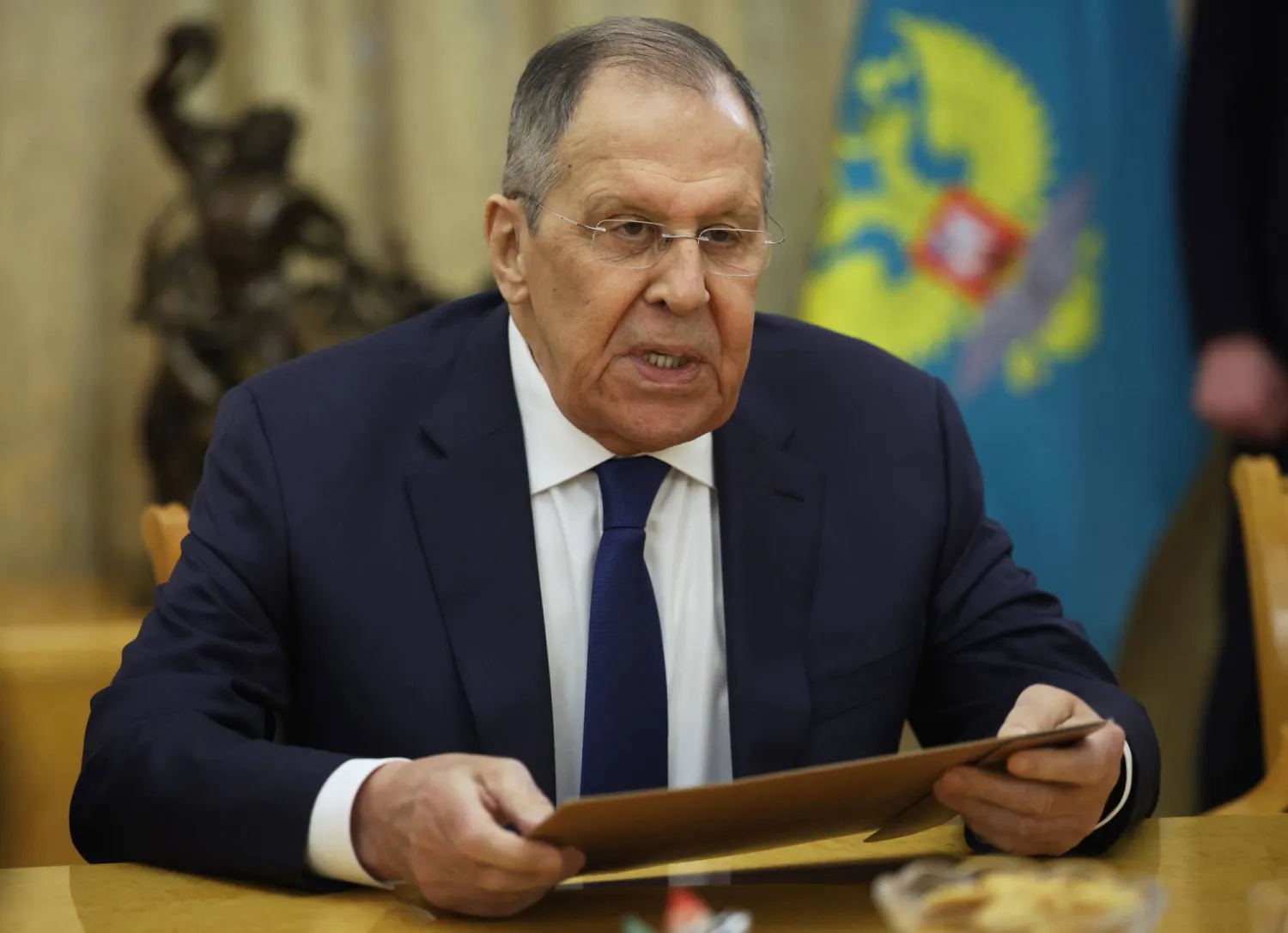
Russian Foreign Minister Sergei Lavrov attends a meeting with Tanzanian Minister of Foreign Affairs and East African Cooperation Mahmoud Thabit Kombo (not pictured), in Moscow, Russia, 09 February 2026. EPA/RAMIL SITDIKOV / POOL
TT

Still a Long Way to Go in Talks on Ukraine, Russia's Lavrov Says

Russian Foreign Minister Sergei Lavrov attends a meeting with Tanzanian Minister of Foreign Affairs and East African Cooperation Mahmoud Thabit Kombo (not pictured), in Moscow, Russia, 09 February 2026.  EPA/RAMIL SITDIKOV / POOL
Russian Foreign Minister Sergei Lavrov attends a meeting with Tanzanian Minister of Foreign Affairs and East African Cooperation Mahmoud Thabit Kombo (not pictured), in Moscow, Russia, 09 February 2026. EPA/RAMIL SITDIKOV / POOL

Russian Foreign Minister Sergei Lavrov said that there was no reason to be enthusiastic about US President Donald Trump's pressure on Europe and Ukraine as there was still a long way to go in talks on peace in Ukraine, RIA reported on Tuesday.

Here are ‌some details:

The ‌United States has ‌brokered ⁠talks between Russia and Ukraine ‌on various different drafts of a plan for ending the war in Ukraine, but no deal has yet been reached despite Trump's repeated promises to clinch one.

* "There is still a long way to go," Lavrov ⁠was quoted as saying by Russian news agencies.

* Lavrov said that ‌Trump had put Ukraine ‍and Europe in their places ‍but that such a move was ‍no reason to embrace an "enthusiastic perception" of the situation.

* Russian Deputy Foreign Minister Alexander Grushko said that any deal would have to exclude NATO membership for Ukraine and rule out the deployment of foreign troops in Ukraine, Izvestia ⁠reported.

* At stake is how to end the deadliest war in Europe since World War Two, the future of Ukraine, the extent to which European powers are sidelined and whether or not a peace deal brokered by the United States will endure.

* Russia invaded Ukraine in February 2022 after eight years of fighting in eastern Ukraine, triggering the biggest confrontation between ‌Moscow and the West since the depths of the Cold War.


Iran Warns of 'Destructive' Influence on Diplomacy ahead of Netanyahu's US Trip

FILE PHOTO: Iran's Supreme National Security Council Secretary Ali Larijani speaks after meeting with Lebanese Parliament Speaker Nabih Berri, in Beirut, Lebanon August 13, 2025. REUTERS/Aziz Taher/File Photo
TT

Iran Warns of 'Destructive' Influence on Diplomacy ahead of Netanyahu's US Trip

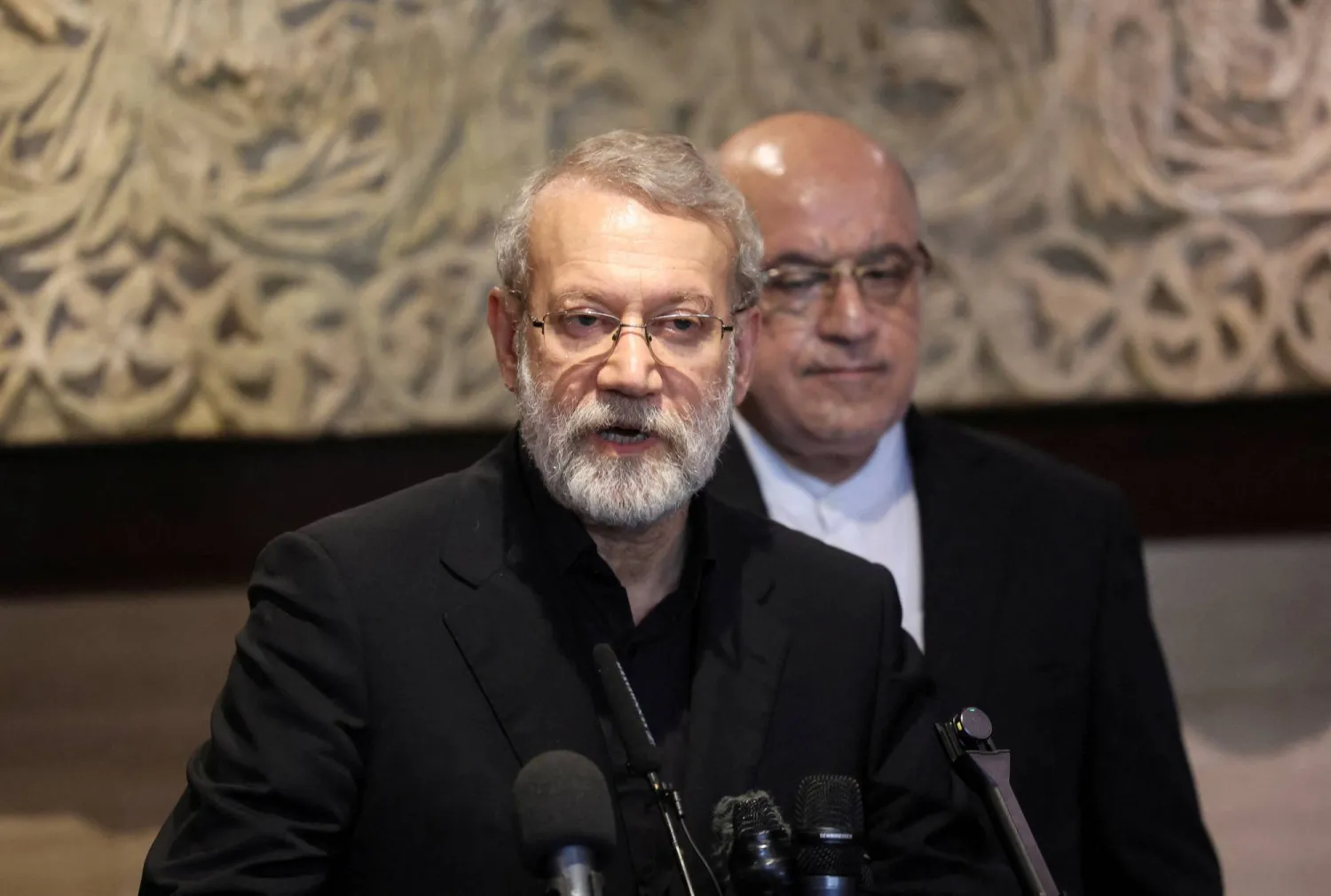
FILE PHOTO: Iran's Supreme National Security Council Secretary Ali Larijani speaks after meeting with Lebanese Parliament Speaker Nabih Berri, in Beirut, Lebanon August 13, 2025. REUTERS/Aziz Taher/File Photo

The secretary of Iran's top security body arrived in Oman on Tuesday, amid Iranian warning of  "destructive" influence on diplomacy ahead of Israeli Prime Minister Benjamin Netanyahu's visit to Washington for talks expected to focus on US negotiations with Tehran. 

"Our negotiating party is America. It is up to America to decide to act independently of the pressures and destructive influences that are detrimental to the region," said Iranian foreign ministry spokesman Esmail Baqaei in a weekly press briefing. 

"The Zionist regime has repeatedly, as a saboteur, shown that it opposes any diplomatic process in our region that leads to peace." 

Ali Larijani, who heads the Supreme National Security Council, is expected to hold talks with Haitham bin Tariq, the Sultan of Oman, and Foreign Minister Badr bin Hamad al-Busaidi, Iran's state news agency IRNA reported.  

They will discuss the latest regional and international developments as well as economic cooperation between Iran and Oman, the news agency said. 

Tehran and Washington resumed talks in Muscat on Friday, months after earlier negotiations collapsed following Israel's unprecedented bombing campaign against Iran last June, which triggered a 12-day war. 

During the conflict, Israel targeted senior Iranian military officials, nuclear scientists and nuclear sites, as well as residential areas. 

The United States later joined the campaign, launching its own strikes on key Iranian nuclear facilities. 

Iran responded with drone and missile attacks on Israel and by targeting the largest US military base in the Middle East, located in Qatar. 

"The June experience was a very bad experience. Therefore, taking these experiences into account, we are determined to secure Iran's national interests through diplomacy," Baqaei said. 

He insisted that Iran's focus would remain strictly on the nuclear file in return for sanctions relief. 

Tehran has repeatedly said it rejects any negotiations that extend beyond that issue. 

On Saturday, Netanyahu's office said in a statement that the Israeli premier "believes any negotiations must include limitations on ballistic missiles and a halting of the support for the Iranian axis" -- referring to Iran's allied armed groups in the region. 

The talks followed threats from Washington and the deployment of a US aircraft carrier group to the region after Iran's deadly crackdown on anti-government protests last month. 

Iranian authorities said the protests, which erupted in late December over the rising cost of living, began as peaceful demonstrations before turning into "riots" involving killings and vandalism, which they said were inflamed by the United States and Israel.