


Iran Likely Had Failed Rocket Launch, Preparing for Another

Satellite images, a US official and a rocket expert all confirmed the failed launch. (AP)
TT

Iran Likely Had Failed Rocket Launch, Preparing for Another

Satellite images, a US official and a rocket expert all confirmed the failed launch. (AP)

Iran likely conducted a failed launch of a satellite-carrying rocket in recent days and now appears to be preparing to try again.

Satellite images, a US official and a rocket expert all confirmed the failed launch, earlier this month, at the Imam Khomeini Spaceport in Iran’s Semnan province.

The attempt comes as Iran’s space program has suffered a series of high-profile losses, while its paramilitary Revolutionary Guard runs its own parallel program that launched a satellite into orbit last year, The Associated Press reported.

As with other failed launches, Iranian state media did not acknowledged it took place. Iran’s mission to the United Nations did not immediately respond to a request for comment early Wednesday.

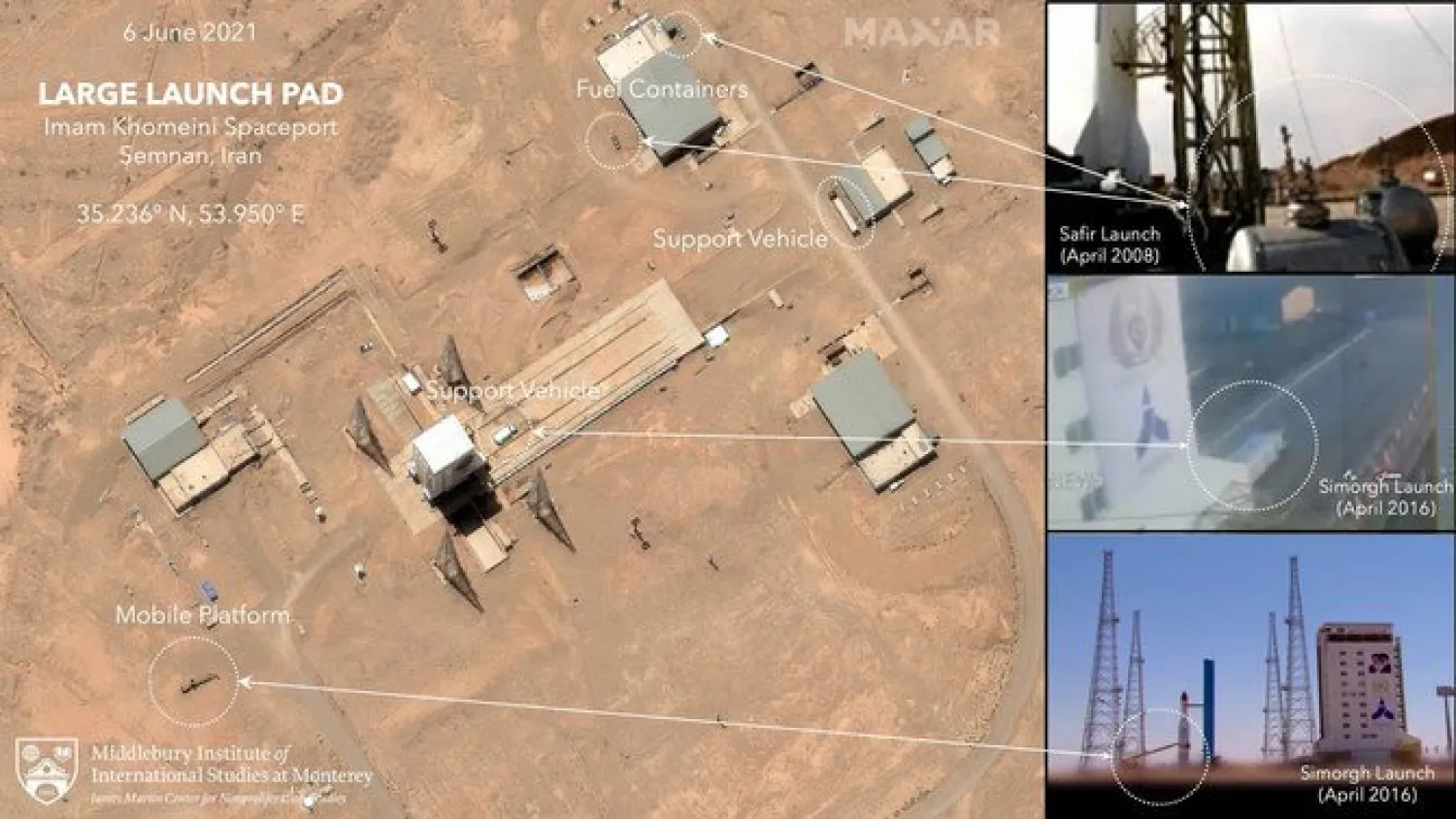
Satellite photos from Planet Labs Inc. and Maxar Technologies show preparations at the spaceport on June 6. Those images include what appears to be fuel tanks alongside a massive white gantry that houses a rocket, while scientists fuel it and prepare for launch. Before the launch, workers tow the gantry away to expose the rocket.

The number of fuel tanks, based on their size, appear to have been enough to fill the first and second stages of an Iranian Simorgh rocket, said Jeffrey Lewis, an expert at the James Martin Center for Nonproliferation Studies at the Middlebury Institute of International Studies. The Simorgh is a satellite-carrying rocket that has been launched from that same area of the spaceport, he said.

Later satellite images on June 17 showed a decrease in activity at the site. Lewis said analysts believe Iran launched the rocket at some point in that window.

“Nothing had blown up. There wasn’t a giant stain — like they had dumped the fuel — and the vehicles had kind of just moved around,” he said. “The overall level of activity at the site was much lower. So to our mind, that looked like a launch.”

CNN, which first reported on the failed launch, quoted Pentagon spokesman Lt. Col. Uriah Orland saying that “US Space Command is aware of the Iranian rocket launch failure which occurred early June 12.” Orland did not elaborate. The Pentagon and US Space Command did not immediately respond to a request for comment early Wednesday from The AP.

It wasn’t immediately clear why Iran would have picked June 12 for a launch as Tehran typically schedules such launches for national commemorations. However, it did come in the run-up to Iran’s presidential election last week, in which the Islamic Republic had hoped to boost turnout.

On Sunday, a new satellite image from Planet Labs showed renewed activity at the site. The image shows a mobile platform previously used to secure a Simorgh rocket at the gantry, a support vehicle seen at previous launches and a new line of fuel containers lined up at the site. Lewis said the equipment suggests that another launch is imminent.

Over the past decade, Iran has sent several short-lived satellites into orbit and in 2013 launched a monkey into space. The program has seen recent troubles, however. A failed launch this month would be the fourth in a row for the Simorgh program. A separate fire at the Imam Khomeini Spaceport in February 2019 also killed three researchers, authorities said at the time.

A rocket explosion in August 2019 drew even the attention of then-President Donald Trump, who later tweeted what appeared to be a classified surveillance image of the launch failure. The successive failures raised suspicion of outside interference in Iran’s program, something Trump himself hinted at by tweeting at the time that the US “was not involved in the catastrophic accident.” But Lewis said such failures are common, especially when trying to put objects carefully into orbit around the Earth.

Meanwhile, the Guard in April 2020 revealed its own secret space program by successfully launching a satellite into orbit. The head of the US Space Command later dismissed the satellite as “a tumbling webcam in space” that wouldn’t provide Iran vital intelligence — though it showed Tehran’s ability to successfully get into orbit.

The US has alleged such satellite launches defy a UN Security Council resolution and called on Iran to undertake no activity related to ballistic missiles capable of delivering nuclear weapons.

Iran, which long has said it does not seek nuclear weapons, previously maintained that its satellite launches and rocket tests do not have a military component. US intelligence agencies and the International Atomic Energy Agency say Iran abandoned an organized military nuclear program in 2003.

The Simorgh, however, is far too large and too slow to fuel to be a good carrier for a nuclear-tipped weapon, Lewis said.

“It’s a butter knife,” he added. “Could you stab someone with a butter knife? Yeah, but that’s not really the tool.”



Thousands Protest Israeli President Herzog’s Visit to Australia

 Demonstrators gather at Town Hall Square to protest against Israeli President Isaac Herzog's state visit to Australia following a deadly mass shooting during a Jewish Hanukkah celebration at Bondi Beach on December 14, 2025, in Sydney, Australia, February 9, 2026. (Reuters)
Demonstrators gather at Town Hall Square to protest against Israeli President Isaac Herzog's state visit to Australia following a deadly mass shooting during a Jewish Hanukkah celebration at Bondi Beach on December 14, 2025, in Sydney, Australia, February 9, 2026. (Reuters)
TT

Thousands Protest Israeli President Herzog’s Visit to Australia

 Demonstrators gather at Town Hall Square to protest against Israeli President Isaac Herzog's state visit to Australia following a deadly mass shooting during a Jewish Hanukkah celebration at Bondi Beach on December 14, 2025, in Sydney, Australia, February 9, 2026. (Reuters)
Demonstrators gather at Town Hall Square to protest against Israeli President Isaac Herzog's state visit to Australia following a deadly mass shooting during a Jewish Hanukkah celebration at Bondi Beach on December 14, 2025, in Sydney, Australia, February 9, 2026. (Reuters)

Thousands gathered across Australia on Monday to protest the arrival of Israeli President Isaac Herzog, who is on a multi-city trip aimed at expressing solidarity with Australia's Jewish community following a deadly mass shooting last year.

Herzog is visiting Australia this week following an invitation from Australian Prime Minister Anthony Albanese in the aftermath of the December 14 shooting at a Hanukkah event at Sydney's Bondi Beach that killed 15.

The visit has attracted the ire of some people in Australia, who accuse Herzog of being complicit in civilian deaths in Gaza. Pro-Palestine groups have organized protests ‌in cities and ‌towns across the country on Monday evening.

In Sydney, thousands gathered ‌in ⁠a square ‌in the city's central business district, listening to speeches and shouting pro-Palestine slogans.

"The Bondi massacre was terrible but from our Australian leadership there’s been no acknowledgment of the Palestinian people and the Gazans," said Jackson Elliott, a 30-year-old protestor from Sydney.

"Herzog has dodged all the questions about the occupation and says this visit is about Australia and Israeli relations but he is complicit."

There was a heavy police presence with a helicopter circling overhead and officers patrolling on horseback.

About 3,000 police personnel ⁠will be deployed across Sydney during Herzog's visit to the city.

PRESIDENT COMMEMORATES LIVES LOST

Herzog began his visit at Bondi ‌Beach, where he laid a wreath at a memorial for ‍the victims of the attack. He ‍also met survivors and the families of 15 people killed in the shooting.

"This was ‍also an attack on all Australians. They attacked the values that our democracies treasure, the sanctity of human life, the freedom of religion, tolerance, dignity and respect," Herzog said in remarks at the site.

In a statement, the Executive Council of Australian Jewry Co-Chief Executive Alex Ryvchin said Herzog's visit "will lift the spirits of a pained community."

Some Jews oppose the visit.

The Jewish Council of Australia, a vocal critic of the Israeli government, released an open letter ⁠on Monday signed by over 1,000 Jewish Australian academics and community leaders, urging Albanese to rescind Herzog's invitation.

POLICE DEPLOY SPECIAL POWERS

Authorities in Sydney have declared Herzog's visit a major event and have been authorized to use rarely invoked powers during the visit, including the ability to separate and move crowds, restrict their entry to certain areas, direct people to leave and search vehicles.

The Palestine Action Group organizing the protest failed in a legal challenge in a Sydney court on Monday against restrictions placed on the expected demonstration.

"We're hoping we won't have to use any powers, because we've been liaising very closely with the protest organizers," New South Wales Police Assistant Commissioner Peter McKenna told Nine News on Monday.

"Overall, it is all of the community that we ‌want to keep safe ... we'll be there in significant numbers just to make sure that the community is safe."


Crackdown on Dissent After Nationwide Protests in Iran Widens to Ensnare Reformist Figures

Iranians cross a road near an anti-US and anti-Israeli billboard reading "You start... we finish it" in Palestine Square in Tehran, Iran, 09 February 2026, amid heightened regional tensions. (EPA)
TT

Crackdown on Dissent After Nationwide Protests in Iran Widens to Ensnare Reformist Figures

Iranians cross a road near an anti-US and anti-Israeli billboard reading "You start... we finish it" in Palestine Square in Tehran, Iran, 09 February 2026, amid heightened regional tensions. (EPA)

Iranian security forces have launched a campaign to arrest figures within the country's reformist movement, reports said Monday.

That widens a crackdown on dissent after authorities earlier put down nationwide protests in violence that killed thousands and saw tens of thousands more detained.

Detained Nobel Peace Prize laureate Narges Mohammadi has received another prison sentence of over seven years. It signals a widening effort to silence anyone opposed to the bloody suppression of unrest by Iran's theocracy as it faces new nuclear talks with the United States. President Donald Trump has repeatedly warned he could launch an attack on the country if no deal is reached.

Media reports quoted officials within the reformist movement, which seeks to change Iran's theocracy from inside, as saying at least four of their members had been arrested. They include Azar Mansouri, the head of the Reformist Front, which represents multiple reformist factions; and former diplomat Mohsen Aminzadeh, who served under reformist President Mohammad Khatami.

Also detained was Ebrahim Asgharzadeh, who led students who stormed the US Embassy in Tehran in 1979, sparking the 444-day hostage crisis.

Their arrests likely stem from a reformist statement in January that called for Iran's 86-year-old Supreme Leader Ali Khamenei to resign from his position and have a transitional governing council oversee the country.

Iran's state-run IRNA news agency quoted a statement from prosecutors in Tehran, the country's capital, saying four people had been arrested and others summoned to meet authorities. It accused those allegedly involved of “organizing and leading ... activities aimed at disrupting the political and social situation in the country amid military threats from the United States and the Zionist regime.”

“Having bludgeoned the streets into silence with exemplary cruelty, the regime has shifted its attention inward, fixing its stare on its loyal opposition,” wrote Ali Vaez, an Iran expert at the International Crisis Group.

“The reformists, sensing the ground move beneath them, had begun to drift — and power, ever paranoid, is now determined to cauterize dissent before it learns to walk.”

However, it remains unclear just how much political support reformists have within Iran. The anger on the streets of Iran during the demonstrations, heard in people shouting “Death to Khamenei!” and in support of the country's exiled crown prince, appeared to lump reformists in with all other politicians now working in the country.

Iran and the US held new nuclear talks last week in Oman. Foreign Minister Abbas Araghchi, speaking Sunday to diplomats at a summit in Tehran, signaled that Iran would stick to its position that it must be able to enrich uranium — a major point of contention with Trump, who bombed Iranian atomic sites in June during the 12-day Iran-Israel war.

Israeli Prime Minister Benjamin Netanyahu is to travel to Washington this week, with Iran expected to be the major subject of discussion, his office said.

The US has moved the aircraft carrier USS Abraham Lincoln, ships and warplanes to the Middle East to pressure Iran into an agreement and have the firepower necessary to strike the country should Trump choose to do so.

Meanwhile, Iran issued a warning to pilots that it planned “rocket launches” Monday into Tuesday in an area over the country’s Semnan province, home to the Imam Khomeini Spaceport. Such launches have corresponded in the past with Iran marking the anniversary of its 1979 revolution.


China Vows ‘Resolute Response’ to Any Reckless Acts After Japan Election

 Japan's Prime Minister Sanae Takaichi, leader of the ruling Liberal Democratic Party (LDP), arrives at the Prime Minister's office after her party's historic election win in Sunday's poll in Tokyo, Japan, February 9, 2026. (Reuters)
Japan's Prime Minister Sanae Takaichi, leader of the ruling Liberal Democratic Party (LDP), arrives at the Prime Minister's office after her party's historic election win in Sunday's poll in Tokyo, Japan, February 9, 2026. (Reuters)
TT

China Vows ‘Resolute Response’ to Any Reckless Acts After Japan Election

 Japan's Prime Minister Sanae Takaichi, leader of the ruling Liberal Democratic Party (LDP), arrives at the Prime Minister's office after her party's historic election win in Sunday's poll in Tokyo, Japan, February 9, 2026. (Reuters)
Japan's Prime Minister Sanae Takaichi, leader of the ruling Liberal Democratic Party (LDP), arrives at the Prime Minister's office after her party's historic election win in Sunday's poll in Tokyo, Japan, February 9, 2026. (Reuters)

Beijing warned Tokyo on Monday that reckless actions would be met with a "resolute response", a day after Japan's Prime Minister Sanae Takaichi, who is viewed as critical of China, won a landslide election.

China and Japan have been locked in a spat over comments by Takaichi in November that Tokyo could intervene militarily in any attack on self-ruled Taiwan.

China claims the democratic island as part of its territory and has not ruled out force to annex it.

A spokesman for China's foreign ministry on Monday urged Japan to retract the comments and warned of consequences for any rash actions.

"If the far-right forces in Japan misjudge the situation and act recklessly, they will inevitably face resistance from the Japanese people and a resolute response from the international community," spokesman Lin Jian told a regular news conference.

"We once again urge the Japanese side to retract the erroneous remarks made by Takaichi regarding Taiwan and demonstrate basic sincerity in safeguarding the political foundation of China-Japan relations, through concrete actions," he said.

In the wake of Takaichi's comments in November, China has discouraged its nationals from travelling to Japan, citing deteriorating public security and criminal acts against Chinese nationals in the country.

In the latest escalation of the row in December, Chinese military aircraft locked radar onto Japanese jets, prompting Tokyo to summon Beijing's ambassador.

Beijing also reportedly choked off exports to Japan of rare-earth products crucial for making everything from electric cars to missiles.

And last month, two popular pandas departed Tokyo for China, leaving Japan without any of the beloved bears for the first time in 50 years.