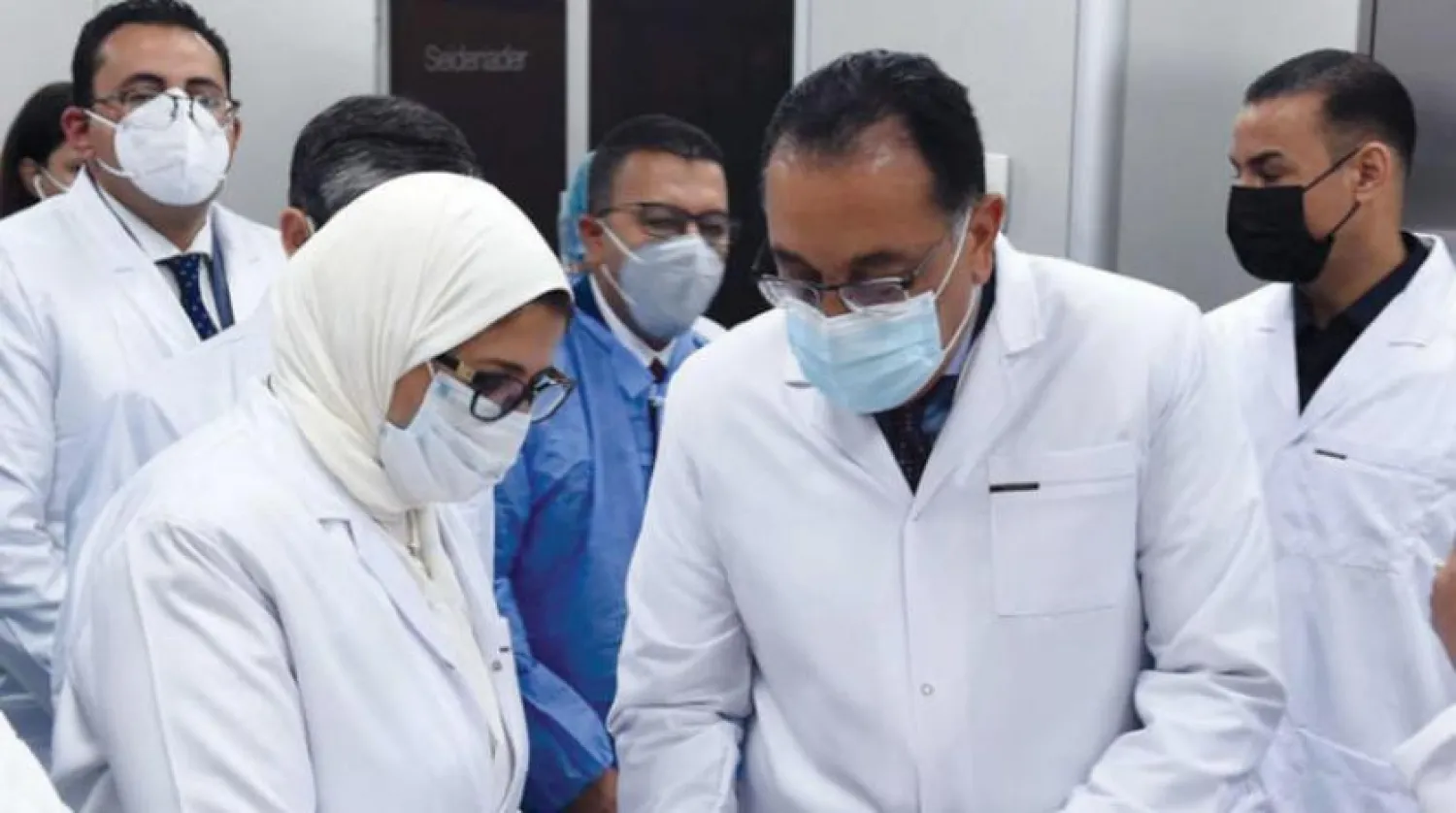
Egypt Manufactures First 1 Million Doses of COVID-19 Vaccine

 Egypt’s Prime Minster Mostafa Madbouly attends the production of the first one million doses of the locally manufactured COVID-19 vaccine (Egyptian Government)
Egypt’s Prime Minster Mostafa Madbouly attends the production of the first one million doses of the locally manufactured COVID-19 vaccine (Egyptian Government)
TT

Egypt Manufactures First 1 Million Doses of COVID-19 Vaccine

 Egypt’s Prime Minster Mostafa Madbouly attends the production of the first one million doses of the locally manufactured COVID-19 vaccine (Egyptian Government)
Egypt’s Prime Minster Mostafa Madbouly attends the production of the first one million doses of the locally manufactured COVID-19 vaccine (Egyptian Government)

Egypt produced one million doses of the locally manufactured COVID-19 vaccine, while the government confirmed it aims at vaccinating 40 percent of the population by the end of 2021.

Egypt’s Prime Minster Mostafa Madbouly said Monday that one million Sinovac doses have been produced so far, pointing out that the current capacity of the factory reached 300,000 doses per shift.

He said the challenge the government faces is receiving the raw materials necessary for producing the vaccine, but Egypt discussed with the Chinese side, doubling the amount of the raw materials to be delivered to it.

Madbouli said an agreement was reached with the company's head office to supply Egypt with the materials needed for manufacturing 80 million doses enough for vaccinating 40 million citizens.

“Under the directives of President Abdel Fattah El Sisi, the government seeks to produce the largest number of COVID-19 vaccines in order to protect its citizens,” the PM said.

It seems the pandemic would not come to an end any time soon, the PM said during a joint press conference with Health Minister Hala Zayed.

The minister confirmed that Egypt is considered one of the first countries in the world to start producing the COVID-19 vaccine.

“This step allows Egypt to become a pioneer in the production of vaccines and later to start exporting them to Africa and other regional states, after achieving self-sufficiency,” she said.

The daily COVID-19 infection rate in the country has continued to decline.

Egypt said on Monday it recorded 179 new coronavirus cases in the last 24 hours, upping the total number of confirmed cases since the outbreak in the country began to 282,082.

Ministry spokesman Khaled Megahed said 22 patients died from the virus, raising the death toll to 16,264.

On Sunday, Cabinet spokesman Nader Saad, said Egypt aims at vaccinating 40 percent of the population by the end of 2021, and that it will begin using the locally manufactured vaccines starting August.


In Lebanon Shelters, Women Care for Tiny Babies, Face Pregnancy

Mariam Zein (R) brings her son to a mobile health clinic run by charity Caritas Lebanon. Joseph EID / AFP
TT

In Lebanon Shelters, Women Care for Tiny Babies, Face Pregnancy

Mariam Zein (R) brings her son to a mobile health clinic run by charity Caritas Lebanon. Joseph EID / AFP

Mariam Zein cradled her 11-week-old son on a mattress on the floor where she and her family have sheltered near Beirut since the Israel-Hezbollah war upended her young family's life.

"I was really excited when I was in my ninth month of pregnancy... I never thought he'd be born and there'd be war," said Zein, 26, clutching baby Hussein.

"I haven't been able to enjoy my son -- my first child... to see him getting bigger in his own bed, in his own home."

"I was very sad, and I'm still sad," she told AFP, nappies and baby formula wedged near a photocopier, clothes hanging on an improvised line.

Zein fled with her husband, their baby and other relatives when war erupted between Israel and Hezbollah on March 2, drawing Lebanon into the Middle East conflict, said AFP.

She does not know if her home in south Lebanon is still standing.

Israel has kept up strikes despite a fragile US-Iran ceasefire, a landmark meeting this week between Israeli and Lebanese officials in Washington, and reports that leaders from both countries would talk for the first time in decades.

Lebanese authorities say the war has killed more than 2,100 people and displaced more than one million others.

Some 140,000 people are in overcrowded shelters like the center in Beirut's suburbs housing Zein's family and around 500 other people, among them five pregnant women and others with young babies.

Zein said she stopped breastfeeding because there was no privacy, and now struggles to buy baby formula, while Hussein is outgrowing his clothes.

"Whatever happens I just want my son near me," she said.

- Pregnancy -

According to the United Nations Population Fund (UNFPA), an estimated 620,000 women and girls are displaced, including some 13,500 pregnant women, of whom "1,500 are expected to give birth within the next 30 days".

The agency and other organizations have sought to support women as the authorities struggled to cope.

In a small tent containing a portable ultrasound, obstetrician and gynecologist Theresia Nassar has checked on women including Zein as part of a mobile health clinic run by charity Caritas Lebanon with support from UNFPA.

Displaced pregnant women risk missing important tests and scans, she said, and they are trying to fill the gaps.

"We're not just worried about physical health but also their mental health," she said.

"They don't know if they can go home, they don't have their medication, they're not being properly followed."

Elsewhere, at a school-turned-shelter in central Beirut, heavily pregnant Ghada Issa, 36, is due to deliver a baby girl in a few weeks.

But "this place, this environment, is not for pregnant women", said Issa, who was displaced from south Lebanon with her husband, their daughter Siham, five, and son Ali, four.

They live in a cramped tent, and she said even the basics are a problem, like having to make frequent trips to crowded, far-away communal toilets.

- Twins -

Her husband set up an improvised bed so she doesn't have to sleep on the floor.

Underneath are precious donated items like tiny socks and little blankets. A worker from charity Amel Association International brought them a "baby kit" including nappies and baby powder.

Without donations and other support, "there wouldn't be anything" for the baby, Issa said, as people playing football yelled, children squealed and washing hung on improvised lines.

The shelter's administration said some 20 pregnant women and two who had recently given birth were among more than 2,600 people staying there.

"I haven't got my head around the idea of having a baby here," Issa said.

"I'm still hoping that one day they'll tell me, let's go to the village, and I'll have the baby at home."

In a university classroom in south Lebanon's city of Sidon, Ghada Fadel, 36, cares for her tiny twin sons. Mohammed and Mehdi are just over one month old, and in blue jumpsuits and matching beanies.

The family has been there since she was eight months' pregnant, after fleeing their border village.

"After we left the house, they (Israel) bombed it. The house is gone" along with everything they had prepared for the twins, Fadel said.

"I was hoping to give birth and come home," she said sadly.

"Every mum hopes to take her kids home... no matter the circumstances."


Sudan Enters a Fourth Year of War as Officials Lament an 'Abandoned Crisis'

 08 April 2026, Chad, Aboutengye: Women and girls wait for water distribution at the Aboutengue refugee camp in eastern Chad near the border with Sudan. Photo: Eva Krafczyk/dpa
08 April 2026, Chad, Aboutengye: Women and girls wait for water distribution at the Aboutengue refugee camp in eastern Chad near the border with Sudan. Photo: Eva Krafczyk/dpa
TT

Sudan Enters a Fourth Year of War as Officials Lament an 'Abandoned Crisis'

 08 April 2026, Chad, Aboutengye: Women and girls wait for water distribution at the Aboutengue refugee camp in eastern Chad near the border with Sudan. Photo: Eva Krafczyk/dpa
08 April 2026, Chad, Aboutengye: Women and girls wait for water distribution at the Aboutengue refugee camp in eastern Chad near the border with Sudan. Photo: Eva Krafczyk/dpa

Famine. Massacres. And now badly needed food and other supplies are under strain. Sudan on Wednesday entered a fourth year of war that's been called an “abandoned crisis,” as a new Middle East conflict throws into shadow the fighting that has forced 13 million people to flee their homes.

The North African country is described as the world's largest humanitarian challenge, notably in terms of displacement and hunger. There is no end in sight to the fighting between the military and the paramilitary group Rapid Support Forces, or RSF, which witnesses and aid groups say has laid waste to parts of the vast Darfur region.

“We’ve lost so many people in this war,” said Hussein Mohamed Shareef, running his fingers over the scar on his head where he said an RSF sniper had shot him in the city of Omdurman, near Khartoum, Sudan's capital. He said at least 10 friends have been killed.

Numbers tell a tale of pain

At least 59,000 people have been killed. At least 6,000 died over three days as the RSF rampaged through the Darfur outpost of el-Fasher in October, according to the United Nations, with UN-backed experts concluding that the offensive bore “the defining characteristics of genocide.” More than 11,000 people have gone missing over the course of the war, the Red Cross says.

The war has pushed parts of Sudan into famine. The number of people with severe acute malnutrition, the most dangerous and deadly kind, is expected to increase to 800,000, the world's foremost experts on food security, the Integrated Food Security Phase Classification, said in February.

About 34 million people, or almost two out of three Sudanese, need assistance, the UN says. Only 63% of health facilities remain fully or partially functional amid disease outbreaks, including cholera, according to the World Health Organization.

At a center for malnourished children in the Red Sea city of Port Sudan, health staff weighed crying babies and fed some through a tube in their nose.

The number of severely malnourished children entering the 16-bed center has doubled since the war began, to 60 a week, staff said. Several children often must share a mattress.

“I don’t know what will happen in the coming days,” Dr. Osman Karrar said.

Now fuel prices in Sudan have increased by more than 24% because of the Iran war and its effects on shipping, driving up food prices.

“A plea from me: Please don’t call this the forgotten crisis. I’m referring to this as an abandoned crisis,” the top UN official in Sudan, Denise Brown, said Monday, criticizing the international community for failing to focus on ending the fighting.

War could spread beyond Sudan

The conflict exploded from a power struggle that emerged following Sudan’s transition to democracy after an uprising forced the military ouster of longtime autocratic President Omar al-Bashir in April 2019.

Tensions boiled over three years later, in April 2023 between Sudan's military chief Gen. Abdel-Fattah Burhan, who chairs the ruling sovereign council, and RSF commander Gen. Mohamed Hamdan Dagalo, who was Burhan’s deputy.

Neither side can achieve a decisive victory, said Shamel Elnoor, a Sudanese journalist and researcher, adding that Sudanese “have become powerless and are subjected to foreign dictates.”

Germany was hosting a Sudan conference in Berlin on Wednesday for governments, UN agencies and aid groups. The aim was to rally humanitarian donors and “promote an immediate ceasefire," the German Development Ministry said.

The Sudanese government in Khartoum, however, slammed the conference as an “unacceptable” interference and said Germany didn't consult with Sudan before convening it.

Sudan is now essentially divided between a military-backed, internationally recognized government in Khartoum and a rival RSF-controlled administration in Darfur.

The military has established control over the north, east and central regions, including Sudan’s Red Sea ports and its oil refineries and pipelines. The RSF and its allies control Darfur and areas in the Kordofan region along the border with South Sudan. Both regions include many of Sudan’s oil fields and gold mines.

The Yale School of Public Health’s Humanitarian Research Lab, which tracks the war through satellite imagery, said this month that the RSF had received military support from a base in Ethiopia. The RSF didn't comment on the allegation.

Josef Tucker, senior analyst for the Horn of Africa at the International Crisis Group, told The Associated Press that the war could spill over Sudan’s borders, making the conflict “even more intractable.”

Experts look at possible war crimes

Three years of fighting have seen widespread atrocities such as mass killings and rampant sexual violence, including gang rapes.

Hospitals, ambulances and medical workers in Sudan have been attacked, with more than 2,000 people killed, WHO has said.

The International Criminal Court has said that it was investigating potential war crimes and crimes against humanity, particularly in Darfur, a region that two decades earlier, during al-Bashir's rule, became synonymous with genocide and war crimes.

Most of the latest atrocities have been blamed on the RSF and their Janjaweed allies — militias that were notorious for atrocities in the early 2000s against people identifying as East or Central African in Darfur. The RSF grew out of the Janjaweed.

The military's seizure of Khartoum and other urban areas in central Sudan in early 2025 did allow the return of about 4 million people to their homes, the UN migration agency said in March. But they struggle with damaged infrastructure and other challenges.

“It’s not really a return to normal. It is trying to survive amid a new normal,” said Tjada D’Oyen McKenna, CEO of aid group Mercy Corps.


Gaza's War Amputees Short of Prostheses under Israeli Restrictions

Palestinian amputee Hazem Foura, who lost one leg, sits at his home in Gaza City, April 3, 2026. REUTERS/Dawoud Abu Alkas
TT

Gaza's War Amputees Short of Prostheses under Israeli Restrictions

Palestinian amputee Hazem Foura, who lost one leg, sits at his home in Gaza City, April 3, 2026. REUTERS/Dawoud Abu Alkas

Fourteen-year-old Fadel al-Naji used to be a keen footballer but is now largely confined to his home in Gaza City since both legs were severed in an Israeli drone attack in September. He sits sullenly on a couch with one hollow pant leg dangling and the other tucked into his waist beside his 11-year-old brother who lost an eye in the same strike.

"He has become withdrawn and isolated," said his mother Najwa al-Naji, showing old videos of him doing kick-ups on her phone. "It is as if he is dying slowly, and I wish that they would fit him with prosthetic limbs." But those are in scarce supply for Gaza's nearly 5,000 war amputees - a quarter of whom are children like al-Naji - because of Israeli restrictions on materials like plaster of Paris, seven aid and medical sources told Reuters.

Israel, which fought a two-year war with Hamas militants in the Palestinian enclave, cites security concerns as the reason for restrictions. Taken together with Gaza's pre-war amputee population provided by Palestinian health officials, its per capita amputee rate now exceeds even Cambodia, which had been the worst due to landmines, aid group Humanity & Inclusion said. Such is the need that two medical centers said they were trying to reuse old ‌prosthetic limbs recovered ‌from people killed in the war. Others are creating makeshift artificial limbs with plastic piping or wooden planks, medics ‌said, though ⁠this risks damaging the ⁠stump or causing infection.

UNFULFILLED PROMISE

Gaza's amputees are a symbol of unfulfilled pledges from the October ceasefire and US President Donald Trump's 20-point plan envisaging full aid "without interference". It also foresaw the reopening of the Rafah border crossing - Gaza's sole route out to Egypt - but medical evacuations including for amputees have been irregular.

Israel restricts imports of items it says have potential military as well as civilian use under a policy pre-dating the two-year war. While plaster of Paris and other plastic components for prostheses are not specified on Israeli lists of so-called dual use items, "construction products" are there, an Israeli export control document showed.

Israel's COGAT military agency, which controls access to Gaza, says it facilitates the regular entry of medical equipment but will not permit materials that could be used by Hamas for a "terrorist build-up". Responding to questions about prostheses, COGAT said it is in dialogue with the UN ⁠and other aid groups to identify ways to enable an adequate medical response.

The International Committee of the Red Cross, ‌which supports the Artificial Limbs and Polio Center in Gaza, the main center for prosthetics, said imports of ‌plaster of Paris have been almost completely restricted for over four months with supplies left only to June or July.

"What we are producing now are very small quantities compared ‌to the actual need," said Hosni Mhana, the center's spokesperson, without giving numbers. The Qatari-funded Sheikh Hamad Hospital said no supplies have been received during the war and ‌that it has run out. It can now only offer maintenance on existing prostheses. "There are no local alternatives for prosthetic manufacturing materials," said the hospital's General Director Ahmed Naim.

Humanity & Inclusion, which has fit 118 temporary prostheses in Gaza since early 2025, said supplies from its last shipment in December 2024 are dwindling.

The Trump-led Board of Peace, which has sought to boost aid for Gaza, said it took very seriously the hardships of amputees and other patients in Gaza.

"These are urgent civilian needs," it said in a statement to Reuters, noting that the ‌ceasefire obligations included the sustained flow of humanitarian, commercial and medical supplies.

Restrictions and delays are raised with the relevant authorities, it added. "We have significant guarantees and commitments that these restrictions will be eased and eliminated as armed parties ⁠agree to decommission their weapons and hand over ⁠authority to a Palestinian technocratic government in Gaza."

PROLONGED TRAUMA

Artificial limbs cannot be imported whole into Gaza since they are built for each patient, with plaster used to take an exact cast of the residual limb to shape a custom-made socket.

Reuters interviewed three other Gaza amputees all struggling to resume their pre-war lives without prostheses. Some of the amputees are on a waiting list and may have undergone preparatory work, which can include stump revisions, a form of surgery to hone its shape. One on the list is Hazem Foura, a 40-year-old former office worker unable to work since losing his left leg above the knee in December 2024 when he says Israel bombed his house.

"I am not asking for the luxuries of life, I am asking for a limb so I can regain my humanity," he said. Lack of prostheses severely disrupts recovery and prolongs trauma for amputees, many of whom might have avoided limb loss had more specialist surgeons been available.

It also puts them in greater danger from ongoing Israeli attacks, which have killed 750 Palestinians since the ceasefire, Palestinian health officials say.

Israeli restrictions on items like wheelchairs have eased since the ceasefire, the ICRC and the UN children's agency said, but medics said maneuvering around Gaza’s rubble-strewn roads remains a challenge. As well as materials, expertise is lacking, with only eight prosthetists still in Gaza according to the World Health Organization.

Follow-up care for children is especially tough, medics said, since they need regular refittings as they grow. "The amputation itself is not just a lost limb, it's lost hope, it's lost independence," said Heba Bashir, prosthetic and orthotic technical officer for Humanity & Inclusion. "For the kids, it means losing their future."