


Israel Again Demolishes Palestinian Village in West Bank

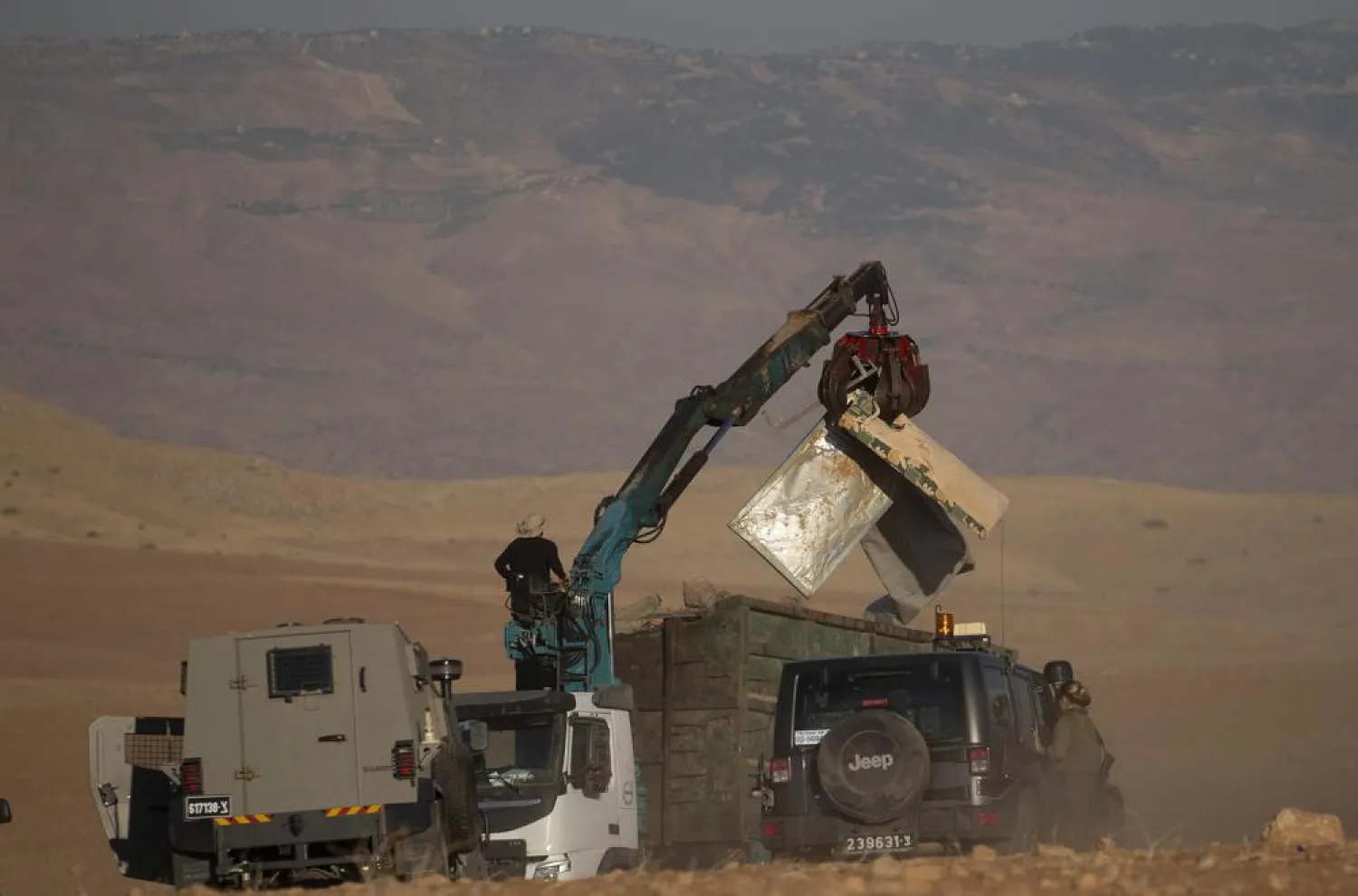
Israeli forces demolish tents and other structures belong to Bedouins at the Khirbet Humsu hamlet in Jordan Valley in the West Bank, Wednesday, July 7, 2021. (AP Photo/Majdi Mohammed)
TT

Israel Again Demolishes Palestinian Village in West Bank

Israeli forces demolish tents and other structures belong to Bedouins at the Khirbet Humsu hamlet in Jordan Valley in the West Bank, Wednesday, July 7, 2021. (AP Photo/Majdi Mohammed)

Israel on Wednesday demolished the Bedouin herding community of Khirbet Humsu in the occupied West Bank, the latest chapter in the military’s attempts to uproot the Palestinian village of makeshift homes.

At least 65 people, including 35 children, were displaced, said Christopher Holt of the West Bank Protection Consortium, a group of international aid agencies supported by the European Union that is assisting the residents.

The demolitions left the villagers, who earn their livelihood primarily by herding some 4,000 sheep, homeless for at least the fifth time in the past year, according to The Associated Press. The EU in the past has helped residents rebuild after previous demolitions.

Holt, who was in the area, said the army arrived without warning at 9 a.m., asked the residents to move, and when they refused, began flattening the makeshift homes. “It’s a very serious escalation,” he said.

At least 65 people, including 35 children, were displaced, said Christopher Holt of the West Bank Protection Consortium, a group of international aid agencies supported by the European Union that is assisting the residents.

The demolitions left the villagers, who earn their livelihood primarily by herding some 4,000 sheep, homeless for at least the fifth time in the past year. The EU in the past has helped residents rebuild after previous demolitions.

Holt, who was in the area, said the army arrived without warning at 9 a.m., asked the residents to move, and when they refused, began flattening the makeshift homes. “It’s a very serious escalation,” he said.

The Israeli government, now run by a coalition headed by Prime Minister Naftali Bennett, says the village was built illegally in the middle of a military firing range.

But Palestinians say it is nearly impossible to receive building permits in Israeli-controlled territory, and human rights groups accuse Israel of stifling Palestinian development to make way for Israeli needs. Just a few kilometers away on either side are two large Jewish farming settlements, with greenhouses, animal enclosures and irrigated fields.

An Israeli security official said the government has carried out months of discussions with residents and offered an alternative site nearby. The official, who was not authorized to speak publicly, said the offer for the new location stands.

Holt said the residents had no warning and say they have nowhere else to go in the sweltering heat. Minutes after the last demolition in February, residents got to work repairing their fences in hopes of gathering their sheep before dark.

Israel captured the West Bank in the 1967 Mideast war, and the Palestinians want it to form the main part of their future state.

Perched on the rolling highlands above the Jordan Valley, Khirbet Humsu is part of the 60% of the West Bank known as Area C, which is under full Israeli control as part of interim peace agreements from the 1990s.



Arab Parliament Affirms Support for Stability in Yemen, Unity Efforts in Sudan

Arab Parliament Affirms Support for Stability in Yemen, Unity Efforts in Sudan
TT

Arab Parliament Affirms Support for Stability in Yemen, Unity Efforts in Sudan

Arab Parliament Affirms Support for Stability in Yemen, Unity Efforts in Sudan

The Arab Parliament reiterated its strong and unwavering support for the security and stability of Yemen. It emphasized that prioritizing dialogue, understanding, and wisdom is essential to serve the best interests of the Yemeni people.

In a statement issued on Friday, the parliament highlighted the importance of making every effort to de-escalate the situation, address the crisis, and achieve a sustainable political solution that respects Yemen's sovereignty and the will of the Yemeni people, the Saudi Press Agency said.

The parliament expressed its full commitment to supporting all initiatives that enhance security, stability, and development in Yemen, as well as to fulfilling the legitimate aspirations of the Yemeni people for progress, stability, and prosperity.

The Arab Parliament also reiterated its strong and unwavering support for all initiatives aimed at resolving the Sudanese crisis and ensuring the security, stability, and unity of Sudan.

In a statement, the Arab Parliament congratulated the Sudanese people on the anniversary of Independence Day. It expressed hope that the next Independence Day will be celebrated with the crisis fully resolved, fulfilling the aspirations of the Sudanese people for security, stability and development.


Lebanon PM Pledges State Authority, Vows to End Israeli Attacks

An Israeli officer displays weapons seized by the army in Gaza, Lebanon and Syria during a media tour (AFP). 
TT

Lebanon PM Pledges State Authority, Vows to End Israeli Attacks

An Israeli officer displays weapons seized by the army in Gaza, Lebanon and Syria during a media tour (AFP). 

Lebanon’s Prime Minister Nawaf Salam has pledged to press ahead with reforms, extend the authority of the state, and work to end Israeli attacks and remove the occupation, even as Israel signals preparations for a “measured” military action against Hezbollah.

In a New Year message posted on X, Salam wished Lebanese a year marked by hope, continued state recovery, and restored public trust.

“We promise to continue together the path of reform and the extension of state authority,” he wrote. He added a renewed pledge “to keep working to end Israeli attacks, remove the occupation, and secure the return of our detainees,” saluting the Lebanese army and security forces deployed nationwide to safeguard public safety.

Lebanon has maintained diplomatic contacts with the sponsors of the ceasefire with Israel, which took effect in November 2024 and ended 66 days of fighting between Hezbollah and the Israeli army.

Beirut says diplomacy and steps by the Lebanese army have prevented a renewed war. Israel, however, still occupies five border points inside Lebanese territory, holds around 20 detainees, including civilians, and continues to violate the agreement through intermittent strikes and targeted killings inside Lebanon.

In parallel, Israeli media report heightened security readiness for possible action against Hezbollah, citing Israeli assessments that recent Lebanese measures fall short of ceasefire terms.

The daily Maariv said security chiefs are preparing to brief Prime Minister Benjamin Netanyahu on readiness levels, pointing to what Israel describes as Lebanon’s failure to dismantle Hezbollah’s military infrastructure south and north of the Litani River.

According to the report, Lebanon may soon declare the end of army operations to disarm Hezbollah south of the Litani without extending them northward, an outcome Israel deems a breach. Israeli assessments suggest this could prompt unilateral action if Lebanon is seen as unable or unwilling to comply.

Israel accuses Hezbollah of rebuilding capabilities, including precision missiles, and says recent airstrikes targeted training sites linked to the Radwan Forces. Israeli officials argue Hezbollah is currently in a weakened operational state, enabling “calibrated” options aimed at pressuring the group while preserving the ceasefire framework.


Türkiye Plans First Overseas Deepwater Drilling in Somalia Next Month

Türkiye Minister of Energy and Natural Resources Alparslan Bayraktar speaks during the conference 'Energy Security in the World and Türkiye: Risks and Solutions in Critical Minerals' at the Sabanci University Istanbul International Center for Energy and Climate (IICEC), in Istanbul, Türkiye, December 26, 2025. REUTERS/Umit Bektas
TT

Türkiye Plans First Overseas Deepwater Drilling in Somalia Next Month

Türkiye Minister of Energy and Natural Resources Alparslan Bayraktar speaks during the conference 'Energy Security in the World and Türkiye: Risks and Solutions in Critical Minerals' at the Sabanci University Istanbul International Center for Energy and Climate (IICEC), in Istanbul, Türkiye, December 26, 2025. REUTERS/Umit Bektas

Türkiye will send a drilling vessel to Somalia in February to carry out the country's first deepwater exploration project abroad, ‌Energy Minister ‌Alparslan Bayraktar ‌said.

He ‌said the operation with the Cagri Bey vessel will focus on offshore areas ⁠in Somali waters but did not ‍provide ‍details on targeted ‍reserves or investment size.

In 2024, Türkiye signed an energy exploration deal with Somalia. It has been ⁠seeking to diversify its energy sources and reduce reliance on imports, investing in exploration at home and overseas.