


Ten Reasons Behind Russia’s Breach of US 'Red Lines' in Syria

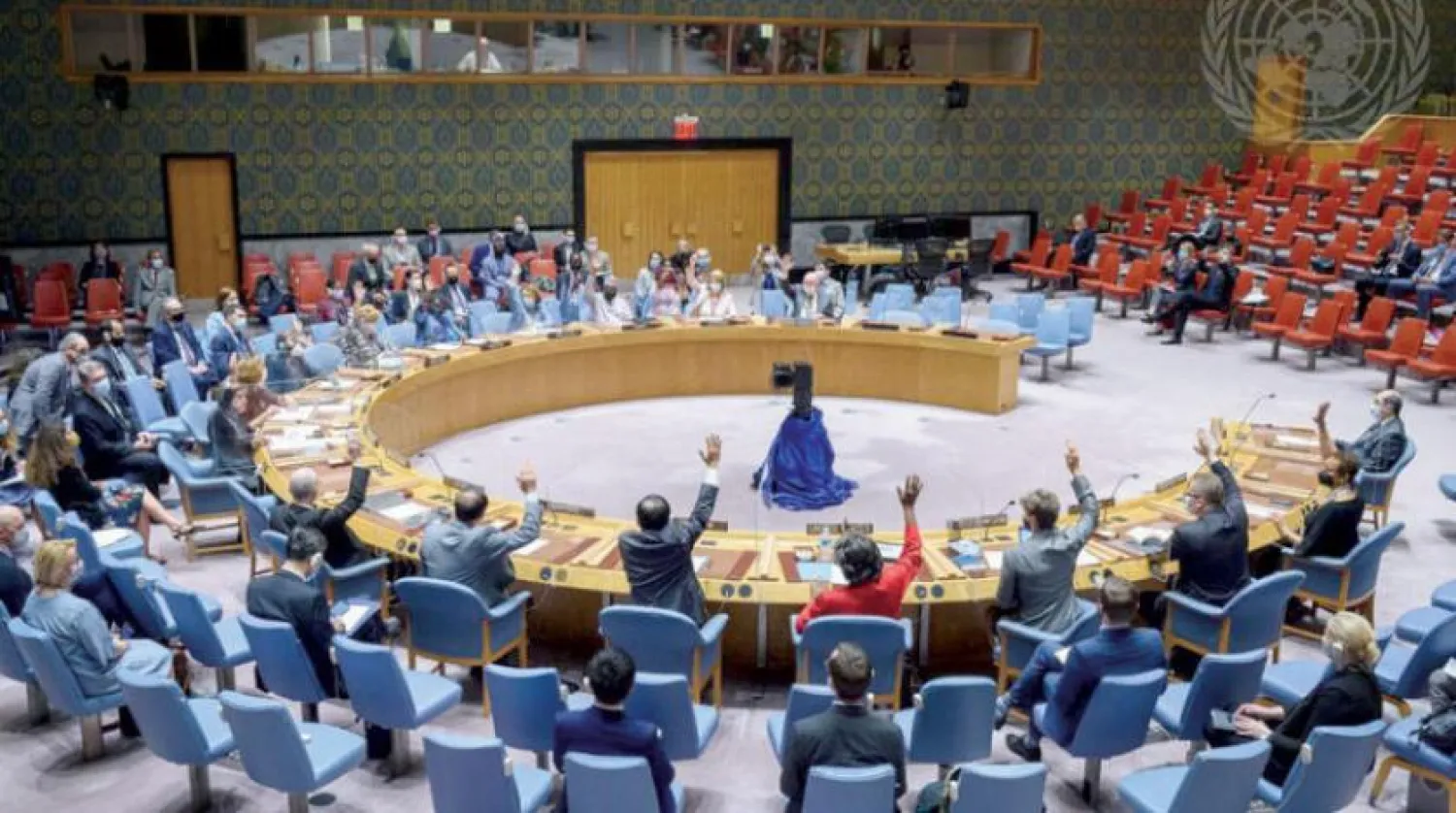
Representatives of the member states of the Security Council vote in favor of an international mechanism for the delivery of aid to Syria. (United Nations)
TT

Ten Reasons Behind Russia’s Breach of US 'Red Lines' in Syria

Representatives of the member states of the Security Council vote in favor of an international mechanism for the delivery of aid to Syria. (United Nations)

The international resolution, which was unanimously adopted by the Security Council to extend the mechanism for the cross-border delivery of humanitarian aid to Syria without the consent of Damascus, came after an American-Russian “deal” and secret negotiations that took place between the envoys of Presidents Joe Biden and Vladimir Putin after their summit in Geneva in mid-June.

However, despite American attempts to present the resolution as a “diplomatic victory”, the Russian president made fundamental breaches of the “red lines”, which have long been set by Washington and its allies. Here are ten notes on the new decision:

1- A “historic achievement”: The White House announced that Biden and Putin “praised” cooperation in issuing the resolution. A US official said that it was “better than we expected.” The US Ambassador to the United Nations, Linda Thomas-Greenfield, welcomed this rarely recorded cooperation with Russia. “It's important that the United States and Russia were able to come together on a humanitarian initiative that serves the interests of the Syrian people,” she said after the vote.

For his part, Russia’s UN Ambassador Vassily Nebenzia told reporters that the agreement was “historic.” He added: “We hope that this scenario will constitute a turning point from which not only Syria, but also the entire Middle East region and the entire world will benefit.”

2- “Political dialogue”: Washington and Moscow’s exaggeration in highlighting the decision, despite the great concessions made, reflects a desire to resume the political dialogue between them on Syria and other issues, and their willingness to accept the “Russian ceiling.”

If the US-Russian dialogue achieves some breakthroughs, it may revive the initiative of UN envoy Geir Pedersen for a “step for step” approach, which includes trade-offs between sanctions and aid, cease-fire, terrorism, and detainees.

3- “American concessions”: Since the Biden administration assumed office, senior US officials, including Secretary of State Antony Blinken, have announced that they wanted to extend the mechanism that began with Resolution 2165 seven years ago, through the delivery of aid through three crossings, two of which are with Turkey, and a third with Iraq. But Washington cut down its demands to a single crossing with Turkey, which is Bab al-Hawa, provided that the text of the same resolution, which was drafted in 2014, continues to apply.

4- “The Battle of Interpretation”: Washington agreed to extend the work of the Bab al-Hawa crossing for one year, but Moscow insisted on only six months. The final wording of the resolution contained “constructive ambiguity.” It provided for the extension of the Security Council resolution on the Bab al-Hawa border crossing for six months, till Jan. 10, 2022, with an extension of an additional six months, till July 10, 2022, subject to the issuance of the UN secretary-general’s substantive report, with particular focus on transparency in operations, and progress on cross-line access in meeting humanitarian needs.

US officials argue that the legal interpretation means that the extension is automatic, while the Russians say that it is subject to the Secretary-General’s report. Oxfam expressed the fear of an “ambiguous future” with an extension of only six months.

5- “Revising the decision”: The first decision was issued in 2014, that is, before the direct Russian military intervention at the end of 2015, and before the US intervention under the cover of the international coalition to fight ISIS in northeastern Syria, in the fall of 2014. However, the US negotiators agreed to review text of the resolution, deleting all the paragraphs that criticized the “Syrian authorities,” and accepting a new language that reflects the facts over the past seven years, although Damascus still considers the resolution a “violation of sovereignty.”

6- “Early recovery”: Washington accepted Moscow’s demands to introduce a new language in the resolution. Thus, the expression, “early recovery” was mentioned three times. Diplomats say that this is “a circumvention” of the conditions set by Western countries on refusing to contribute to the reconstruction of Syria “before tangible progress in the political process and the implementation of Resolution 2254,” according to the statement of the European Union Council.

7- “Conditions for Reconstruction”: In parallel with the secret dialogue with Russia in Geneva, Blinken’s team insisted on deleting two paragraphs from the final statement of the ministerial conference on Syria in Rome on June 28. Those pertaining to the rejection of “normalization” with Damascus and setting conditions for the contribution to reconstruction.

European countries had proposed a paragraph stating: “Only when progress occurs on the political track, will we consider providing assistance in the process of rebuilding Syria.” But the statement was issued without this condition.

On the other hand, the Russian-US deal “legitimized” the financing of the “recovery”, the humanitarian infrastructure and the activities of the International Committee of the Red Cross and other organizations, calling on “international humanitarian agencies and concerned parties to support them,” including organizations in Damascus.

8- “Governmental support”: The resolution expressed concern about the COVID-19 pandemic, which “represents a major challenge to the health system and the humanitarian situation in Syria.” It stressed the need for full and safe humanitarian access, without obstruction or delay, including to humanitarian workers, medical personnel, their equipment, transportation, and supplies, in order to facilitate the provision of humanitarian aid and vaccines against the COVID-19 to all parts of Syria without discrimination.

This text opens the door to expanding the aid, by an international decision, to the Syrian government, bearing in mind that the Biden administration had provided exceptions to the sanctions for medical, pharmaceutical, humanitarian reasons, and other matters related to confronting the epidemic.

9- “United Nations Principles”: The international resolution stipulated the need for all concerned parties to respect the relevant provisions of international humanitarian law and the United Nations core principles for humanitarian aid. This means bypassing a document prepared by the United Nations two years ago, the text of which was obtained by Asharq Al-Awsat, which stressed that UN workers must commit to “accountability” and refrain from cooperating with “those involved in war crimes” in Syria.

The two-page document was prepared by the United Nations in New York and set strict standards for the work of UN institutions, including a text that stated: “Only when a comprehensive, serious and negotiated political transition occurs (between representatives of the government and the opposition), will the United Nations be ready to facilitate reconstruction.”

10- “Across the Lines”: Moscow wanted to pressure Western countries to work with the Syrian government to end “isolation” and encourage “normalization” regardless of the progress in implementing Resolution 2254. Thus, it stipulated the expansion of aid “across the lines” inside Syria.

Gaza Tailor Turns Waste Fabrics Into Dresses for Girls

Palestinian dressmakers add skirt hoops to a child's gown, at a workshop where dresses are created including evening and wedding gowns despite limited resources and old dresses are recycled, in the city of Khan Yunis in the southern Gaza Strip on June 13, 2026. (Photo by BASHAR TALEB / AFP) /
TT

Gaza Tailor Turns Waste Fabrics Into Dresses for Girls

Palestinian dressmakers add skirt hoops to a child's gown, at a workshop where dresses are created including evening and wedding gowns despite limited resources and old dresses are recycled, in the city of Khan Yunis in the southern Gaza Strip on June 13, 2026. (Photo by BASHAR TALEB / AFP) /

A young Gazan girl twirls across the floor of a dressmaker's shop, her white dress billowing around her as a shy smile spreads across her face.

Trimmed with delicate tulle and topped with a soft veil, the dress looks fit for a celebration.

Few would guess that parts of it are from discarded fabric or an old gown salvaged from the ruins of the Israel-Hamas war in Gaza.

The dress is the work of 24-year-old tailor Amir al-Rantisi, who has made it his mission to provide elegant dresses for special occasions for young girls and women in southern Gaza's Khan Yunis area.

He does this by recycling used fabrics and old dresses.

"When I go to Gaza (City) to get the fabric, I take it from a place that's been destroyed, from old fabric that's available, which was probably damaged by shrapnel or burnt," Amir told AFP.

"I select pieces from it, and I make dresses from those pieces. I also take old dresses and recycle them."

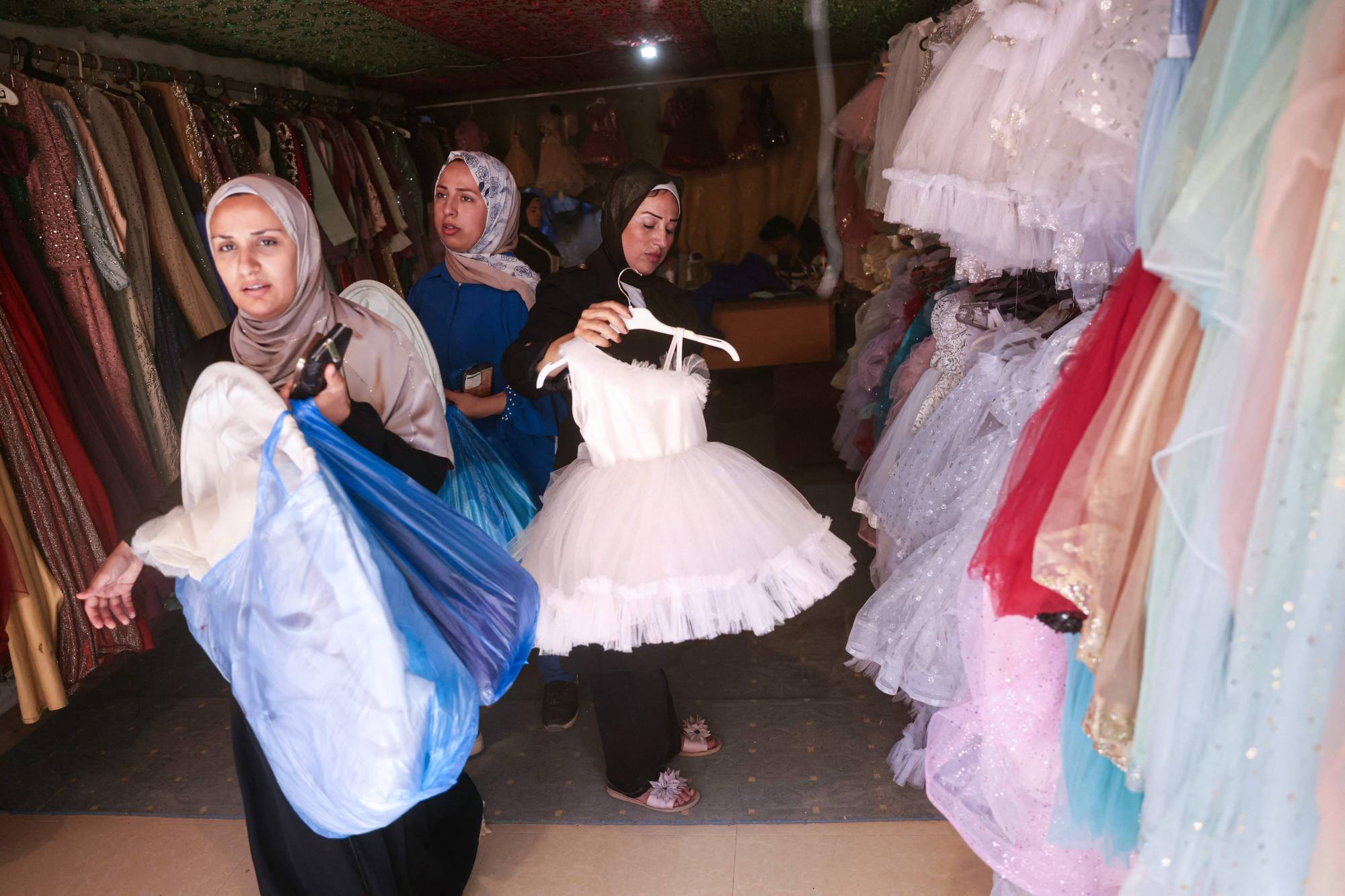
Palestinian women shop for dresses in the city of Khan Yunis in the southern Gaza Strip on June 13, 2026. (Photo by BASHAR TALEB / AFP)

Outside the shop, his colorful creations in satin, organza and tulle hang from makeshift mannequins fashioned from iron poles -- vivid splashes of color against a backdrop of grey concrete and blackened buildings.

Several elegant long gowns are displayed on cement mannequins outside the shop, while colorful frocks sway gently from a clothesline stretched across the storefront, allowing customers to inspect the garments with ease.

Inside the workshop, neat rows of ready-to-wear dresses line the walls. Nearby, a customer dressed in a black abaya carefully examines a small dress, considering its intricate details.

The workshop itself hums with activity. On a table beside a collapsed wall, piles of old dresses sit waiting to be given new life as festive creations.

His mother, Nisreen al-Rantisi, works alongside him in the workshop, while another assistant tailor attentively takes the measurements of a young girl.

As Nisreen sorts through the colorful fabrics, selecting the perfect materials for the next creation, the assistant tailor deftly guides his scissors through a length of cloth, skillfully shaping it into what will soon become a beautifully crafted dress.

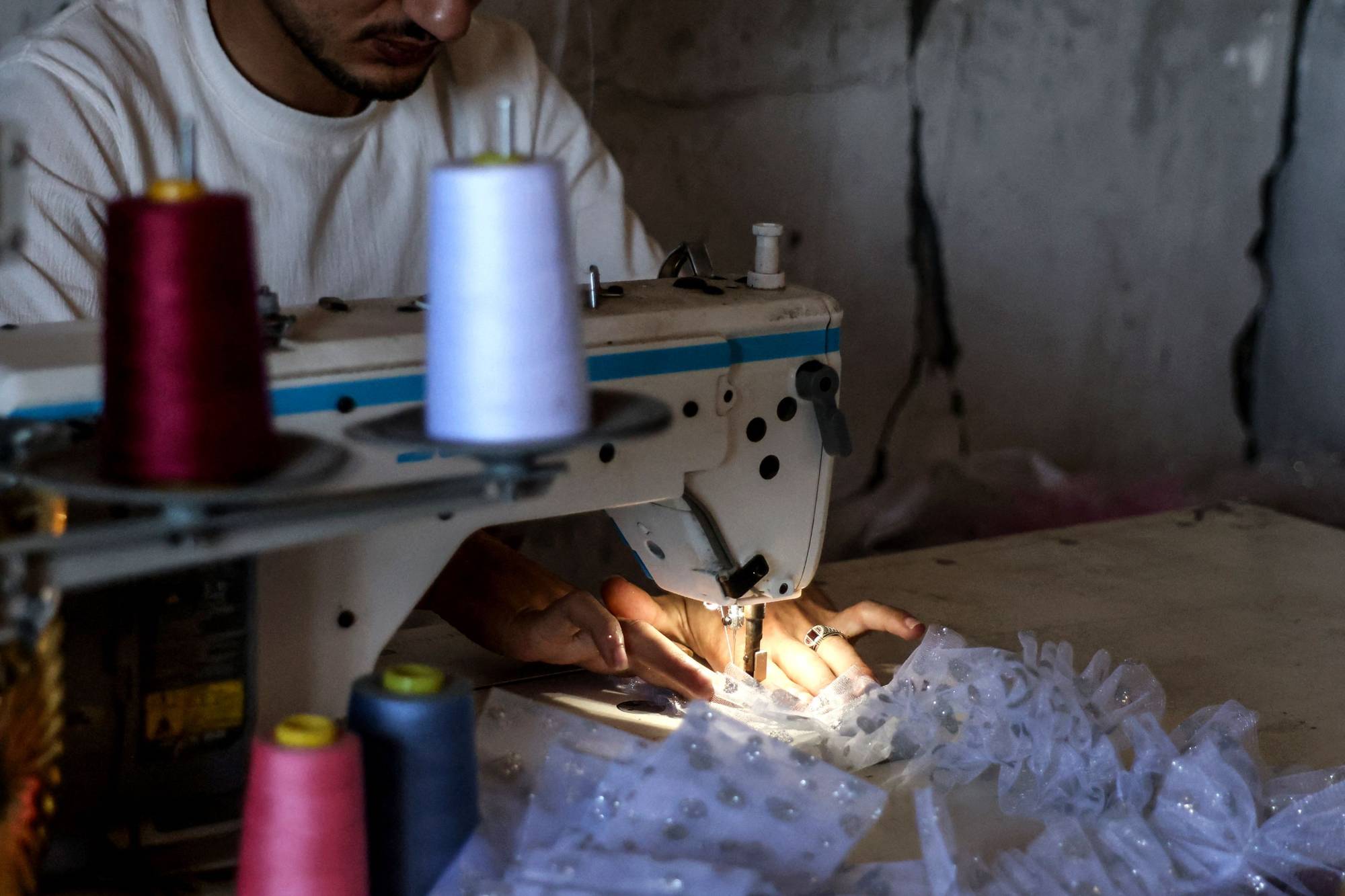
A Palestinian dressmaker sits at a sewing machine as he assembles a gown in the city of Khan Yunis in the southern Gaza Strip on June 13, 2026. (Photo by BASHAR TALEB / AFP)

Keeping the business running, however, requires constant improvisation.

"We suffer greatly from power outages," said mother Nisreen al-Rantisi.

"Sometimes, we have orders or work that we can't complete."

Amir has found a way to tackle that too.

He has rigged an old bicycle pedal to his sewing machine, a makeshift solution to keep working through the frequent power cuts that plague the devastated Gaza Strip.

But it is difficult and inconvenient, said his mother.

"Sewing is done manually; one person has to sew while the other has to do the rest," she said.

Meanwhile, the cost of supplies has soared.

With imports into Gaza severely restricted and shortages widespread, even basic materials have become difficult to obtain.

"This spool of black thread is no longer available, and even if it's available, it used to cost seven shekels ($2.40), but now it's 50," said Amir.

Israel controls all entry points into the territory, and the number of trucks carrying foreign aid and private sector goods remains far too low to ease war-inflated prices or shortages, according to NGOs on the ground.

Yet, as the little girl spins once more in her white dress, her eyes wide with joy, Amir's work offers a rare reminder of how residents of Gaza are finding ways to create and celebrate despite the hardships of war.


Netanyahu and Trump on Collision Course as US, Iran Agree to Halt War

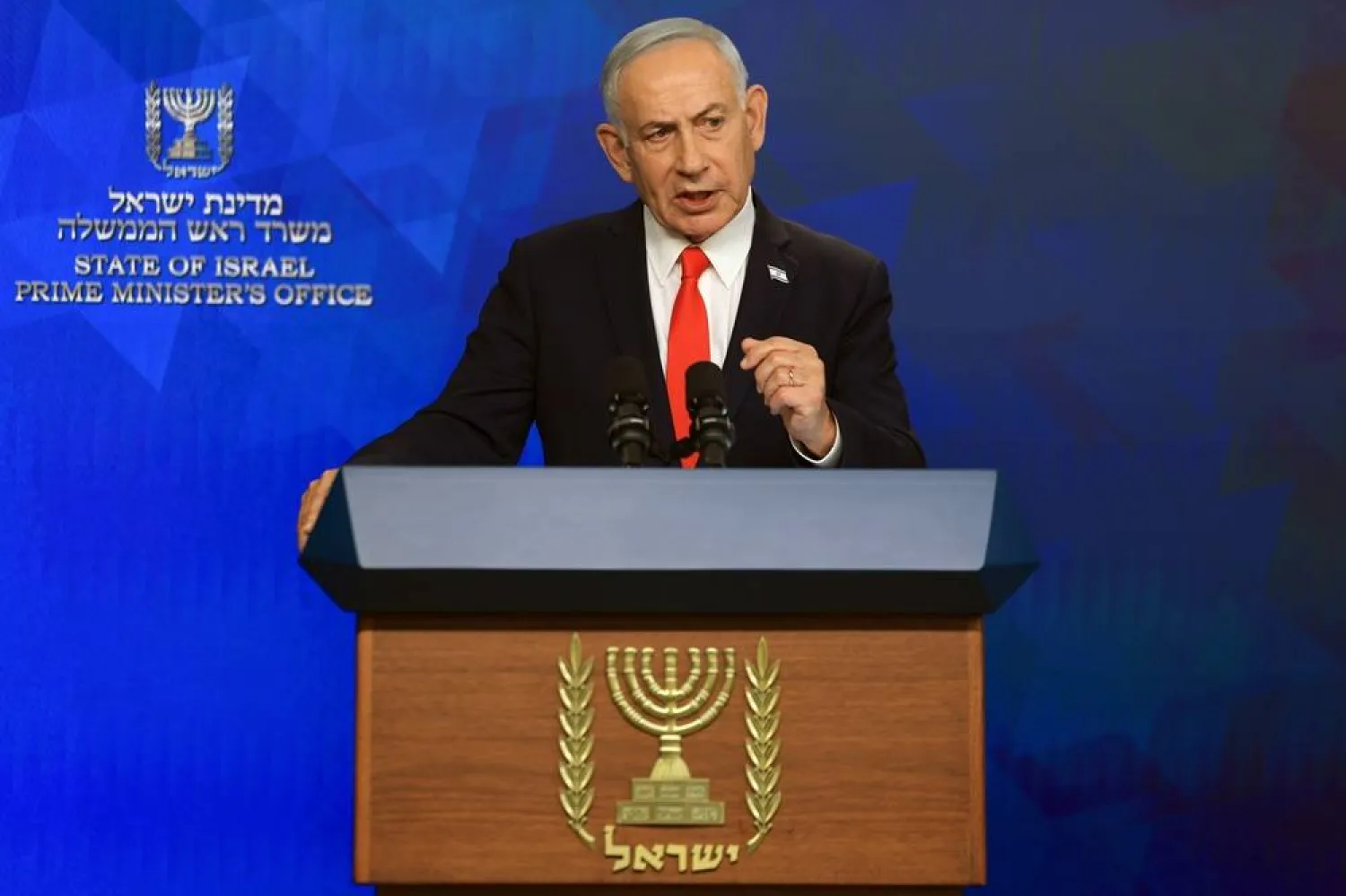
Israeli Prime Minister Benjamin Netanyahu holds a news conference in Jerusalem, 15 June 2026, following the announcement of a US-Iran mediated preliminary framework to end regional military hostilities. (EPA)
TT

Netanyahu and Trump on Collision Course as US, Iran Agree to Halt War

Israeli Prime Minister Benjamin Netanyahu holds a news conference in Jerusalem, 15 June 2026, following the announcement of a US-Iran mediated preliminary framework to end regional military hostilities. (EPA)

Benjamin Netanyahu bet that his joint war alongside Donald Trump would topple Iran's clerical rulers and bolster himself ahead of elections at home, as the architect of a US-Israeli alliance that would reshape the Middle East.

Instead, Israel's longest-serving prime minister is on a collision course with Trump as the US president seeks to extricate himself from the war, with both men's goals unmet and Israeli military operations tied down in Lebanon.

For now, Israeli officials have been cautious in public for fear of angering their most important ally, known for being prickly towards critics.

But in private conversations, the frustration is clear. The preliminary agreement is "terrible for Israel," said one senior Israeli official, giving a frank assessment on condition of anonymity. "And there is no one in the Israeli leadership who views it otherwise, from the prime minister to the chief of staff."

Washington says that over the next 60 days, when a ceasefire is in place, it will negotiate full terms that will address US and Israeli concerns, especially over Iran's nuclear program.

But Israeli officials told Reuters they thought the negotiating period under the deal was likely to be extended, tying Israel's hands from taking military action, while its concerns remain unresolved.

Netanyahu and Trump have repeatedly clashed over Israel's refusal to constrain its pursuit of Iran-backed Hezbollah in Lebanon, where a cessation of hostilities is a key Iranian demand.

At the start of the month, Trump described ‌Netanyahu as "[expletive] crazy" in ‌an angry phone call, ordering him not to strike Beirut while the US was seeking a deal with Iran.

Netanyahu called ‌off attacks ⁠that day, but ⁠struck Beirut's southern suburbs a week later, provoking Iranian missile strikes on Israel and a public rebuke of both sides from Trump.

Hours before the US and Iran announced their interim deal, Israel hit the Lebanese capital again on Sunday, after rockets were launched at Israel from Lebanon, fire Trump described as "small and meaningless".

Netanyahu said that Israel has emerged "strong and steady," with a leadership that stands firm and wise. At a press conference in Jerusalem late on Monday, he acknowledged that he and Trump have sometimes had their differences.

"He is the president of the United States, I am the prime minister of Israel. We many times see eye-to-eye and there are times when we see eye-to-eye less so. I am in charge of Israel's security interests," Netanyahu said.

Netanyahu, facing autumn elections he is projected to lose, may be more willing to defy Trump as he contends with an Israeli public that opinion polls show has grown skeptical of the US president's commitment to Israel's security.

"This is ⁠a pretty stark moment of divergence of interests," said Dan Shapiro, a former US ambassador to Israel under the Obama administration, now ‌with the Atlantic Council think tank.

"He will try to not openly oppose (the deal), so as not to get into ‌a brawl with Trump," said Shapiro. "But he will indicate Israel is not bound by it, and Israel reserves its rights."

ISRAEL SAYS IT'S NOT BOUND BY US-IRAN PACT

The memorandum of understanding between the US ‌and Iran is expected to be signed on Friday in Switzerland. While precise terms were not immediately known, mediator Pakistan said the pact called for a permanent halt to military ‌operations on all fronts, including in Lebanon.

Netanyahu said that Israel would keep its forces in southern Lebanon and maintain “freedom of action” against Hezbollah attacks.

"Iran wanted us to withdraw from it but I stood firm," he told reporters.

"We are keeping our freedom of action and we are keeping the security zone to protect (Israel's) northern citizens," he said.

The interim deal would reopen the Strait of Hormuz oil chokepoint while leaving the fate of Tehran's nuclear program to be resolved during a 60-day negotiation period towards a final deal.

Two other issues that Netanyahu and Trump had both declared as justifications for the war at its outset - curbing Iran's missile ‌program and ending its support for regional armed groups - are not thought to be on the agenda during those talks.

Three Israeli officials said Israel sees it as very likely the 60-day pact will be extended to 90 days, with the US maintaining ⁠its deployment of military assets in the region ⁠as it negotiates a broader deal.

Two other Israeli officials said that Israel was caught by surprise last week when Trump first said that a deal with Iran was close. They acknowledged that Israel has had little success in influencing the talks.

All of the officials spoke on condition of anonymity because they weren't authorized to speak publicly.

NETANYAHU UNABLE TO SELL THIS AGREEMENT TO ISRAELI PUBLIC, ANALYST SAYS

Netanyahu, who often clashed with Washington under the administrations of Democrats Barack Obama and Joe Biden, has long portrayed himself to the Israeli public as being uniquely adept in dealing with the Republican Trump.

During Trump's first term, Israel secured major policy changes from Washington, which moved its embassy to Jerusalem and backed the Abraham Accords that brought Israel formal diplomatic ties with the UAE and Bahrain.

On Iran, Trump ditched a nuclear agreement negotiated under Obama that Israel had long complained was too soft.

During elections in 2019, Netanyahu displayed massive campaign billboards in Tel Aviv and Jerusalem showing him and Trump smiling and shaking hands.

But now, the US-Iran pact undermines Netanyahu's case that a close relationship with Trump sets him apart from other candidates for prime minister, said Jonathan Rynhold, a political scientist at Bar-Ilan University, near Tel Aviv.

"(Netanyahu) will be unable to sell this agreement to the Israeli public," Rynhold said. "The best that he can hope for is that they fail to reach an agreement and the war restarts to Israel's advantage in 60 days."

According to a poll released on Friday by the Israel Democracy Institute, just 41% of Jewish Israelis think their security is a central consideration for Trump, down from 64% in March.

Eli Cohen, Netanyahu's energy minister, said that Israel would be prepared to act alone if Iran rebuilds its nuclear and missile capabilities, though he said the chances of Tehran taking that step during Trump's tenure were low.

"If Iran tries to renew its nuclear and ballistic missile programs - we will be there and act," Cohen told Israel's public broadcaster Kan.


US-Iran Deal Leaves Major Lebanon Questions Unresolved

Displaced families drive past a man holding the Hezbollah party flag as they drive along the highway through the area of Jiyyeh as they return to their home villages in southern Lebanon on June 15, 2026. (AFP)
TT

US-Iran Deal Leaves Major Lebanon Questions Unresolved

Displaced families drive past a man holding the Hezbollah party flag as they drive along the highway through the area of Jiyyeh as they return to their home villages in southern Lebanon on June 15, 2026. (AFP)

A deal between Washington and Tehran that ends the Israel-Hezbollah war leaves many issues in Lebanon unresolved, failing to mention Israel withdrawing from the country or an end to Tehran's support for the armed group.

Under US pressure, Lebanese officials have been holding direct talks with Israel aimed at reaching a separate agreement on ending the hostilities, but Beirut appeared to have been sidelined with the overnight announcement on the regional conflict.

AFP looks at the deal and the questions it raises in Lebanon.

- What does the deal involve? -

Details of the agreement to end the Middle East war on all fronts have not been made public, but Iran and mediator Pakistan have both said it includes Lebanon.

Hezbollah drew the country into the Middle East war on March 2 with rocket fire at Israel to avenge the killing of Iran's supreme leader in US-Israeli strikes.

Israel responded with airstrikes and a ground invasion that Lebanon says have killed more than 3,700 people and displaced more than one million others.

An official source told AFP that "Lebanon was not informed of the terms of the agreement or the time of the ceasefire".

Influential Lebanese parliament Speaker Nabih Berri, a Hezbollah ally and intermediary for the group, thanked Washington and Tehran for their "insistence on including... an essential and binding clause on halting the Israeli aggression on all of Lebanon".

Hezbollah on Monday had so far not claimed any fresh attacks on Israeli targets.

- Israeli withdrawal? -

Information circulating about the deal does not mention any Israeli withdrawal from south Lebanon, and Israeli Defense Minister Israel Katz on Monday said forces would remain in the country indefinitely.

Karim Bitar, a lecturer in Middle East Studies at the Sciences Po University in Paris, said that "the deal does not seem to involve Israel, which immediately meant that it wasn't a party to it... So it's very unlikely that there will be an Israeli withdrawal from south Lebanon."

Israeli forces control a strip of Lebanese territory running along the entire border.

A Western military source told AFP that Israeli forces had crossed the Litani River at several points, referring to the waterway running about 30 kilometers (20 miles) from the frontier but closer in some areas.

"Tens of thousands of Israeli soldiers" are in south Lebanon where they hold some established positions, the source said, adding that Hezbollah still had a presence there.

"It's the biggest invasion since their withdrawal in 2000," the source said, referring to Israel's previous pullout after some two decades of occupation.

Hezbollah says it sent reinforcements south of the Litani after the latest war erupted.

Under a 2024 ceasefire that followed a previous round of hostilities, Hezbollah fighters were supposed to withdraw from the area.

- What future for Hezbollah? -

Washington has pressured Lebanese authorities to disarm Hezbollah for months, but the accord makes no mention of the group.

"Iran doesn't seem to have committed to ending its support and financing for Hezbollah," Bitar said.

Military expert Riad Kahwaji said that "Hezbollah will not agree to give up arms... and this crisis will be protracted."

He said this could lead to political instability and even unrest, "especially now Hezbollah believes that through Iran it has emerged victorious from this agreement, and therefore is going to try and dictate its terms on who rules."

- Lebanon-Israel negotiations? -

Lebanon and Israel have been holding direct talks in Washington since April, seeking to end the hostilities and to separate Lebanon from the regional war.

A new round is scheduled for later this month.

Lebanese Prime Minister Nawaf Salam said Monday that "we will redouble our efforts" through the Washington negotiations "to secure a full Israeli withdrawal."

But after the Iran-US announcement, some cast doubt on the effectiveness of the bilateral negotiations.

Bitar said that "Lebanon could find itself once again as a scapegoat that pays the price both of American amateurism, Iranian cynicism, Israeli hubris and... the lack of a clear strategy from its own political class."
