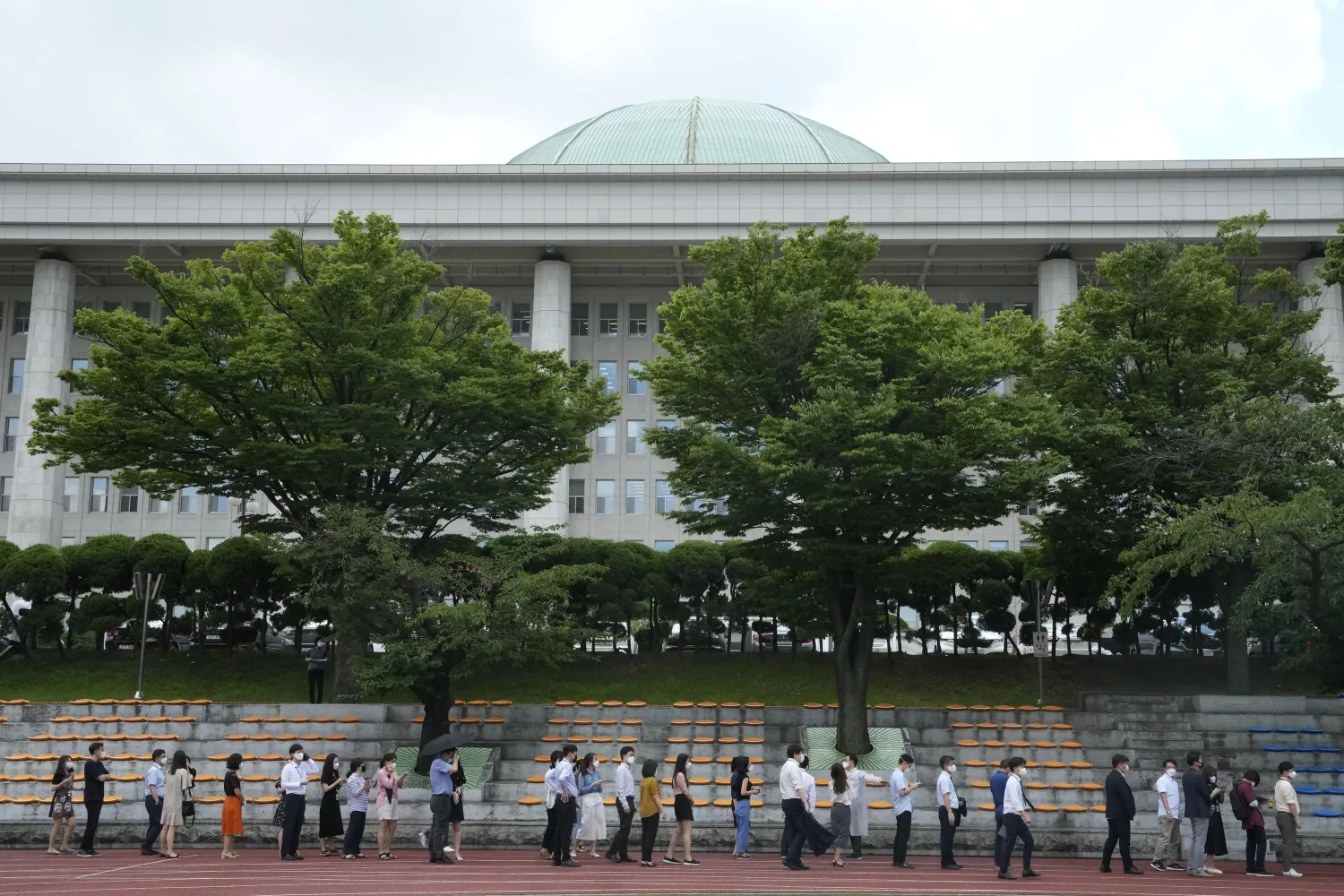
Virus Spreads in S. Korean Regions with Lighter Restrictions

People queue in line to wait for the coronavirus testing at a makeshift testing site at the National Assembly in Seoul, South Korea, Thursday, July 15, 2021. (AP Photo/Ahn Young-joon)
TT

Virus Spreads in S. Korean Regions with Lighter Restrictions

People queue in line to wait for the coronavirus testing at a makeshift testing site at the National Assembly in Seoul, South Korea, Thursday, July 15, 2021. (AP Photo/Ahn Young-joon)

South Korea reported a near-high in coronavirus infections Thursday as a weekslong surge extends beyond the capital region and the country's toughest pandemic restrictions.

The surge, increasingly fueled by the more contagious delta variant, is a worrisome development in a country where 70% of the population is waiting for their first vaccine dose. It further erases what had been a success story in the pandemic and underscores the challenges policymakers face in balancing measures to control virus outbreaks without further damaging their economy.

“Over the past week, there has been a clear increase in the speed of transmissions not only in the (Seoul) metropolitan area but also in non-metropolitan areas,” said Bae Kyung-taek, a senior Korea Disease Control and Prevention Agency official, during a briefing. “We ask our people to cancel unnecessary meetings and refrain from going out as much as possible.”

Thursday's 1,600 new cases nearly matched South Korea's high from a day earlier and was the ninth straight day exceeding 1,000. The country’s caseload is now 173,511, including 2,050 deaths.
Most were in Seoul and nearby Gyeonggi province and Incheon, part of the densely populated capital region that’s home to half of South Korea’s more than 51 million people.

Officials here have raised social distancing restrictions to the highest “Level 4,” closing nightclubs and churches, banning visitors at hospitals and nursing homes and clamping down on private social gatherings of three or more people after 6 p.m.

But rising infections outside the capital area are prompting calls for virus restrictions to be elevated nationwide. The 494 cases outside the capital region were the highest since February 2020, when the country dealt with its first major outbreak, which was mostly limited to the southern city of Daegu and nearby areas.

The virus is once again circulating quickly in southern regions, with Daegu, Busan and South Gyeongsang province reporting more than 200 cases combined. Health workers here are scrambling to trace infections linked to various places, including hostess bars, restaurants, schools and offices.

More than 110 cases were reported in the central city of Daejeon and nearby South Chungcheong Province, where hundreds of hostess bars in Cheonan are participating in voluntary closures at least until Sunday over virus concerns.

The regions outside the greater capital area are currently maintaining Level 1-2 restrictions, which allow for social bubbles of up to eight people and for restaurants, bars and nightclubs to receive customers until midnight.

Busan, South Korea’s second largest city, has added extra precautions to its Level 2 rules since last Friday, forcing entertainment venues to close after 10 p.m. and prohibiting social gatherings of five or more people after 6 p.m.

Some experts have urged the government to elevate distancing measures simultaneously across the country to prevent a “ballooning effect” where the squeeze in the capital area spikes transmissions elsewhere. But KDCA officials during the briefing said such action isn’t currently being discussed.

South Korea was praised for its initial response to the pandemic that included aggressive testing and contact-tracing, but the early success was followed by months of complacency before the country was hit by a devastating winter surge.

Critics say the country has slipped into another huge wave of the virus in a similar way it sleepwalked into the crisis in December and January, with officials sending the wrong message to the public by pushing for a premature easing of social distancing.

Anticipating the COVID-19 caseload to slow during the summer, officials announced plans in May and June to ease mask requirements and allow larger gatherings and longer indoor dining hours at restaurants starting in July.

The changes were put on hold in the capital area as infections spiked. Before the implementation of the Level 4 measures, the packed restaurants and bars and huge beer-drinking crowds at Seoul’s Han River displayed how the country had let its guard down despite a slow vaccine rollout.

As of Thursday, only 30.8% of the population have been administered their first dose of vaccines and only 12% have received their second shot. But compared to the winter surge, deaths and hospitalizations have slowed after the country concentrated its early supplies to high-risk groups, including elders in their 60s or older and people in long-term care settings.

Health officials expect vaccinations to pick up later this month when it starts inoculating people in their 50s. Bae said around 35 million doses of shots produced by AstraZeneca, Pfizer, Moderna and Johnson & Johnson will arrive in the country through late August.


Russia Says French Troops in Ukraine a ‘Direct Participation’ in War

Russian Foreign Minister Sergei Lavrov attends a joint press conference with the Secretary General of the Collective Security Treaty Organization (CSTO) Taalatbek Masadykov following the Joint Meeting of the CSTO Council of Foreign Ministers, Council of Ministers of Defense and Committee of Secretaries of Security Councils during the International Collective Security Forum in Moscow, Russia 10 November 2026. (EPA)
TT

Russia Says French Troops in Ukraine a ‘Direct Participation’ in War

Russian Foreign Minister Sergei Lavrov attends a joint press conference with the Secretary General of the Collective Security Treaty Organization (CSTO) Taalatbek Masadykov following the Joint Meeting of the CSTO Council of Foreign Ministers, Council of Ministers of Defense and Committee of Secretaries of Security Councils during the International Collective Security Forum in Moscow, Russia 10 November 2026. (EPA)

Russia said Tuesday it was aware of French troops having been sent to Ukraine, calling it "direct participation" in the war and saying a message had been issued to Paris.

"Not only French ones, we know this. We have conveyed our concern... this is no longer support for Ukraine, but direct participation in the war," Foreign Minister Sergei Lavrov told reporters.

His remarks come a day after a source told AFP and other media that French soldiers had been operating in Ukraine for several months to train Ukrainian personnel and help maintain equipment.

France on Tuesday rejected Lavrov's claim that the deployment amounted to "direct participation" in the Ukraine war as "absurd".

There is a "very limited" deployment of French troops in Ukraine for training and equipment maintenance, deputy defense minister Alice Rufo told parliament.

"There is the absence of any intention to fight, contrary to what the Russian foreign minister said this morning, which is absurd."

A source told AFP earlier the mission of a small contingent of French troops excludes any combat role.

They spoke on condition of anonymity after Radio France Internationale (RFI) first revealed the presence of French troops in the war-torn country earlier Monday.

"The rotation of French trainers supporting Ukraine in France, Poland, or occasionally in Ukraine is a reality," the source told AFP.

"But this is not a military operation. There is absolutely no intention of engaging in coercive actions."


US Attacks Iran’s Qeshm Island in Strait of Hormuz

An aerial view of the Iranian shores and the island of Qeshm in the Strait of Hormuz, December 10, 2023. (Reuters)
TT

US Attacks Iran’s Qeshm Island in Strait of Hormuz

An aerial view of the Iranian shores and the island of Qeshm in the Strait of Hormuz, December 10, 2023. (Reuters)

The United States on Tuesday carried out several attacks on Iran's southern Island of Qeshm, located in the Strait of Hormuz, a local Iranian official said.

"The American attack on locations on Qeshm island caused no damage to residential, commercial, or infrastructural areas," said Ahmad Nafisi, deputy provincial governor of the southern province of Hormozgan, quoted by the official IRNA news agency.

"The situation on Qeshm island is under control, and all relief, service, and executive agencies are on full alert," he added.

"The sounds of five to six explosions were heard on Qeshm on Tuesday evening," IRNA said.

Earlier in the day Iran's Revolutionary Guards said they had launched a drone attack targeting a radar system in Bahrain operated by the United States.

Since the outbreak of the Middle East war in late February, Tehran has attempted to restrict traffic through the strategic waterway, insisting vessels use only routes authorized by the country.

It has regularly targeted ships that transit without its authorization.

The United States has in response imposed a naval blockade on Iranian ports and helped tankers travel the strait, which normally carries about one-fifth of global oil supplies.

In recent weeks, Tehran has made multiple announcements saying ships have caught fire in the strait, often claiming they struck mines.

On Tuesday, the Iranian armed forces said three oil tankers struck naval mines while attempting to transit Hormuz.

The US military recently said it had cleared all mines from the main routes through the waterway.

US Central Command, which oversees US military operations in the region, said last month that it had helped Gulf countries export 1.5 billion barrels of oil via Hormuz since the summer.


4 Detained in North Macedonia for Alleged Iran-Backed Assassination Plot in Greece

Domestic security agency director Bojan Hristovski speaks to media after announcing the detention of four people implicated in an alleged Iran-backed assassination plot in neighboring Greece, in Skopje, North Macedonia, Tuesday, Nov. 17, 2026. (AP)
TT

4 Detained in North Macedonia for Alleged Iran-Backed Assassination Plot in Greece

Domestic security agency director Bojan Hristovski speaks to media after announcing the detention of four people implicated in an alleged Iran-backed assassination plot in neighboring Greece, in Skopje, North Macedonia, Tuesday, Nov. 17, 2026. (AP)

Authorities in North Macedonia have detained four people for questioning over an alleged Iran-linked assassination plot in neighboring Greece, officials said Tuesday.

Bojan Hristovski, director of North Macedonia's domestic security agency, said Tuesday that the suspects are all Macedonian citizens, adding that a fifth person had also been questioned and a sixth remained wanted by the authorities.

Hristovski named one of the Iranian recruiters as Naji Sharifi Zindashti, who is wanted in the United States for allegedly operating a criminal network that targets Iranian dissidents and activists abroad.

He did not give details of the alleged target in Greece, and Greek authorities did not immediately comment on the announcement.

“This concerns the dismantling of an Iranian proxy network involved in planning a terrorist attack,” Hristovski said.

“The network operating in Macedonia consisted of individuals embedded in criminal organizations within the country,” he said. “Acting on direct instructions from an Iranian national, they undertook preparatory and logistical activities for a terrorist act — an assassination targeting a previously identified individual located in Greece.”

Iran's mission to the United Nations did not immediately respond to a request for comment.