


Jeff Bezos Blasts into Space on Own Rocket: 'Best Day Ever!'

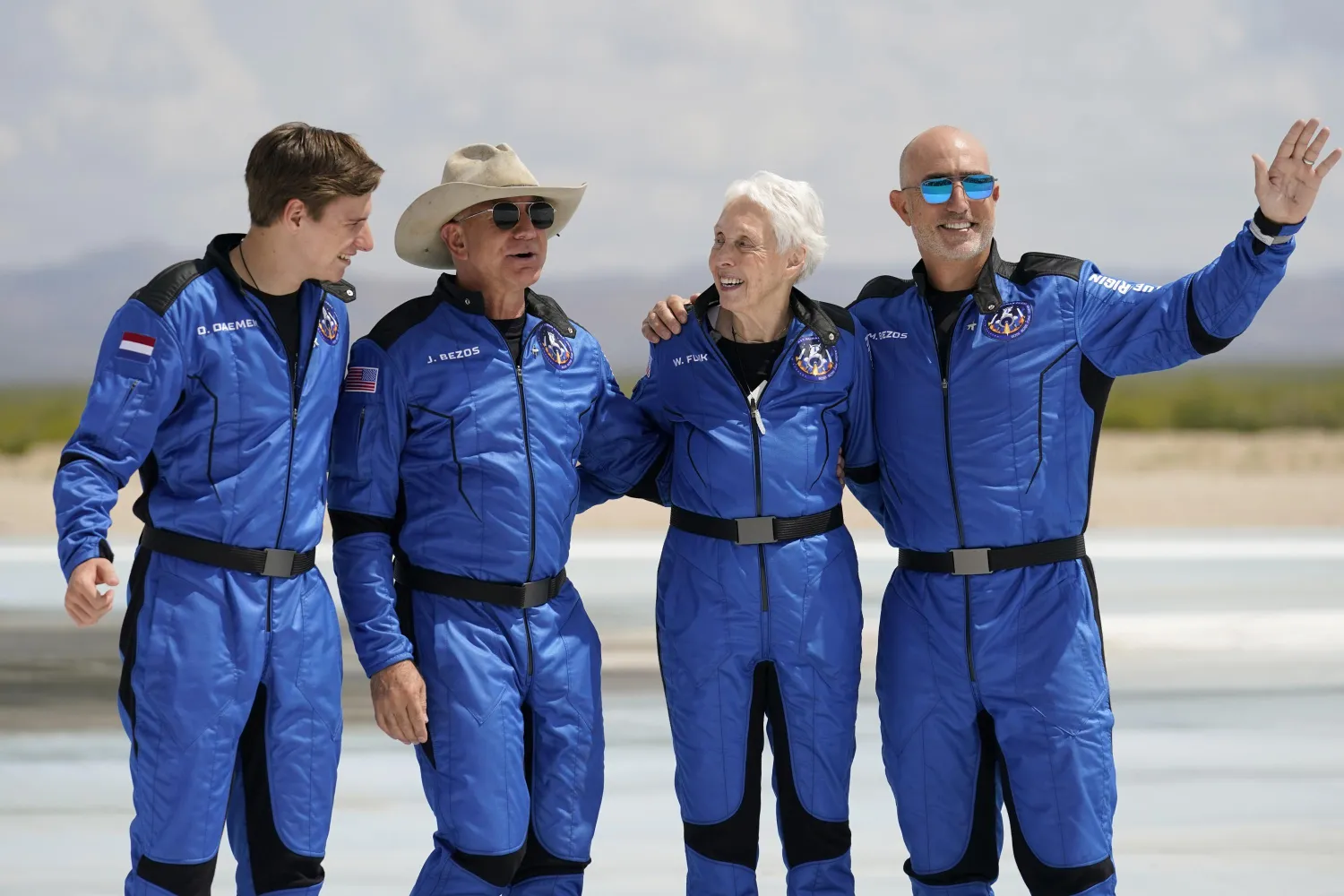
Oliver Daemen, from left, Jeff Bezos, founder of Amazon and space tourism company Blue Origin, Wally Funk and Bezos' brother Mark pose for photos in front of the Blue Origin New Shepard rocket, derby, after their launch from the spaceport near Van Horn, Texas, Tuesday, July 20, 2021. (AP Photo/Tony Gutierrez)
TT

Jeff Bezos Blasts into Space on Own Rocket: 'Best Day Ever!'

Oliver Daemen, from left, Jeff Bezos, founder of Amazon and space tourism company Blue Origin, Wally Funk and Bezos' brother Mark pose for photos in front of the Blue Origin New Shepard rocket, derby, after their launch from the spaceport near Van Horn, Texas, Tuesday, July 20, 2021. (AP Photo/Tony Gutierrez)

Jeff Bezos blasted into space Tuesday on his rocket company’s first flight with people on board, becoming the second billionaire in just over a week to ride his own spacecraft.

The Amazon founder was accompanied by a hand-picked group: his brother, an 18-year-old from the Netherlands and an 82-year-old aviation pioneer from Texas — the youngest and oldest to ever fly in space.

“Best day ever!” Bezos said when the capsule touched down on the desert floor in remote West Texas after the 10-minute flight, said The Associated Press.

Named after America’s first astronaut, Blue Origin’s New Shepard rocket soared on the 52nd anniversary of the Apollo 11 moon landing, a date chosen by Bezos for its historical significance. He held fast to it, even as Virgin Galactic’s Richard Branson pushed up his own flight from New Mexico and beat him to space by nine days.

The two private companies chasing space tourism dollars, though, have drawn criticism for catering to the rich while so many are struggling amid the pandemic.

During Tuesday's flight, Blue Origin's capsule reached an altitude of about 66 miles (106 kilometers), more than 10 miles (16 kilometers) higher than Branson’s July 11 ride. The 60-foot (18-meter) booster accelerated to Mach 3 or three times the speed of sound to get the capsule high enough, before separating and landing upright.

Unlike Branson’s piloted rocket plane, Bezos’ capsule was completely automated and required no official staff on board for the up-and-down flight.

During their several minutes of weightlessness, video from inside the capsule showed the four floating, doing somersaults, tossing Skittles candies and throwing balls, with lots of cheering, whooping and exclamations of “Wow!” The Bezos brothers also joined their palms to display a “HI MOM” greeting written on their hands. The capsule landed under parachutes, with Bezos and his guests briefly experiencing nearly six times the force of gravity, or 6 G’s, on the way back.

Led by Bezos, they climbed out of the capsule after touchdown with wide grins, embracing parents, partners and children, then popped open bottles of sparkling wine, spraying one another.
“My expectations were high and they were dramatically exceeded,” Bezos said later.

Their flight lasted 10 minutes and 10 seconds — five minutes shy of Alan Shepard’s Freedom 7 flight in 1961. Shepard's daughters, Laura and Julie, were introduced at a press event a few hours later.

Sharing Bezos’ dream-come-true adventure was Wally Funk, from the Dallas area, one of 13 female pilots who went through the same tests as NASA’s all-male astronaut corps in the early 1960s but never made it into space.

"I’ve been waiting a long time to finally get it up there,” Funk said.

“I want to go again — fast," she added.

Joining them on the ultimate joyride was the company’s first paying customer, Oliver Daemen, a last-minute fill-in for the mystery winner of a $28 million charity auction who opted for a later flight. The Dutch teen’s father took part in the auction, and agreed on a lower undisclosed price last week when Blue Origin offered his son the vacated seat.

“It was so amazing," Daemen said. “Let’s hope that many, many more people can do this."

Four hours after their flight, Bezos drove his crew over to see the rocket that carried them safely to space.

Among the items brought on the flight: A pair of aviator Amelia Earhart’s goggles and a piece of fabric from the original Wright Flyer.

“I got goose bumps,” said Angel Herrera of El Paso, who watched the launch from inside Van Horn High School, about 25 miles (40 kilometers) away. “The hair on the back of my neck stood up, just witnessing history.”

No one is rushing to buy a ticket from this bleak and isolated town.

“This ride is only for the wealthy,” pizza shop owner Jesus Ramirez said after watching the launch, adding that he hoped the venture would attract businesses to the town and provide opportunities for local companies.

Blue Origin — founded by Bezos in 2000 in Kent, Washington, near Amazon’s Seattle headquarters — hasn't revealed its price for a ride to space but has lined up spots for other auction bidders. Ticket sales, including the auction, are approaching $100 million, Bezos said. Two more flights are planned by year’s end.

The recycled rocket and capsule used Tuesday flew on the last two space demos, according to company officials.

Virgin Galactic already has more than 600 reservations at $250,000 apiece. Founded by Branson in 2004, the company has sent crew into space four times and plans two more test flights from New Mexico before launching customers next year.

Blue Origin’s approach was slower and more deliberate. After 15 successful unoccupied test flights to space since 2015, Bezos finally declared it was time to put people on board. The Federal Aviation Administration agreed last week, approving the commercial space license.

Bezos, 57, who also owns The Washington Post, claimed the first seat. The next went to his 50-year-old brother, Mark Bezos, an investor and volunteer firefighter, then Funk and Daemen. They spent two days together in training.

University of Chicago space historian Jordan Bimm said the passenger makeup is truly remarkable. Imagine if the head of NASA decided he wanted to launch in 1961 instead of Shepard on the first US spaceflight, he said in an email.

“That would have been unthinkable!” Bimm said. “”It shows just how much the idea of who and what space is for has changed in the last 60 years.”

Bezos stepped down this month as Amazon’s CEO and last week donated $200 million to renovate the National Air and Space Museum.

Fewer than 600 people have reached the edge of space or beyond. Until Tuesday, the youngest was 25-year-old Soviet cosmonaut Gherman Titov and the oldest at 77 was Mercury-turned-shuttle astronaut John Glenn.

Both Bezos and Branson want to drastically increase those overall numbers, as does SpaceX’s Elon Musk, who’s skipping brief space hops and sending his private clients straight to orbit for tens of millions apiece, with the first flight coming up in September.

“We're going to build a road to space so our kids and their kids can build the future,” Bezos said. "We need to do that to solve the problems here on Earth.”

Despite appearances, Bezos and Branson insist they weren’t trying to outdo each other by strapping in themselves. Bezos noted this week that only one person can lay claim to being first in space: Soviet cosmonaut Yuri Gagarin, who rocketed into orbit on April 12, 1961.

Branson sent a congratulatory tweet: “Impressive! Very best to all the crew from me and all the team” at Virgin Galactic.

Blue Origin is working on a massive rocket, New Glenn, to put payloads and people into orbit from Cape Canaveral, Florida. The company also wants to put astronauts back on the moon with its proposed lunar lander Blue Moon; it’s challenging NASA’s sole contract award to SpaceX.

Included in the many people that Bezos thanked Tuesday was "every Amazon employee and every Amazon customer. Because you guys paid for all this.” Bezos has said he finances the rocket company by selling $1 billion in Amazon stock each year.



Somalia Welcomes Its First Bowling Alley as the Middle Class and Diaspora Returnees Grow

 People bowl at the Feynuus Bowling Center in Mogadishu, Somalia, on Jan. 15, 2026. (AP)
People bowl at the Feynuus Bowling Center in Mogadishu, Somalia, on Jan. 15, 2026. (AP)
TT

Somalia Welcomes Its First Bowling Alley as the Middle Class and Diaspora Returnees Grow

 People bowl at the Feynuus Bowling Center in Mogadishu, Somalia, on Jan. 15, 2026. (AP)
People bowl at the Feynuus Bowling Center in Mogadishu, Somalia, on Jan. 15, 2026. (AP)

In a city long defined by conflict, Somalia ’s capital of Mogadishu now echoes with the crash of pins at the country's first modern bowling alley.

It's the latest sign of revival in the once-thriving Indian Ocean port shaped by 35 years of civil war and militant bombings. Millions of people were forced to flee what became one of the world’s most dangerous cities. Those who remained avoided public spaces as the al-Qaeda-linked group al-Shabab waged an insurgency against the Somali state.

In recent years, improved security measures against al-Shabab, an expanded government presence and growing private investment have allowed daily life to re-emerge. Cafes line newly reopened streets, beaches draw evening crowds and traffic congestion, once unimaginable, now clogs key intersections.

The Feynuus Bowling Center opened last year and draws many locals and Somalis returning from the diaspora, who bring investment and business ideas after years of sending billions of dollars in remittances from abroad.

On a recent evening, young Somalis gathered in groups, laughing and filming each other on their phones while music played. Many from the diaspora are visiting Mogadishu for the first time in years, or the first time ever.

“I couldn’t believe Mogadishu has this place,” said Hudoon Abdi, a Somali-Canadian on holiday, as she prepared to take her turn to bowl.

“I’m enjoying it. Mogadishu is actually safe,” she said, urging others to visit.

Mogadishu remains vulnerable to militant attacks, however, with security measures like checkpoints and heavily guarded zones part of daily life. Non-Somalis remain largely confined to a compound at the international airport.

But residents say the ability to gather for recreation signals an important psychological shift. Such venues provide a welcoming environment for a younger generation eager for safe spaces to socialize.

Abukar Hajji returned from the United Kingdom on holiday after many years away and found the difference between what he imagined and what he experienced eye-opening.

“When I was flying from the UK, I believed it was a scary place, like a war-torn country,” he said. “Everyone told me, ‘Good luck,’ but when I came and saw it with my own eyes, I didn’t want to leave.”

Sadaq Abdurahman, the manager of the bowling center, said the idea for the business emerged from a growing demand among young people for recreational facilities.

“It has created employment opportunities for at least 40 youths,” he said.

According to the Somali National Bureau of Statistics, Somalia’s unemployment rate stands at 21.4%.

The bowling alley has private security guards, bag checks and surveillance cameras, reflecting the precautions common at public venues in Mogadishu.

Urban planners and economists say businesses like the bowling alley signal a broader shift in Mogadishu’s recovery, as private sector growth increasingly complements international aid and government-led rebuilding efforts.

Ahmed Khadar Abdi Jama, a lecturer in economics at the University of Somalia, said innovative businesses are responding to the needs of diaspora returnees and the growing middle class, “which in turn adds to the expected increase in Somalia’s GDP.”

Outside the bowling alley, traffic hummed and neon signs flickered, other reminders of Mogadishu’s fragile transformation.


Benefit of Taking Magnesium Does Not Get Enough Attention

Nutrition experts recommended trying to get more of magnesium in our diet from food first (Harvard University)
TT

Benefit of Taking Magnesium Does Not Get Enough Attention

Nutrition experts recommended trying to get more of magnesium in our diet from food first (Harvard University)

Nutrition experts revealed that magnesium is often not given the same attention as other vitamins and minerals, although it plays a pivotal role in supporting the overall health of our body, especially improving blood sugar management and supporting neuro-psychological balance.

According to the US National Institutes of Health (NIH), magnesium is an abundant mineral in our body and it’s naturally present in many foods.

The mineral is required in more than 300 different reactions in our body, including those that regulate muscle and nerve function, blood sugar levels, and blood pressure.

“Magnesium plays a role in how our body handles sugar,” Scott Keatley, RD, co-owner of Keatley Medical Nutrition Therapy told Prevention magazine.

“It helps with the action of insulin, the hormone that controls blood sugar levels.” When you have enough magnesium in your body, insulin can work better and your body can manage blood sugar more effectively, Keatley said.

Also, stress can cause our body to use more magnesium than usual, which can limit our body’s ability to do other tasks with the nutrient, Keatley said.

“In addition, magnesium can help reduce the release of stress hormones like cortisol,” he said. “It’s like a natural chill pill that can help keep our body’s stress response in check.”

Magnesium helps regulate brain function and mood. It plays a role in releasing and using neurotransmitters, which are chemicals in our brain that affect our mood and emotions.

The mineral may help improve bone density and decrease fracture risk.
“Magnesium is stored in bones and is an important part of bone health,” said Deborah Cohen, DCN, an associate professor in the department of clinical and preventive nutrition sciences at Rutgers University School of Health Professions.

At baseline, magnesium can help to relax and widen your blood vessels, Keatley said. “This makes it easier for blood to flow and can help lower blood pressure,” he added. “It’s like making the highways wider so that traffic can move more smoothly.”

A 2025 review in hypertension found that magnesium seems to be beneficial for lowering blood pressure in people with high blood pressure and magnesium deficiency, but larger studies are needed.

There are a lot of foods that are high in magnesium. Nutrition experts recommended trying to get more of the nutrient in our diet from food first.

These are the most magnesium-rich foods, according to the NIH are: Pumpkin seeds, Chia seeds, almonds, spinach, cashews, peanuts, shredded wheat, soymilk, black beans, edamame, peanut butter, potato with skin, brown rice and plain yogurt.


SpaceX Prioritizes Lunar 'Self-growing City' over Mars Project

FILE - A SpaceX logo is displayed on a building, May 26, 2020, at the Kennedy Space Center in Cape Canaveral, Fla. (AP Photo/David J. Phillip, File)
TT

SpaceX Prioritizes Lunar 'Self-growing City' over Mars Project

FILE - A SpaceX logo is displayed on a building, May 26, 2020, at the Kennedy Space Center in Cape Canaveral, Fla. (AP Photo/David J. Phillip, File)

Elon Musk said on Sunday that SpaceX has shifted its focus to building a "self-growing city" on the moon, which could be achieved in less than 10 years.

SpaceX still intends to start on Musk's long-held ambition of a city on Mars within five to seven years, he wrote on his X social media platform, "but the overriding priority is securing the future of civilization and the Moon is faster."

Musk's comments echo a Wall Street Journal report on Friday, stating that SpaceX has told investors it would prioritize going to the moon and attempt a trip to Mars ⁠at a later time, targeting March 2027 for an uncrewed lunar landing.

As recently as last year, Musk said that he aimed to send an uncrewed mission to Mars by the end of 2026.

The US faces intense competition from China in the race to return humans to the moon this decade. Humans have not visited the lunar surface since the Apollo 17 mission in 1972. Less than a week ago, Musk announced that SpaceX ⁠acquired the artificial intelligence company he also leads, xAI, in a deal that values the rocket and satellite company at $1 trillion and the artificial intelligence outfit at $250 billion.

Proponents of the move view it as a way for SpaceX to bolster its plans for space-based data centers, which Musk sees as more energy efficient than terrestrial facilities as the demand for compute power soars with AI development.

SpaceX is hoping a public offering later this year could raise as much as $50 billion, which could make it the largest public offering in history.

On Monday, Musk said in response to a user on X that NASA will constitute less than 5% of SpaceX's revenue this year. SpaceX is ⁠a core contractor in NASA's Artemis moon program with a $4 billion contract to land astronauts on the lunar surface using Starship.

"Vast majority of SpaceX revenue is the commercial Starlink system," Musk added.

Earlier on Sunday, Musk shared the company's first Super Bowl ad, promoting its Starlink Wi-Fi service.

Even as Musk reorients SpaceX, he is also pushing his publicly traded company, Tesla, in a new direction.

After virtually building the global electric vehicles market, Tesla is now planning to spend $20 billion this year as part of an effort to pivot to autonomous driving and robots.

To speed up the shift, Musk said last month Tesla is ending production of two car models at its California factory to make room for manufacturing its Optimus humanoid robots.