


After Milestone-Rich Lunar Flyby, Astronauts Start Trip Home

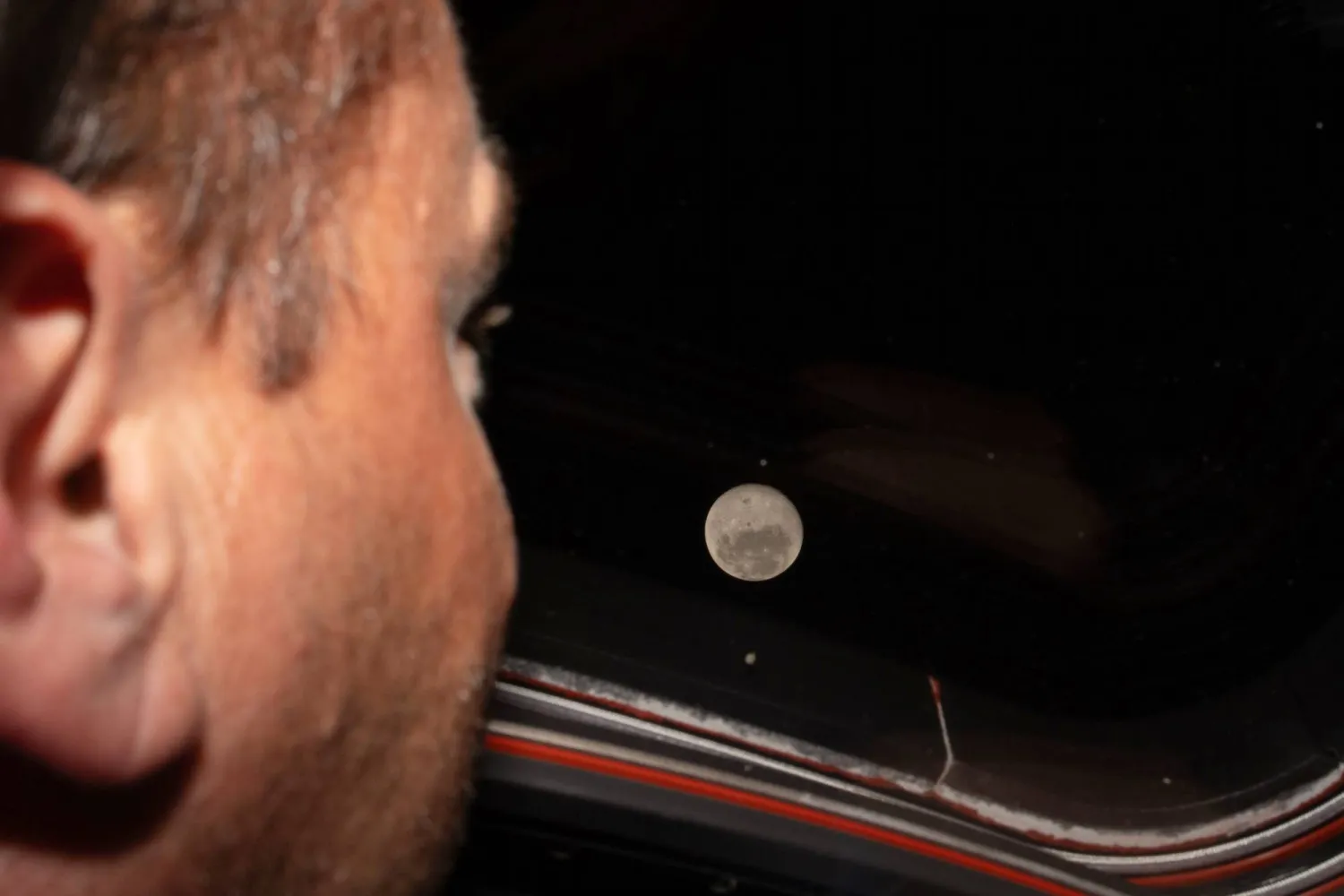
 In this photo provided by NASA, Artemis II commander and NASA astronaut Reid Wiseman looks out one of the Orion spacecraft's main cabin windows at the Moon ahead of the crew's lunar flyby on April 6, 2026. (NASA via AP)
In this photo provided by NASA, Artemis II commander and NASA astronaut Reid Wiseman looks out one of the Orion spacecraft's main cabin windows at the Moon ahead of the crew's lunar flyby on April 6, 2026. (NASA via AP)
TT

After Milestone-Rich Lunar Flyby, Astronauts Start Trip Home

 In this photo provided by NASA, Artemis II commander and NASA astronaut Reid Wiseman looks out one of the Orion spacecraft's main cabin windows at the Moon ahead of the crew's lunar flyby on April 6, 2026. (NASA via AP)
In this photo provided by NASA, Artemis II commander and NASA astronaut Reid Wiseman looks out one of the Orion spacecraft's main cabin windows at the Moon ahead of the crew's lunar flyby on April 6, 2026. (NASA via AP)

The Artemis II astronauts wrapped up their lunar flyby as they continue their journey back to Earth on Tuesday, bringing with them rich celestial observations including little-known lunar craters, a solar eclipse and meteor strikes that scientists hope will open doors.

Their eyes glued to the spacecraft windows for nearly seven hours, the team of four who spent their day breaking records and making history were treated to a view of the Moon unlike any other.

"Humans probably have not evolved to see what we're seeing," said Victor Glover. "It is truly hard to describe. It is amazing."

The crew reported in vivid detail features of the lunar surface and later witnessed a solar eclipse, when the Moon passed in front of the Sun.

They also described flashes of light -- meteor strikes -- on the Moon's surface.

"I can't say enough how much science we've already learned," Kelsey Young, lead scientist for the Artemis II mission, told the astronauts.

"You really brought the Moon closer for us today, and we cannot say thank you enough."

- Trump praises 'modern-day pioneers' -

But even after becoming the furthest humans ever to travel from Earth, their day was not over: the bleary-eyed astronauts remained in good spirits as they took a late-night call from US President Donald Trump.

Unlike the Artemis astronauts and NASA administrator Jared Isaacman, Trump at age 79 is old enough to remember the Apollo program.

"You've really inspired the entire world," Trump said, calling them "modern-day pioneers" who have "a lot of courage doing what you're doing."

"America will be second to none in space and everything we're doing, and we will continue to lead the whole thing into the stars, this incredible journey into the stars."

He probed the astronauts about their favorite moments and asked what it was like to lose connection with Earth for some 40 minutes during an expected communications blackout and even experienced his own signal glitch while calling into space.

"Might have gotten cut off," Trump said as he waited a full minute for the signal to return. "It is a long distance."

- Historic trip -

The journey wrapped up late Monday and had plenty of milestones including when the Artemis II team broke the distance record set by the 1970 Apollo 13 mission, which they surpassed by more than 4,000 miles (more than 6,000 kilometers) when they reached the journey's furthest distance from Earth 252,756 miles (406,771 kilometers).

Astronaut Jeremy Hansen said the moment should "challenge this generation and the next, to make sure this record is not long-lived."

And as noted by Trump, the crew lost contact with planet Earth for about 40 minutes as their spacecraft passed behind Earth's satellite.

The blackout period was expected but still notable: they were the first people in more than 50 years to lose contact with the rest of humanity.

"It is so great to hear from Earth again," said astronaut Christina Koch, as the crew regained connection with their home planet.

"We will always choose Earth."

- Moon memorials -

The Orion capsule will now travel back to Earth in a so-called "free-return trajectory," a trip that will take about four days.

Adding to the historic nature of the mission led by Reid Wiseman, the Artemis II crew includes several firsts.

Glover was the first person of color to fly around the Moon, Koch was the first woman, and Canadian Hansen the first non-American.

The celestial workday Monday included a poignant moment just after the crew broke the distance record, when they proposed designating two previously unnamed craters.

The first they requested to name in honor of their spacecraft's nickname, "Integrity."

They offered a second name, "Carroll," for another crater, which they asked be named after the late wife of mission commander Reid Wiseman, who died of cancer.

"It's a bright spot on the Moon," said Hansen, his voice breaking with emotion. "And we would like to call it Carroll."

The astronauts embraced, and mission control in Houston held a moment of silence.

"Integrity and Carroll crater, loud and clear. Thank you," said Gibbons.

NASA said they would formally submit the name proposals to the International Astronomical Union, the body charged with naming celestial bodies and surface features.



Jurassic Art: Fossils Transformed Into Artwork at Amsterdam Museum

Typical Amsterdam houses sit next to a canal in Amsterdam, Netherlands, March 19, 2026. (Reuters)
TT

Jurassic Art: Fossils Transformed Into Artwork at Amsterdam Museum

Typical Amsterdam houses sit next to a canal in Amsterdam, Netherlands, March 19, 2026. (Reuters)

Hanging by a thin metal strap, a 67-million-year-old triceratops skull twirls above a coral sculpture, the centerpiece of a new exhibition aiming to make art out of prehistoric fossils.

The "Relics" show at Amsterdam's Art Zoo will display nine works by creative duo Jaap Sinke and Ferry van Tongeren that combine science and art.

The aim was to highlight the aesthetic side of the fossils, usually presented in an educational way in natural history museums, van Tongeren told AFP.

The artists tried to give the fossils "a more monumental form" with "more stature," the 59-year-old told AFP in an interview.

The exhibition also features the bones of a basilosaurus, which roamed the seas up to 40 million years ago, but arranged as a sculpture rather than a traditional skeleton reconstruction.

Natural history museums have a valuable scientific and educational value "but lack a captivating element," said van Tongeren. "And that was the starting point for everything we did."

The artists worked with Zoic, an Italian palaeontology company that processes fossils and reconstructs dinosaur skeletons.

Creating the exhibits required "an extraordinary combination of knowledge and different processes," Iacopo Briano, 42, curator of the exhibition and palaeontology expert at Zoic, told AFP.

First comes the "puzzle" of unearthing and reconstructing the bones from a fossil discovery.

Then the fragile bones need to be transported so the artists could start their own work -- a 10-year process in the case of this exhibit.

This prehistoric show, whose oldest exhibit is a dinosaur vertebra about 150 million years old, opens to the public on Friday and runs until November 2026.


Greenpeace Warns of Potential ‘Catastrophic’ Chernobyl Collapse

Representatives of Greenpeace and media stand in front of the sarcophagus covering the destroyed fourth reactor under the New Safe Confinement (NSC), at the Chernobyl Nuclear Power Plant on April 9, 2026. (AFP)
TT

Greenpeace Warns of Potential ‘Catastrophic’ Chernobyl Collapse

Representatives of Greenpeace and media stand in front of the sarcophagus covering the destroyed fourth reactor under the New Safe Confinement (NSC), at the Chernobyl Nuclear Power Plant on April 9, 2026. (AFP)

An uncontrolled collapse of the internal radiation shell at the defunct Chernobyl nuclear power station in Ukraine could increase the risk of radioactivity release in the environment, Greenpeace warned on Tuesday.

In 1986, while Ukraine was part of the Soviet Union, a reactor at Chernobyl exploded, sending clouds of radiation across much of Europe and forcing tens of thousands of people to evacuate.

The remnants of the plant are covered by an inner steel-and-concrete radiation shell -- known as the sarcophagus and built hastily after the disaster -- and a modern, high-tech outer shell, called the New Safe Confinement (NSC) structure.

Kyiv has accused Russia of repeatedly targeting the site since Moscow launched its full-scale invasion in 2022, including of a strike last year that pierced the outer shell.

In a report released Tuesday, days before the 40th anniversary of the Chernobyl disaster, Greenpeace warned that despite some repair works, the confinement function of the NSC "could not be fully restored".

"This increases the risk of radioactivity release in the environment, especially in the case of a collapse" of the internal shelter, Greenpeace said.

"That would be catastrophic because... there's four tons of dust, highly radioactive dust, fuel pellets, enormous amounts of radioactivity inside the sarcophagus," Shaun Burnie, a senior nuclear specialist for Greenpeace Ukraine, told AFP earlier this month.

"And because the New Safe Confinement cannot be repaired at the moment, it cannot function as it was designed, there's a possibility of radioactive releases," Burnie added.

Greenpeace said deconstruction of unstable elements of the internal shell was necessary to prevent their uncontrolled collapse.

But any works at the site were impeded by the war raging on as "there's missiles from the Russians still being fired across Chernobyl," Burnie said.

"Here we are 40 years on, and Russia is still conducting effectively a nuclear war against the people of Ukraine and Europe."

Plant director Sergiy Tarakanov said the situation around the site was "very dangerous".

"If a rocket will drop, not directly into the safe confinement, but just in 200 meters, it will create an external impact like an earthquake," increasing the risk of the inner shell collapsing.

"And what actually 1986 accident showed to us... that the radioactive particles, they do not recognize borders," Tarakanov added.

Last month, France said that the Chernobyl protective dome would require almost 500 million euros of repairs after the Russian strike in 2025.


Prince Harry and Meghan Arrive in Australia to a Muted Welcome

 Prince Harry and Meghan Markle, the Duke and Duchess of Sussex, arrive at the Australian National Veterans Arts Museum (Anvam) in Southbank, Melbourne, Australia, Tuesday, April 14, 2026. (Jonathan Brady/Pool Photo via AP)
Prince Harry and Meghan Markle, the Duke and Duchess of Sussex, arrive at the Australian National Veterans Arts Museum (Anvam) in Southbank, Melbourne, Australia, Tuesday, April 14, 2026. (Jonathan Brady/Pool Photo via AP)
TT

Prince Harry and Meghan Arrive in Australia to a Muted Welcome

 Prince Harry and Meghan Markle, the Duke and Duchess of Sussex, arrive at the Australian National Veterans Arts Museum (Anvam) in Southbank, Melbourne, Australia, Tuesday, April 14, 2026. (Jonathan Brady/Pool Photo via AP)
Prince Harry and Meghan Markle, the Duke and Duchess of Sussex, arrive at the Australian National Veterans Arts Museum (Anvam) in Southbank, Melbourne, Australia, Tuesday, April 14, 2026. (Jonathan Brady/Pool Photo via AP)

Britain's Prince Harry and wife Meghan landed in Australia on Tuesday for a four-day visit with engagements covering sport, mental health and veterans' affairs.

The Duke and Duchess of Sussex began their trip at the Royal Children’s Hospital in Melbourne, where they took part in an activity in the hospital's therapeutic garden spaces.

"It was a genuinely meaningful visit for our staff and for the young people receiving care," said Dr. Peter Steer, the hospital's CEO.

Harry, ‌wearing a navy ‌suit and white shirt, spoke to children and posed ‌for ⁠photographs with patients ⁠in the foyer of the hospital, calling one of the handmade signs welcoming the couple "beautiful".

Meghan, who wore a matching A$1,250 ($885) navy dress by Sydney-based designer Karen Gee, later helped serve food at a women's domestic violence shelter in the city.

The Sussexes stepped down as working members of the British royal family and moved to the US in 2020, citing a desire to be financially independent and ⁠to escape what they characterized as media intrusion into ‌their private lives.

They last visited Australia in ‌2018 while still working royals, announcing Meghan's first pregnancy hours after arriving in Sydney.

Their latest visit has captured public attention in Australia, where ‌Britain's King Charles is the head of state, though a sizeable minority supports becoming a republic. But there was little sign of the ecstatic reception that greeted them on the 2018 trip. Television networks aired footage that they said showed the couple arriving ‌in Melbourne on a commercial flight from Los Angeles, before being taken from the tarmac in a vehicle convoy.

The ⁠couple's travel is ⁠being privately funded, though local media reported some policing costs associated with the visit would be paid by Australian taxpayers, sparking a protest petition signed by more than 45,000 people.

The couple will travel to the capital, Canberra, on Wednesday to meet military veterans, attend a mental health summit in Melbourne on Thursday and round off the joint leg of their trip with sailing and rugby events in Sydney on Friday.

In contrast to their previous visit, the Sussexes will also undertake commercial activities while in Australia, with Meghan remaining in the country to host a wellness retreat at a luxury beachside hotel in Sydney over the weekend.

Tickets for the event, which includes yoga, manifestation and sound healing, start at A$2,699 ($1,912) per person.