

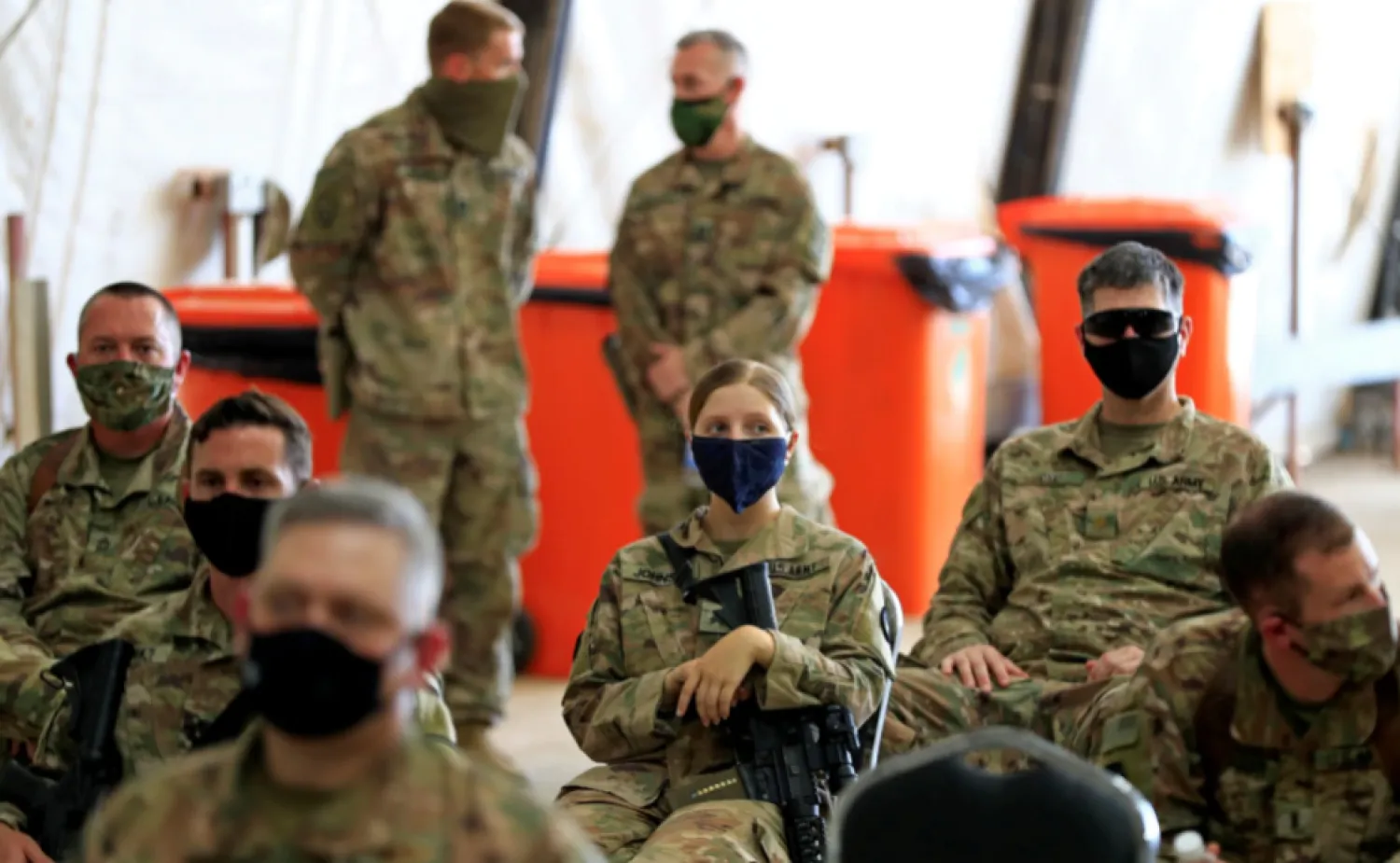

US, Iraq Agree on Basic Troop Withdrawal End 2021

 US soldiers wearing protective masks are seen during a handover ceremony of Taji military base from US-led coalition troops to Iraqi security forces, in the base north of Baghdad, Iraq August 23, 2020. REUTERS/Thaier Al-Sudani/File Photo
US soldiers wearing protective masks are seen during a handover ceremony of Taji military base from US-led coalition troops to Iraqi security forces, in the base north of Baghdad, Iraq August 23, 2020. REUTERS/Thaier Al-Sudani/File Photo
TT

US, Iraq Agree on Basic Troop Withdrawal End 2021

 US soldiers wearing protective masks are seen during a handover ceremony of Taji military base from US-led coalition troops to Iraqi security forces, in the base north of Baghdad, Iraq August 23, 2020. REUTERS/Thaier Al-Sudani/File Photo
US soldiers wearing protective masks are seen during a handover ceremony of Taji military base from US-led coalition troops to Iraqi security forces, in the base north of Baghdad, Iraq August 23, 2020. REUTERS/Thaier Al-Sudani/File Photo

With the launching of the strategic dialogue between the United States and Iraq in Washington, US officials hinted at the possibility of agreeing to the Iraqi “wishes” and the issuance of a statement following US President Joe Biden’s meeting with Iraqi Prime Minister Mustafa Al-Kadhimi on Monday, announcing in principle that the US forces would leave Iraq by the end of this year.

Iraqi Foreign Minister Fouad Hussein had pointed to a new approach sought by Baghdad. He said that Iraq “does not need fighters, but rather intelligence cooperation, military training and air cover.” These demands are at the core of the role that the US forces are still assuming in Iraq.

The US State Department spokesman, Ned Price, was clear in responding to these expectations, saying that he would not anticipate the dialogue and its outcome, but he believed that the joint collective efforts to ensure the defeat of ISIS would be at the top of the agenda.

“Iraq is our partner and our forces are there. At the request of the government, we are working in coordination with them against common challenges,” he stated.

American and Iraqi officials were quoted as saying that the aim of the statement was to enable Al-Kadhimi to relieve the political pressure exerted by the Iraqi hardline factions loyal to Iran, who want the withdrawal of all US forces from the country.

A US official said that Washington was planning to redefine the role of some forces in Iraq, rather than reducing the US presence, according an article published by The Wall Street Journal.

In a statement, Pentagon spokesman John Kirby said that the first round of the strategic dialogue discussed bilateral security relations between the United States and Iraq, the long-term security collaboration and areas of cooperation outside the scope of counter-terrorism.

Kirby also stressed the renewal of the two countries’ joint commitment to eliminating ISIS, and the need to enable the US-led coalition to safely support the Iraqi security forces.

The Iraqi Joint Operations Command also said that it had held a meeting with its US counterpart, during which talks focused on the future of the strategic security relationship.

According to US experts, the changes demanded by the Iraqis in the current dialogue session would not have an impact on the daily tasks of the US forces, which are already carrying out the duties demanded by the Iraqi foreign minister.

The US forces practically do not carry out any combat missions, outside the scope of coordination with the Iraqi forces in their campaigns against terrorism. But they engage in combat operations only when exposed to attacks, as is happening now, and this is a legitimate right, according to US officials.

Pending the release of the statement, which is supposed to explain the modification in the role of US forces, US and Iraqi officials did not provide details on how the withdrawal of combat forces would take place and how the statement could be interpreted to allow for essential missions.



Israel Strikes Tyre in South Lebanon After Evacuation Warnings

Damage at the site of an Israeli airstrike in the southern port city of Tyre, Lebanon, 04 April 2026. (EPA)
TT

Israel Strikes Tyre in South Lebanon After Evacuation Warnings

Damage at the site of an Israeli airstrike in the southern port city of Tyre, Lebanon, 04 April 2026. (EPA)

Israel's military renewed its strikes on the southern Lebanese city of Tyre on Saturday after issuing evacuation warnings, following attacks on nearby buildings that damaged a hospital in the city. 

Israel has carried out strikes across Lebanon and launched a ground invasion in the south since March 2, when Hezbollah entered the war in the Middle East on the side of its backer Iran. 

The Israeli army struck three buildings it had warned people to evacuate, according to Lebanon's state-run National News Agency (NNA). 

An AFP correspondent said a missile hit an 11-storey building northeast of Tyre, completely destroying it and reducing it to a pile of rubble that covered a nearby gas station. 

A second raid on a five-storey building near the city levelled half of it, leaving the other half standing. 

The third strike was on the Burj al-Shamali Palestinian refugee camp, southeast of the city. 

Tens of thousands of people have left Tyre, but around 20,000 remain, including 15,000 displaced from surrounding villages, despite Israeli evacuation warnings covering most of the city and a broad swathe of the south. 

Saturday's Israeli warning followed strikes that wounded at least 11 people, including three civil defense members, and damaged a major hospital, the health ministry in Beirut said. 

The director of the Lebanese Italian Hospital told the NNA that it would "remain open to provide the necessary medical care" despite the damage. 

Overnight strikes destroyed two buildings nearby, an AFP correspondent saw, shattering windows and also causing suspended ceilings to collapse in the hospital, management said. 

A wave of attacks hit the Tyre area on Saturday, including one on its port that struck a small boat and damaged others moored nearby, the correspondent said. 

Another Israeli airstrike targeted and completely destroyed a mosque in the town of Baraashit in the Bint Jbeil district, the NNA reported. 

- 'Unacceptable' attacks - 

Dawn strikes also targeted Beirut's southern suburbs, a largely evacuated Hezbollah stronghold that has been attacked repeatedly during more than a month of war. 

In a statement on Saturday, Israel's military said it had "completed an additional wave of strikes targeting command centers belonging to the Quds Force Lebanon corps in Beirut", referring to the Iranian Revolutionary Guards' foreign operations arm, and "two headquarters of the (Palestinian Islamic Jihad)". 

After attacking a bridge in the West Bekaa region in eastern Lebanon on Friday "to prevent the transfer of reinforcements and military equipment", Israel hit it again on Saturday, destroying it completely, the NNA said. 

West Bekaa is right above Lebanon's south, where Israeli troops have been advancing on the ground. 

The NNA also reported that, in Shebaa near the eastern side of the Israeli border, Israeli forces abducted a man at around 3:00 am on Saturday. 

It was at least the third time Israeli forces have seized someone from south Lebanon after infiltrating their home since the war with Hezbollah began. 

The Iran-backed group claimed responsibility Saturday for a series of attacks on northern Israeli towns and Israeli troops in Lebanese border towns, particularly Mar0un al-Ras, H0ula and Ainata. 

The war has displaced upwards of a million people in Lebanon and killed more than 1,400 people in the country, including 54 medics and three Indonesian UN peacekeepers in the south. 

On Saturday, a strike on al-Hawsh near Tyre wounded 18 people, and a strike on Habboush in the Nabatiyeh district killed at least two children and wounded 22 people, according to Lebanon's health ministry. 

The United Nations force said on Friday that three peacekeepers were wounded in a blast inside a UN facility near Odaisseh, and were rushed to hospital. 

Jakarta slammed the incident as "unacceptable" after the UN office there confirmed the wounded were Indonesian. 

Indonesia's government said "these events underscore the urgent need to strengthen protection for UN peacekeeping forces amid an increasingly dangerous conflict situation". 

On Saturday, a UN security official told AFP that Israeli forces destroyed 17 surveillance cameras linked to UNIFIL's main headquarters in Naqoura. 

The UN peacekeeping force has been caught in the crossfire in southern Lebanon since the start of the war, with Hezbollah launching attacks on Israel and its troops, and Israeli forces pushing into border towns. 


Indonesia Slams 'Unacceptable' Peacekeeper Casualties in Lebanon

FILE PHOTO: UNIFIL vehicles drive on a main road in Qlayaa, amid escalating hostilities between Israel and Hezbollah, as the US-Israel conflict with Iran continues, in Qlayaa, southern Lebanon, March 27, 2026. REUTERS/Karamallah Daher/File Photo
TT

Indonesia Slams 'Unacceptable' Peacekeeper Casualties in Lebanon

FILE PHOTO: UNIFIL vehicles drive on a main road in Qlayaa, amid escalating hostilities between Israel and Hezbollah, as the US-Israel conflict with Iran continues, in Qlayaa, southern Lebanon, March 27, 2026. REUTERS/Karamallah Daher/File Photo

The Indonesian government on Saturday slammed as "unacceptable" an explosion that injured three of its peacekeepers in Lebanon within days of three other blue helmets from the Southeast Asian nation being killed.

The United Nations Interim Force in Lebanon (UNIFIL) said three peacekeepers were wounded in a blast that occurred inside a UN facility near Adaisseh on Friday afternoon, and rushed to hospital.

Two were seriously wounded.

The UN Information Center in Jakarta said the "origin of the explosion" was unknown but identified the injured soldiers as Indonesian.

"Repeated attacks or incidents of this kind are unacceptable," the Indonesian foreign ministry said in a statement.

"Regardless of their cause, these events underscore the urgent need to strengthen protection for UN peacekeeping forces amid an increasingly dangerous conflict situation."

The government urged the UN Security Council to investigate the events and "to immediately convene a meeting of troop-contributing countries to UNIFIL to conduct a review and take measures to enhance the protection of personnel serving with UNIFIL".

Friday's incident came just days after an Indonesian peacekeeper died when a projectile exploded on March 29 in southern Lebanon, where Israel and Hezbollah have been fighting since Lebanon was drawn into the Middle East war.

A UN security source told AFP on condition of anonymity Tuesday that fire from an Israeli tank was responsible for that attack.

A day later, two more Indonesian peacekeepers died after an explosion struck a UNIFIL logistics convoy, also in southern Lebanon.

The father of one of the two fallen soldiers, 33-year-old Zulmi Aditya Iskandar, said this week he was shocked that peacekeepers were losing their lives in the conflict.

"We were really sad and regretful, because this is a UN troop, a peacekeeping troop, not deployed for war," 60-year-old Iskandarudin told reporters at his house in West Java province.

The bodies of the three peacekeepers are scheduled to arrive in Jakarta on Saturday evening, according to the military.

The Indonesian National Armed Forces has said it will deploy more than 750 personnel to Lebanon next month as part of the scheduled UNIFIL peacekeeping troop rotation.


Strike Kills One Iraqi Fighter near Syria Border

Mourners attend the funeral of members of Iraq's Hashed al-Shaabi, who were killed in an airstrike in the town of al‑Qaim near the Syrian border, amid heightened regional tensions due to the US-Israel conflict with Iran, in Baghdad, Iraq, March 12, 2026. REUTERS/Stringer
TT

Strike Kills One Iraqi Fighter near Syria Border

Mourners attend the funeral of members of Iraq's Hashed al-Shaabi, who were killed in an airstrike in the town of al‑Qaim near the Syrian border, amid heightened regional tensions due to the US-Israel conflict with Iran, in Baghdad, Iraq, March 12, 2026. REUTERS/Stringer

An attack killed one fighter from the former paramilitary coalition Hashed al-Shaabi on Saturday, the alliance said, blaming the US and Israel.

Iraq has been dragged into the war between the United States, Israel and Iran, with strikes targeting both US interests and pro-Iran groups in the country, reported AFP.

"This treacherous attack resulted in the martyrdom of one PMF fighter and the wounding of four others, as well as a member of the ministry of defense," said a short statement from the group, which is also known as the Popular Mobilization Forces (PMF), adding it was a "Zionist-American attack".

The PMF is a coalition of armed groups -- formed in 2014 to fight extremists-- that is now part of Iraq's regular army, but also contains pro-Iran factions who have a reputation for acting independently.

PMF positions have been repeatedly targeted since the outbreak of war, with the group consistently blaming the attacks on the US and Israel.

According to the group's statement, the latest attack targeted a position in western Anbar province of the 45th Brigade, which belongs to the US-blacklisted, pro-Iran Kataeb Hezbollah group.

Kataeb Hezbollah is part of the umbrella movement known as the Islamic Resistance in Iraq, which has been claiming daily attacks since the start of the war on US interests in Iraq and the region.

The Pentagon has said helicopters have carried out strikes against pro-Iran armed groups in Iraq during the war.

Washington has strongly denied claims it has targeted Iraqi security forces.