

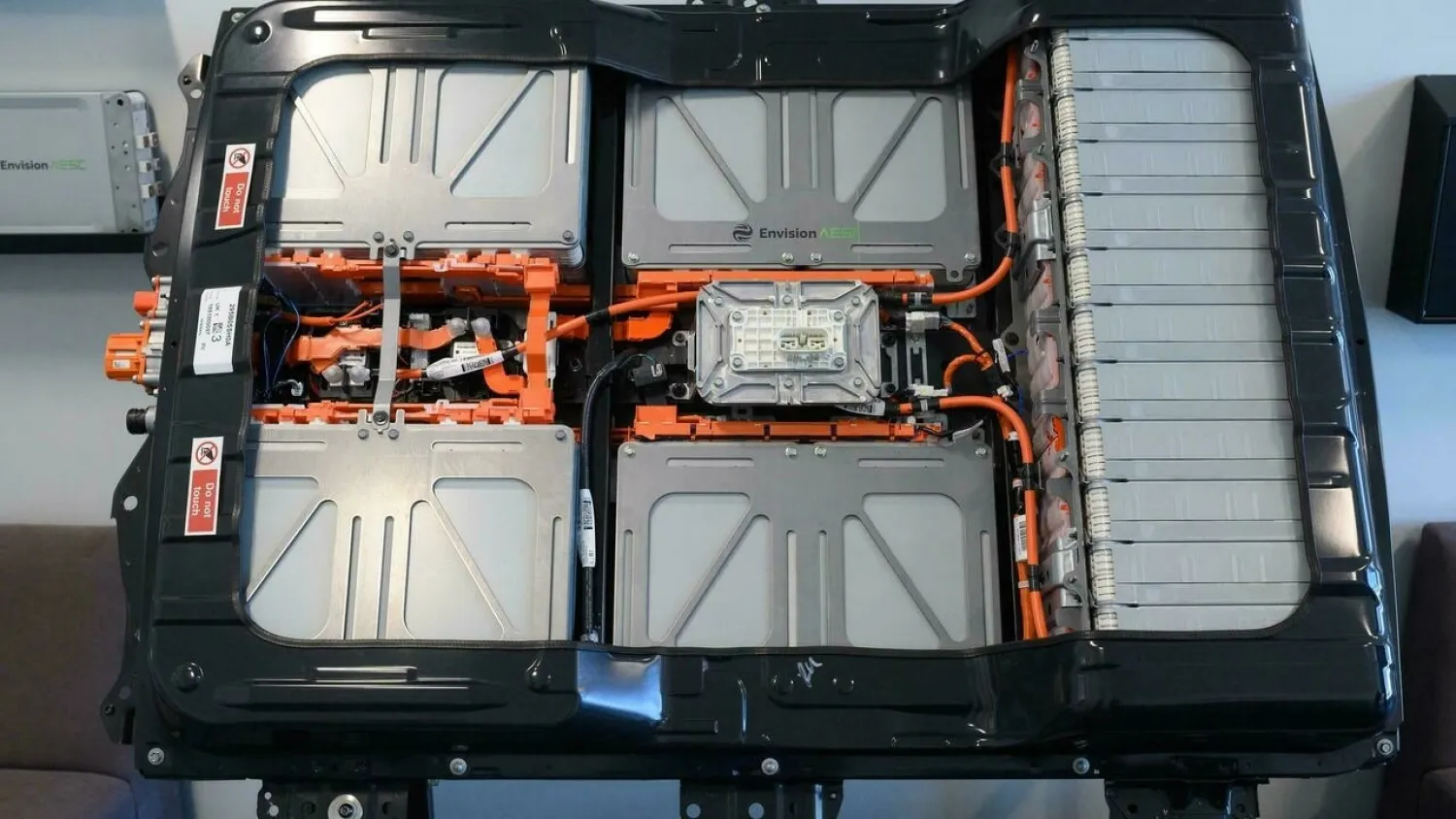

Europe to Boost Battery Production as Electric Shift Accelerates

Batteries have become the key component of tomorrow's vehicles OLI SCARFF AFP/File
TT

Europe to Boost Battery Production as Electric Shift Accelerates

Batteries have become the key component of tomorrow's vehicles OLI SCARFF AFP/File

As electric car sales take off and petrol engines face being phased out by 2035, Europe is looking to develop its own battery production base.

Far from being autonomous, Europe needs to accelerate domestic battery output as a national security issue as well as a boost for businesses and jobs.

Batteries that power electric cars and which weigh up to 600 kilograms (1,300 pounds), represent a considerable part of the vehicle's value.

At the moment, they are mostly produced in Asia, with China, South Korea and Japan the leading manufacturers.

With a mid-July announcement that it intends to ban the sale of new petrol and diesel vehicles by 2035, the European Commission has set a timetable for the bloc's shift to electric cars.

Many carmakers, having sensed which way the wind is blowing with governments, have now announced plans to shift towards electric vehicles.

Germany's Daimler was the latest, announcing last week that from 2025 it will launch only electric vehicle platforms as it gears up for a full shift to electric cars from 2030.

It is not only governments pushing the change, as the latest European data shows that electric cars doubled their market share in the second quarter of 2021.

- Giga plans -
If Europe is going to shift to electric cars, it will need lots of batteries.

After years of slow progress, there are now plans to invest 40 billion euros ($47 billion) in 38 European factories that could turn out 1,000 gigawatt hours of batteries per year, according to Transport & Environment, a non-governmental organization.

With average battery capacity of 60 kilowatt hours, that would be enough to power 16.7 million vehicles, according to the group.

One initiative is Sweden's Northvolt, which already has a factory under construction that is to produce batteries with total capacity of 150 gigawatt hours by 2030.

Volkswagen is a major partner, and the German carmaker is seeking to build five other factories as well.

Daimler, as part of its announcement this past week, said it would build eight battery factories worldwide for its Mercedes-Benz and Smart cars.

Stellantis, which includes 12 brands including Fiat, Chrysler, Jeep and Peugeot, plans to build five factories in Europe and North America.

Tesla expects to open its first European "gigafactory" near Berlin later this year, which it claims will be the world's largest battery cell production site with 250 gigawatt hours of capacity in 2030.

EU Commission Vice President Maros Sefcovic recently said the planned factories put the EU "well on track to achieve open strategic autonomy in this critical sector".

- Partners needed -
That view is not shared by Olivier Montique, an automotive analyst at Fitch Solutions.

He said the planned facilities "will make the bloc a significant player in the space, but will not enable it to meet anywhere close to all of its internal demand for EV batteries."

Montique said that is why automakers are still working with Asian battery makers.

China's Envision AESC is partnering with Nissan and Renault to build factories in Britain and France.

South Korean firms LG Chem and SKI have plants in Poland and Hungary, while China's CATL is building one in Germany.

- Lithium needed -
Raw materials are essential of course to manufacture batteries.

Car batteries currently use lithium-ion technology, similar to what powers most electronic devices today.

Unless there is a rapid breakthrough in solid-state batteries that could use other materials, huge amounts of lithium will be needed.

Europe has domestic sources of lithium, notably in the Czech Republic and Germany, but it will also probably have to depend on imports.

Montique said Europe would likely end up "developing supply agreements with markets where there are abundant resources, favorable diplomatic ties, and strong investment frameworks" to reduce the threat of shortages.



China Approves First Two Level-3 Autonomous Driving Cars from State-owned Automakers

People pass by the entrance to Volkswagen (China) Technology Company, a 3 billion euros ($3.5 billion) R&D center in Hefei in eastern China's Anhui province, on Feb. 25, 2025. (AP Photo/Ken Moritsugu)
TT

China Approves First Two Level-3 Autonomous Driving Cars from State-owned Automakers

People pass by the entrance to Volkswagen (China) Technology Company, a 3 billion euros ($3.5 billion) R&D center in Hefei in eastern China's Anhui province, on Feb. 25, 2025. (AP Photo/Ken Moritsugu)

China's industry regulator on Monday approved two Chinese cars with level-3 autonomous driving capabilities, marking the first time such vehicles have been cleared by the national regulator as legitimate products ready for mass adoption.

The Ministry of Industry and Information Technology approved the two electric sedans from state-owned automakers Changan Auto and BAIC Motor in its latest automobile product entry category, said Reuters.

The two models are allowed to activate conditional autonomous driving in designated areas of Chongqing and Beijing with speed limits of 50km/h and 80km/h, respectively, the ministry said in a statement. The automakers will conduct trial operation with the cars on the specific roads via their ride-hailing units, it added.

The auto industry has defined five levels of autonomous driving, from cruise control at level one to fully self-driving cars at level five, and level three allows drivers to take their eyes and hands off the road in certain situations.

The move underscored China's ambition to lead the development and adoption of autonomous driving, a technology poised to disrupt the auto industry globally. Last year, China lined up nine automakers for public tests to advance the adoption of self-driving cars.

Chinese regulators earlier this year had sharpened scrutiny of the assisted driving technologies following an accident involving a Xiaomi SU7 sedan in March. That incident killed three occupants when their car crashed seconds after the driver took control from the assisted-driving system.

But government officials are pressing Chinese automakers to rapidly deploy even more advanced systems. In their level-3 push, Chinese regulators also are upping the regulatory ante by holding automakers and parts suppliers liable if their systems fail and cause an accident.

Autonomous driving developers such as Pony AI and WeRide have been testing their level-4 cars with licenses granted by local governments across China.

Tesla's Full Self-Driving, a level-2 driver assistance system, has been partially approved in China since February and falls short of its capabilities in the United States.


Elm Company Named Strategic Partner for International Data and AI Conference

Elm Company Named Strategic Partner for International Data and AI Conference
TT

Elm Company Named Strategic Partner for International Data and AI Conference

Elm Company Named Strategic Partner for International Data and AI Conference

The Saudi Data and Artificial Intelligence Authority (SDAIA) announced a strategic partnership with Elm Company for the International Conference on Data and AI Capacity Building (ICAN 2026), enhancing collaboration to empower the data and artificial intelligence ecosystem and promote innovation in education and human capacity development.

This partnership comes as part of preparations for ICAN 2026, organized by SDAIA from January 28 to 29 at King Saud University in Riyadh, with the participation of a select group of specialists and experts from around the world, SPA reported.

The step represents a qualitative addition that contributes to enriching the conference’s knowledge content and expanding partnerships with leading national entities.

Elm Company brings extensive experience in designing digital solutions and building technical capabilities, reinforcing its role as a strategic partner in supporting the conference. It contributes by developing training tracks and digital empowerment programs, participating in the technology exhibition, and presenting qualitative initiatives that help empower national competencies in the fields of data and artificial intelligence.


Foxconn to Invest $510 Million in Kaohsiung Headquarters in Taiwan

Construction is scheduled to start in 2027, with completion targeted for 2033. Reuters
TT

Foxconn to Invest $510 Million in Kaohsiung Headquarters in Taiwan

Construction is scheduled to start in 2027, with completion targeted for 2033. Reuters

Foxconn, the world’s largest contract electronics maker, said on Friday it will invest T$15.9 billion ($509.94 million) to build its Kaohsiung headquarters in southern Taiwan.

That would include a mixed-use commercial and office building and a residential tower, it said. Construction is scheduled to start in 2027, with completion targeted for 2033.

Foxconn said the headquarters will serve as an important hub linking its operations across southern Taiwan, and once completed will house its smart-city team, software R&D teams, battery-cell R&D teams, EV technology development center and AI application software teams.

The Kaohsiung city government said Foxconn’s investments in the city have totaled T$25 billion ($801.8 million) over the past three years.